Affiliate marketing generated over $17 billion in revenue in the US alone in 2026. Bloggers account for 40% of all affiliate publisher commissions, more than any other publisher type. And SaaS and software consistently rank as the highest-earning affiliate niche, with average monthly incomes of $7,400+ once established, because commission structures are recurring rather than one-time. If you haven’t set up your site yet, you should first learn how to start a blog in 2026 and make money.
You probably already know this. What nobody tells you clearly is the rest of it.
Most beginners earn $0 to $100 in the first six months. Not because affiliate marketing does not work, it absolutely does, but because they misunderstand the business model. They treat it as a quick monetization tactic, jump between niches, scatter their effort across five platforms simultaneously, and give up four months before their content would have started ranking and earning.
This guide is built around a different premise: How to Start Affiliate Marketing is a business content that takes six to eighteen months to generate meaningful income, compounds in value over time once it does, and rewards consistency and specificity above everything else. If you approach it that way from day one, the income numbers become very achievable. If you approach it as a shortcut, you join the majority who quit before the results arrive.
I have built this exact model on RateTheTool.com, testing software tools for 30–60 days, publishing honest comparisons, and earning commissions from readers who trust the recommendations because the site regularly recommends free tools with no affiliate arrangement. Here is the full process, step by step, with real numbers.
Table of Contents
How This Guide Is Structured
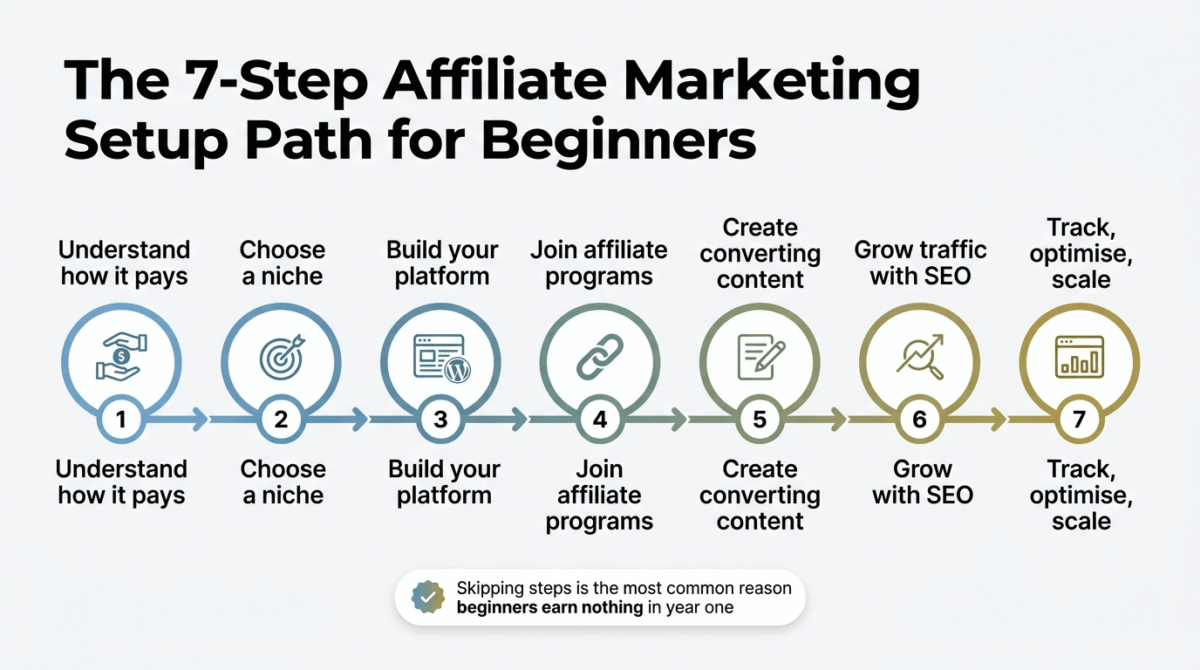
Rather than listing abstract tactics, this guide follows the exact sequence a beginner needs to complete, in order. Each step builds on the one before it. Skipping steps is the most common reason new affiliate marketers fail to generate income in year one.
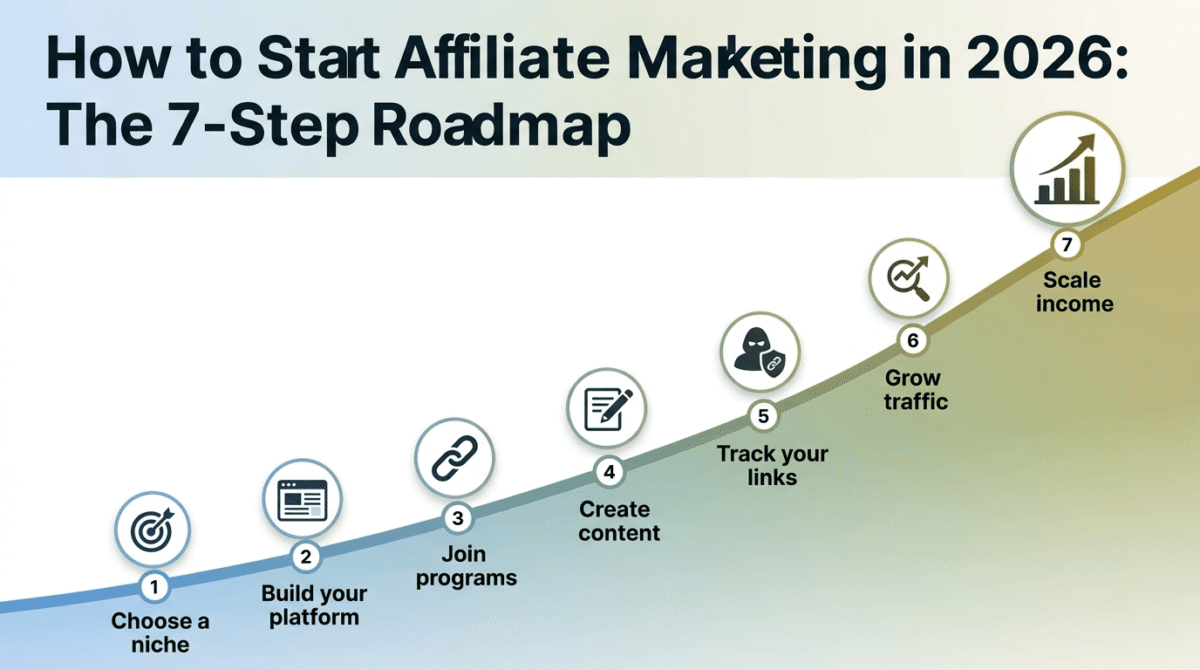
The process covers seven steps:
- Understanding what affiliate marketing actually is and how it pays
- Choosing a niche you can build authority in
- Building your primary traffic platform
- Finding and joining affiliate programs
- Creating content that converts at high rates
- Growing traffic systematically
- Tracking, optimizing, and scaling toward consistent income
What Affiliate Marketing Actually Is, And How the Money Works
Affiliate marketing is a performance-based income model. You recommend a product or service using a unique tracking link. When someone clicks that link and makes a qualifying purchase, you earn a commission. You never handle inventory, customer support, or fulfillment. You connect buyers with products and earn a percentage of the transaction. To manage these recommendations, you will need the best affiliate link management plugins to track your clicks and commissions.
The mechanics are simple. The strategy is not.
Understanding commission structures before choosing your niche determines how hard you will have to work to reach any given income level.
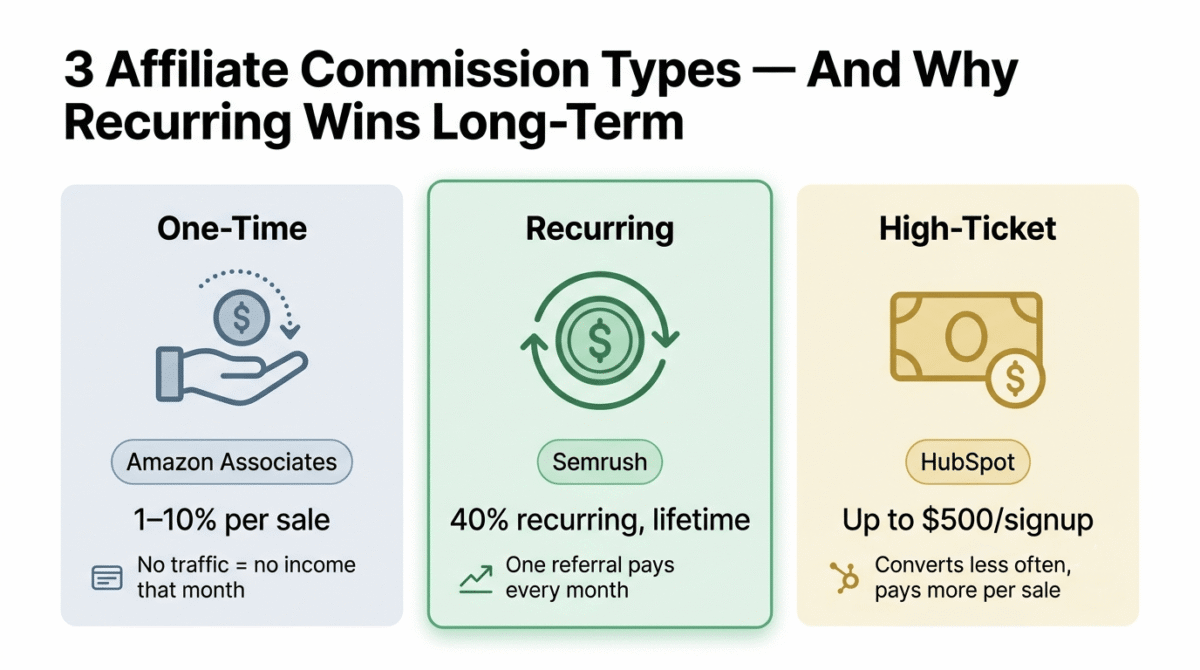
One-time commissions: You earn a fixed fee or percentage when someone purchases. Amazon Associates typically pays 1–10% of the sale value. Physical product programs average 5–15%. One-time commissions require continuous traffic to generate continuous income, no traffic in a month means no commissions that month.
Recurring commissions: You earn a percentage every month a customer you referred continues paying. SaaS programs, email marketing tools, project management software, VPNs, SEO tools, typically pay 20–40% recurring monthly commissions. A single customer paying $99/month for a tool you recommended two years ago still generates $20–40 for you every month. This is why software is the most valuable affiliate niche for income that compounds over time. Semrush pays 40% recurring lifetime commission. Kit (formerly ConvertKit) pays 30% recurring for 24 months. NordVPN pays 40% on the first purchase plus 30% on renewals.
High-ticket one-time commissions: Some programs pay $100–$500+ per conversion. HubSpot pays up to $500 per signup. Shopify pays $150 per merchant. Hostinger pays up to $150 per hosting signup. These convert less frequently than lower-priced tools but deliver substantial per-conversion income.
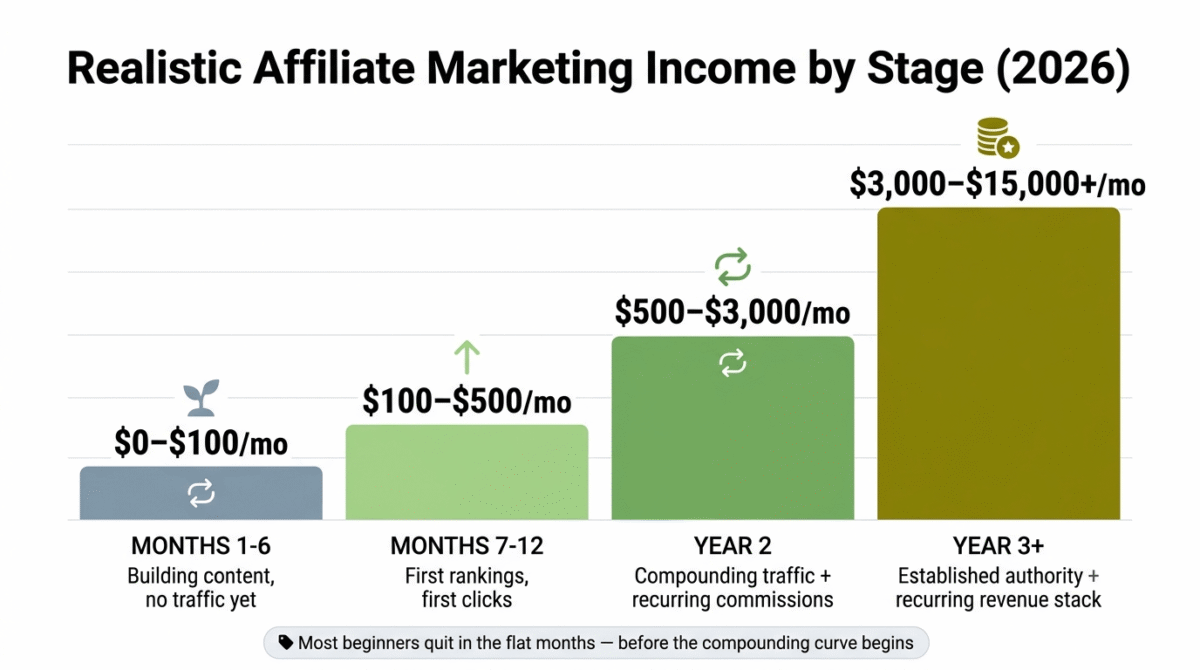
Realistic income by experience stage:
- Months 1–6: $0–$100/month (building content, no meaningful traffic yet)
- Months 7–12: $100–$500/month (first organic rankings, initial affiliate clicks)
- Year 2: $500–$3,000/month (compounding traffic, recurring commissions building)
- Year 3+: $3,000–$15,000+/month (established authority, large content library, recurring revenue stack)
The transition from year one to year two is where the vast majority of affiliates who stick with it see income jump significantly. The content they published in month three starts ranking in month nine. The recurring commissions from year-one referrals keep paying. The income builds on itself.
Step 1: Choose a Niche That Can Actually Make You Money
The single most consequential decision in affiliate marketing is niche selection. A well-chosen niche makes every subsequent step easier. A poorly chosen niche makes every step harder and limits your income ceiling regardless of how good your content is.
The criteria for a good affiliate niche in 2026:
Products with affiliate programs exist and pay meaningful commissions. Search “[niche topic] + affiliate program” on Google. If you find dozens of programs with commission rates above 20% or CPA payouts above $50, the niche has strong commercial infrastructure. If you find Amazon Associates at 4% as the primary option, the economics will be difficult.
Buyer intent search traffic exists. Your content needs to rank for keywords where the person searching is close to making a purchase decision. “Best [tool category] 2026”, “[Tool A] vs [Tool B]”, “Is [Tool] worth it?”, these are high-intent searches that convert. “What is [Tool]?” is informational intent and converts poorly for affiliate purposes.
You have genuine knowledge or willingness to develop it. Topical authority, Google’s trust in your site as an expert on a subject, is built through the depth and volume of content you publish on a focused topic. A site that covers 30 software tool comparisons with genuine expertise outranks a site that covers 5 software tools and 25 unrelated topics.
Competition is not completely dominated by giant sites with 10+ years of domain authority. Search your target keywords on Google. If every result on page one is Forbes, CNET, PCMag, and Wirecutter with domain ratings above 80, ranking there as a new site will take years. Look for niches where smaller, newer sites appear on page one, that signals the authority gap is bridgeable.
Profitable niches for 2026 with strong affiliate programs:
- Software reviews (SaaS), recurring commissions, highest per-referral value, RateTheTool.com’s exact model
- Personal finance tools, budgeting apps, investment platforms, fintech ($50–$200 CPA standard)
- Online education and courses, 20–50% commissions, high ticket prices
- Home office and remote work equipment, Amazon Associates plus direct brand programs
- Health and fitness technology, supplements, equipment, apps (5–30% commissions)
- Pet care, products and services, lower competition than many niches, loyal buyers
The niche trap to avoid: Choosing a niche you know nothing about purely because the commission rates look attractive. Readers and search engines both detect thin, low-expertise content quickly. A site that covers software tools written by someone who actively uses software tools outperforms a site covering the same tools written purely for commission purposes, every time.
Step 2: Build Your Primary Traffic Platform
You need an audience to recommend products to. In 2026, the most durable affiliate income comes from platforms you own, primarily a blog on your own domain. Social media channels can be suspended, demonetized, or devastated by algorithm changes overnight. Your blog and the email list it builds cannot be taken from you.
A blog on your own domain is the foundation. WordPress powers over 40% of all websites on the internet. It is free, open-source, and has a plugin ecosystem that covers every affiliate marketing need. The core setup:
- Domain: Register a memorable, niche-relevant domain. Namecheap or your hosting provider.
- Hosting: Hostinger Premium is the recommended starting point, LiteSpeed servers, strong performance, and pricing starting at approximately $3/month with the promotional rate. Note the renewal rate before committing annually.
- Platform: WordPress.org (self-hosted, not WordPress.com, you need the self-hosted version for full affiliate marketing capability).
- Theme: Astra (free, lightweight, fast-loading, used on RateTheTool.com).
- Essential plugins: Rank Math SEO (free, handles all on-page SEO), ThirstyAffiliates (affiliate link cloaking and management), LiteSpeed Cache (site speed), Wordfence (security), MonsterInsights (Google Analytics 4 integration).
Your total monthly cost for a professionally running affiliate blog: approximately $3–10/month for hosting, $0 for WordPress and most essential plugins, and as much as you choose to invest in premium tools as income grows.
Content takes 60–120 days to rank on Google. This is the reality that causes most beginners to quit. You publish content in month one. You see very little traffic in months one and two. Traffic begins arriving in months three through six as Google indexes and begins ranking your content. By month nine, content you published in month three is potentially on page one for its target keywords, driving consistent daily traffic and affiliate clicks.
Understanding this timeline in advance is the difference between staying consistent through the quiet months and abandoning the site before the results arrive.
Secondary traffic channels to build alongside your blog:
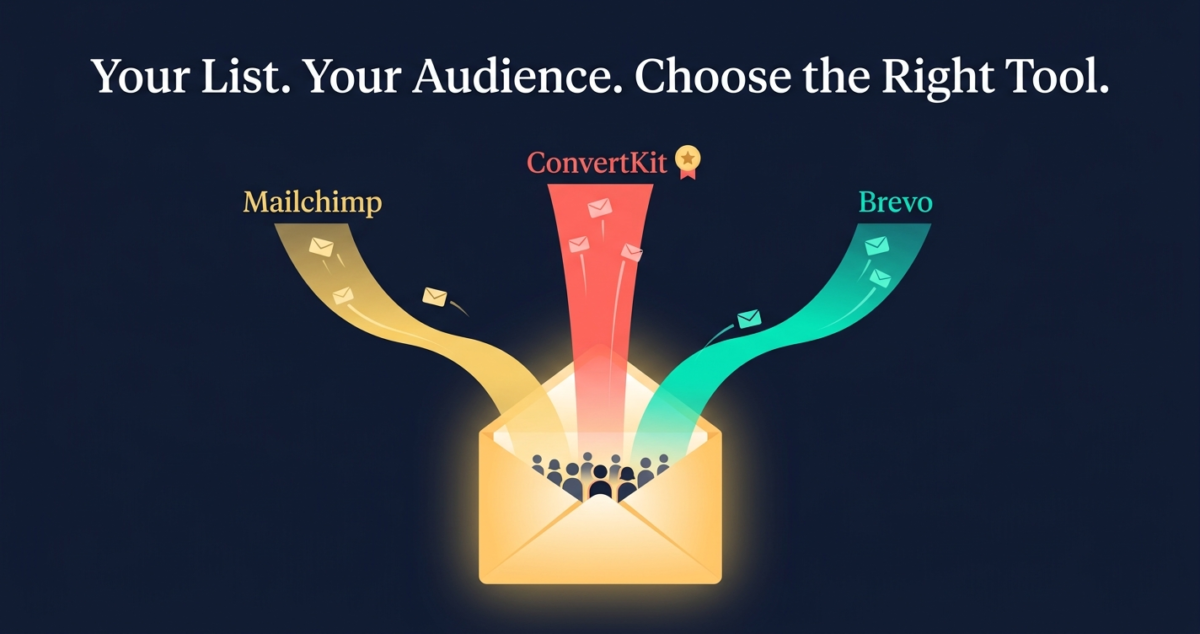
- Email list: Start collecting email subscribers from day one. A reader who joins your email list is significantly more likely to click affiliate links than one who reads a single post and leaves. Kit (formerly ConvertKit) offers a free plan covering up to 10,000 subscribers, there is no reason not to start building this immediately.
- YouTube: Product review and comparison videos drive high purchase intent. Your affiliate links live in the video description. An evergreen comparison video can generate commissions for years from a single piece of content.
- Pinterest: Drives significant traffic to blog posts in visual niches. Lower competition for new sites compared to Google in many categories.
Do not attempt to build all channels simultaneously in year one. Choose your blog as the foundation. Add one secondary channel after month three. This focus is what separates affiliates who build sustainable traffic from those who spread themselves thin and gain traction nowhere.
Step 3: Find and Join the Right Affiliate Programs
There are two types of affiliate programs: direct programs run by individual companies, and affiliate networks that aggregate hundreds of programs in one place.
Direct affiliate programs offer the highest commission rates and a direct relationship with the brand. Find them by searching “[Brand Name] affiliate program” on Google. Most SaaS companies run their own programs. The programs with the strongest commission structures for bloggers in the software niche:
| Program | Commission | Cookie | Payout |
|---|---|---|---|
| Semrush | 40% recurring lifetime | 120 days | $10 minimum |
| HubSpot | Up to $500/signup | 90 days | $100 minimum |
| Hostinger | Up to $150/signup | 30 days | $100 minimum |
| NordVPN | 40% + 30% renewals | 30 days | $100 minimum |
| Shopify | $150/merchant | 30 days | $25 minimum |
| Kit (ConvertKit) | 30% recurring, 24 months | 90 days | $50 minimum |
| Teachable | 30% recurring | 90 days | $50 minimum |
| Ahrefs | 20% recurring | 60 days | $50 minimum |
Affiliate networks allow you to apply once and access hundreds of programs through a single dashboard. The most useful networks for content bloggers in 2026:
- ShareASale, largest network for small and mid-market brands, easy beginner approval, thousands of programs across all niches
- Impact, the preferred network for premium SaaS and software brands
- CJ Affiliate (Commission Junction), established network with major brand programs
- Amazon Associates, essential for any physical product content, despite the low 1–10% commissions; the trust and conversion rate of Amazon links compensates for the lower percentage on high-traffic content
Which programs to join first: Start with two to three programs that match your niche directly and have straightforward approval requirements. Amazon Associates approves most applicants immediately. ShareASale approves most new publishers within 48 hours. Direct SaaS programs typically require a basic site with some published content before approving.
Do not apply to 20 programs before you have traffic. Focus on your content first, join two to three relevant programs, and add more programs as your traffic grows and your audience profile becomes clearer.
Step 4: Create Content That Converts
Affiliate marketing content works when it serves the reader’s actual decision-making process. The content types with the highest conversion rates are not general informational posts, they are decision-support content targeting people who are close to buying.
The highest-converting affiliate content formats:
Comparison posts (“Tool A vs Tool B vs Tool C”) catch readers in the final stage of the buying decision. They have already decided they want a solution in this category, they are now deciding which specific tool to buy. A post that answers this question with genuine testing experience and an honest verdict earns the click when the reader reaches a conclusion.
Best-of roundups (“Best [Category] Tools in 2026”) catch readers who are beginning their research. These posts rank for broader keywords with higher search volume. They earn trust by covering multiple options honestly rather than pushing a single preferred affiliate.
Individual tool reviews (“Is [Tool] Worth It?”) catch readers searching specifically for one tool after encountering it elsewhere. These convert at high rates because the reader is already interested in the product, they are looking for a trusted second opinion before buying.
How-to guides that require specific tools, like this post, introduce readers to affiliate tools in a problem-solving context. The recommendation feels natural because it serves the reader’s goal rather than interrupting it.
The content rule that separates high-earning affiliates from low-earning ones: Recommend the genuinely best tool even when the best tool pays a lower commission than an alternative. Readers who trust your recommendations enough to click your affiliate links are built through dozens of interactions where you proved your advice was reliable. A single dishonest recommendation destroys that trust immediately. Honesty is not just an ethical position, it is the most commercially viable strategy in a market where readers have learned to distrust affiliate content.
RateTheTool.com implements this by regularly recommending free tools with no affiliate arrangement: Wave for accounting, Clockify for time tracking, Bitwarden for personal password management, OBS for screen recording. Readers who notice these recommendations trust every paid recommendation significantly more as a result.
Step 5: Manage and Track Your Affiliate Links
Raw affiliate URLs are long, ugly, and break silently when programs change their tracking structure. An affiliate link management plugin is not optional, it is the difference between a professional affiliate operation and a maintenance nightmare.
ThirstyAffiliates (covered in detail in post #71 of this series) handles every link management need for a WordPress blog:
- Cloaks raw affiliate URLs into clean branded links (
ratethetool.com/go/toolname) - Updates all occurrences of a link globally from a single dashboard when a program changes its URL
- Tracks clicks per link and per page so you know which posts drive the most revenue
- Automatically applies
rel="nofollow"andrel="sponsored"attributes for Google compliance - The free plugin covers everything a new affiliate needs; the Pro version at $99.60/year adds automatic keyword linking and link health monitoring
Google Analytics 4 tracks your overall site traffic, which posts receive the most visitors, where readers come from, how long they stay, and which pages they visit before clicking an affiliate link. Install it via MonsterInsights plugin, which adds GA4 to WordPress without touching code.
Your affiliate network dashboards show clicks, conversions, and commissions per program. The monthly workflow that compound-growing affiliates follow: check GA4 to identify highest-traffic posts, cross-reference with affiliate dashboard to identify which posts convert to commissions, increase internal links from high-traffic non-converting posts to high-converting posts, and identify content gaps where a new post would capture search traffic and earn commissions.
Step 6: Grow Traffic Systematically With SEO
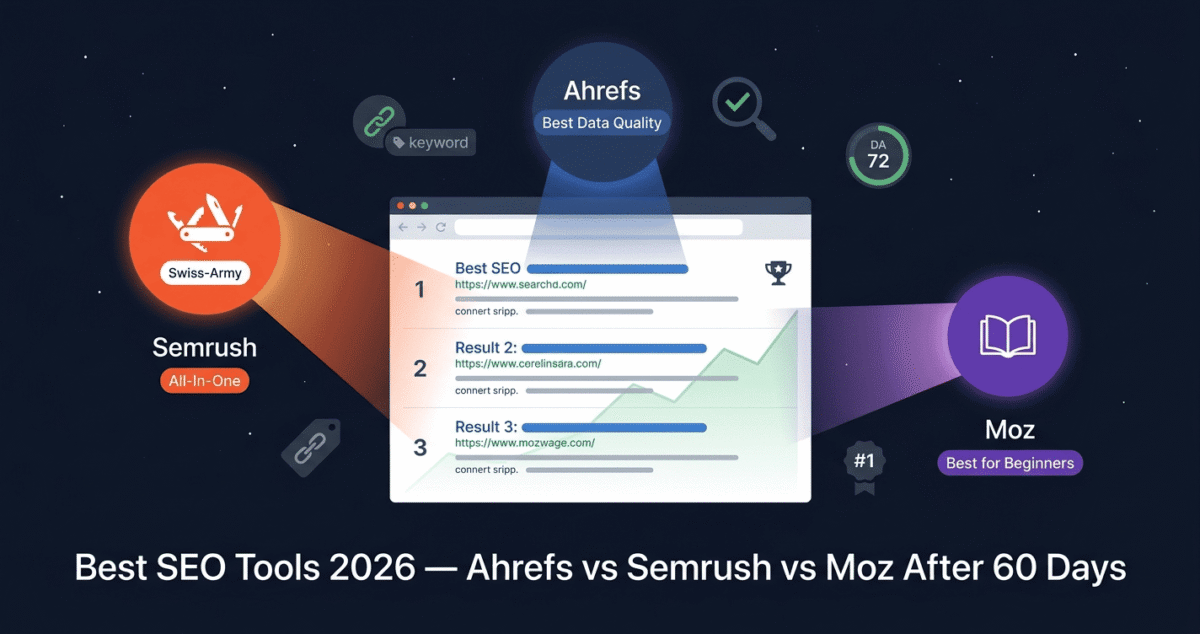
SEO is how 78% of affiliate marketers generate their primary traffic, and for good reason: a blog post that ranks on page one of Google for a buyer-intent keyword generates daily traffic and daily affiliate clicks indefinitely, from a single piece of content you wrote once. Before you can target the right keywords, you need to grow your traffic with SEO research, see our Ahrefs vs Semrush vs Ubersuggest comparison for the best keyword tool to start with.
The four-layer SEO approach RateTheTool.com uses for every post:
Traditional SEO: Target keyword in the title, H1, first paragraph, meta description, and conclusion. Secondary keywords distributed naturally throughout the post. Comparison tables (which Google renders as rich results). 2,500–3,200 word posts that comprehensively cover the topic. Two to three internal links per post connecting related content.
AEO (Answer Engine Optimization): 7–8 FAQ questions at the end of each post, each answered in 40–60 words. This length is optimal for Google’s featured snippet algorithm. When Google selects a featured snippet, it typically appears above all organic results, generating significant click-through traffic from position zero.
AIO (AI Optimization): Factual, verifiable claims. Author expertise signals. Original testing data and first-hand opinions. These are the E-E-A-T (Experience, Expertise, Authority, Trust) signals that both Google and AI chatbots use to evaluate content credibility. AI tools like ChatGPT and Perplexity increasingly recommend content from sources that demonstrate genuine first-hand experience.
GEO (Generative Engine Optimization): Clear verdicts (“Fathom is the best AI meeting assistant for individual bloggers in 2026”) rather than vague conclusions. Specific data points (prices, ratings, percentages). Structured summaries that AI citation engines can extract and attribute. An llms.txt file at your domain that signals to AI crawlers what your site covers and authorizes them to use your content in responses.
Rank Math SEO (free WordPress plugin) handles the technical implementation of all four layers: meta description and title optimization, FAQ schema markup, review schema, breadcrumbs, and XML sitemap generation.
What Blogger and Content Creator Affiliates Do Differently
Bloggers who build sustainable affiliate income approach the model differently from people who treat it as passive income from day one.
They test everything they recommend. The credibility gap between “I read about this tool” and “I have used this tool for 60 days” is audible in the writing and visible to readers. Test the tools you recommend. Your testing experience produces the specific details, which features actually work, which are overstated, which pricing plans are worth upgrading to, that generic review articles written without testing cannot provide. That specificity is what builds trust, and trust is what produces affiliate income.
They build content clusters, not isolated posts. A single post about “Best Email Marketing Tools” earns less than a cluster of posts covering the category from multiple angles, a comparison post, individual tool reviews, a how-to guide for getting started, a post about email marketing for bloggers specifically, and a cost comparison post. Each post in the cluster links to the others, building topical authority that helps the entire cluster rank.
They prioritize recurring commission programs. A beginner who focuses on building recurring commission relationships, SaaS tools, subscription software, membership programs, builds an income that grows even when they take a month off publishing. One customer who pays $99/month for Semrush generates $39.60/month in commission for the lifetime of that subscription. One hundred such customers generates $3,960/month from referrals made over the previous two years, even if you publish nothing new this month.
They treat affiliate disclosure as a trust asset, not a legal obligation. Required by FTC guidelines, affiliate disclosures are typically treated as a compliance checkbox. Treated as a trust signal, “I may earn a commission, and here is exactly how that influences or does not influence my recommendations”, they become part of the reason readers trust the content enough to act on it.
Final Verdict: What to Realistically Expect
Affiliate marketing works. It generates substantial income for the people who stay consistent through the first difficult year when traffic is low and income is near zero. Affiliate commissions are one income stream among several bloggers typically stack together, see our full guide on how to make money blogging for the rest of the mix (ads, sponsorships, digital products, and more). It fails for the majority who expect faster results and quit before the compounding effect of content + SEO + recurring commissions has time to materialize.
The honest timeline for a blogger starting from scratch in 2026:
Months 1–3: Build the site, publish 20–30 posts, apply for affiliate programs, earn very little. The work is all input, almost no output.
Months 4–6: First organic rankings appear. First affiliate clicks. First commissions, likely $50–$200/month if you have published consistently. Apply for AdSense.
Months 7–12: Traffic compounds from posts that have now been indexed for 3–6 months. Commissions build from $200 toward $500–$1,000/month for bloggers in high-commission niches who have been consistent.
Year 2: Recurring commissions from year-one referrals continue paying every month. New content generates new referrals. Total affiliate income for bloggers in software niches who have maintained consistency commonly reaches $1,000–$5,000/month. This is where affiliate marketing begins to feel like a business rather than an experiment.
The tools and the tactics covered in this guide are well-established and reliably work. The variable that determines income is consistency over time, publishing quality content regularly, treating every post as a long-term traffic asset, and staying in the market long enough for the compounding to begin.
Frequently Asked Questions
How much money can you make from affiliate marketing as a beginner?
Beginners realistically earn $0–$100 per month in the first six months while building content and traffic. By month twelve with consistent publishing, $200–$800 per month is achievable in high-commission niches like software and SaaS. The median income for experienced active affiliates sits at $1,200–$2,500 per month, with top earners well above that after three or more years.
Do you need a website to start affiliate marketing in 2026?
No, you can promote affiliate links through YouTube, TikTok, Instagram, Pinterest, or email newsletters without a website. However, a blog on your own domain is the most durable foundation because you own the platform. Social media accounts can be suspended or demonetized; your self-hosted WordPress blog cannot be taken from you. Most successful long-term affiliates use a blog as their primary platform even if they also use social channels.
How long does it take to make money from affiliate marketing?
Most bloggers see their first meaningful affiliate income between months six and nine. The typical pattern is: months one to three produce very little while content is being indexed, months four to six produce first commissions as rankings begin, and month nine onward produces consistent compounding income. Affiliates using paid traffic can monetize faster but also carry higher costs and risk.
What are the best affiliate programs for beginners in 2026?
For software and SaaS niches: Semrush (40% recurring lifetime), Hostinger (up to $150/signup), Kit (30% recurring 24 months), and NordVPN (40% initial + 30% renewals) are the strongest starting programs. For beginners who are not yet in a specific niche, Amazon Associates offers easy approval and universal product coverage, despite lower commission rates of 1–10%.
Is affiliate marketing still worth it in 2026?
Yes, the affiliate marketing industry generates over $17 billion annually in the US alone and is growing at 71% year-over-year for content creator publishers. The opportunity is larger than ever, but the bar for quality has also risen. Generic, low-effort review articles rank poorly. Honest, first-hand tested content from sites that demonstrate genuine expertise consistently earns both rankings and reader trust.
How do I find affiliate programs in my niche?
Search [your niche topic] + affiliate program on Google and review the official affiliate pages of tools and brands you already use or respect. Join ShareASale and Impact as your primary affiliate networks, between them they cover thousands of programs across most niches. For software specifically, check the footer of any SaaS tool’s website, most include an Affiliates or Partner Program link.
Do I need to disclose affiliate links?
Yes, the FTC (Federal Trade Commission) requires clear disclosure that you may earn a commission from links in your content. This applies to all platforms including blogs, YouTube, Instagram, and email newsletters. The disclosure must be clear and conspicuous, not buried in fine print. Standard disclosure language is included at the bottom of every RateTheTool.com post and should be similarly prominent on any affiliate content you publish.
What is the biggest mistake beginners make in affiliate marketing?
Switching niches too early. Most beginners see limited results in the first three to four months, which is a normal consequence of the time Google takes to index and rank content, and conclude their niche is wrong. They start over in a new niche, which resets the clock entirely. The affiliates who build significant income are overwhelmingly those who picked a viable niche and stayed consistent for eighteen to twenty-four months without switching.