Email marketing generates $36 for every $1 spent, the highest ROI of any digital marketing channel in 2026. For small businesses, an engaged email list is the most valuable marketing asset you own, more reliable than social media algorithms, more cost-effective than paid advertising, and more personal than any other channel at scale.
But choosing the wrong email marketing platform costs more than the subscription fee. The wrong tool means poor deliverability (emails landing in spam), limited automation (manual sending instead of triggered sequences), or complexity that prevents you from using the tool consistently.
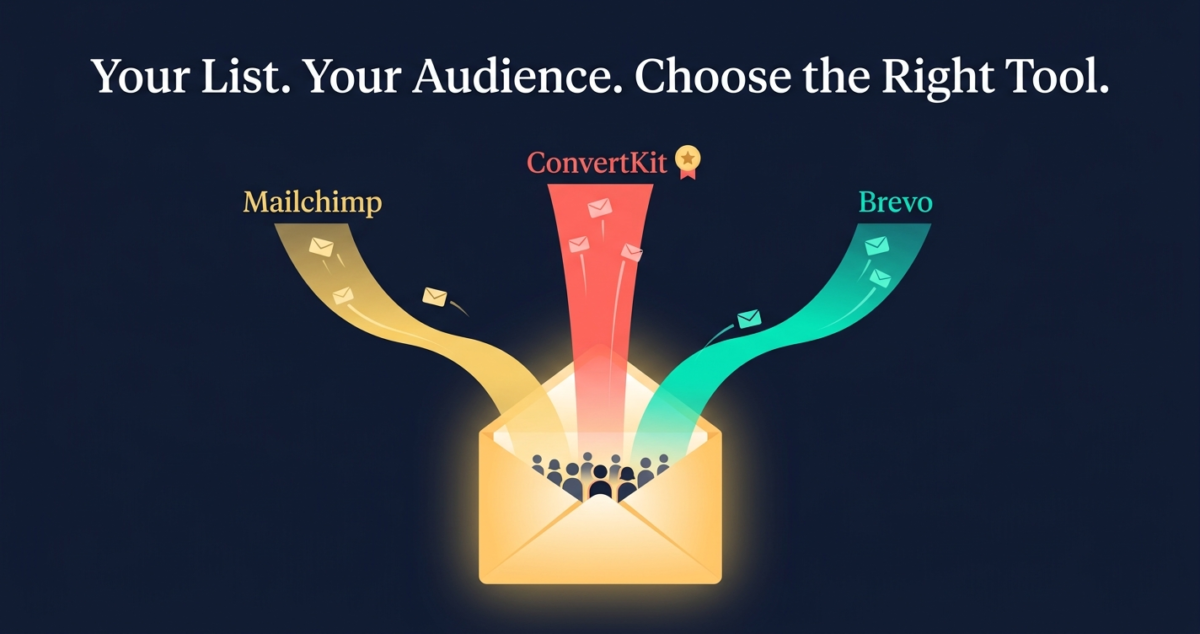
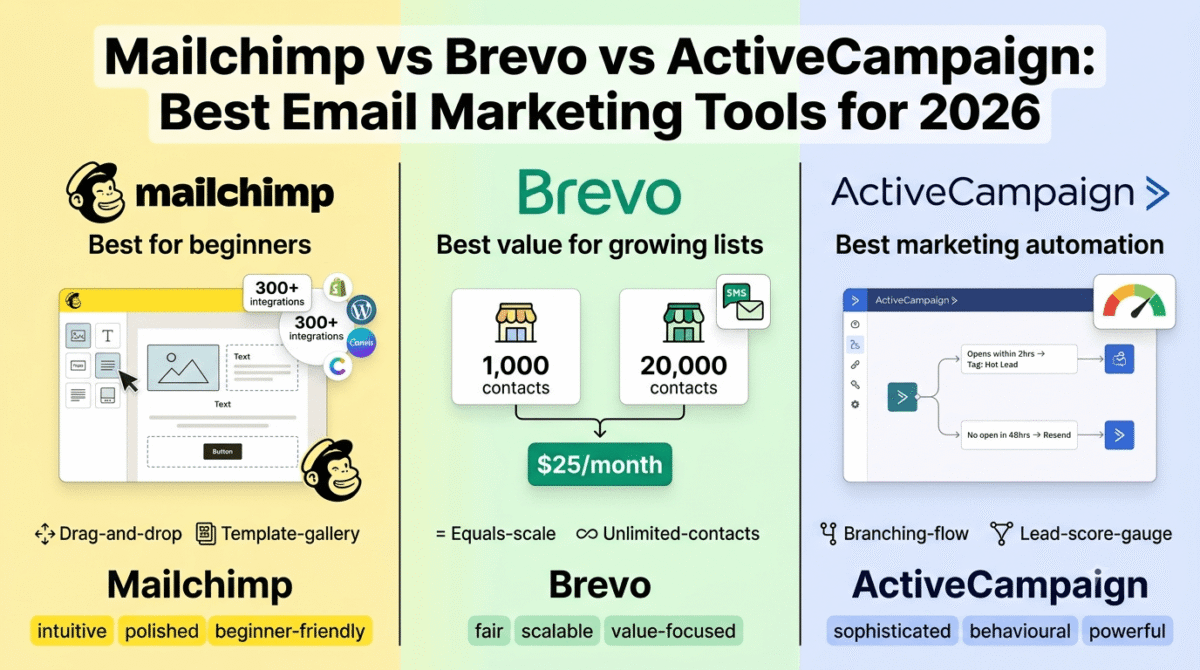
Mailchimp vs Brevo vs ActiveCampaign are the three email marketing platforms most widely compared by small businesses. Each targets a different level of sophistication and serves different business needs. This honest comparison covers what each tool does best, where each falls short, and which is the right choice for your specific situation.
I tested all three for 30 days across real email campaigns, newsletters, automated welcome sequences, abandoned cart recovery, and behavioural trigger campaigns, measuring deliverability, automation capability, and overall workflow experience.
Table of Contents
How We Evaluated These Tools
Every platform was tested across five criteria:
- Email deliverability, what percentage of emails reach the inbox versus spam folder?
- Automation capability, how sophisticated and flexible are the automated sequence tools?
- Ease of use, how quickly can a non-technical small business owner create and send campaigns?
- Segmentation and personalisation, how precisely can audiences be targeted with relevant content?
- Value, free plan quality and paid plan pricing versus features offered
Why Email Marketing Matters More Than Social Media for Small Businesses
Before comparing the platforms, understanding the fundamental advantage of email over social media shapes how you invest in it:
You own your email list. If Instagram changes its algorithm tomorrow and your posts reach 10% of your followers instead of 30%, your reach drops by two thirds overnight, with no recourse. Your email list belongs to you. If your email platform shuts down, you export your list and move to another platform. No algorithm decides whether your subscribers see your message.
Email converts better. Email marketing converts at 2–5% for average campaigns and 5–15% for well-segmented, triggered campaigns. Social media organic posts convert at 0.5–1%. The same audience reached via email generates 4–30x more revenue than the same audience reached via social media. If you are ready to build your own platform, learn how to start a blog and begin growing your list.
Email compounds. A subscriber added to your list today receives every email you send for months or years. A social media follower sees your posts only when the algorithm chooses to show them. The compounding value of email subscribers, each one receiving ongoing communication, creates a marketing asset that appreciates over time.
Mailchimp Review: Best Email Marketing for Beginners and Simple Small Businesses
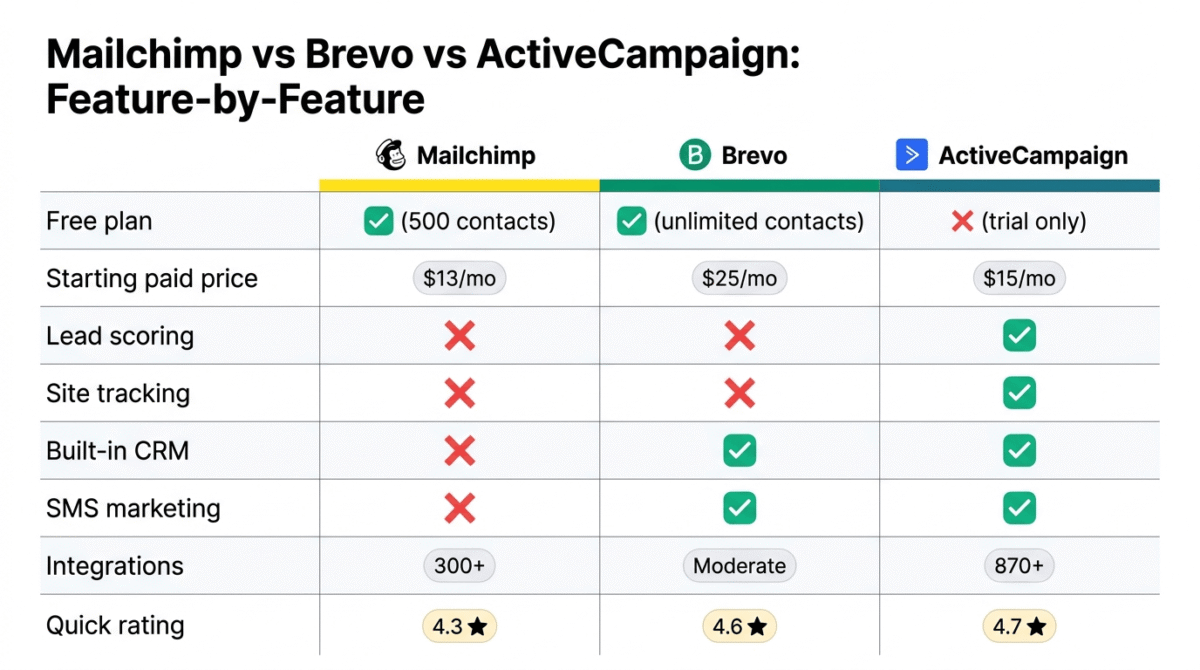
Free plan: Yes, 500 contacts, 1,000 emails/month
Starting price: $13/month (Essentials, 500 contacts)
Best plan for most small businesses: Standard, $20/month (500 contacts)
Platforms: Web, iOS, Android
Affiliate program: Yes, Mailchimp affiliate program
Mailchimp is the world’s most widely used email marketing platform, used by over 11 million businesses globally, recognised by its friendly Freddie chimp mascot, and the default choice that most small businesses try first. In 2026, Mailchimp’s combination of an intuitive email builder, extensive template library, and broad third-party integrations makes it the most accessible starting point for email marketing beginners.
What Mailchimp does best
Mailchimp’s email builder is the most intuitive of the three tools, the drag-and-drop interface, the preview as you build functionality, and the extensive pre-designed template library enable non-designers to create professional-looking emails without HTML knowledge. The Content Studio stores your brand assets (logo, brand colours, frequently used images) for one-click insertion across all campaigns.
The template library covers every common small business email type, newsletters, product announcements, event invitations, holiday promotions, welcome emails, and seasonal campaigns, with dozens of professionally designed layouts for each. For small business owners without dedicated marketing staff, starting from a polished template reduces campaign creation time from hours to minutes. For more ways to optimize your operations, check out our guide to the best tools for small business.
Mailchimp’s integrations are the most extensive of the three tools, connecting to over 300 apps including Shopify, WooCommerce, Salesforce, WordPress, Facebook, Instagram, Canva, and virtually every major business tool. The breadth of integrations makes Mailchimp the lowest-friction email marketing addition to any existing technology stack.
The Customer Journey Builder, Mailchimp’s automation workflow tool, enables visual mapping of automated email sequences triggered by subscriber behaviour. A welcome series (email 1 immediately on subscribe, email 2 three days later, email 3 one week later) is built visually by connecting blocks in a flowchart interface that non-technical users navigate intuitively.
Mailchimp’s analytics, open rate, click rate, click map, revenue attribution, and unsubscribe tracking, provide the standard email performance metrics in a clean dashboard. The comparison against industry average benchmarks shows whether your open rates and click rates are competitive for your industry.
Where Mailchimp falls short
Mailchimp’s free plan has been aggressively restricted over several years, the current free limit of 500 contacts and 1,000 emails per month is the least generous free tier of the three tools. Brevo’s free plan covers unlimited contacts with 300 emails per day; ConvertKit’s free plan covers 10,000 subscribers with unlimited emails. Mailchimp’s free plan is a demonstration, not a usable free tier for growing businesses. To see how these platforms compare to other top options, read our full analysis of Mailchimp vs ConvertKit vs Brevo.
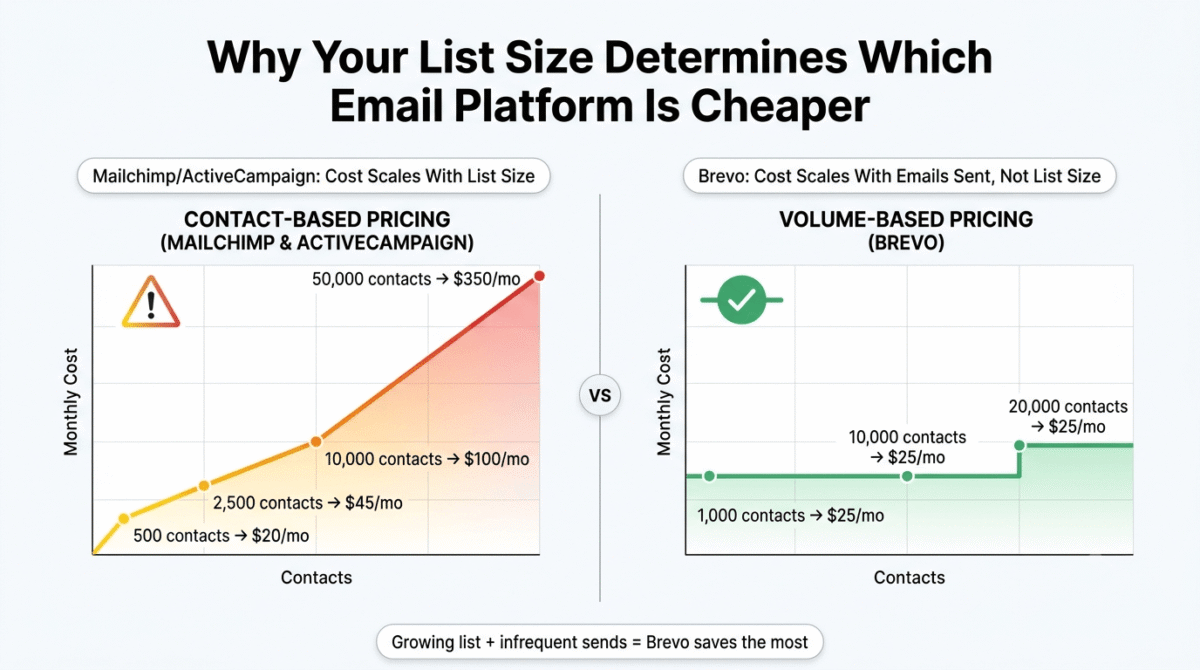
The pricing escalation as list size grows is Mailchimp’s most significant long-term cost concern. At 500 contacts the Standard plan costs $20/month; at 2,500 contacts it costs $45/month; at 10,000 contacts it costs $100/month; at 50,000 contacts it costs $350/month. For fast-growing email lists, Mailchimp becomes expensive quickly, the pricing model rewards list size rather than email send volume.
The automation capability, while adequate for simple sequences, is less sophisticated than ActiveCampaign’s. Complex conditional branching (if subscriber clicks link A, send email B; if they click link C, send email D; if they open within 24 hours, tag as highly engaged) requires the more expensive plans and is less intuitive to build than ActiveCampaign’s workflow editor.
The famous Mailchimp pricing trap, promotional prices that escalate significantly at renewal and as list size grows, warrants explicit mention. The $13/month “Essentials” starting price covers only 500 contacts; exceeding this requires immediate plan upgrades. Read the pricing page carefully and model what your plan will cost at your projected list size in 12 months before committing.
Mailchimp pricing
| Plan | Price/month | Contacts | Emails/month | Key features |
|---|---|---|---|---|
| Free | $0 | 500 | 1,000 | Basic email, limited templates |
| Essentials | $13 | 500 | 5,000 | + All templates, A/B testing, 24/7 support |
| Standard | $20 | 500 | 6,000 | + Automation, behavioural targeting, custom templates |
| Premium | $350 | 10,000 | 150,000 | + Advanced segmentation, multivariate testing |
Prices increase as contact count grows above each plan’s base limit
Mailchimp: Pros and Cons
Pros:
- Most intuitive email builder, best for non-technical users
- Largest template library, polished designs for every campaign type
- Most extensive integrations, 300+ app connections
- Brand and name recognition, clients and partners know it
- Customer Journey Builder for visual automation
- Comprehensive analytics with industry benchmarking
- iOS and Android apps for mobile campaign management
Cons:
- Most restrictive free plan, 500 contacts, 1,000 emails/month
- Pricing escalates aggressively with list growth
- Automation less sophisticated than ActiveCampaign
- Complex segmentation requires Premium plan
- Promotional pricing misleads on true long-term cost
- Less suitable for e-commerce automation than Klaviyo
- Customer support quality inconsistent on lower plans
Rating: 4.3 / 5, Best email marketing for complete beginners who prioritise ease of use over cost efficiency. Outgrown quickly by businesses with growing lists or sophisticated automation needs.
Brevo Review: Best Value Email Marketing for Small Businesses
Free plan: Yes, unlimited contacts, 300 emails/day (9,000/month)
Starting price: $25/month (Starter, 20,000 emails/month)
Best plan for most small businesses: Starter, $25/month
Platforms: Web, iOS, Android
Affiliate program: Yes, Brevo affiliate program, 20% recurring commission
Brevo (formerly Sendinblue) is the best value email marketing platform for small businesses, its pricing model based on email sends rather than contact count means costs do not escalate as your list grows. A business with 20,000 subscribers sending 2 emails per month pays the same as a business with 1,000 subscribers sending 2 emails per month, both fit within the Starter plan’s 20,000 monthly email limit at $25/month.
What Brevo does best
Brevo’s contact-unlimited pricing model is its defining commercial advantage. Mailchimp charges more as your contact list grows, even if you email those contacts rarely. Brevo charges based on emails sent, businesses with large but infrequently emailed lists pay far less with Brevo than with Mailchimp or ActiveCampaign.
The free plan, unlimited contacts with 300 emails per day, is the most generous free email marketing tier from a reputable provider. For small businesses just starting their email marketing journey, Brevo’s free plan enables building a complete subscriber list and sending weekly newsletters to hundreds of contacts at zero cost.
Brevo’s transactional email capability, sending order confirmations, password resets, shipping notifications, and other automated system emails alongside marketing campaigns, is included in all plans without additional cost. Businesses that previously used Mailchimp for marketing emails and SendGrid for transactional emails can consolidate to Brevo at lower total cost.
The SMS marketing feature, sending text message campaigns alongside email campaigns from the same platform, enables multi-channel marketing without a separate SMS tool. Combining email and SMS for promotional campaigns (email announcement + SMS reminder 24 hours later) consistently improves campaign response rates versus email alone.
The marketing automation in Brevo, triggered email sequences based on contact behaviour, date-based triggers, and workflow branching, covers the most common small business automation needs: welcome sequences, birthday emails, post-purchase follow-ups, and re-engagement campaigns. The visual workflow builder is less sophisticated than ActiveCampaign’s but more intuitive than Mailchimp’s for users comfortable with basic conditional logic.
Brevo’s landing page builder, creating dedicated opt-in pages for lead generation without a separate landing page tool, is included in Business plans and reduces the need for additional subscriptions.
The CRM built into Brevo, storing contact history, deal pipeline, and sales activity alongside email marketing, enables small businesses to manage both marketing and sales from one platform. For businesses where the same team handles both marketing and sales, this integration eliminates the need for a separate CRM.
Where Brevo falls short
Brevo’s email template library is smaller and less polished than Mailchimp’s, the designs are functional but less visually impressive than Mailchimp’s curated collection. Non-designers who rely heavily on templates may find Brevo’s options limiting.
The integrations, while covering major platforms (WordPress, WooCommerce, Shopify, Salesforce), are less extensive than Mailchimp’s 300+ app connections. Niche tools not covered by Brevo’s native integrations require Zapier workarounds.
The advanced automation features, complex behavioural triggers, lead scoring, and sophisticated segmentation based on predictive analytics, are less developed than ActiveCampaign’s. Brevo covers intermediate automation needs but is not the right choice for businesses that need enterprise-level marketing automation.
Brevo’s brand recognition is lower than Mailchimp’s, some business owners feel less confident presenting email marketing from Brevo to clients or partners who recognise the Mailchimp brand.
Brevo pricing
| Plan | Price/month | Contacts | Emails/month | Key features |
|---|---|---|---|---|
| Free | $0 | Unlimited | 9,000 (300/day) | Basic email, unlimited contacts |
| Starter | $25 | Unlimited | 20,000 | + No daily sending limit, basic reporting |
| Business | $65 | Unlimited | 20,000 | + Marketing automation, A/B testing, landing pages |
| Enterprise | Custom | Unlimited | Custom | + Advanced features, dedicated support |
Brevo: Pros and Cons
Pros:
- Best free plan, unlimited contacts, 300 emails/day
- Contact-unlimited pricing, costs don’t escalate with list growth
- Best value for businesses with large lists and moderate send frequency
- Transactional email included, no separate SendGrid needed
- SMS marketing alongside email from one platform
- Built-in CRM for combined marketing and sales management
- Landing page builder on Business plans
- 20% recurring affiliate commission
Cons:
- Smaller template library than Mailchimp
- Fewer native integrations than Mailchimp
- Advanced automation less sophisticated than ActiveCampaign
- Lower brand recognition than Mailchimp
- Business plan ($65/month) required for full automation features
- Interface less polished than Mailchimp for first-time users
Rating: 4.6 / 5, Best value email marketing for small businesses. Contact-unlimited pricing and the most generous free plan make it the most financially sensible choice for growing email lists.
ActiveCampaign Review: Best Email Marketing Automation for Growing Small Businesses
Free plan: No (14-day free trial)
Starting price: $15/month (Lite, 1,000 contacts, billed annually)
Best plan for most growing small businesses: Plus, $49/month (1,000 contacts)
Platforms: Web, iOS, Android
Affiliate program: Yes, ActiveCampaign affiliate program, 20–30% recurring commission
ActiveCampaign is the most powerful email marketing automation platform in this comparison, combining email marketing, marketing automation, CRM, and sales automation in the deepest integrated system available for small businesses. For businesses that have outgrown basic newsletters and welcome sequences and want sophisticated, behaviour-driven automation that personalises communication based on what contacts actually do, ActiveCampaign is the clear leader.
What ActiveCampaign does best
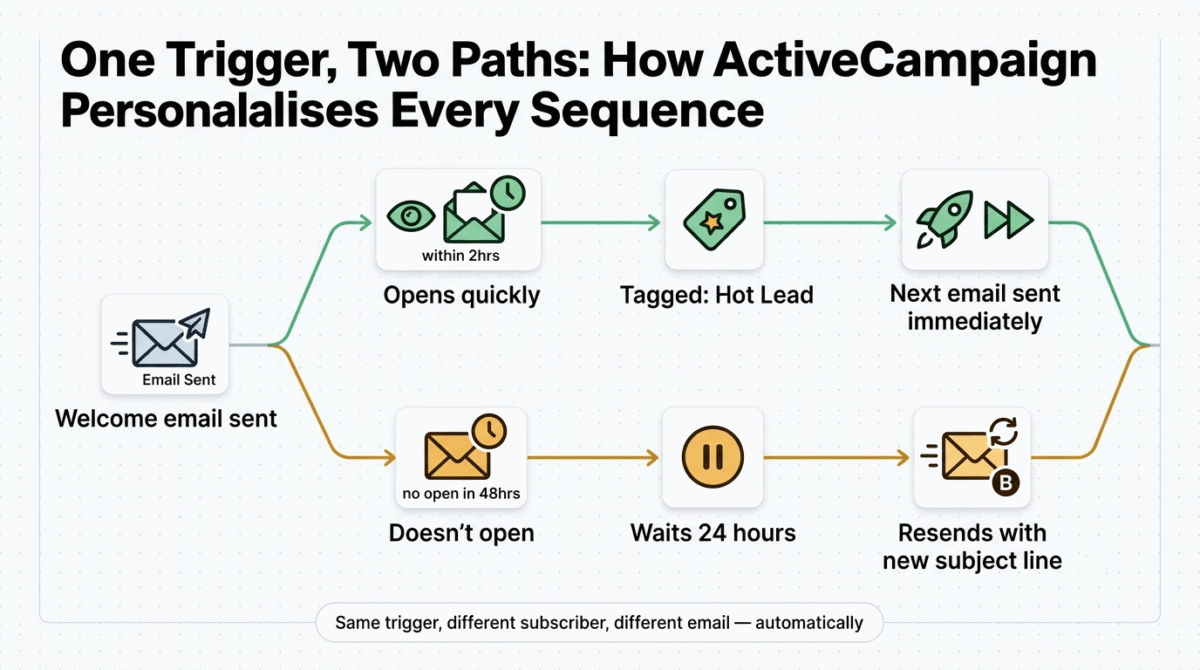
ActiveCampaign’s automation builder is the most powerful of the three tools, enabling multi-branch, conditional workflows that personalise the email sequence every subscriber receives based on their specific behaviour. The visual workflow canvas connects triggers, conditions, actions, and waits in an infinite canvas that handles sequences of any complexity:
- If subscriber opens email within 2 hours → tag as “highly engaged” → add to high-priority segment → send next email immediately
- If subscriber does not open within 48 hours → wait 24 hours → send same email with different subject line → if still not opened → remove from sequence and add to re-engagement campaign
- If subscriber clicks the pricing page link → trigger sales notification to your CRM → add to “hot lead” pipeline → start 3-day follow-up sequence
This conditional logic, responding differently to different subscriber behaviours, produces dramatically higher conversion rates than linear sequences that treat all subscribers identically regardless of engagement.
The lead scoring system, assigning numerical scores based on email opens, clicks, website visits, form submissions, and purchase behaviour, automatically identifies your most engaged prospects. When a lead’s score reaches a defined threshold, ActiveCampaign can trigger a sales notification, add the contact to a high-priority follow-up sequence, or alert a sales team member to make contact. For businesses with sales teams, lead scoring transforms email marketing from a broadcast medium into a sales intelligence tool.
Site tracking, embedding a lightweight script on your website that records which pages each contact visits, enables behavioural triggers based on website activity. A contact who visits your pricing page three times in a week without purchasing triggers an abandoned browsing sequence. A contact who visits your blog consistently for a month without subscribing to a paid plan triggers a conversion nurture sequence. This website activity awareness creates a level of personalisation that email-only tools cannot achieve.
The CRM built into ActiveCampaign, combining contact management, deal pipeline, and task management, creates a unified sales and marketing system. If you’d rather run a standalone system instead of ActiveCampaign’s built-in CRM, our dedicated CRM comparison of HubSpot vs Zoho vs Pipedrive covers the leading options. Marketing automation and sales processes share the same contact data without integration, a contact’s email engagement history is visible to the sales team in the CRM, and CRM pipeline stage changes trigger appropriate marketing sequences automatically.
ActiveCampaign’s email deliverability is the strongest of the three platforms, consistently achieving inbox placement rates above 95% in independent tests. The deliverability infrastructure investment reflects ActiveCampaign’s focus on sophisticated users who care deeply about whether their emails actually reach subscribers.
Where ActiveCampaign falls short
ActiveCampaign’s complexity is its most consistent limitation for small businesses, the power of the automation builder comes with a learning curve that simple newsletter senders find unnecessary. Setting up a basic welcome sequence takes longer in ActiveCampaign than in Mailchimp or Brevo because the tool is designed for sophisticated use, not simplicity.
The pricing model, contact-based like Mailchimp, means costs escalate as your list grows. The Lite plan at $15/month covers 1,000 contacts; the same plan at 10,000 contacts costs $139/month; at 25,000 contacts it reaches $229/month. For businesses with large lists who send infrequently, Brevo’s email-volume pricing is more cost-effective.
The free plan absence, 14-day trial only, means committing to a paid subscription without enough time to fully evaluate a tool this complex. Most ActiveCampaign users report needing 3–4 weeks to build meaningful automation workflows and assess whether the results justify the cost.
ActiveCampaign pricing
| Plan | Price/month (annual, 1,000 contacts) | Key features |
|---|---|---|
| Lite | $15 | Email marketing, basic automation, 1 user |
| Plus | $49 | + CRM, lead scoring, SMS, landing pages |
| Professional | $79 | + Predictive sending, split automation, site messages |
| Enterprise | $145 | + Custom reporting, SSO, dedicated support |
Prices increase significantly with contact count growth
ActiveCampaign: Pros and Cons
Pros:
- Best marketing automation, most powerful conditional workflow builder
- Lead scoring identifies hottest prospects automatically
- Site tracking enables behaviour-based triggers from website activity
- Strongest email deliverability of the three tools
- Best CRM integration, marketing and sales in one system
- Most sophisticated segmentation and personalisation
- Predictive sending optimises delivery time per subscriber
- 20–30% recurring affiliate commission
Cons:
- No free plan, 14-day trial only
- Steepest learning curve, overkill for simple email needs
- Contact-based pricing escalates with list growth like Mailchimp
- Most expensive of the three tools at equivalent contact counts
- Complex automation requires time investment before delivering results
- Less intuitive for complete beginners than Mailchimp
Rating: 4.7 / 5, Best email marketing automation for small businesses that have outgrown basic newsletters. The power justifies the cost for businesses where sophisticated automation drives measurable revenue.
Head-to-Head Comparison
| Mailchimp Free | Mailchimp Standard | Brevo Free | Brevo Starter | ActiveCampaign Plus | |
|---|---|---|---|---|---|
| Price/month | $0 | $20 | $0 | $25 | $49 |
| Contacts | 500 | 500 | Unlimited | Unlimited | 1,000 |
| Emails/month | 1,000 | 6,000 | 9,000 | 20,000 | Unlimited |
| Email builder quality | Excellent | Excellent | Good | Good | Good |
| Template library | Largest | Largest | Moderate | Moderate | Good |
| Automation | Basic | Good | Basic | Basic | Excellent |
| Lead scoring | No | No | No | No | Yes |
| Site tracking | No | No | No | No | Yes |
| CRM built-in | No | No | Yes | Yes | Yes |
| SMS marketing | No | No | Yes | Yes | Yes |
| Transactional email | No | No | Yes | Yes | Add-on |
| Landing pages | No | No | No | No | Yes (Plus+) |
| A/B testing | Yes | Yes | No | No | Yes |
| Deliverability | Good | Good | Good | Good | Excellent |
| Integrations | 300+ | 300+ | Moderate | Moderate | 870+ |
| Best for | Beginners | Growing basics | Value seekers | Value + growth | Automation power |
| Affiliate commission | Standard | Standard | 20% recurring | 20% recurring | 20–30% recurring |
Which Email Marketing Tool Should You Choose?
Choose Mailchimp if:
You are starting email marketing for the first time and prioritise ease of use over cost efficiency. The intuitive email builder, extensive template library, and 300+ integrations make Mailchimp the lowest-friction way to send your first campaigns. Be prepared to migrate to a more cost-effective platform as your list grows beyond 1,000 contacts, Mailchimp’s pricing advantage disappears quickly at scale.
Choose Brevo if:
You want the best long-term value for a growing email list. The contact-unlimited pricing prevents the cost escalation that makes Mailchimp expensive at scale. The free plan’s unlimited contacts and 300 emails/day cover most small business newsletter needs at zero cost. Upgrade to Starter ($25/month) when you need to send more than 9,000 emails per month or require more sophisticated automation.
Choose ActiveCampaign if:
You have an established email list (500+ subscribers), have experienced the limitations of basic email tools, and want sophisticated automation that personalises communication based on subscriber behaviour. ActiveCampaign’s lead scoring, site tracking, and conditional automation workflows produce measurably higher conversion rates than simpler tools, but require time investment to implement correctly. The Plus plan at $49/month is the entry point for the CRM and full automation features.
The Blogger Email Marketing Setup
For bloggers building RateTheTool.com or a similar software review blog, the recommended email marketing approach:
Start with ConvertKit free (not in this comparison but specifically designed for bloggers, free for up to 10,000 subscribers, with creator-focused features). ConvertKit’s subscriber tagging, sequence automation, and landing pages are better aligned with blogger workflows than Mailchimp, Brevo, or ActiveCampaign for content creator use cases.
Upgrade to Brevo when you want to add transactional email, SMS marketing, or CRM alongside email marketing, Brevo’s contact-unlimited model makes it the most cost-effective option for bloggers building larger lists.
Consider ActiveCampaign when your blog generates consistent affiliate revenue and you want to build sophisticated email sequences that nurture readers toward specific affiliate offers based on which content they have consumed. If you want to automate your sequences and are weighing ActiveCampaign against other automation-focused platforms, see our ActiveCampaign vs GetResponse vs Kit comparison.
Final Verdict
Brevo is the best email marketing tool for most small businesses in 2026, the contact-unlimited pricing model prevents cost escalation, the free plan is the most genuinely usable free tier in email marketing, and the transactional email and SMS features provide multi-channel capability at no additional cost. The best long-term value for businesses serious about growing their email list.
ActiveCampaign is the best email marketing automation platform, the conditional workflow builder, lead scoring, and site tracking create the most sophisticated marketing automation available at this price point. Worth the investment for businesses where email automation drives measurable revenue and where basic newsletters have proven insufficient.
Mailchimp is the best starting point for complete beginners, the ease of use and template quality make it the lowest-friction introduction to email marketing. Plan to evaluate alternatives when your list approaches 1,000 contacts and the pricing escalation begins to feel disproportionate to the features received.
Ratings:
- Brevo: 4.6 / 5
- ActiveCampaign: 4.7 / 5
- Mailchimp: 4.3 / 5
Frequently Asked Questions
What is the best free email marketing tool for small business?
Brevo offers the most genuinely useful free email marketing plan, unlimited contacts and 300 emails per day (9,000/month) at zero cost. Mailchimp’s free plan limits contacts to 500 and emails to 1,000 per month, which is insufficient for most growing small businesses. ConvertKit’s free plan covers 10,000 subscribers for bloggers and creators, making it the best free option for content-first businesses.u003cbru003e
Is Mailchimp still worth using in 2026?
Yes, for beginners and very small businesses prioritising ease of use. Mailchimp’s template library, integrations, and intuitive builder remain the best in class. However, Mailchimp’s contact-based pricing becomes expensive quickly, and the automation capabilities are inferior to ActiveCampaign at equivalent price points. Businesses that have used Mailchimp for 6+ months and want more sophisticated automation should evaluate ActiveCampaign; businesses focused on cost efficiency should evaluate Brevo.u003cbru003e
What is the difference between Brevo and Mailchimp?
The fundamental difference is pricing model: Mailchimp charges based on contact list size (more contacts = higher monthly cost), while Brevo charges based on email volume (more emails sent = higher cost, regardless of list size). For businesses with large lists that email infrequently, Brevo is dramatically cheaper. Mailchimp has a better template library and more integrations. Brevo includes transactional email and SMS in its plans; Mailchimp requires separate tools for these.
Is ActiveCampaign worth the price for small businesses?
Yes, for small businesses that have established email lists, consistent email open rates, and clear customer journeys they want to automate. ActiveCampaign’s ROI comes from the automation: a well-built abandoned cart sequence, post-purchase upsell series, or lead nurturing workflow generates recurring revenue that typically exceeds the platform cost within 30–60 days. ActiveCampaign is not worth the complexity for businesses that only send occasional newsletters.
What email marketing tool do most small businesses use?
Mailchimp has the largest user base globally, the most widely used email marketing tool by total user count. However, the fastest growing email platforms among small businesses are Brevo (for its value pricing), ConvertKit (for creators and bloggers), and ActiveCampaign (for businesses that need automation). Market share does not equal best fit, the most used tool is not necessarily the right tool for every business.
How do I grow my email list as a small business?
The most effective small business email list growth strategies are: (1) lead magnets, a free valuable resource (ebook, checklist, template, discount) in exchange for an email address; (2) opt-in forms on your website’s highest-traffic pages, after blog posts, in the sidebar, and as an exit-intent pop-up; (3) social media promotion, sharing your lead magnet on every social channel; (4) referral incentives, encouraging existing subscribers to share your newsletter with peers. A list grown with a specific lead magnet attracts subscribers specifically interested in that topic, producing higher open rates and conversion rates than general newsletter subscription prompts.