Every piece of content you publish is either targeting a keyword someone is searching for, or hoping to get lucky. Keyword research is what separates the two. It tells you what your audience is actually typing into Google, how competitive each topic is, and whether a post you spend six hours writing has any realistic chance of ranking in the first place.
In 2026, organic search traffic has become harder to earn and more valuable when you earn it. Google’s AI Overviews, featured snippets, and zero-click searches mean that only content that ranks in the top three positions for its target keyword generates meaningful traffic. Choosing the right keywords before writing, rather than reverse-engineering why a post failed after publishing, is no longer optional for any blogger building an affiliate or AdSense revenue stream. This guide assumes you already have a blog publishing content, if you haven’t set one up yet, see our step-by-step guide to start a blog and make money first. To adapt to these changes, bloggers are increasingly relying on the best AI tools for bloggers to optimize their content.
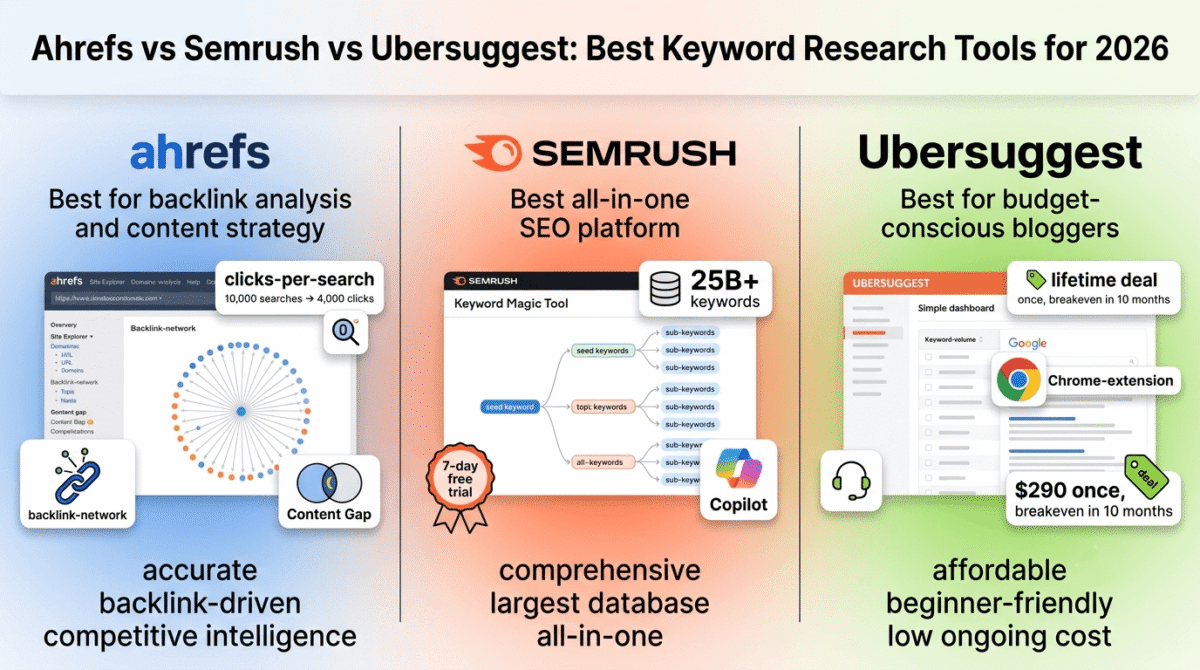
The three tools that dominate every keyword research conversation are Ahrefs, Semrush, and Ubersuggest. They appear to do the same thing. They do not. Ahrefs is built for backlink intelligence and content strategy. Semrush is built as an all-in-one marketing platform. Ubersuggest is built for bloggers and small businesses who need 80% of the functionality at 20% of the price.
I tested all three(Ahrefs vs Semrush vs Ubersuggest) on real research workflows for RateTheTool.com across 30 days, finding content opportunities, analysing competitor rankings, and building content calendars for a software review blog. Here is the honest comparison.
Table of Contents
How We Evaluated These Tools
Every tool was tested across five criteria:
- Keyword data accuracy, how well does the reported search volume, keyword difficulty, and traffic estimate match real-world performance after publishing?
- Competitor research depth, can you meaningfully understand why a competitor ranks for a keyword and what it would take to outrank them?
- Usability for bloggers, how quickly can a non-SEO-specialist blogger find actionable keyword opportunities without a steep learning curve?
- Pricing transparency, are the real monthly costs and usage limits clear before you sign up, or do hidden caps push you toward higher tiers than the entry price suggests?
- Value for money, at each pricing tier, does the productivity gain justify the monthly cost for a solo blogger or small content team?
Why Keyword Research Tools Matter Specifically for Bloggers
Keyword research is not just a technical SEO task. For bloggers and content creators, it is the foundation of every revenue decision.
Finding content that earns affiliate commissions. The most valuable affiliate content targets keywords with commercial intent, “best [tool category] 2026”, “[Tool A] vs [Tool B]”, “is [Tool] worth it?”, rather than informational intent. A keyword research tool shows you the difference: which searches come from buyers close to making a decision versus curious readers who will never purchase. Affiliate commissions are one piece of the picture, see our full guide on how to make money blogging for the broader monetisation mix keyword-targeted content feeds into.
Avoiding unwinnable battles. Without data, a blogger might spend weeks writing a comprehensive guide to best email marketing tools, only to discover after publishing that the keyword is dominated by Mailchimp, HubSpot, and Forbes with domain ratings above 80. A keyword tool shows this competitive reality before a single word is written, allowing you to find adjacent, lower-competition keywords where a new site can actually rank.
Identifying content gaps competitors are missing. Every competitor in your niche is ranking for topics you have not covered yet, and some of those topics have significant search volume and low competition. Keyword research tools reveal these gaps, turning competitor analysis from a discouraging exercise into a content opportunity map.
Building topical authority systematically. Google rewards sites that demonstrate comprehensive expertise on a focused topic. Keyword research tools show the full semantic map of a niche, all the related subtopics, questions, and variations that together constitute thorough coverage. Building a content plan from this map produces topical authority faster than publishing posts based on instinct.
Ahrefs Review: Best Keyword Research Tool for Backlink Analysis and Content Strategy
Free plan: Yes, Ahrefs Webmaster Tools (site audit and limited Site Explorer for your own domain only)
Starting paid price: $29/month (Starter, monthly only) / $129/month (Lite)
Best plan for most users: Lite, $108/month (annual billing)
Platforms: Web, Chrome and Firefox extension available
Affiliate program: Yes, Ahrefs affiliate program, 20% recurring commission
Ahrefs was built from the ground up as a backlink intelligence platform and evolved into a comprehensive SEO suite. In 2026, it holds its reputation as the most accurate backlink database in the industry, and that backlink data is what makes its keyword research uniquely powerful, because keyword difficulty in Ahrefs is calculated primarily from the backlink profiles of ranking pages, not just raw competition metrics.
What Ahrefs does best
Ahrefs Keywords Explorer is the most comprehensive keyword research interface of the three tools tested. Enter a seed keyword and the platform returns keyword ideas, related questions, search volume, keyword difficulty scores, traffic potential estimates, and the number of clicks actually happening per search (accounting for zero-click searches where Google answers the query directly). That clicks metric is one of Ahrefs’ most distinctive data points, a keyword might show 10,000 monthly searches but only 4,000 actual clicks because Google’s featured snippets answer most queries without a website visit. Knowing this before targeting a keyword changes content prioritisation meaningfully.
The Content Gap tool, available from the Lite plan upward, analyses two or more competing domains and identifies keywords they rank for that your site does not. On a software review blog, entering three competitor URLs into Content Gap immediately surfaces hundreds of tool comparison topics and category roundups that competitors are capturing traffic from. This feature alone has informed more than a dozen content decisions on RateTheTool.com.
Site Explorer is Ahrefs’ flagship tool. Enter any URL and get the full breakdown of organic traffic, ranking keywords, backlink profile, referring domains, and content performing best in that niche. Entering a competitor’s URL on a software review blog and filtering for their top-ranking posts by estimated traffic produces a prioritised list of content to create, ranked by the traffic opportunity available.
Ahrefs introduced a $29/month Starter plan in January 2026, cutting its entry price by 77% from the previous minimum. The Starter plan is deliberately limited, 1,000-row report caps, no rank tracking, no Content Explorer, and monthly-only billing, but it gives bloggers a real way to evaluate Ahrefs’ keyword data quality before committing to Lite at $108/month annually.
Where Ahrefs falls short
The 2023 pricing increase, Ahrefs raised Lite from $99/month to $129/month without adding corresponding new features, generated significant community backlash and remains a genuine sticking point. At $108/month annually, Ahrefs Lite is more expensive than Semrush Pro ($117.33/month annually) by a narrow margin but covers fewer features, no advertising research, no social media tools, no content marketing toolkit. For the pure keyword research use case, Ahrefs’ data quality justifies the price. For bloggers who want a broader marketing toolkit alongside keyword research, Semrush Pro delivers more at a comparable price. If you want to see how these platforms compare when including Moz, check out our comprehensive review of Ahrefs vs Semrush vs Moz.
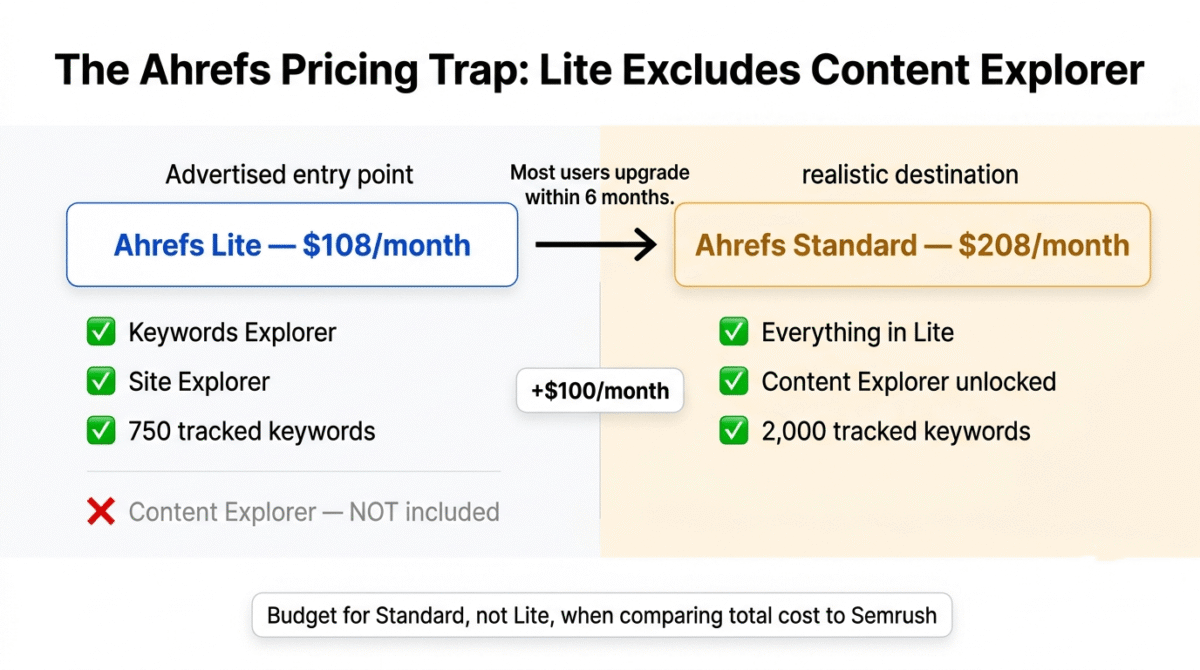
Content Explorer, Ahrefs’ billion-page content research database for finding viral content and link-building opportunities, requires the Standard plan at $208/month annually. On Lite, you access the core keyword and backlink tools without the content discovery feature that many SEO professionals consider essential. Most serious bloggers who start on Lite eventually upgrade to Standard for Content Explorer alone.
Ahrefs offers no free trial. The Starter plan at $29/month (monthly only) is the closest equivalent, a deliberately restricted evaluation tier rather than a fully featured trial. There is also no refund policy on paid plans, which makes the financial commitment more significant than for Semrush, which offers a 7-day free trial on Pro.
Ahrefs pricing
| Plan | Monthly Price | Annual Price | Key limits |
|---|---|---|---|
| Free (Webmaster Tools) | $0 | $0 | Your own domain only, limited data |
| Starter | $29/month | Monthly only, no annual option | 1,000 report rows, no rank tracking, no Content Explorer |
| Lite | $129/month | ~$108/month | 5 projects, 750 tracked keywords, full Keywords Explorer, Site Explorer |
| Standard | $249/month | ~$208/month | 20 projects, 2,000 tracked keywords, + Content Explorer |
| Advanced | $449/month | ~$374/month | 50 projects, 5,000 keywords, 5 user seats, Google Looker Studio |
| Enterprise | Custom | From ~$1,249/month | Custom limits, API access, SSO |
Pricing trap warning: Ahrefs Lite looks like the entry point but excludes Content Explorer, the feature most content strategists consider essential for finding link-building opportunities and viral content angles. Most bloggers who commit to Ahrefs find themselves upgrading to Standard at $208/month annually within six months. Budget for Standard as your likely destination, not Lite, when comparing total annual cost against Semrush alternatives. Also note: there is no refund on any Ahrefs plan, test on Starter first.
Ahrefs: Pros and Cons
Pros:
- Most accurate backlink database in the industry, the gold standard for link analysis
- Clicks metric in Keywords Explorer shows actual traffic potential, not just search volume
- Content Gap tool identifies keyword opportunities competitors rank for that you don’t
- Site Explorer gives the most comprehensive competitor traffic and ranking analysis
- $29/month Starter plan enables real evaluation before the full Lite commitment
- Ahrefs Webmaster Tools free forever for your own domain, no paid plan required
- 20% recurring affiliate commission for verified publishers
Cons:
- No free trial on paid plans, and no refund policy
- Lite plan excludes Content Explorer, most serious users end up on Standard at $208/month
- 2023 price increase (Lite: $99 → $129/month) without proportional feature additions
- No advertising research or social media tools, pure SEO focus
- Starter plan monthly-only, no annual billing option for the entry tier
- Steeper learning curve than Ubersuggest for new SEO users
- Most expensive comparison across all plans vs. Semrush and Ubersuggest
Rating: 4.6 / 5, Best keyword research tool for bloggers and content marketers who prioritise backlink intelligence, competitor analysis, and accurate traffic potential data. Budget for Standard at $208/month annually as the realistic plan for serious content strategy work.
Semrush Review: Best All-in-One SEO and Keyword Research Platform
Free plan: Yes, 10 keyword searches/day, limited reports, 1 project
Starting paid price: $117.33/month (Pro, annual billing) / $139.95/month (monthly)
Best plan for most users: Pro, $117.33/month (annual billing)
Platforms: Web, Chrome extension available
Affiliate program: Yes, Semrush affiliate program, 40% recurring lifetime commission
Semrush is the most complete digital marketing platform in this comparison, combining keyword research, backlink analysis, site auditing, rank tracking, advertising research, social media tools, and a content marketing toolkit in one subscription. For bloggers and content marketers who want a single tool that covers every dimension of SEO and content strategy, Semrush delivers more breadth than any competitor at its price point.
What Semrush does best
Semrush’s keyword database is the largest of the three tools tested, over 25 billion keywords across 142 countries, updated continuously. For a software review blog targeting global English-speaking audiences, this breadth ensures that niche long-tail keywords, “best time tracking software for remote teams UK”, “Semrush alternative for bloggers on a budget”, appear in results even when search volumes are modest. Ahrefs’ database is competitive in accuracy; Semrush’s is competitive in sheer volume of keywords indexed.
The Keyword Magic Tool is Semrush’s primary keyword research interface and one of the most intuitive in the market. Enter a seed keyword and navigate through hundreds of related suggestions grouped by subtopic clusters, questions, related terms, broad match variations, with filters for search volume, keyword difficulty, competitive density, and SERP feature presence (does this keyword trigger a featured snippet? A People Also Ask box?). For a blogger building a content calendar from scratch, this interface produces an actionable topic list faster than any competing tool.
Semrush’s 7-day free trial is the most generous evaluation offer in this comparison, full Pro access for a week without any feature restrictions. For a blogger evaluating whether to invest in a $117/month tool, seven days of unrestricted access to run competitor analyses, keyword audits, and site reports is enough to make an informed decision. Neither Ahrefs nor Ubersuggest offers an equivalent evaluation window on their paid feature sets.
The Semrush Copilot AI assistant, included free on all paid plans, reviews your projects daily and surfaces the three most important actions across keyword rankings, site health, and backlink changes. For bloggers managing a growing content library without dedicated SEO support, this daily briefing format reduces the cognitive load of monitoring across multiple dimensions simultaneously.
Semrush One, launched in 2026, bundles classic SEO toolkit features with AI visibility tracking, monitoring how your brand and content are cited in ChatGPT responses, Google AI Overviews, and Perplexity answers. Starting at $199/month, it is the only tool in this comparison with dedicated AI search visibility monitoring built into the platform.
Where Semrush falls short
The Pro plan’s project and keyword tracking limits are the most common point of frustration for growing bloggers. Pro covers 5 projects and 500 tracked keywords, adequate for a single blog starting out, but restrictive for anyone managing more than one site or tracking rankings for more than a few hundred content pieces. The jump from Pro ($117.33/month) to Guru ($208.33/month) is a $91/month increase that unlocks historical data, 1,500 tracked keywords, and the Content Marketing Toolkit. Most serious content marketers need Guru within six months of starting on Pro.
Additional user seats are not included on any plan up to Business, each additional seat is charged separately, which drives up team costs significantly compared to Taskade or tools with flat team pricing. A two-person content team on Semrush Pro needs to budget for two subscriptions, not one.
The interface is the most complex of the three tools, over 55 tools available across SEO, advertising, social, and content functions. For a blogger whose only need is keyword research and basic competitor analysis, navigating this interface is initially overwhelming. Ubersuggest’s more focused interface delivers the core workflow faster for new users.
Semrush pricing
| Plan | Monthly Price | Annual Price | Key limits |
|---|---|---|---|
| Free | $0 | $0 | 10 searches/day, 1 project, limited reports |
| Pro | $139.95/month | $117.33/month | 5 projects, 500 tracked keywords, 10,000 results/report |
| Guru | $249.95/month | $208.33/month | 15 projects, 1,500 keywords, historical data, Content Toolkit |
| Business | $499.95/month | $416.66/month | 40 projects, 5,000 keywords, API access, white-label |
| Semrush One | From $199/month | Available | Classic SEO + AI visibility tracking (ChatGPT, AI Overviews, Perplexity) |
Pricing trap warning: The Pro plan’s 500 keyword tracking limit and 5-project cap are hit faster than most new subscribers expect, a single blog actively tracking ranking progress for 2–3 months of published content can fill 500 keyword slots quickly. Budget for the Guru plan at $208.33/month (annual) as the realistic long-term tier for a growing blog. The jump from Pro to Guru is one of the steepest price increases relative to feature additions in the category.
Semrush: Pros and Cons
Pros:
- Largest keyword database in the comparison, 25 billion+ keywords, 142 countries
- Best free trial, 7 days of full Pro access, no feature restrictions
- Keyword Magic Tool is the most intuitive keyword research interface of the three tools
- Most complete platform, SEO, PPC, social, content marketing in one subscription
- Semrush Copilot AI daily briefing reduces monitoring overhead for solo bloggers
- Semrush One adds AI visibility tracking (ChatGPT, AI Overviews, Perplexity citations)
- 40% recurring lifetime affiliate commission, highest affiliate payout in this comparison
- Free plan genuinely usable for occasional keyword spot-checks (10 searches/day)
Cons:
- Pro plan limits (500 keywords, 5 projects) push most serious bloggers to Guru at $208.33/month
- Additional user seats charged separately, expensive for multi-person content teams
- Most complex interface of the three tools, steeper learning curve than Ubersuggest
- Guru plan Content Marketing Toolkit behind a $90/month upgrade from Pro
- Pro-to-Guru price jump is the steepest relative value gap in the comparison
- Semrush One AI visibility feature starts at $199/month, not included in standard plans
Rating: 4.5 / 5, Best keyword research and SEO platform for bloggers who want a complete marketing toolkit in one subscription. The 7-day free trial is the most generous in the category, start there before committing. Budget for Guru ($208.33/month annual) as the realistic long-term plan once your blog is publishing consistently.
Ubersuggest Review: Best Keyword Research Tool for Bloggers on a Budget
Free plan: Yes, 3 keyword searches/day, limited suggestions
Starting paid price: $29/month (Individual) / $290 lifetime (one-time payment)
Best plan for most users: Individual, $29/month or $290 lifetime
Platforms: Web, Chrome extension
Affiliate program: Yes, Ubersuggest affiliate program
Ubersuggest was created by Neil Patel and has evolved from a basic keyword suggestion tool into a genuinely capable SEO platform for bloggers, small business owners, and solo content creators. Its defining characteristic in 2026 is not a feature, it is a price. At $29/month for the Individual plan, Ubersuggest costs less than a quarter of Ahrefs Lite and a fifth of Semrush Pro. And the lifetime deal, a one-time payment of $290 for the Individual tier, eliminates the monthly subscription entirely, paying back in under ten months.
What Ubersuggest does best
For a blogger who needs keyword research, basic competitor analysis, site audits, rank tracking, and backlink monitoring at the lowest possible monthly cost, Ubersuggest covers all five competently. The keyword research interface is the cleanest and most beginner-friendly of the three tools tested, enter a keyword, see search volume, SEO difficulty, paid difficulty, CPC estimate, and a list of keyword ideas with comparable metrics. No configuration required, no learning curve beyond the interface itself.
The Chrome extension is one of the most practical features for content creators doing quick research during normal browsing. Search any keyword on Google and the extension overlays Ubersuggest data, volume, difficulty, and CPC, directly on the search results page alongside the organic results. This browser-native workflow removes the step of opening a separate tool tab for every keyword check, which compounds into real time savings during active research sessions.
The lifetime deal is Ubersuggest’s most unusual and most discussed commercial feature. Neil Patel’s broader NP Digital agency, estimated at $100+ million in annual agency revenue, subsidises the platform’s development, which allows Ubersuggest to offer a one-time payment structure that virtually every other SEO tool abandoned years ago. The Individual lifetime plan at $290 pays back the monthly subscription equivalent in under ten months. After the ten-month breakeven, every subsequent month of use is free compared to the subscriber. Over five years, the lifetime deal saves over $1,400 compared to paying the monthly Individual rate.
The biweekly Neil Patel coaching calls, included with all paid Ubersuggest plans, are a genuinely unusual value-add. Group Q&A sessions on SEO strategy, content marketing, and traffic growth hosted by one of the most widely followed digital marketers in the industry, available on a $29/month plan. No equivalent feature exists in Ahrefs or Semrush at any plan tier.
Where Ubersuggest falls short
Data accuracy and depth are where Ubersuggest shows its budget positioning most clearly. Keyword difficulty scores in Ubersuggest are less nuanced than Ahrefs’ link-based difficulty model, Ahrefs scores difficulty based primarily on the backlink profiles of ranking pages, which is a more accurate predictor of ranking effort required. Ubersuggest’s difficulty scores are algorithmically simpler and can lead new bloggers to underestimate competition on keywords that look approachable in the data but are defended by well-linked content in practice.
The keyword database is smaller than both Ahrefs and Semrush. Very specific long-tail keywords, niche software comparisons, regional variations, newly trending tool names, frequently return limited or no data in Ubersuggest while appearing clearly in Ahrefs and Semrush. For a software review blog targeting precise long-tail comparison keywords, this database gap is a recurring practical limitation.
The backlink data, while functional, is less comprehensive than Ahrefs’ industry-leading backlink index. For serious link building campaigns, identifying referring domains, analysing competitor link acquisition strategies, finding broken link building opportunities, Ahrefs or Semrush provide significantly more actionable data.
No API access is available on any Ubersuggest plan in 2026, which limits its use for teams building custom reporting, integrating SEO data into dashboards, or automating rank tracking workflows.
Ubersuggest pricing
| Plan | Monthly Price | Lifetime Price | Sites | Key features |
|---|---|---|---|---|
| Free | $0 | — | 1 | 3 keyword searches/day, limited data |
| Individual | $29/month | $290 one-time | 1 | Keyword research, site audit, rank tracking, backlinks, Chrome extension, coaching calls |
| Business | $49/month | $490 one-time | 7 | All Individual + 7 sites, priority support |
| Enterprise/Agency | $99/month | $990 one-time | 15 | All Business + 15 sites, white-label |
Pricing note: The lifetime deal is the single most unusual commercial feature in this comparison and deserves direct attention. At $290 for Individual, the lifetime deal breaks even against the monthly plan in under 10 months, after which every subsequent month is free. If you are comfortable with that risk and plan to use Ubersuggest for two or more years, the lifetime deal is straightforwardly the most cost-efficient option in this comparison.
Ubersuggest: Pros and Cons
Pros:
- Lowest monthly cost of the three tools, $29/month Individual plan
- Lifetime deal at $290 pays back in under 10 months, eliminates ongoing subscription cost
- Cleanest, most beginner-friendly interface, minimal learning curve
- Chrome extension overlays keyword data directly on Google search results
- Biweekly Neil Patel coaching calls included on all paid plans
- Site audit, rank tracking, and backlink monitoring included on the entry plan
- 7-day free trial on monthly plans before committing
Cons:
- Smaller keyword database than Ahrefs and Semrush, long-tail gaps are common
- Keyword difficulty scores less accurate than Ahrefs’ link-based difficulty model
- Backlink data less comprehensive, not suitable as a primary link building research tool
- No API access on any plan
- Fewer advanced features for agencies and teams managing multiple client sites
- Data depth inadequate for competitive niches requiring deep competitor link analysis
- Lifetime deal risk: platform continuity dependent on NP Digital’s commercial decisions
Rating: 4.2 / 5, Best keyword research tool for bloggers and content creators on a budget who need core SEO data without a premium subscription. The lifetime deal at $290 is the most cost-efficient option in the market for long-term individual use. Not suitable as the primary tool for competitive niches requiring deep backlink intelligence.
Head-to-Head Comparison
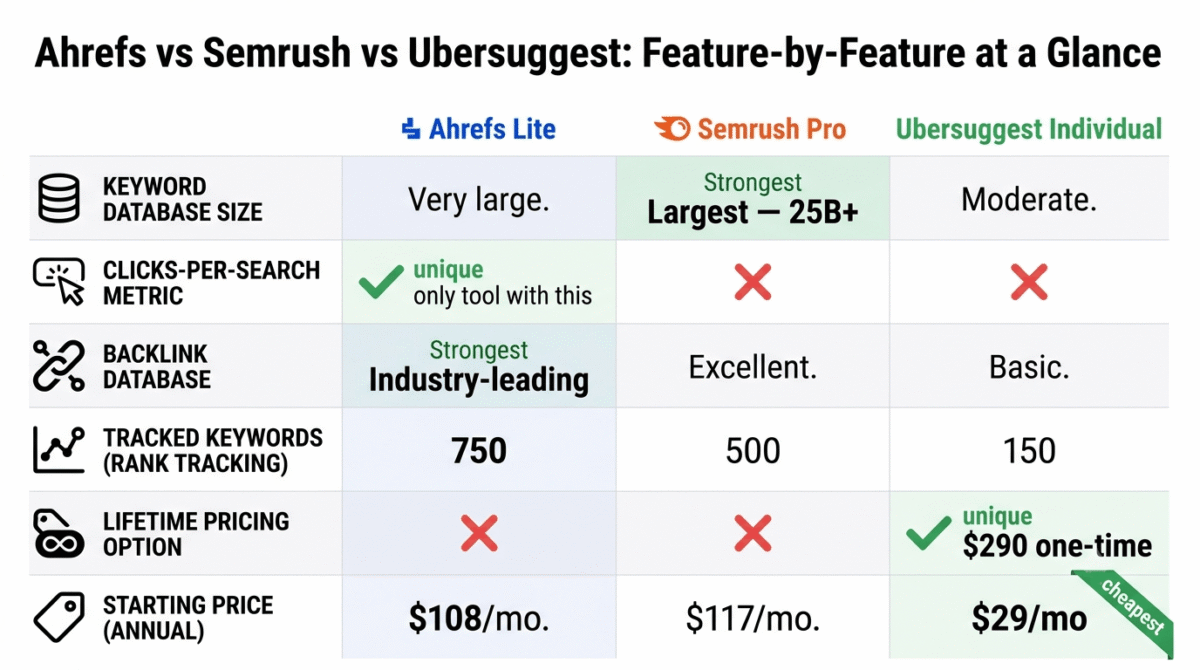
| Feature | Ahrefs Lite | Semrush Pro | Ubersuggest Individual |
|---|---|---|---|
| Annual price | ~$108/month | ~$117.33/month | $29/month (or $290 lifetime) |
| Free plan | Webmaster Tools (own domain only) | 10 keyword searches/day | 3 keyword searches/day |
| Free trial | No (Starter at $29/month monthly) | 7 days full Pro access | 7 days on monthly plans |
| Keyword database size | Very large | Largest (25B+ keywords) | Moderate |
| Keyword difficulty accuracy | Excellent (link-based model) | Very good | Good (simpler model) |
| Clicks-per-search metric | Yes | No | No |
| Backlink database | Industry-leading | Excellent | Basic |
| Content Gap / competitor keyword gap | Yes (Lite and above) | Yes (all paid plans) | Limited |
| Rank tracking (tracked keywords) | 750 (Lite) | 500 (Pro) | 150 (Individual) |
| Site audit | Yes | Yes | Yes |
| Content marketing toolkit | Not on Lite (Standard+) | Not on Pro (Guru+) | Basic |
| Advertising/PPC research | Limited | Yes (Pro+) | Basic |
| Chrome extension | Yes | Yes | Yes |
| Lifetime deal | No | No | Yes ($290 Individual) |
| Refund policy | No refunds | 7-day trial (no refund after) | 30-day refund on annual |
| Affiliate commission | 20% recurring | 40% recurring lifetime | Standard |
| Best for | Backlink analysis, content strategy | All-in-one marketing platform | Budget bloggers, beginners |
Which Keyword Research Tool Should You Choose?
Choose Ahrefs Lite if:
Your primary research need is competitor analysis and content strategy, understanding why competing pages rank, identifying content gap opportunities, and building a link acquisition strategy based on accurate backlink intelligence. The $29/month Starter plan lets you evaluate the keyword data quality before committing to Lite. Note the absence of Content Explorer on Lite and budget for Standard if that feature becomes essential, it typically does within six months.
Choose Semrush Pro if:
You want the broadest keyword database, the most intuitive keyword research interface, and the flexibility to expand into advertising research, social media tools, and content marketing without switching platforms. The 7-day free trial is the correct first step, run a full competitor analysis on your niche and a keyword audit for your existing content before committing. Budget for Guru ($208.33/month annual) as the realistic long-term plan once your blog publishes content consistently and rank tracking needs exceed 500 keywords.
Choose Ubersuggest Individual if:
You are a solo blogger or content creator who needs reliable keyword data, site auditing, rank tracking, and backlink monitoring at the lowest possible ongoing cost. The lifetime deal at $290 is the strongest financial case in this comparison for any individual who plans to use the tool for more than ten months, after breakeven, you pay nothing while Ahrefs and Semrush subscribers pay $108–$117 every month. Start with the 7-day free trial to verify the data depth covers your niche before purchasing the lifetime plan.
Use the free tiers first regardless of which tool you choose. Ahrefs Webmaster Tools (free forever, your own domain), Semrush’s 10 daily keyword searches, and Ubersuggest’s 3 daily searches all provide data without cost. For a blog in its first month with minimal existing content, these free tiers are sufficient for initial keyword planning before committing to any subscription.
Setting Up Your Keyword Research Workflow, The Practical Guide
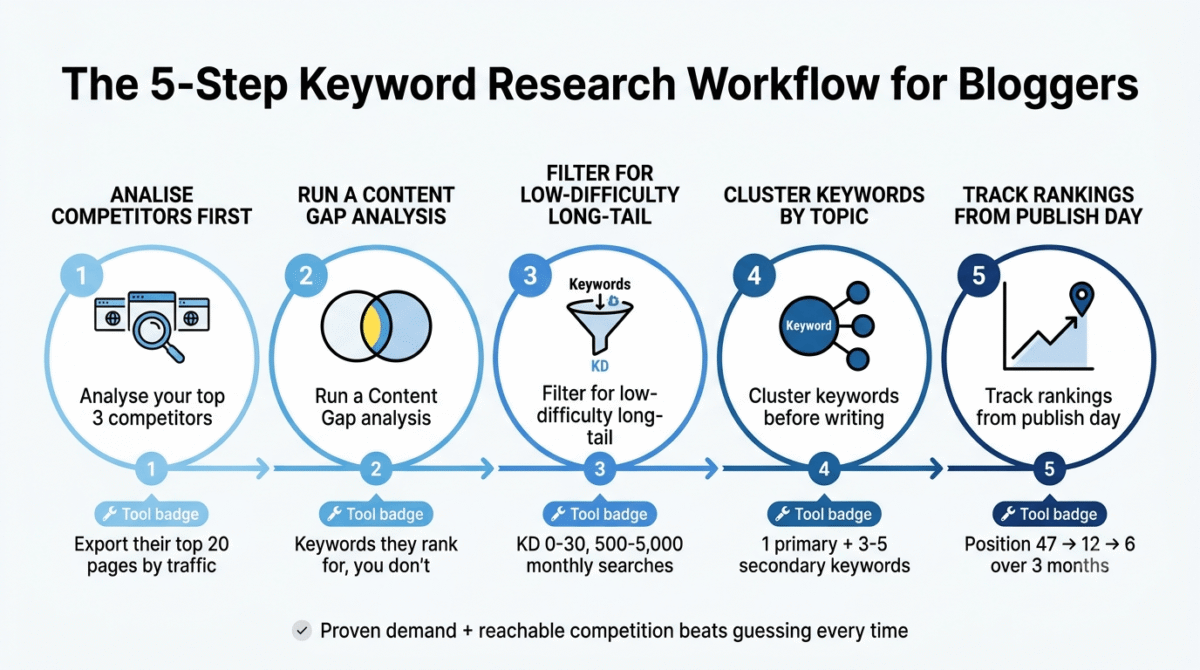
For bloggers building their first keyword research process, here is the workflow that produces the most actionable results fastest:
Step 1, Analyse your top three competitors first. Before searching for keywords from scratch, enter your three closest competitors into Site Explorer (Ahrefs) or Domain Overview (Semrush) and export their top 20 organic pages by estimated traffic. This list is your initial content priority queue, topics already proven to drive organic traffic in your niche.
Step 2, Run a Content Gap analysis. Enter your domain and two to three competitor domains into Ahrefs Content Gap or Semrush Keyword Gap. Filter results for keywords where competitors rank in positions 1–10 but your site does not rank at all. These are the highest-priority content opportunities because demand is proven and the competition profile is already understood.
Step 3, Filter for long-tail keywords with low difficulty. For a new blog with limited domain authority, target keywords with difficulty scores below 30 in Ahrefs (KD 0–30) or below 40% in Semrush, with monthly search volumes between 500 and 5,000. These long-tail keywords are where new sites can rank within three to six months, before your domain authority has built enough to compete for head terms.
Step 4, Cluster keywords by topic before writing. A single post should target one primary keyword and three to five related secondary keywords that share the same search intent. Rank Math SEO (free WordPress plugin) makes implementing this cluster structure straightforward, enter your primary keyword, secondary keywords, and the plugin scores your content against all targets simultaneously. Once you have your keyword clusters, an AI SEO writing tool helps you use keywords in your blog posts more systematically as you draft, see our Jasper vs Surfer SEO vs MarketMuse comparison for options built around this exact workflow.
Step 5, Track your rankings from publication week. Add every post’s primary keyword to rank tracking in your tool of choice immediately after publishing. Watching a keyword move from “not ranking” to position 47 to position 12 to position 6 over three months shows the compounding effect of SEO clearly, and identifies which posts need additional work (additional internal links, updated content, new backlinks) to break into the top three.
Final Verdict
Ahrefs is the best keyword research tool for serious content strategists and established blogs, the backlink intelligence, Content Gap tool, and clicks-per-search metric justify the premium for bloggers who need competitive accuracy in their keyword decisions. Budget Standard at $208/month annually as the realistic plan; Lite is a stepping stone.
Semrush is the best all-in-one keyword research platform for bloggers who want everything in one subscription, the largest keyword database, best free trial, and widest marketing toolkit make it the most complete option. The 40% recurring affiliate commission is also the strongest in this comparison for bloggers who recommend tools to their audience.
Ubersuggest is the best keyword research tool for budget-conscious bloggers, the $29/month Individual plan covers the core SEO workflow, the lifetime deal at $290 eliminates ongoing subscription cost after ten months, and the coaching calls add genuine educational value at no extra cost. Not suitable for advanced competitive analysis, but sufficient for most solo blogging workflows.
Ratings:
- Ahrefs: 4.6 / 5
- Semrush: 4.5 / 5
- Ubersuggest: 4.2 / 5
Frequently Asked Questions
What is the best free keyword research tool in 2026?
For bloggers with a WordPress site, Ahrefs Webmaster Tools is the best permanently free option, it provides full Site Explorer data for your own domain including organic keywords, backlinks, and technical SEO issues, at zero cost with no time limit. Google Search Console (also free) shows which keywords your site already ranks for and gets clicked. Semrush’s free plan allows 10 keyword searches per day. Ubersuggest allows 3 searches per day. For occasional research, these free tools together cover most basic needs before a paid subscription is warranted.
Is Ahrefs or Semrush better for keyword research in 2026?
Ahrefs is better for keyword research accuracy and backlink-based difficulty scoring, its clicks-per-search metric and link-based keyword difficulty model produce more reliable estimates of ranking effort required. Semrush has a larger raw keyword database and the more intuitive Keyword Magic Tool interface for rapid keyword discovery. For a blogger who needs to choose one: Semrush’s 7-day free trial lets you test the full keyword research workflow risk-free, which Ahrefs does not offer.u003cbru003e
Is Ubersuggest good enough for serious bloggers in 2026?
For bloggers targeting low-to-medium competition keywords in most niches, yes, Ubersuggest’s data is sufficient to build and execute an effective keyword strategy. The limitation appears in highly competitive niches, deep competitor link analysis, and very specific long-tail keyword research where Ubersuggest’s smaller database has gaps. A serious blogger who discovers these gaps consistently should treat Ubersuggest as a starting point and budget for Ahrefs or Semrush as their content library grows.
What is the Ubersuggest lifetime deal and is it worth it?
The Ubersuggest lifetime deal is a one-time payment, $290 for Individual, $490 for Business, $990 for Enterprise, that provides permanent access to the respective plan’s features with no recurring charges. At $290, the Individual lifetime deal breaks even against the $29/month subscription in 10 months. After that, you pay nothing while monthly subscribers pay $29 every month. It is financially worth it for any individual who will use the tool for more than a year. The risk is platform continuity, NP Digital subsidises Ubersuggest, but no company guarantees permanent operation.
Can I use Ubersuggest instead of Ahrefs or Semrush?
For most individual bloggers building content in low-to-medium competition niches, yes, Ubersuggest covers keyword research, site auditing, rank tracking, and basic backlink monitoring at a fraction of the cost. For bloggers in competitive niches (finance, health, major tech categories) where understanding backlink profiles of ranking pages is essential to content strategy, Ahrefs or Semrush provide data depth that Ubersuggest cannot match. Many bloggers start on Ubersuggest and migrate to Ahrefs or Semrush once their site reaches 20,000+ monthly visitors and competitive keyword research becomes a regular workflow need.u003cbru003e
How many keyword research tools do I need?
One paid tool is sufficient for most individual bloggers. Pair it with free tools, Google Search Console for your own ranking data, Google Keyword Planner for basic volume estimates, and Ahrefs Webmaster Tools for your own domain, and you have a complete research stack. Using three paid tools simultaneously produces diminishing returns and unnecessary expense. Start with one tool, master its workflow, and upgrade only when a specific data gap consistently limits your content decisions.
What keyword difficulty should I target as a new blogger?
For a new blog with domain rating (DR) below 20, target keywords with Ahrefs difficulty scores of 0–20 and search volumes of 300–3,000 per month. At DR 20–40, keyword difficulty up to 30–35 becomes viable. Above DR 40, keywords up to difficulty 50 become realistic targets with strong content. In Semrush, the equivalent targets are keyword difficulty percentages below 40% for new sites and below 55% for established sites. Ubersuggest difficulty scores run on a 0–100 scale, below 30 is low competition, 30–50 is medium, above 50 is high.u003cbru003e
Does keyword research still matter with AI search in 2026?
Yes, and in some ways more than before. Google’s AI Overviews, ChatGPT web search, and Perplexity are all driven by underlying semantic search intent that keyword research reveals. The specific search terms people use to find information have not disappeared, they have evolved, with more conversational and question-based queries gaining volume. Keyword research tools that track People Also Ask data, featured snippet opportunities, and question-based keyword variations are more relevant than ever. Semrush One’s AI visibility tracking, monitoring citations in AI search results, represents the next evolution of keyword research as AI-mediated search grows.