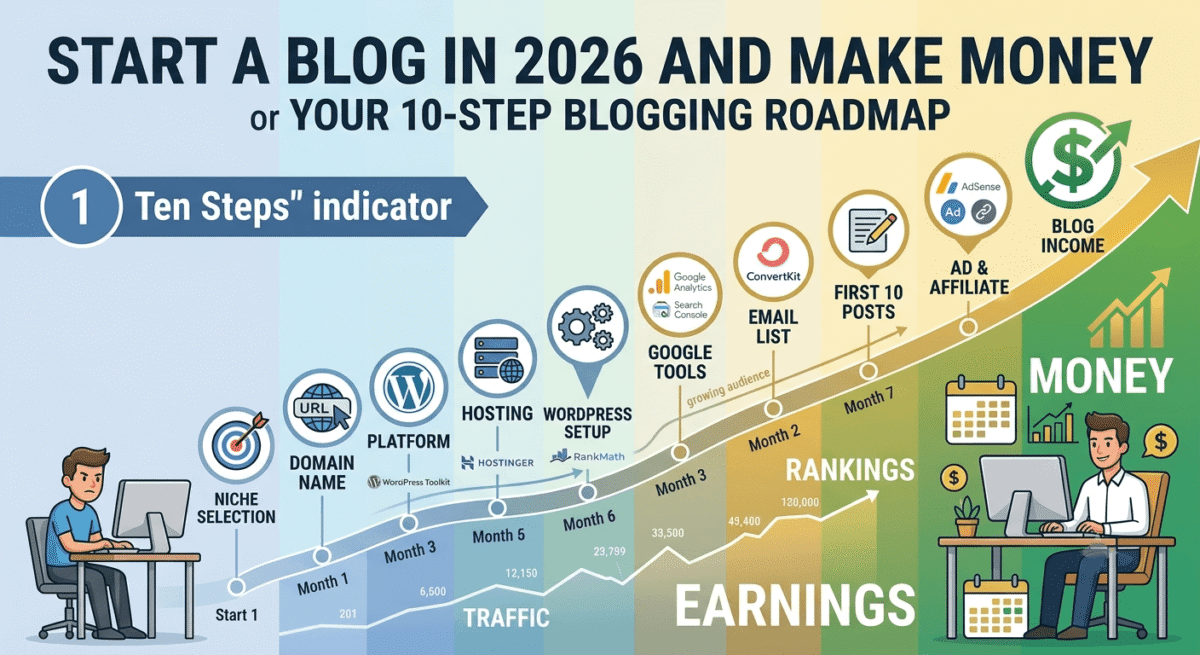
Blogging can generate real, significant income, but not the way most people imagine it. If you haven’t launched your site yet, read our comprehensive guide on how to start a blog in 2026 and make money. The fantasy version: write a few posts, wait for AdSense cheques to roll in, earn passive income forever. The reality: blogging income is earned through consistent work over 6–18 months before meaningful money arrives, and the bloggers who earn the most diversify across multiple income streams rather than depending on any single source.
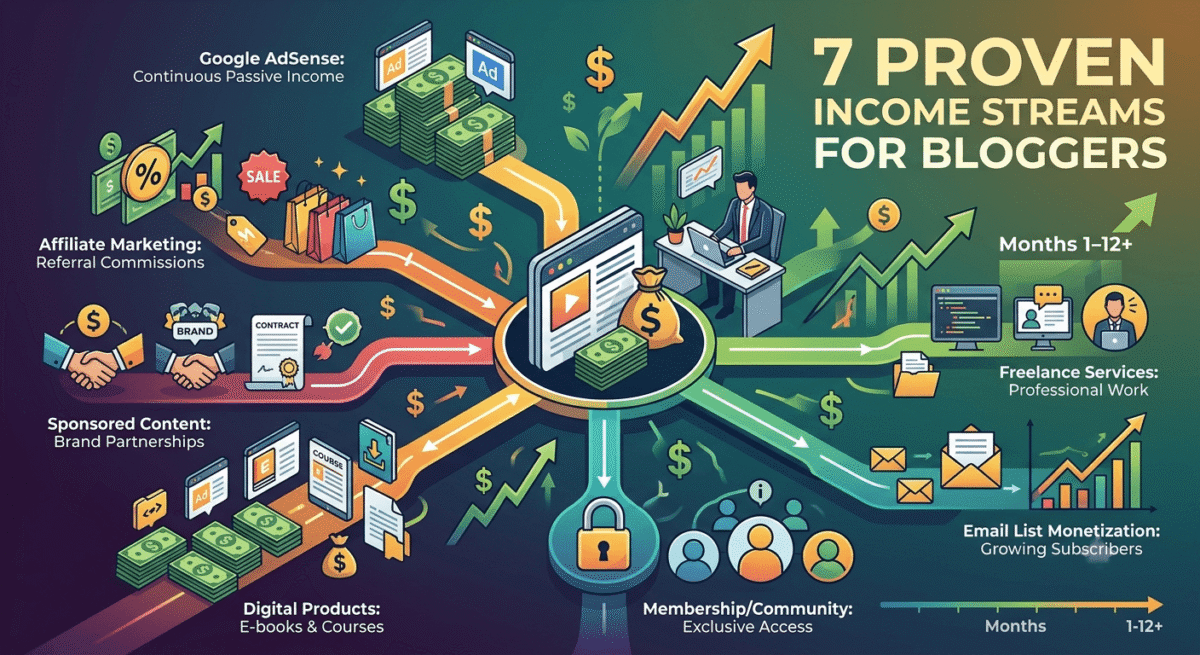
This guide covers How to Make Money Blogging and Best 7 Proven Income Streams that professional bloggers actually use in 2026, with realistic earning potential, what is required to activate each one, and how they work together to build income that compounds month over month.
Table of Contents
The Truth About Blogging Income in 2026
Before diving into income streams, three facts that most blogging income guides omit:
Fact 1: Most blogging income is not passive. The “write once, earn forever” model exists, but only after months or years of active work building traffic, authority, and an audience. Early blogging is active work that gradually becomes more passive as content ages and ranks.
Fact 2: Traffic is the foundation of everything. Every income stream covered in this guide scales with traffic. More monthly visitors = more AdSense impressions = more affiliate clicks = more email subscribers = more potential product buyers. Building traffic through SEO and consistent content creation is the prerequisite for all income streams.
Fact 3: The income compounds. A blog earning $500/month in month 6 from three income streams typically earns $2,000/month by month 12 from the same three streams as traffic grows, without proportionally more work. This compounding is what makes blogging worth the early investment.
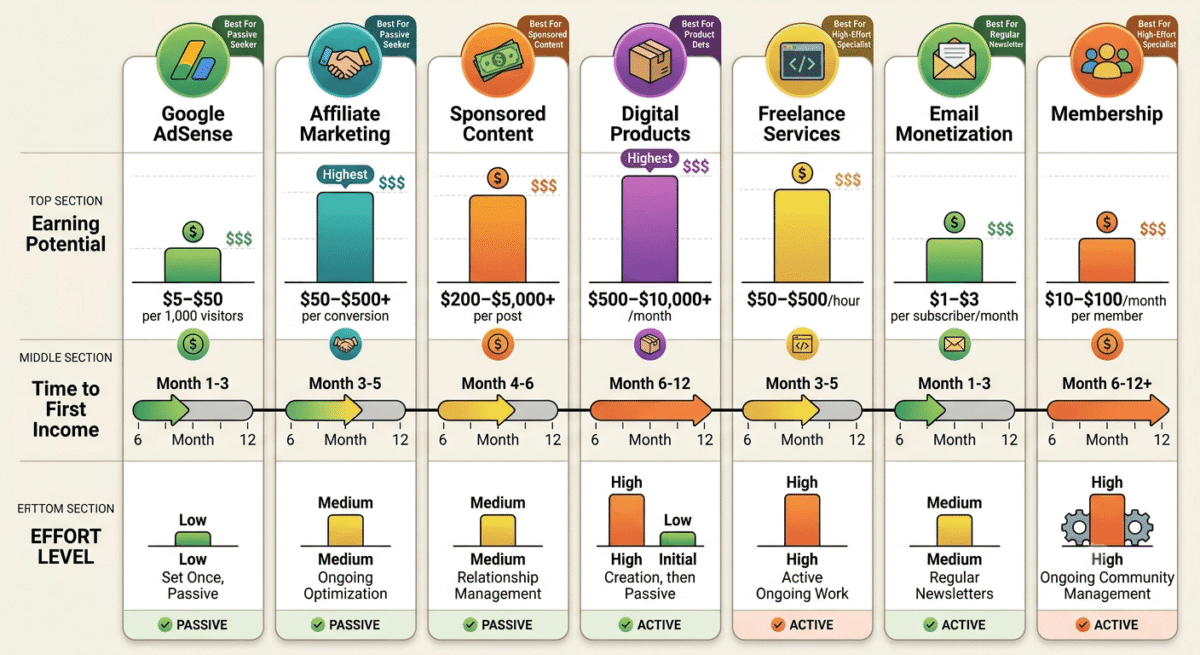
Income Stream 1: Google AdSense (and Premium Ad Networks)
Earning potential: $5–$50 per 1,000 visitors (RPM)
Time to first income: Month 3–5 (after AdSense approval)
Effort level: Low (set up once, earns automatically)
Best for: Any blog with consistent traffic, especially informational content
How It Works
Google AdSense places contextually relevant ads on your blog. Every time a visitor views or clicks an ad, you earn money. The amount earned per 1,000 visitors, called RPM (Revenue Per Mille), varies significantly by niche, audience geography, and time of year.
RPM by niche (approximate 2026 averages):
Niche | Average RPM |
Software/SaaS reviews | $15–$40 |
Business/Finance | $20–$50 |
Cybersecurity | $15–$35 |
Health/Wellness | $10–$30 |
Travel | $8–$20 |
Food/Recipes | $5–$15 |
General lifestyle | $3–$10 |
Software reviews earn the highest RPM because advertisers in the software industry bid aggressively for audiences actively evaluating purchasing decisions.
Income Calculation
At 10,000 monthly visitors with a $20 RPM: 10,000 ÷ 1,000 × $20 = $200/month
At 50,000 monthly visitors with a $25 RPM: 50,000 ÷ 1,000 × $25 = $1,250/month
At 100,000 monthly visitors with a $30 RPM: 100,000 ÷ 1,000 × $30 = $3,000/month
How to Apply for AdSense
Requirements before applying:
- At least 15–20 quality posts published
- Posts published consistently over 3–4 weeks (not all on the same day)
- About page, Privacy Policy, and Contact page live
- Site loads on HTTPS (SSL active)
- No content that violates AdSense policies
Apply at adsense.google.com using your Gmail account. Add the AdSense code via the Insert Headers and Footers plugin. Approval typically takes 1–14 days.
The AdSense Upgrade Path
Once you reach 50,000 sessions/month, apply to Mediavine, a premium ad network that earns 3–5x the RPM of AdSense for equivalent traffic. The same 50,000-session blog earning $750/month on AdSense might earn $2,500–$3,750/month on Mediavine. This upgrade is one of the highest-impact income improvements available to growing blogs.
Income Stream 2: Affiliate Marketing
Earning potential: $50–$500+ per conversion
Time to first income: Month 4–6 (after first rankings and traffic)
Effort level: Medium (requires content optimisation and link placement)
Best for: Review, comparison, and recommendation content
How It Works
Affiliate marketing pays you a commission when a reader clicks your unique affiliate link and purchases a product. Unlike AdSense where you earn fractions of a dollar per impression, affiliate marketing pays $50–$500 per conversion, making it the highest-potential income stream for software review blogs.
The Affiliate Income Mathematics
At 10,000 monthly visitors:
- 5% click an affiliate link = 500 clicks
- 2% of clicks convert to purchases = 10 purchases
- Average commission $75 = $750/month from affiliates
Combined with $200 AdSense = $950/month at 10,000 visitors
This is why affiliate marketing is typically the primary income source for software review bloggers, the per-conversion value is dramatically higher than AdSense.
Best Affiliate Programs for Software Review Bloggers
Recurring commissions (earn monthly as long as reader stays subscribed):
Program | Commission | Cookie | Monthly earning example |
Semrush | 40% lifetime | 120 days | 10 signups × $56/mo = $560/mo recurring |
NordVPN | 30% renewals | 30 days | 20 signups × $4/mo = $80/mo recurring |
ConvertKit | 30% (24mo) | 60 days | 10 signups × $7.50/mo = $75/mo recurring |
Jasper AI | 25% lifetime | 60 days | 10 signups × $10/mo = $100/mo recurring |
High one-time commissions:
Program | Commission | Cookie |
HubSpot | Up to $500 | 90 days |
Hostinger | Up to $150 | 30 days |
Shopify | $150 | 30 days |
Gusto HR | Up to $500 | 90 days |
Bitdefender | Up to $70 | 30 days |
Affiliate Marketing Best Practices
Place links where they convert: Links in comparison tables, verdict sections, and “Which Should You Choose” sections convert at higher rates than links in introductory paragraphs. The reader who has read your entire comparison and reached the verdict section is the most purchase-ready, this is where your strongest affiliate call-to-action should appear.
Use honest recommendations: Recommending a product you genuinely believe is the best option for the reader converts at higher rates than pushing the highest-commission option. Readers trust honest reviewers, and that trust translates directly into affiliate revenue.
Cloak your links: Use ThirstyAffiliates to create clean branded links (yourdomain.com/go/nordvpn) rather than ugly affiliate URLs. This improves click-through rates, allows you to update links without editing every post, and provides click tracking.
Disclose always: FTC requires disclosure of affiliate relationships on every page containing affiliate links. “This post contains affiliate links” at the top of every review post, mandatory, not optional.
Income Stream 3: Sponsored Content and Brand Partnerships
Earning potential: $200–$5,000+ per sponsored post
Time to first income: Month 6–12 (requires established traffic and audience)
Effort level: Medium (negotiation, content creation, relationship management)
Best for: Established blogs with engaged audiences
How It Works
Brands pay bloggers to write posts featuring their product or service. Unlike affiliate marketing (where you earn only when readers purchase), sponsored content pays a flat fee regardless of conversions, making it predictable income.
Sponsorship rates for software review blogs in 2026:
Monthly Traffic | Typical Sponsored Post Rate |
5,000–10,000 | $100–$300 per post |
10,000–50,000 | $300–$1,000 per post |
50,000–100,000 | $1,000–$3,000 per post |
100,000+ | $3,000–$10,000+ per post |
How to Get Sponsored
Inbound approach (wait for brands to find you): Once your blog has 10,000+ monthly visitors and ranks for relevant keywords, software companies whose products you have reviewed may contact you directly for partnership opportunities. This becomes more common as your domain authority grows.
Outbound approach (pitch brands directly): Create a media kit, a PDF document showing your monthly traffic, audience demographics, email subscriber count, and social media following. Reach out directly to the marketing teams of software products you have reviewed positively, proposing a sponsored post arrangement.
Sponsored content disclosure: FTC requires prominent disclosure that a post is sponsored. “This post is sponsored by [Brand]” or “This is a paid partnership with [Brand]” must appear clearly at the top of any sponsored content.
Editorial Independence in Sponsored Content
The bloggers who earn the most from sponsorships are those who maintain editorial credibility, they only sponsor products they genuinely recommend, include honest assessments alongside sponsored promotion, and turn down sponsorships for products they do not believe in.
Readers who trust your editorial judgment will read sponsored posts with the same trust they bring to your organic reviews. Readers who feel manipulated by purely promotional sponsored content stop trusting everything you write. Protect your editorial reputation, it is the foundation of all your income streams.
Income Stream 4: Digital Products
Earning potential: $500–$10,000+ per month (scales with audience size)
Time to first income: Month 6–12 (requires email list and established content)
Effort level: High (upfront creation), then Low (evergreen sales)
Best for: Bloggers with established email lists and expertise
How It Works
You create a digital product, an ebook, online course, template pack, or digital tool, and sell it directly to your audience. Unlike affiliate marketing (where the vendor takes the majority of the revenue), digital products let you keep 95%+ of the sale price.
The compounding effect is significant: a $97 ebook bought by 100 people per month generates $9,700/month in revenue that costs nothing additional to deliver, no physical inventory, no shipping, no per-unit cost.
Digital Product Ideas for Software Review Bloggers
Ebook ($27–$97):
- “The Complete Software Toolkit for Freelancers: 50 Tools Tested and Ranked”
- “Free vs Paid: Which Software Subscriptions Are Actually Worth the Money”
- “The Blogger’s Tech Stack: Every Tool I Use to Run a $5,000/Month Blog”
Email course ($47–$197):
- “7 Days to Your First Blog Income: Setting Up AdSense and Affiliate Marketing”
- “The WordPress Setup Masterclass: Launch a Professional Blog in a Weekend”
Templates and resources ($17–$47):
- “Blog Post Template Pack: 10 Proven Structures for High-Ranking Review Posts”
- “The Affiliate Marketing Tracking Spreadsheet”, a ready-made spreadsheet for managing 30+ affiliate programs
Premium guides ($97–$297):
- “The Complete Guide to Building a Software Review Blog That Earns $5,000/Month”
Selling Digital Products
Teachable and Thinkific (reviewed in our online course platforms post) handle the technical side of digital product delivery, payment processing, file delivery, and student management, for course-format products.
Gumroad or Lemon Squeezy work well for ebook and simple file delivery, simpler setup than a full course platform for straightforward digital downloads.
WooCommerce (on your existing WordPress site) enables direct digital product sales without any additional platform, keeping all revenue and customer data on your own infrastructure.
Income Stream 5: Freelance Services
Earning potential: $50–$500/hour depending on service
Time to first income: Immediate (can start before significant blog traffic)
Effort level: High (active service delivery, not passive)
Best for: Bloggers with valuable expertise to offer
How It Works
Your blog establishes your credibility in a niche, and that credibility converts directly into freelance consulting and service opportunities from readers who want your expertise applied to their specific situation.
For a WordPress developer who writes a software review blog, the service opportunities include:
WordPress development services: Readers who follow your blog for software recommendations may need a WordPress site built. Your blog demonstrates your expertise, serving as a portfolio that attracts clients without cold outreach.
Blog setup consulting: New bloggers who read your “How to Start a Blog” guide often want someone to implement the setup for them. Offering a “done-for-you blog launch” service at $500–$1,500 per engagement attracts readers who want the result without the process.
Software consultation: Small businesses who read your software comparisons may hire you to evaluate and implement the right software stack for their specific business, at $150–$300/hour consulting rates.
Content strategy: Businesses who need a content strategy for their own blog hire experienced bloggers as consultants, your demonstrated ranking success is proof of capability.
Positioning Freelance Services on Your Blog
Add a “Work With Me” page listing your services, pricing (or “pricing starts at”), and a contact form or Calendly link for booking calls. Link to this page from your About page and sidebar. Mention it occasionally in email newsletters.
Freelance services are the fastest path to income before your blog has significant traffic, but the least scalable long-term. Transition freelance clients to lower-touch engagements (consulting calls rather than full implementation) as your passive income grows.
Income Stream 6: Email List Monetization
Earning potential: $1–$3 per subscriber per month (industry average)
Time to first income: Month 4–8 (requires list building first)
Effort level: Medium (regular newsletters and occasional promotions)
Best for: Any blogger, the email list amplifies every other income stream
How It Works
Your email list is the most direct channel to your audience, and a properly monetized email list generates income across multiple methods:
Affiliate promotions via email: Send a newsletter featuring your top affiliate recommendation of the month. An email list of 5,000 subscribers with a 25% open rate = 1,250 readers seeing your recommendation. At 5% click rate = 62 clicks. At 3% conversion = 1.86 sales × $75 average commission = $140 per email send.
Digital product launches: When you launch an ebook or course, your email list is the primary sales channel. A launch email sequence to 5,000 subscribers targeting 1% conversion at $97 product price = $4,850 from a single launch.
Sponsored newsletters: Brands pay to be featured in your newsletter, typically $30–$100 per 1,000 subscribers (CPM model). A list of 10,000 subscribers might command $300–$1,000 per sponsored newsletter mention.
Building Your Email List
The fastest email list growth comes from:
- Content upgrades, a specific free resource related to each post (a checklist from a how-to guide, a template from a tutorial)
- Lead magnets, a valuable free resource available to anyone who subscribes (an ebook, a toolkit PDF)
- Pop-up opt-in forms, timed to appear after 60 seconds on site or at 70% scroll depth (when readers have demonstrated genuine interest)
- In-post opt-in forms, after your best content where readers want more
ConvertKit is the recommended email platform for bloggers, free for up to 10,000 subscribers with unlimited email sends on the free plan. The creator-focused features (subscriber tagging, automation sequences, landing pages) make it the most practical platform for monetizing an audience.
Income Stream 7: Membership and Community
Earning potential: $10–$100/month per member (recurring)
Time to first income: Month 12+ (requires significant audience trust)
Effort level: High ongoing (community management and content creation)
Best for: Established bloggers with highly engaged audiences
How It Works
A paid membership provides exclusive content, community access, or direct interaction with you in exchange for a monthly or annual fee. Unlike one-time product sales, memberships generate predictable recurring revenue.
Membership models for software review bloggers:
Premium content membership ($10–$29/month): Members get access to in-depth tool reviews before public publication, monthly software stack recommendations tailored to specific business types, and exclusive interviews with software founders. Implemented via Memberful or Patreon.
Community membership ($20–$49/month): A private community where members discuss software decisions, share results, and get your direct input on their specific tool choices. Implemented via Discord (technical community) or Circle (structured community platform).
Mastermind membership ($100–$500/month): A small group of serious bloggers or business owners who get monthly group coaching calls, peer accountability, and direct access to your expertise. Limited to 20–50 members for quality.
When to Consider Memberships
Memberships require an audience that trusts you enough to pay for ongoing access. This typically requires:
- 12+ months of consistent publishing
- 50,000+ monthly visitors or 5,000+ email subscribers
- A demonstrated track record of income from your blog (social proof)
- An audience vocal enough about wanting more access that a membership is clearly demanded
Do not build a membership community until your audience is clearly asking for more. Premature membership launches to small audiences consistently underperform.
![Income composition comparison showing Month 12 blog earning $2,500–$7,500/month (AdSense $500–1,000 [20%], Affiliate Marketing $1,000–3,000 [40%], Sponsored Content $500–1,500 [20%], Digital Products $300–1,000 [12%], other streams [8%]) versus Year 2+ earning $5,000–$15,000+/month (Mediavine $1,500–3,000 [30%], Affiliate Marketing $1,500–4,000 [30%], Digital Products $1,000–4,000 [20%], other streams [20%]).](https://ratethetool.com/wp-content/uploads/2026/06/Realistic-Blog-Income-Composition-Month-12-vs-Year-2--1200x655.png)
How the Income Streams Work Together
The most successful bloggers do not rely on any single income stream, they build multiple streams that reinforce each other:
The compounding effect:
- Traffic growth (from consistent SEO-focused content) grows every income stream simultaneously
- Email list growth (from lead magnets and content upgrades) amplifies affiliate promotions and product launches
- Affiliate income (from honest, high-quality reviews) funds further tool investment and establishes credibility for sponsorships
- Sponsored content income (from established credibility) funds email marketing and tool subscriptions that improve blog quality
- Digital product income (from established authority) funds advertising to grow traffic faster
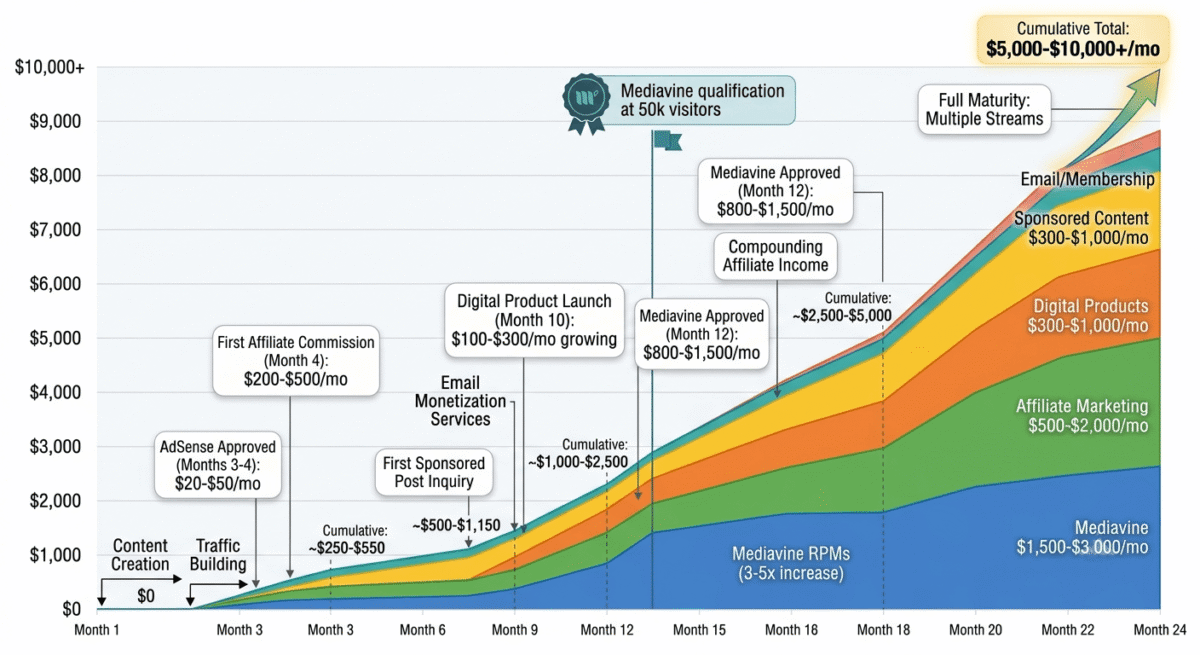
A realistic month-12 income breakdown for a software review blog:
Income Stream | Monthly Income | Notes |
Google AdSense | $500–$1,000 | At 25,000–50,000 monthly visitors |
Affiliate marketing | $1,000–$3,000 | 5–10 recurring + occasional high-ticket |
Sponsored content | $500–$1,500 | 1–3 sponsored posts at $300–$500 each |
Freelance services | $500–$2,000 | 2–4 WordPress or consulting engagements |
Total | $2,500–$7,500 | Growing month-over-month |
Your Monetization Timeline
Month 1–2: Foundation Only
Focus entirely on content creation and technical setup. No income expected, every action is an investment in future returns. When creating and selling online courses as digital products, you will need to choose from the best online course platforms available. If you offer freelance services, having the right setup is essential; check out our guide to the best tools for freelancers to get started. Using the best SEO tools can help you find low-competition keywords to rank faster. You can also use the best AI tools for bloggers to streamline your content creation process.
Month 3–4: First Income
- AdSense approved and earning $20–$50/month (low traffic)
- First affiliate clicks, possibly first conversions from hosting and VPN posts
- Action: join all affiliate programs, optimise internal linking
Month 5–6: Growing Income
- AdSense earning $100–$300/month
- Affiliate income $200–$500/month (multiple posts ranking)
- Email list: 100–500 subscribers
- Action: create first lead magnet, launch email newsletter
Month 7–12: Scaling Income
- AdSense earning $300–$1,000/month
- Affiliate income $500–$2,500/month (compounding recurring commissions)
- First sponsored content inquiry (respond professionally, negotiate fairly)
- First digital product launch to email list
- Action: apply to Mediavine at 50,000 sessions, systemise content production
Year 2+: Established Income
- Premium ad network (Mediavine) earning 3–5x AdSense RPM
- Affiliate income compounding as recurring commissions stack
- Regular sponsored content partnerships
- Digital product generating passive sales
- Freelance services optional (transition to consulting for premium clients)
Frequently Asked Questions
How much money can you make blogging?
Blogging income ranges from $0 to millions, a genuinely wide range that reflects the diversity of approaches. Realistic earnings for consistent bloggers: $500–$2,000/month by month 6–9, $2,000–$8,000/month by month 12–18, and $5,000–$15,000/month by year 2. Full-time income replacement ($3,000–$5,000/month for most locations) is achievable within 12–18 months for bloggers who publish consistently and follow proven monetization strategies.u003cbru003e
What is the fastest way to make money from a blog?
Affiliate marketing generates the highest income per visitor of any blog monetization method, commissions of $50–$500 per conversion versus cents per AdSense impression. The fastest path to affiliate income is writing honest comparison posts targeting keywords with commercial intent (u0022best VPN,u0022 u0022best web hostingu0022) and joining the relevant affiliate programs immediately. First affiliate conversions typically happen within 3–5 months of publishing with consistent SEO-focused content.u003cbru003e
How many monthly visitors do you need to make $1,000/month blogging?
At a software review blog with mixed AdSense and affiliate income: approximately 15,000–25,000 monthly visitors to earn $1,000/month. The exact number depends on your RPM (ad earnings per 1,000 visitors) and affiliate conversion rates. Blogs in high-RPM niches with well-placed affiliate links can reach $1,000/month at 10,000 visitors. General lifestyle blogs with low RPM might need 50,000+ visitors for the same income.u003cbru003e
Is affiliate marketing or AdSense better for bloggers?
Affiliate marketing generates significantly more income per visitor than AdSense for most software review bloggers. A single $150 Hostinger affiliate commission requires fewer visitors than earning $150 from AdSense at $15 RPM (which requires 10,000 visitors). The most effective strategy combines both, AdSense provides consistent baseline income from every visitor regardless of purchase intent, while affiliate marketing captures high-value conversions from purchase-ready readers.u003cbru003e
Do you need a large social media following to make money blogging?
No, the most profitable blogs generate the majority of their traffic from Google search (organic SEO), not social media. A blog ranking on page 1 of Google for 50 target keywords receives consistent traffic 24/7 without any social media presence. Social media is valuable for amplifying content and building an audience, but it is not required for blogging income. SEO is the primary traffic strategy for sustainable blogging income.u003cbru003e
Can I make money blogging without showing my face?
Yes, many successful bloggers operate without personal branding based on their appearance. Writing-focused blogs build authority through content quality, depth of expertise, and demonstrated results rather than personal celebrity. An author photo (for E-E-A-T signals) and real name are beneficial for trust and Google’s quality assessment, but video content and social media presence with your face are optional.u003cbru003e