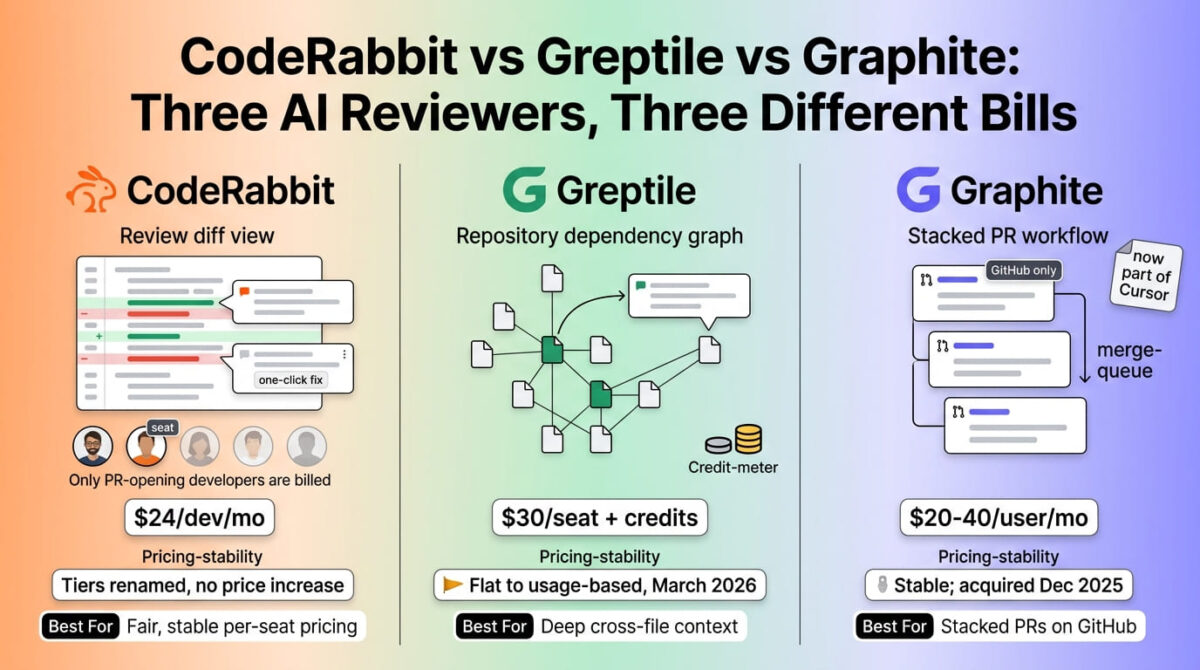
CodeRabbit vs Greptile vs Graphite all put an AI reviewer on every pull request, but they’ve taken different paths on how predictable that costs over time. One changed its billing model mid-year in a way that caught heavy users off guard. One only charges for developers who open pull requests in the first place. One is now owned by a different AI coding company entirely.
All three read code differently too: CodeRabbit reviews the diff with linters and custom rules, Greptile builds a graph of the whole repository before reviewing, and Graphite is built specifically around stacked pull requests rather than single large diffs.
I tested CodeRabbit vs Greptile vs Graphite for 30 days, running the same set of pull requests through all three and tracking how each one’s pricing held up against typical usage, much like evaluating workflow efficiency with Zapier vs Make vs n8n. Here is the honest comparison, including a quiet 2026 billing change that pushed one developer’s bill from $30 to over $500 in a single month.
Table of Contents
How We Tested
Five criteria shaped the testing:
- Pricing stability: whether the billing model has changed recently, and how that affected existing users
- Who gets billed: whether only active PR authors count as seats, or every team member
- Review depth: diff-only review versus whole-repository context
- Git host support: GitHub, GitLab, Bitbucket, or GitHub-only
- Recent ownership or structural changes: acquisitions or pricing shifts that affect long-term stability
CodeRabbit Review: Pricing That Only Charges for Developers Who Open PRs
Free plan: Yes, unlimited public and private repos, unlimited team members, rate-limited
Starting price: $24/developer/month (Essentials, billed annually)
Best plan for most users: Essentials, since it covers unlimited PR reviews with no review-count cap
Platforms: GitHub, GitLab, Azure DevOps, Bitbucket
Affiliate program: No, CodeRabbit runs no consumer referral program
CodeRabbit reviews every pull request with a plain-English summary, inline comments, and one-click fixes, billing only for developers who actively open pull requests rather than every team member with repo access.
What CodeRabbit does best
Billing only PR-opening developers, not reviewers, QA, or managers who just need visibility, is a measurably fairer model than typical per-seat software, and it means the bill doesn’t inflate just because more people have read access to a repository. The free tier is also unusually generous: unlimited public and private repos and unlimited team members, rate-limited to roughly 200 files and 4 PR reviews per hour rather than cut off entirely.
CodeRabbit renamed its tiers in 2026, Pro became Essentials and Pro Plus became Team, without raising prices in the process, a contrast to how pricing changes played out at one of its competitors this year.
Where CodeRabbit falls short
The free tier’s rate limits mean line-by-line reviews and one-click autofix are reserved for Essentials and above; free tier users get summaries and walkthroughs but not the deeper line-level feedback. Advanced, the newer third paid tier at $72/developer/month, adds blast-radius analysis and a security review of every PR, features that weren’t available at any price before 2026.
Enterprise pricing starts around $15,000/month for 500-plus users through AWS Marketplace, a meaningful jump for any organization that outgrows Team’s per-seat structure.
CodeRabbit pricing
| Plan | Price | Who’s Billed | Notable Feature |
|---|---|---|---|
| Free | $0 | N/A | Unlimited repos and members, rate-limited |
| Essentials | $24/developer/month (annual) | PR-opening developers only | Unlimited reviews, 40+ linters, autofix |
| Team | $48/developer/month (annual) | PR-opening developers only | Unit test generation, custom pre-merge checks |
| Advanced | $72/developer/month (annual) | PR-opening developers only | Blast-radius analysis, security review |
CodeRabbit: Pros and Cons
Pros:
- Only bills developers who open pull requests, not every team member
- Generous free tier with unlimited repos and members, just rate-limited
- Stable pricing through its 2026 tier rename, no price increases
- Broadest git host support of the three, including Bitbucket and Azure DevOps
Cons:
- Line-by-line review and autofix reserved for paid tiers
- Enterprise pricing jumps to a $15,000/month minimum for larger organizations
- Rate limits on the free tier can interrupt a high-velocity team’s workflow
- Newer Advanced tier’s security review features are unproven relative to dedicated security tools
Rating: 4.3 / 5, the fairest billing model of the three and the most stable pricing history through 2026.
Greptile Review: The Deepest Codebase Context, With a Pricing Change That Backfired
Free plan: Yes, 1 active developer, 50 credits/month
Starting price: $30/seat/month (Pro), 50 credits included, then $1 per extra credit
Best plan for most users: Pro, with usage tracked carefully against the included credit allowance
Platforms: GitHub, GitLab, Bitbucket, Gitea, Perforce
Affiliate program: No, Greptile runs no consumer referral program
Greptile builds a graph of an entire repository, its files, functions, and dependencies, reviewing each pull request against that whole-codebase picture rather than the diff in isolation, echoing the sophisticated language models seen in Voiceflow vs Chatbase vs Botpress.
What Greptile does best
Full-repository context noticeably improves review quality for logic that spans multiple files, catching issues a diff-only reviewer would miss entirely. TREX, a beta feature that writes and executes live tests in a sandbox rather than just commenting on code, is the only capability of its kind among the three tools tested, and Greptile’s reported 82% bug detection rate reflects that depth.
The widest git host support of the three, including Gitea and Perforce alongside the usual GitHub, GitLab, and Bitbucket, makes Greptile a fit for teams on less common version control setups.
Where Greptile falls short
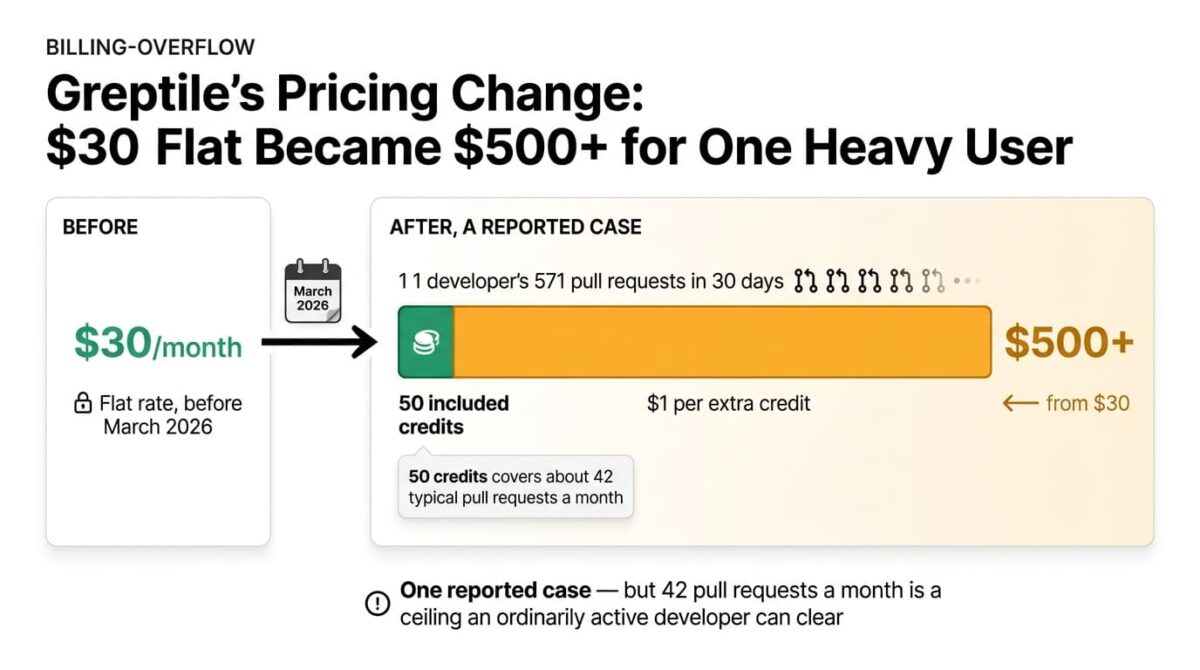
In March 2026, Greptile quietly changed its pricing from a flat $30/month rate to a usage-based model: the same $30 now includes only 50 review credits, with $1 charged per credit beyond that. One developer who pushed 571 pull requests in a 30-day period reported his bill jumping from $30 to over $500, since the included quota covered roughly 9% of his monthly usage. Greptile’s own data shows 50 credits covers approximately 42 pull requests monthly at typical review rates, a ceiling an ordinarily active developer clears without unusual behavior.
Multiple open-source maintainers have also reported being charged despite Greptile’s public commitment to free reviews for MIT, Apache, and GPL-licensed projects. TREX runtime reviews consume 3 credits instead of 1, meaning the tool’s most distinctive feature is also the one that burns through the included allowance fastest.
Greptile pricing
| Plan | Price | Credits | Notable Feature |
|---|---|---|---|
| Starter | $0 | 50/month, 1 developer | Permanent free tier |
| Pro | $30/seat/month | 50/seat/month, then $1/extra credit | Codebase chat, Slack integration |
| Enterprise | Custom | Custom | Self-hosting, SSO, BYOK |
Greptile: Pros and Cons
Pros:
- Deepest full-repository context of the three tools tested
- TREX sandbox test execution is a unique capability among AI code reviewers
- Widest git host support, including Gitea and Perforce
- Reported 82% bug detection rate, the highest cited among the three
Cons:
- March 2026 shift from flat to usage-based pricing significantly increased total costs for active developers
- Heavy users have reported bills rising 10x or more past the included credit allowance
- Open-source maintainers report being charged despite a public free-review promise
- TREX’s premium feature consumes credits three times faster than standard reviews
Rating: 3.8 / 5, the most technically capable reviewer of the three, with a 2026 pricing change that damaged trust more than the credit math alone suggests.
Graphite Review: Built for Stacked PRs, Now Owned by Cursor
Free plan: Yes, Hobby tier, limited AI reviews
Starting price: $20/user/month (Starter, billed annually)
Best plan for most users: Team, $40/user/month, for unlimited AI reviews and merge queue automation
Platforms: GitHub only
Affiliate program: No, Graphite runs no consumer referral program
Graphite is built around stacked pull requests, breaking large changes into smaller, dependent PRs that merge faster and review more easily than one large diff, which is especially useful for remote engineering teams managing distributed workflows similar to using TeamViewer vs AnyDesk vs Chrome Remote Desktop.
What Graphite does best
The stacked PR workflow measurably changes review speed for teams that adopt it: reported results from companies using Graphite show meaningfully faster median merge times compared to traditional single-PR review. The Graphite Agent, formerly branded Diamond before the Cursor acquisition, reviews each PR in the stack with a reported false-positive rate under 3%, among the lowest cited in the category.
Following the Cursor acquisition, Graphite now integrates directly with Cursor’s Cloud Agents inside the pull request page, a natural fit for teams already using Cursor for AI-assisted coding.
Where Graphite falls short
Graphite works with GitHub only, ruling it out entirely for teams on GitLab, Bitbucket, or Azure DevOps. Unlimited AI reviews require the $40/user/month Team tier; Starter at $20 still limits AI review volume, meaning the full capability costs more than either CodeRabbit’s or Greptile’s entry-level paid tier.
GitHub itself opened a private preview of native stacked pull requests in April 2026, a direct challenge to Graphite’s core value proposition. If GitHub absorbs stacked PR functionality into its own platform over time, the question of whether Graphite’s $20-40/user/month layer still earns its place becomes more pressing than it was when Graphite had the category to itself.
Graphite pricing
| Plan | Price | AI Reviews | Notable Feature |
|---|---|---|---|
| Hobby | $0 | Limited | CLI stacking, VS Code extension |
| Starter | $20/user/month (annual) | Limited | Org repos, team insights |
| Team | $40/user/month (annual) | Unlimited | Merge queue, automations, unlimited Graphite Agent |
| Enterprise | Custom | Unlimited | Advanced team features |
Graphite: Pros and Cons
Pros:
- Stacked PR workflow meaningfully speeds up review for teams that adopt it
- Reported under 3% false-positive rate, among the lowest in the category
- Direct Cursor Cloud Agent integration since the December 2025 acquisition
- Strong fit for teams already standardized on Cursor for AI coding
Cons:
- GitHub-only, no support for GitLab, Bitbucket, or Azure DevOps
- Unlimited AI reviews require the pricier $40/user/month Team tier
- GitHub’s own native stacked PR preview threatens Graphite’s core differentiator
- Requires the whole team to adopt the stacked PR workflow to see full benefit
Rating: 4.0 / 5, the strongest stacked-PR workflow in the category, facing an open question about its long-term differentiation as GitHub builds the same feature natively.
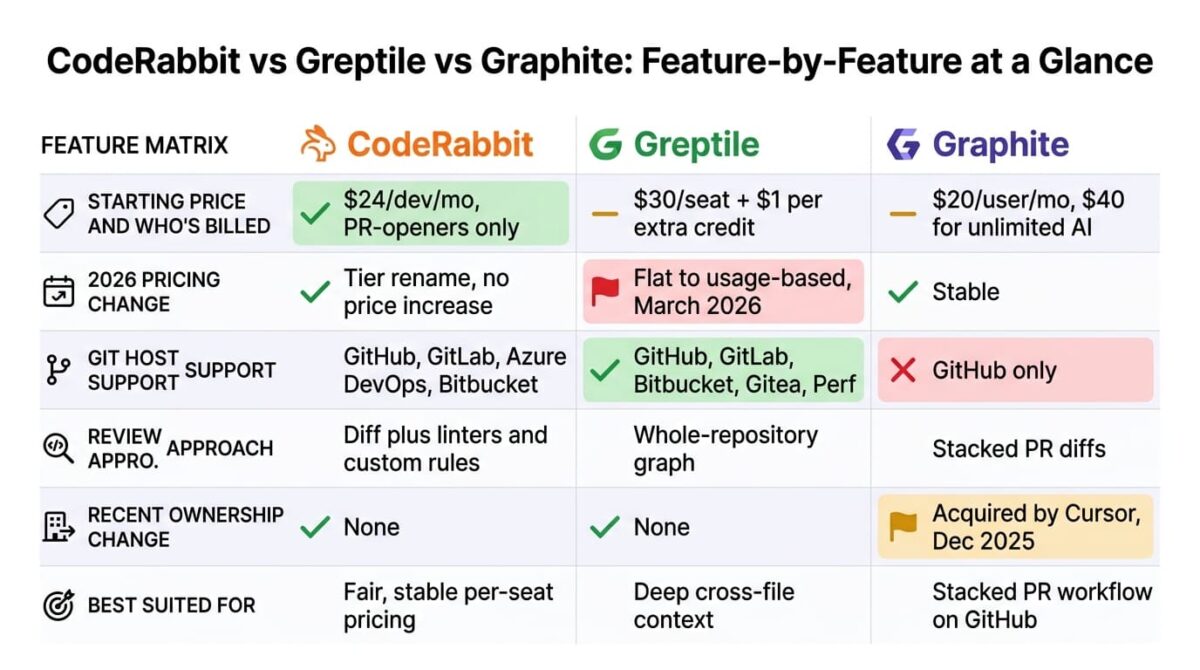
Head-to-Head Comparison
| Feature | CodeRabbit | Greptile | Graphite |
|---|---|---|---|
| Starting paid price | $24/developer/month | $30/seat/month | $20/user/month |
| Billing basis | PR-opening developers only | Per seat, plus review credits | Per user |
| 2026 pricing changes | Tier rename, no price increase | Flat to usage-based (March 2026) | Stable |
| Git host support | GitHub, GitLab, Azure DevOps, Bitbucket | GitHub, GitLab, Bitbucket, Gitea, Perforce | GitHub only |
| Review approach | Diff plus linters and custom rules | Full repository graph | Stacked PR diffs |
| Recent ownership change | No | No | Yes, acquired by Cursor (Dec 2025) |
| Best suited for | Teams wanting fair, stable per-seat pricing | Teams needing deep cross-file context | Teams adopting a stacked PR workflow on GitHub |
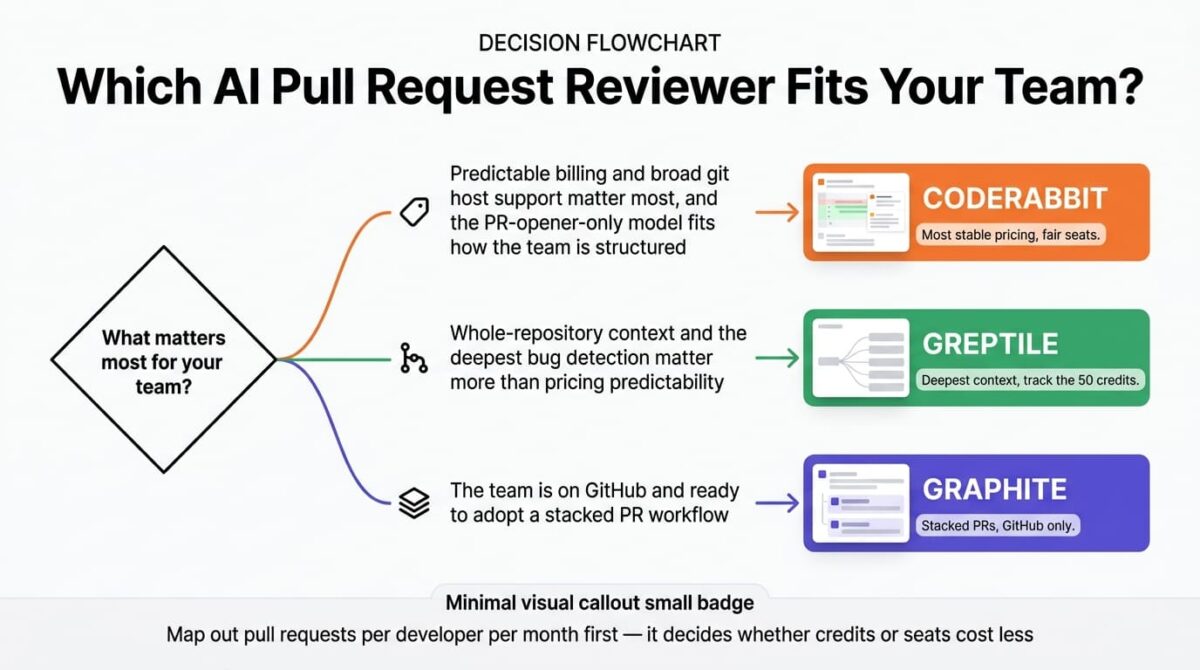
Which Should You Choose?
Choose CodeRabbit if predictable billing and the broadest git host support matter most, and the fair PR-opener-only billing model fits how the team is structured.
Choose Greptile if whole-repository context and the deepest bug detection matter more than pricing predictability, with usage tracked carefully against the 50-credit allowance.
Choose Graphite if the team is on GitHub and willing to adopt a stacked PR workflow, with the $40/user/month Team tier budgeted for unlimited AI review access.
Our Recommendations
Based on 30 days of testing across review depth, pricing behavior, and git host compatibility, here is the recommended setup by situation:
Team wanting the most predictable long-term billing: CodeRabbit Essentials, for stable pricing and a model that doesn’t charge for non-PR-opening team members.
Team on GitLab, Bitbucket, or a less common git host: CodeRabbit or Greptile, since Graphite’s GitHub-only limitation rules it out entirely.
High-velocity team opening many PRs per developer monthly: CodeRabbit, to avoid Greptile’s per-review overage risk at volume.
Team already adopting stacked PRs and standardized on Cursor: Graphite Team, for the native Cloud Agent integration and stacked workflow benefits.
Team specifically needing full-codebase bug detection depth: Greptile, budgeting conservatively for credit overages given the March 2026 pricing change.
Final Verdict
CodeRabbit, Greptile, and Graphite all put AI review on every pull request, but 2026 treated their pricing very differently.
- CodeRabbit (4.3 / 5): the fairest billing model and the most stable pricing history of the three
- Graphite (4.0 / 5): the strongest stacked-PR workflow, facing a notable challenge from GitHub’s own native feature development
- Greptile (3.8 / 5): the deepest technical capability, undercut by a 2026 pricing change that significantly increased total costs for active users
Before committing to any of these three, map out roughly how many PRs per developer get opened monthly, since that number determines whether Greptile’s credit model works in your favor or against it, and whether CodeRabbit’s PR-opener-only billing saves meaningfully over a flat per-seat model, much like budgeting team resources across publishing platforms like Hootsuite vs Publer vs Buffer.
Frequently Asked Questions
Did Greptile really change its pricing without much warning?
Yes. In March 2026, Greptile shifted from a flat $30/month rate to a model that includes 50 review credits at that price, charging $1 for each additional credit. The change drew public criticism, including from developers whose bills increased by 10 times or more based on their existing usage patterns.
Does CodeRabbit charge for every team member with repo access?
No. CodeRabbit only bills developers who actively open pull requests. Reviewers, QA staff, and managers who need visibility into the repository but don’t open PRs themselves aren’t counted toward the seat total.
Is Graphite still independent, or did something change in 2025?
Cursor acquired Graphite in December 2025. The AI reviewer, previously branded Diamond, was renamed Graphite Agent, and the product now integrates directly with Cursor’s Cloud Agents inside the pull request page.
Why is Graphite GitHub-only?
Graphite’s stacked PR workflow and tooling were built specifically around GitHub’s infrastructure. Teams using GitLab, Bitbucket, or Azure DevOps aren’t supported and would need to use CodeRabbit or Greptile instead, both of which work across multiple git hosts.
Is GitHub building its own version of what Graphite does?
GitHub opened a private preview of native stacked pull requests in April 2026, a feature historically unique to tools like Graphite. If GitHub continues building this natively, it raises an open question about Graphite’s long-term differentiation.
Which tool found the most bugs in testing?
Greptile’s reported 82% bug detection rate was the highest cited among the three, attributed to its full-repository graph approach rather than reviewing diffs in isolation. CodeRabbit and Graphite both performed well but didn’t match that specific reported figure.
Does Greptile still offer free reviews for open-source projects?
It publicly commits to this for MIT, Apache, and GPL-licensed projects, but multiple open-source maintainers have reported being charged anyway following the March 2026 pricing change, a discrepancy to confirm directly before relying on it.
Which tool is cheapest for a 10-developer team?
CodeRabbit, generally, at $240/month on Essentials if all 10 developers open PRs regularly, compared to Greptile’s $300/month base plus potential overage charges, or Graphite’s $200-400/month depending on tier, with the added constraint of GitHub-only support.