A feedback tool is supposed to get cheaper per customer as a product grows, much like handling transaction costs as sales scale, since more customers means more votes on the same ideas. Canny vs UserVoice vs Frill shows how often it works the other way. The more engaged the customers are, the more one of these tools charges.
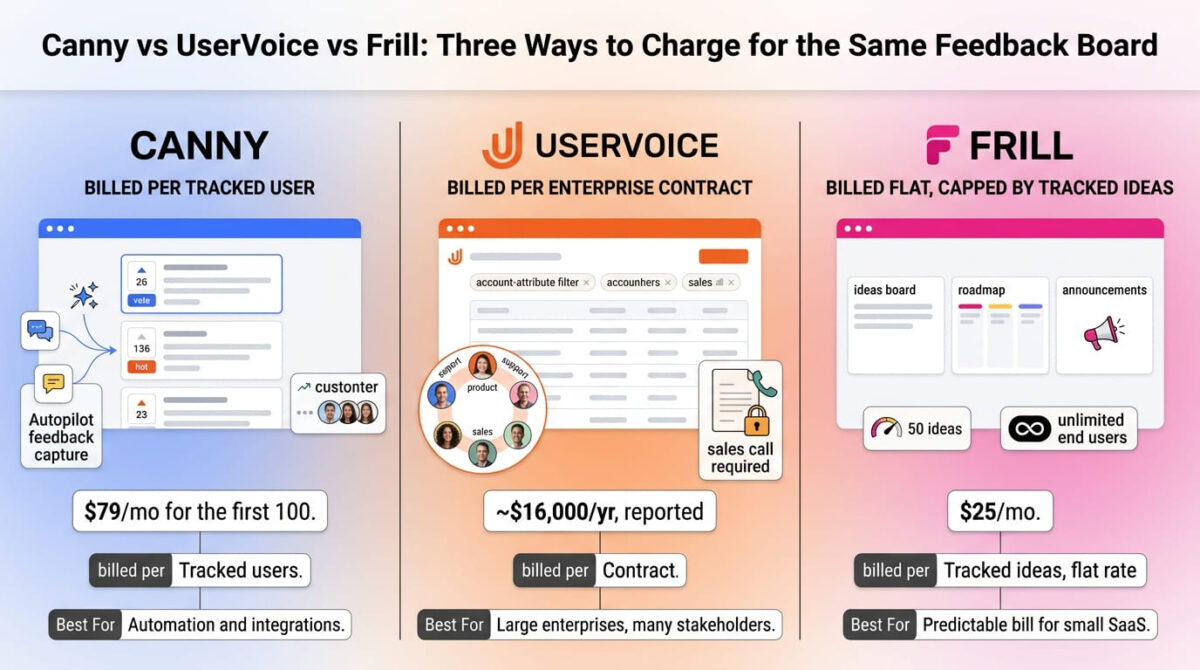
Canny bills by tracked user, meaning the customers whose feedback lives in the system. UserVoice sells on an enterprise contract with no self-serve signup. Frill charges a flat rate and caps the number of tracked ideas instead. Three tools that all offer a voting board, a roadmap, and a changelog meter that same job in three different ways.
I tested Canny vs UserVoice vs Frill for 30 days, setting up a feedback board in each one where self-serve signup allowed it, and pricing out what a growing SaaS product would pay at 100, 1,000, and 5,000 customers. Here is the honest comparison, including how Canny’s $79 headline price turns into $529 at 1,000 tracked users.
Table of Contents
How We Tested
Five criteria shaped the testing:
- Pricing unit: whether cost scales with customers, team members, feedback volume, or a flat rate
- Cost at 1,000 customers: what a growing product pays once engagement picks up
- Self-serve access: whether a team can sign up and try the tool without talking to sales
- Free tier and trial: how much can be evaluated before paying
- Stale pricing information: where older articles describe plans that no longer match the vendor’s pages
Three Ways to Charge for the Same Job
Canny, UserVoice, and Frill all collect feature requests, let customers vote, and publish a roadmap. They differ in what the bill is tied to. Canny ties it to how many customers have feedback tracked. UserVoice ties it to a negotiated contract sized by feedback volume and integrations. Frill ties it to the number of tracked ideas on a flat monthly rate.
That difference matters because customer engagement is usually a good sign. Under Canny’s model, a feature request that goes viral can move an account into a higher pricing band. Under Frill’s model, the same event barely changes the bill. Under UserVoice’s model, the bill was already set in a contract before the first vote came in.
Canny Review: The Deepest Feature Set, Priced by Engagement
Free plan: Yes, 25 tracked users, no time limit
Starting price: $79/month billed annually ($99 monthly), covering the first 100 tracked users
Best plan for most users: Pro, for product teams that need Jira or Linear integrations
Platforms: Web, embeddable widget, integrations with common PM and support tools
Affiliate program: Unconfirmed, check Canny’s partner page before adding links
Canny is the most widely used of the three, built around a feedback board, a roadmap, a changelog, and an AI feature called Autopilot that pulls feedback out of support and sales conversations automatically.
What Canny does best
Autopilot is the standout feature. It captures feedback from the tools where customers already talk to a company and files it against the right feature request, which saves a product team from manual data entry when automating routine workflows. The free plan is also useful for evaluation: it includes boards, a roadmap, a changelog, integrations, and Autopilot for up to 25 tracked users, with no expiry date.
Pro adds Jira and Linear integrations, custom statuses, user segmentation, and advanced privacy controls alongside robust account security measures, a feature depth that Frill’s lower tiers don’t match.
Where Canny falls short
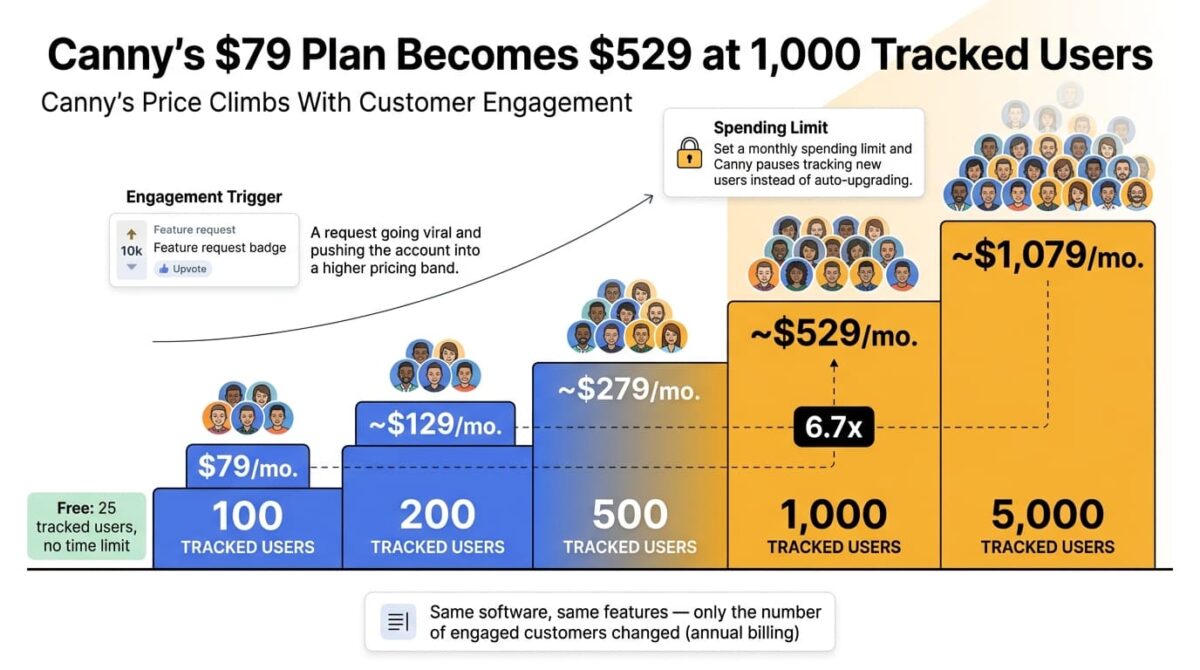
Pricing climbs steeply with tracked users. The $79 Pro headline covers the first 100. Annual billing runs roughly $129 at 200 tracked users, $279 at 500, $529 at 1,000, and about $1,079 at 5,000. That means a product that grows from 100 to 1,000 engaged customers pays about 6.7 times more for the same software, heavily impacting overall operating expenses and tool budgets.
Without a monthly spending limit set, Canny moves an account to the next tracked-user band and prorates the upgrade automatically. With a limit set, Canny stops tracking new users and pauses new Autopilot analysis until the cap is raised. Some pricing guides also still list a lower-priced Core plan from $19/month, while recent checks of Canny’s own pages show Free, Pro, and Business, so confirm the current structure before budgeting.
Canny pricing
| Plan | Price (Annual Billing) | Tracked Users | Notable Feature |
|---|---|---|---|
| Free | $0 | 25 | Boards, roadmap, changelog, Autopilot AI |
| Pro | $79/month ($99 monthly) | First 100 | Jira/Linear integrations, 10 managers, segmentation |
| Pro at scale | ~$279/month | 500 | Same features, higher user band |
| Pro at scale | ~$529/month | 1,000 | Same features, higher user band |
| Business | Custom, typically five figures a year | 5,000+ | Custom roles, white-labeling as a separate add-on |
Canny: Pros and Cons
Pros:
- Autopilot captures feedback from support and sales tools automatically
- Free plan has no time limit and includes Autopilot
- Strongest integration list of the three, including Jira and Linear on Pro
- Unlimited posts and boards on every plan
Cons:
- Cost scales with tracked users, so engagement raises the bill
- $79 headline becomes about $529 at 1,000 tracked users
- Automatic band upgrades happen unless a spending limit is set
- White-labeling and Canny branding removal sit on the custom-priced Business plan
Rating: 4.1 / 5, the most capable platform of the three, with a pricing model that penalizes the engagement it is designed to encourage.
UserVoice Review: Enterprise Depth Behind a Sales Call
Free plan: No, no self-serve signup, 30-day trial offered through sales
Starting price: Roughly $16,000/year (about $1,333/month), custom-quoted
Best plan for most users: Not applicable, every deal is quoted by feedback volume and integrations
Platforms: Web, in-app widget, CRM and support integrations
Affiliate program: Unconfirmed, check UserVoice’s partner page before adding links
UserVoice is the oldest of the three and the most enterprise-focused, built for large organizations where many stakeholders need access to customer feedback data and its connection to account and revenue information.
What UserVoice does best
Flat, volume-based pricing with no per-seat charges suits a large organization where hundreds of people across product, support, and sales all need to see feedback. At that scale, unlimited internal access at a set price makes more sense than a per-seat model that grows with headcount.
Customer segmentation by account attributes, advanced analytics, security and compliance coverage, and hands-on onboarding come with every plan, features that smaller tools tend to sell separately or skip.
Where UserVoice falls short
UserVoice no longer shows tiered plans on its pricing page. Recent write-ups put the entry point near $16,000 a year, with no free plan and no way to sign up without a sales conversation. Vendr’s marketplace data reports a median buyer paying about $16,700 a year, and another analysis cites an average near $21,000.
Older articles describe a different structure: Growth at $999/month for 200 users, Team at $1,299/month for 3,000 users, and Strategic at $1,499/month for 5,000 users, all with quarterly minimum billing. More recent coverage describes flat pricing with unlimited users instead. Confirm which applies in a current quote, since the two descriptions don’t match.
UserVoice pricing (Reported, Not Published)
| Component | Reported Cost | Notes |
|---|---|---|
| Entry price | ~$16,000/year | Custom-quoted, scales with feedback volume and integrations |
| Median buyer | ~$16,700/year | Per Vendr marketplace data |
| Older Growth tier | $999/month, 200 users | Quarterly minimum billing, no longer shown |
| Older Team tier | $1,299/month, 3,000 users | Quarterly minimum billing, no longer shown |
| Older Strategic tier | $1,499/month, 5,000 users | Quarterly minimum billing, no longer shown |
UserVoice: Pros and Cons
Pros:
- Flat pricing with no per-seat charge suits large internal audiences
- Customer segmentation and account-level feedback data included
- Security, compliance, and onboarding support built into every plan
- Longest track record in the category
Cons:
- Entry price near $16,000 a year, the highest of the three by a wide margin
- No free plan and no self-serve signup
- Published tiers have been removed, leaving older articles out of date
- Reviewers describe the interface as dated and the learning curve as steep
Rating: 3.8 / 5, a capable enterprise platform at a price and sales process that rule it out for most small and mid-sized product teams.
Frill Review: Flat Pricing From a Bootstrapped Team
Free plan: No permanent free plan, 14-day free trial with no credit card required
Starting price: $25/month (Startup), 50 tracked ideas and 1 survey
Best plan for most users: Startup, for small SaaS teams that want feedback, roadmap, and changelog together
Platforms: Web, embeddable widget, integrations
Affiliate program: Unconfirmed, check Frill’s partner page before adding links
Frill is a bootstrapped company founded in 2019 in Sydney, with no outside funding, a stability point that stands out in a software market where acquisitions have changed the ownership of many comparable tools.
What Frill does best
Flat pricing with unlimited end users means the bill doesn’t rise when customers vote, comment, or submit ideas. The Startup plan at $25/month bundles an ideas board, a public roadmap, and announcements, which Frill describes as covering all three core features from the entry price.
Being bootstrapped also means no acquirer is likely to reshape pricing or roadmap on short notice, and the product’s design earns consistent praise in user reviews for being clean and quick to set up.
Where Frill falls short
Plans are capped by tracked ideas, with the Startup tier covering 50, so a product with a busy idea board outgrows the entry price faster than the headline suggests. One independent analysis puts the top of Frill’s range near $149/month for a clean customer-facing setup, a figure that fdback.io treats as expensive for what it covers.
Older competitor articles claim roadmaps and changelogs cost an extra $25 each, plus $50 for SSO, which would push the entry price to $125. Frill’s own current pages describe those features as included from $25/month, so that claim looks stale, but SSO and higher-tier limits should be confirmed directly. Integration depth and AI automation also trail Canny’s.
Frill pricing
| Plan | Price | Limits | Notable Feature |
|---|---|---|---|
| Startup | $25/month | 50 tracked ideas, 1 survey | Ideas, roadmap, announcements, unlimited end users |
| Mid tiers | Scale with tracked ideas | Higher idea and survey caps | Same core features, more capacity |
| Top tier | ~$149/month | Highest caps | Largest idea and survey allowance |
| Free trial | $0 for 14 days | No credit card required | Full evaluation before paying |
Frill: Pros and Cons
Pros:
- Flat pricing with unlimited end users, so engagement doesn’t raise the bill
- Ideas, roadmap, and announcements bundled from $25/month
- Bootstrapped, with no acquisition or funding pressure shaping the product
- 14-day trial with no credit card required
Cons:
- Tracked-idea caps push busy boards onto higher tiers
- Top-tier pricing near $149/month for a larger setup
- Integration list and AI automation trail Canny’s
- No permanent free plan
Rating: 4.2 / 5, the most predictable bill of the three at a small-team price, with fewer integrations and automation than Canny.
Head-to-Head Comparison
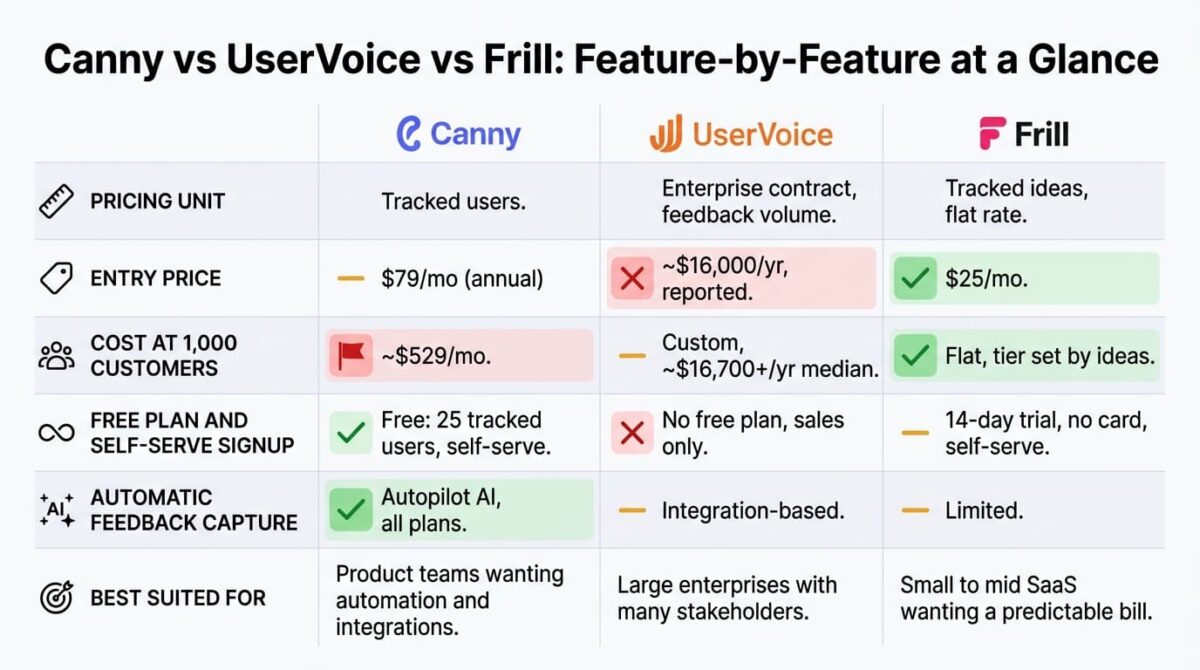
| Feature | Canny | UserVoice | Frill |
|---|---|---|---|
| Pricing unit | Tracked users | Enterprise contract, feedback volume | Tracked ideas, flat rate |
| Entry price | $79/month (annual) | ~$16,000/year | $25/month |
| Cost at 1,000 customers | ~$529/month | Custom, ~$16,700+/year median | Flat, tier set by ideas |
| Free plan | Yes (25 tracked users) | No | No (14-day trial) |
| Self-serve signup | Yes | No | Yes |
| Automatic feedback capture | Autopilot AI, all plans | Integration-based | Limited |
| Ownership | Independent | Independent | Bootstrapped |
| Best suited for | Product teams wanting automation and deep integrations | Large enterprises with many internal stakeholders | Small to mid-sized SaaS teams wanting a predictable bill |
Which Should You Choose?
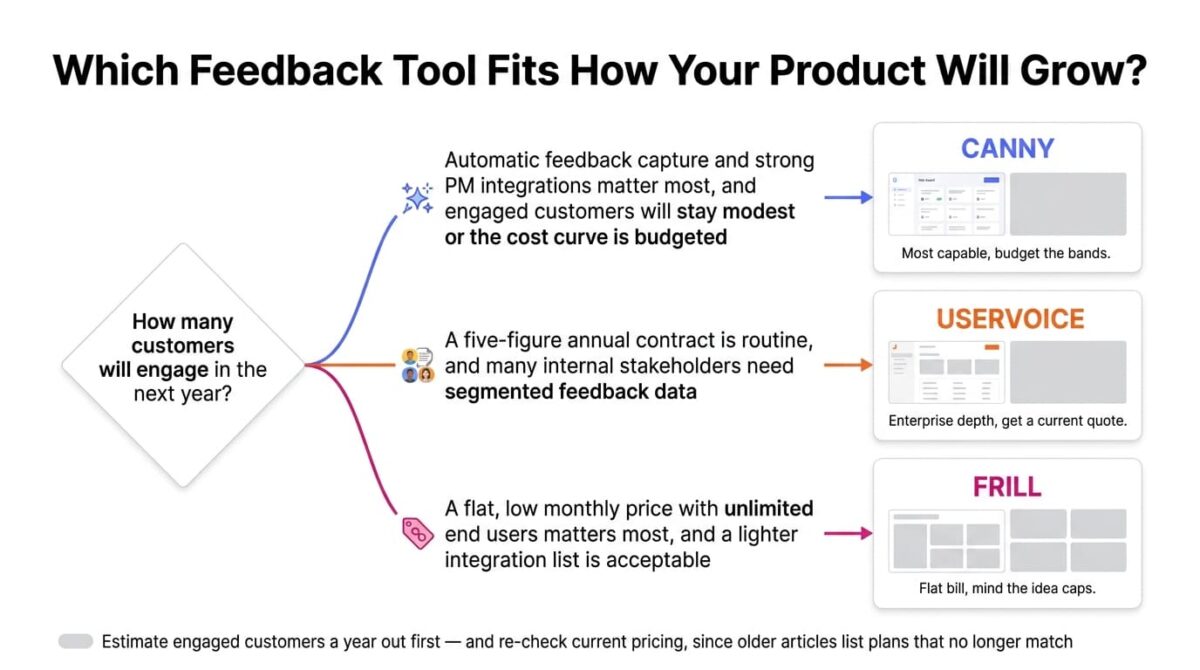
Choose Canny if automatic feedback capture and strong PM integrations matter more than a predictable bill, and the number of engaged customers will stay modest or the cost curve is budgeted in advance.
Choose UserVoice if the organization is large enough that a five-figure annual contract is routine, and many internal stakeholders need access to segmented feedback data.
Choose Frill if a flat, low monthly price with unlimited end users matters most, and a lighter integration list is an acceptable tradeoff.
Our Recommendations
Based on 30 days of testing across setup, pricing research, and growth scenarios, here is the recommended setup by situation:
Early-stage SaaS with fewer than 25 engaged customers: Canny’s free plan, which includes Autopilot and has no time limit.
Growing SaaS with thousands of customers and a tight budget: Frill, since engagement doesn’t raise the bill the way it does under Canny’s tracked-user pricing.
Product team with heavy support and sales volume wanting feedback captured automatically: Canny Pro, budgeting for the tracked-user bands as customer engagement grows.
Enterprise with hundreds of internal stakeholders across product, support, and sales: UserVoice, after getting a current quote rather than relying on older published tiers.
Anyone budgeting from an older pricing article: Re-check Canny’s plan list, UserVoice’s current starting price, and Frill’s add-on structure directly, since each has changed or been described inconsistently.
Final Verdict
Canny, UserVoice, and Frill all run a feedback board, roadmap, and changelog, and the right choice depends on which pricing unit fits how the product is expected to grow.
- Frill (4.2 / 5): the most predictable bill and a bootstrapped team, with fewer integrations than Canny
- Canny (4.1 / 5): the most capable platform, priced in a way that rises with customer engagement
- UserVoice (3.8 / 5): enterprise depth at a starting price near $16,000 a year with no self-serve option
Before comparing sticker prices, estimate how many customers will engage with the feedback board in a year. That one number decides whether Canny’s tracked-user bands stay cheap, whether Frill’s idea caps hold, and whether UserVoice’s contract is even in range.
Frequently Asked Questions
How much does Canny cost at 1,000 tracked users?
About $529 per month on annual billing, or $661 monthly, according to recent pricing breakdowns. The $79 Pro headline covers only the first 100 tracked users, and the price steps up in bands as that number grows.
What counts as a tracked user in Canny?
A customer whose feedback is tracked in the system, which grows as more customers submit, vote on, or have feedback captured against feature requests. Because engagement drives the count, cost rises as the board gets busier.
Does Canny upgrade my plan automatically?
Yes, unless a monthly spending limit is set. Without one, Canny moves the account to the next tracked-user band and prorates the change. With a limit, it stops tracking new users and pauses new Autopilot analysis until the cap is raised.
Does UserVoice still publish its pricing tiers?
No. Recent coverage says UserVoice no longer shows tiered plans on its pricing page, with pricing starting near $16,000 a year through a sales process. Older articles still cite $999, $1,299, and $1,499 monthly tiers that no longer appear.
Is Frill really $25 a month for roadmaps and changelogs too?
Frill’s own current pages describe ideas, roadmap, and announcements as included from $25/month. Older competitor articles claim separate add-on fees for each, which appears out of date, though higher-tier limits and SSO should be confirmed directly.
Does Frill have a free plan?
Not a permanent one. Frill offers a 14-day free trial with no credit card required, and Startup at $25/month is the entry paid plan. Some older third-party listings say no trial is available, which conflicts with Frill’s own site.
Which tool is cheapest for a product with 5,000 customers?
Frill is likely the cheapest of the three, since its pricing doesn’t scale with customer engagement. Canny would run roughly $1,079 a month at 5,000 tracked users on annual billing, and UserVoice starts near $16,000 a year.
Which of these is best for a small startup?
Canny’s free plan for a very early product, then Frill once the board gets busier. UserVoice is built for large organizations and its entry price rules it out for most startups.