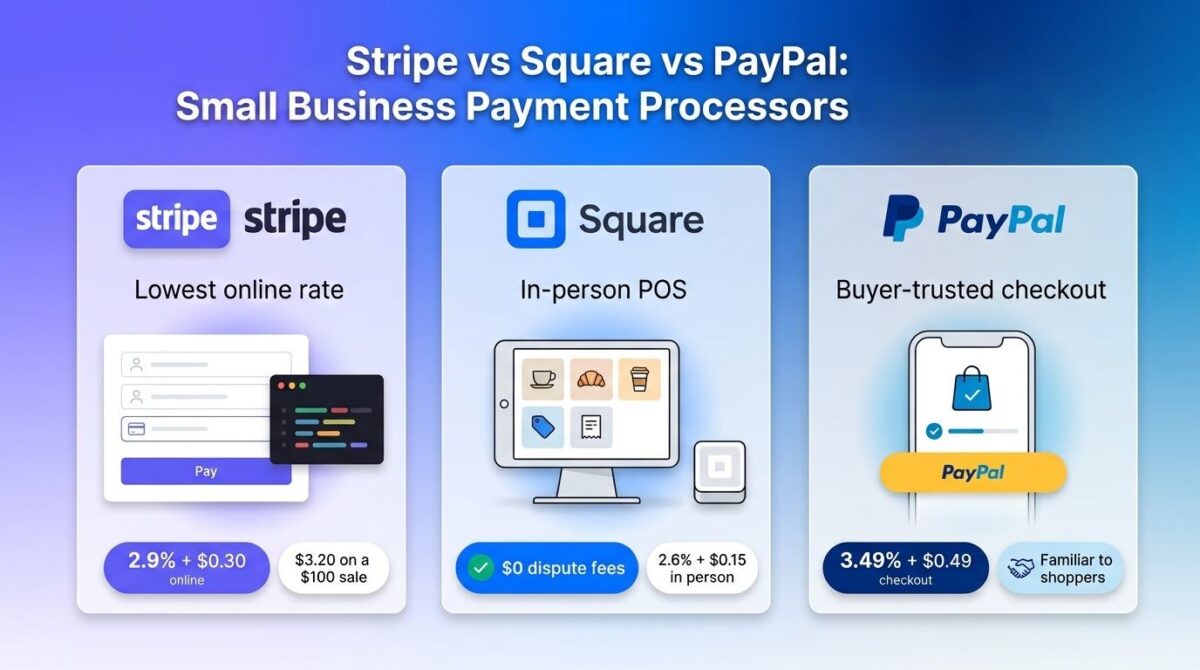
The advice that Stripe and Square charge identical online rates is still circulating widely, and it stopped being true in late 2025. Stripe vs Square vs PayPal is a comparison where the headline percentage tells only part of the story, and each platform attaches a different set of extra fees that change what a business pays on a typical $100 sale.
Stripe is built around developer-friendly online payments and subscriptions, while merchants often pair them with online business checking accounts featuring zero monthly fees to streamline payouts. Square is built around in-person selling with an integrated point-of-sale system. PayPal is built around buyer familiarity, with the highest base rates of the three and the steepest hidden costs once international sales or disputes enter the picture.
I tested Stripe vs Square vs PayPal for 30 days, running the same set of online and in-person transactions through all three and calculating what each one deducted after every fee, not just the headline rate. Here is the honest comparison, including how a Square rate increase in late 2025 changed which platform is cheapest for online sellers.
Table of Contents
How We Tested
Five criteria shaped the testing:
- True effective rate – the percentage deducted after add-on fees, not just the headline rate
- Online versus in-person strength – which platform is built for which selling environment
- Dispute and chargeback costs – what it costs when a customer contests a charge
- International and currency costs – surcharges and conversion spreads on cross-border sales
- Recent rate changes – any increases that make older comparison articles outdated
Stripe Review: The Lowest Online Rate, With Add-On Fees That Stack
Free plan: No monthly fee on the standard plan, pay per transaction only
Starting price: 2.9% + $0.30 per online card payment
Best plan for most users: Standard pay-as-you-go, for online-first businesses and subscription sellers
Platforms: Web, API, Terminal hardware for in-person
Affiliate program: Yes, Stripe partner program
Stripe sets the benchmark for online payment processing with the lowest standard online rate of the three platforms tested, built around a developer-friendly API and deep subscription and billing tools.
What Stripe does best
The developer tooling is also the deepest of the three, which matters most for any business building a custom checkout, subscription product, or connecting disparate tools through no-code workflow automation platforms rather than using a prebuilt storefront.
Custom pricing is available for businesses processing high volume, and in-person payments through Stripe Terminal cost 2.7% + $0.05, lower than Square’s in-person rate on its Free plan.
Where Stripe falls short
Stripe’s headline rate is only the starting point: international cards add 1.5%, currency conversion adds 1%, instant payouts cost 1.5%, manually keyed cards add 0.5%, and Stripe Billing for subscriptions adds 0.7% of billing volume. One independent cost analysis found these add-on meters push most businesses’ effective rate to somewhere between 3.2% and 13%, depending on the mix of sales.
Disputes cost $15 each, a fee Square doesn’t charge at all, and in-person selling requires purchasing Terminal hardware separately, without the integrated point-of-sale software Square provides out of the box.
Stripe pricing
| Payment Type | Fee | Notes |
|---|---|---|
| Online card (domestic) | 2.9% + $0.30 | Standard US rate |
| In-person (Terminal) | 2.7% + $0.05 | Requires hardware purchase |
| Manually keyed card | 3.4% + $0.30 | Extra 0.5% |
| International card | +1.5% | Added to base rate |
| Currency conversion | +1.0% | Added on top of other fees |
| Dispute | $15.00 | Per dispute |
| Stripe Billing (subscriptions) | +0.7% | Of billing volume |
Stripe: Pros and Cons
Pros:
- Lowest standard online rate of the three at 2.9% + $0.30
- Deepest developer tooling and API of the three platforms
- No monthly, setup, or PCI compliance fees on the standard plan
- Custom pricing available for high-volume businesses
Cons:
- Add-on fees for international, currency, keyed, and subscription payments stack up
- $15 per dispute, a cost Square doesn’t charge
- In-person selling requires separate hardware and lacks an integrated POS system
- Effective rate can climb well above the 3.2% base for international or subscription-heavy businesses
Rating: 4.3 / 5, the lowest online base rate and best developer tooling, with add-on fees that make the true rate depend heavily on the sales mix.
Square Review: Best for In-Person Selling, With a Late-2025 Rate Increase
Free plan: Yes, Free plan, no monthly fee
Starting price: 2.6% + $0.15 in-person; 3.3% + $0.30 online on the Free plan
Best plan for most users: Free plan, until volume justifies Plus at $49/month
Platforms: Web, iOS, Android, Square hardware
Affiliate program: Yes, Square referral program
Square built its reputation as the simplest way to take cards in person, with an integrated point-of-sale system and hardware ecosystem, though its late-2025 pricing overhaul changed its online economics.
What Square does best
Square charges no dispute or chargeback fees, a clear advantage over Stripe’s $15 and PayPal’s $15-30 per case, which matters most for businesses with a meaningful dispute rate. The in-person experience is also the most complete of the three: card readers, a point-of-sale app, inventory tools, and reporting all work together without separate integrations.
ACH bank transfers cost 1%, comparable to Stripe’s 0.8% capped at $5, and the Free plan has no monthly fee or contract.
Where Square falls short
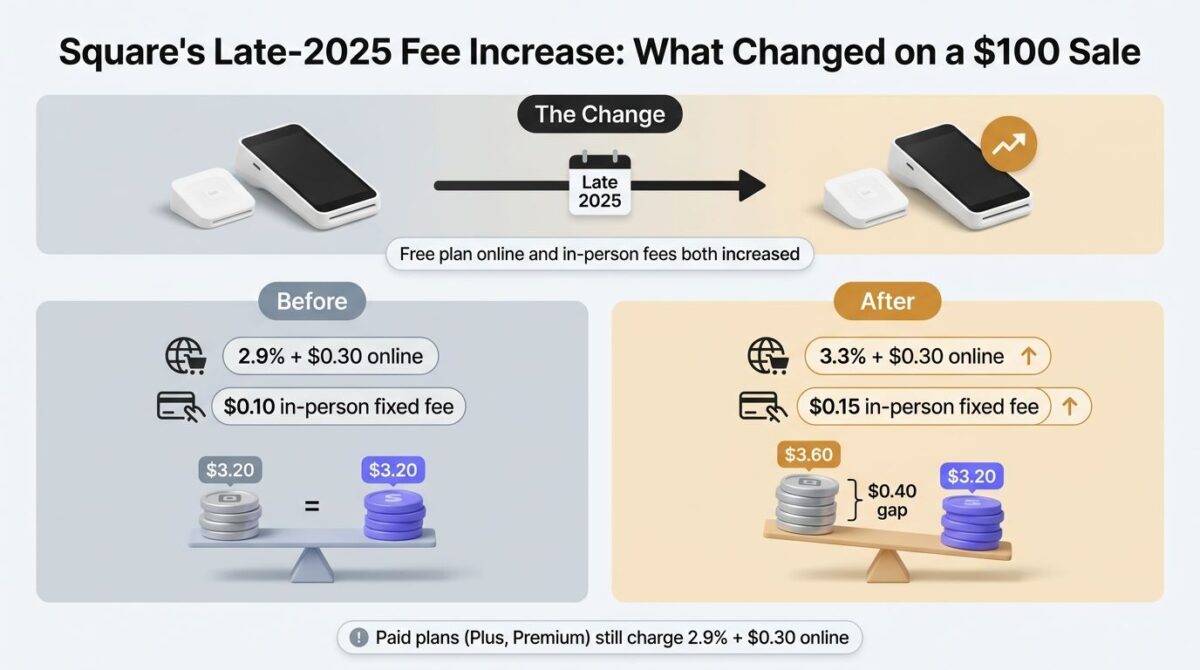
Square overhauled its pricing in late 2025, raising two rates that affect most sellers: the in-person fixed fee rose from $0.10 to $0.15, and the Free plan’s online and invoice rate jumped from 2.9% + $0.30 to 3.3% + $0.30. On a $100 online sale, that’s now $3.60 on Square versus $3.20 on Stripe, a gap that didn’t exist before the change, which means any article still describing the two as having identical online pricing is out of date.
The paid plans offer only modest savings: Plus at $49/month cuts the in-person rate by just 0.1 percentage points and the online rate by 0.4, meaning the subscription needs substantial monthly volume to pay for itself.
Square pricing
| Plan | Monthly Fee | In-Person | Online / Invoices |
|---|---|---|---|
| Free | $0 | 2.6% + $0.15 | 3.3% + $0.30 |
| Plus | $49/month/location | 2.5% + $0.15 | 2.9% + $0.30 |
| Premium | $149/month/location | 2.4% + $0.15 | 2.9% + $0.30 |
Manually keyed payments cost 3.5% + $0.15 on every plan.
Square: Pros and Cons
Pros:
- No dispute or chargeback fees, unlike both competitors
- Most complete integrated in-person system: hardware, POS software, and inventory
- No monthly fee or contract on the Free plan
- Consistent in-person rates across payment methods
Cons:
- Free plan’s online rate rose to 3.3% + $0.30 in late 2025, now above Stripe’s
- In-person fixed fee rose from $0.10 to $0.15 in the same overhaul
- Paid plan savings are small relative to the monthly subscription cost
- Less developer flexibility than Stripe for custom online checkouts
Rating: 4.1 / 5, the strongest all-in-one in-person platform with no dispute fees, with a recent online rate increase that older reviews miss.
PayPal Review: The Highest Rates, With Unmatched Buyer Familiarity
Free plan: Yes, no monthly fee on a standard Business account
Starting price: 3.49% + $0.49 for PayPal Checkout; 2.99% + $0.49 for standard cards
Best plan for most users: Standard Business account, as an added payment option alongside another processor
Platforms: Web, iOS, Android, Zettle for in-person
Affiliate program: Yes, PayPal partner program
PayPal’s checkout is the most familiar to online shoppers, which can lift conversion rates for buyers who prefer paying with a PayPal balance instead of entering card details.
What PayPal does best
Buyer familiarity is PayPal’s clearest advantage: many online shoppers already have an account and will complete a purchase faster, or only complete it at all, when PayPal is offered, an effect that doesn’t show up in a fee comparison but can offset the higher rate for some businesses. QR code payments through PayPal run 2.29% + $0.09, the lowest per-transaction rate of any in-person-style payment in this comparison, though it applies only to that specific payment method.
Pay by Bank (ACH) costs 1% capped at $10, a competitive rate for larger transactions.
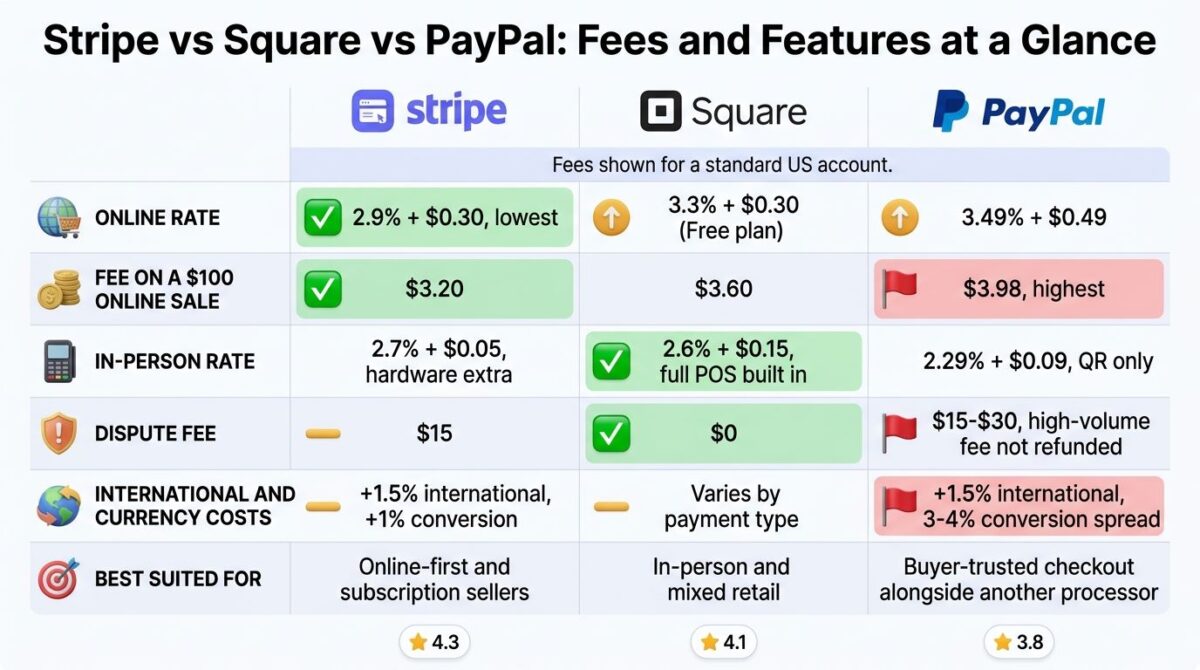
Where PayPal falls short
PayPal Checkout’s 3.49% + $0.49 comes to $3.98 on a $100 sale, the highest of the three. The costs beyond the headline rate are larger too: international transactions add a 1.5% surcharge, and currency conversion carries a 3-4% spread over the mid-market exchange rate, a cost embedded in the exchange rate itself rather than listed as a separate fee, making it easy to underestimate.
Disputes cost $15 for standard accounts and $30 for high-volume dispute accounts, and the high-volume fee isn’t refunded even when the merchant wins the dispute. Chargebacks add a separate $20 fee.
PayPal pricing
| Payment Type | Fee | Notes |
|---|---|---|
| PayPal Checkout / Venmo | 3.49% + $0.49 | Highest base rate of the three |
| Standard card payments | 2.99% + $0.49 | Through PayPal’s card checkout |
| QR code (in-person) | 2.29% + $0.09 | Specific payment method only |
| International surcharge | +1.5% | On cross-border transactions |
| Currency conversion | 3-4% spread | Over mid-market rate |
| Dispute | $15 std / $30 high-vol | High-volume fee not refunded on wins |
| Chargeback | $20.00 | Card payments outside PayPal accounts |
PayPal: Pros and Cons
Pros:
- Highest buyer familiarity, which can improve checkout conversion
- QR code payments at 2.29% + $0.09 for in-person use
- Pay by Bank (ACH) at 1% capped at $10
- No monthly fee on a standard Business account
Cons:
- Highest base online rate of the three at 3.49% + $0.49
- Currency conversion spread of 3-4% is easy to underestimate
- $15-$30 dispute fees, with the high-volume fee not refunded even on wins
- Additional $20 chargeback fee on card payments
Rating: 3.8 / 5, the most expensive of the three with the steepest hidden costs, offset for some businesses by buyer familiarity that lifts conversion.
Head-to-Head Comparison
| Feature | Stripe | Square (Free plan) | PayPal |
|---|---|---|---|
| Online rate | 2.9% + $0.30 | 3.3% + $0.30 | 3.49% + $0.49 |
| Fee on a $100 online sale | $3.20 | $3.60 | $3.98 |
| In-person rate | 2.7% + $0.05 (Terminal) | 2.6% + $0.15 | 2.29% + $0.09 (QR) |
| Dispute fee | $15.00 | $0 | $15-$30 |
| International surcharge | +1.5% | Varies by payment type | +1.5% |
| Currency conversion | +1.0% | Varies | 3-4% spread |
| Recent rate changes | Stable | Online rate rose to 3.3% (late 2025) | Stable |
| Best suited for | Online-first and subscription businesses | In-person and mixed retail | Adding buyer-trusted checkout alongside another processor |
Which Should You Choose?
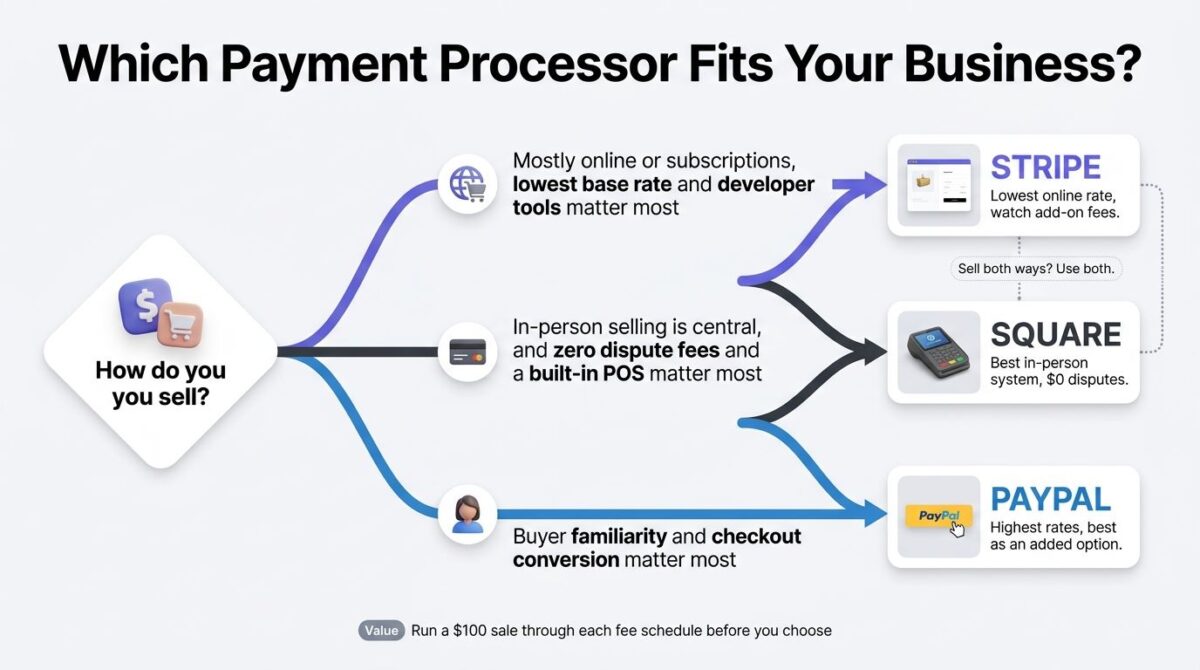
Choose Stripe if the business sells primarily online or by subscription, and the lowest base online rate and developer tooling matter more than integrated in-person hardware.
Choose Square if in-person selling is central to the business, and having no dispute fees and a complete POS system matters more than the lowest possible online rate.
Choose PayPal if buyer familiarity and checkout conversion matter more than the lowest fee, ideally offered alongside Stripe or Square rather than as the only option.
Our Recommendations
Beyond payment gateway fees, growing ecommerce operations also need to track overhead and employee spending using corporate card and expense management platforms. Based on 30 days of testing across online and in-person transactions, here is the recommended setup by situation:
Online store or SaaS business with a subscription model: Stripe, for the lowest online rate and deepest billing tooling, budgeting for the add-on fees that apply to international and subscription volume.
Brick-and-mortar shop, cafe, or market stall: Square, for the integrated POS system and zero dispute fees.
Business with both a website and a physical location: Square for in-person and Stripe for online, since Square’s online rate is now above Stripe’s.
Online seller wanting to capture buyers who prefer PayPal: Stripe as the primary processor, with PayPal added as a secondary checkout option rather than the main one.
Business selling heavily to international customers: Stripe, and watch currency conversion costs closely on any platform, since PayPal’s 3-4% spread is the single largest hidden cost in this comparison.
Final Verdict
Running an online storefront involves more than just processing card transactions; founders also need efficient communication workflows backed by AI-powered email productivity assistants. Stripe, Square, and PayPal each fit a different kind of seller, and the headline rate is less useful than the effective rate after add-on fees and the mix of online, in-person, and international sales.
- Stripe – 4.3 / 5 – the lowest online rate and best developer tooling, with add-on fees that need tracking
- Square – 4.1 / 5 – the strongest in-person platform with no dispute fees, and a late-2025 online rate increase older reviews miss
- PayPal – 3.8 / 5 – the highest rates and steepest hidden costs, offset by buyer familiarity
Before choosing based on the headline rate alone, run a $100 sale through each platform’s full fee schedule for the specific mix of online, in-person, and international sales. The cheapest platform on paper often isn’t the cheapest once currency conversion and disputes are counted.
Frequently Asked Questions
Did Square raise its fees recently?
Yes. In late 2025, Square raised its in-person fixed fee from $0.10 to $0.15 and increased the Free plan’s online and invoice rate from 2.9% + $0.30 to 3.3% + $0.30. On a $100 online sale, that’s now $3.60 versus Stripe’s $3.20.
Are Stripe and Square’s online fees still the same?
No, not anymore. They matched at 2.9% + $0.30 before Square’s late-2025 change. Square’s Free plan is now 3.3% + $0.30 online, though its Plus and Premium plans still charge 2.9% + $0.30.
Does Square charge for disputes?
No. Square charges no dispute or chargeback fees, unlike Stripe at $15 per dispute and PayPal at $15 to $30, plus a separate $20 chargeback fee on card payments outside PayPal accounts.
What is PayPal’s currency conversion spread?
PayPal applies a spread of roughly 3% to 4% over the mid-market exchange rate when converting currencies. It’s built into the exchange rate rather than listed as a separate fee, which is why it’s often underestimated.
Which processor is cheapest for an online store?
Stripe, at 2.9% + $0.30 per online card payment, or $3.20 on a $100 sale. Square’s Free plan costs $3.60, and PayPal Checkout costs $3.98 on the same sale, before any add-on fees apply.
Does Square Plus at $49 a month pay for itself?
Only with meaningful volume. Plus cuts the in-person rate by 0.1 percentage points and the online rate by 0.4 percentage points, so the monthly fee only pays for itself for a business processing enough volume for those small percentage savings to exceed $49.
Can I use more than one payment processor at once?
Yes, and many businesses do. A common setup pairs Stripe or Square as the main processor with PayPal as an added checkout option for customers who prefer paying through their PayPal accounts.
Which processor has the best developer tools?
Stripe, by a clear margin. Its API and documentation are widely regarded as the strongest of the three, which is why it’s the default choice for custom checkouts, subscription products, and marketplaces.