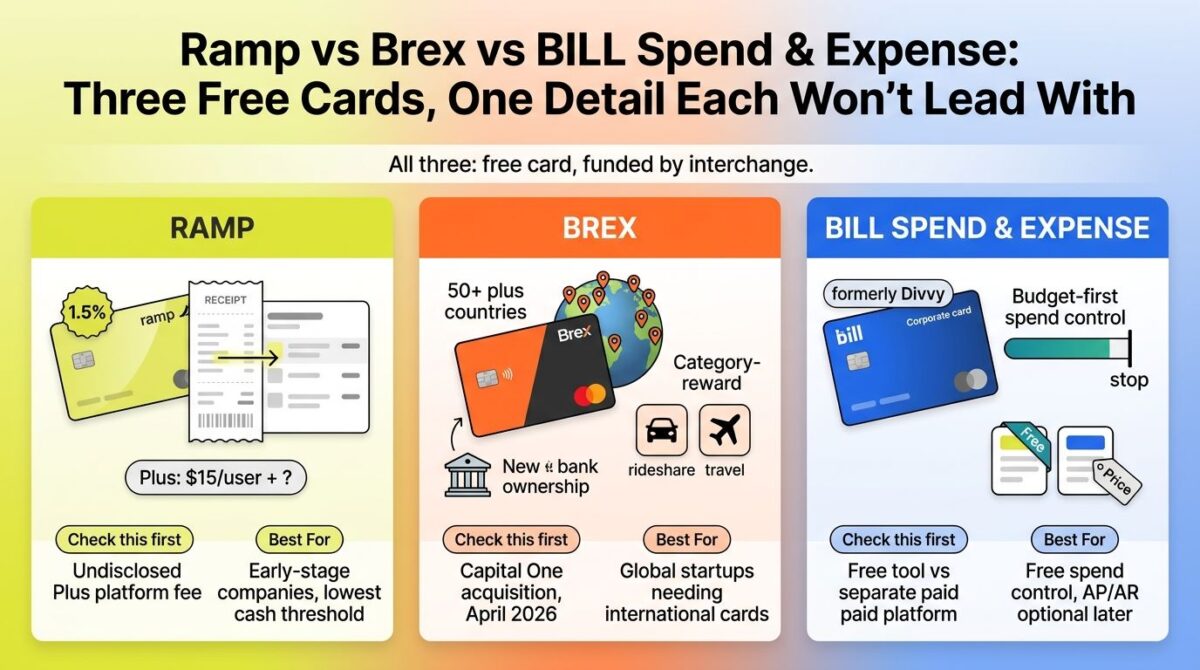
Ramp vs Brex vs BILL Spend & Expense all advertise a free corporate card with expense management built in, making money instead through interchange fees split with the card networks rather than a software subscription. That shared business model is where the similarities mostly end.
One quick note before comparing: BILL Spend & Expense is the current name for Divvy, renamed in September 2023 after BILL acquired it in 2021. Same free card and budgeting tool, consolidated under BILL’s broader brand.
I tested Ramp vs Brex vs BILL Spend & Expense for 30 days, applying for a card with each, setting up budgets and approval policies, and checking what each platform doesn’t put on its main pricing page. Here is the honest comparison, including a major bank acquisition that closed in April 2026 and changes who now owns one of these three platforms.
Table of Contents
How We Tested
Five criteria shaped the testing:
- Fee transparency, what’s published versus what requires digging or a sales conversation
- Eligibility requirements, minimum cash balance or bank account thresholds to qualify for a card
- Free tier depth, how much functionality is included in practice before a paid tier becomes necessary
- Company ownership and stability, any recent acquisitions or structural changes affecting the platform’s direction
- Core banking versus AP/AR scope, whether the free product is the whole platform or one piece of a larger paid suite
Ramp Review: A Mostly Transparent Fee Schedule, With One Undisclosed Number
Free plan: Yes, $0/month, no annual or platform fee on the entry tier
Starting price: $0; Plus adds $15/user/month plus an unpublished platform fee
Best plan for most users: Free, until advanced controls or priority support are specifically needed
Platforms: Web, iOS, Android
Affiliate program: Yes, Ramp referral program
Ramp built its reputation on a fully free entry tier and a published fee schedule, though that transparency has a specific gap once a business moves to its paid plan.
What Ramp does best
The Free plan covers meaningful ground: card issuance, 1.5% cash back, expense management, receipt collection, basic policy controls, and QuickBooks integration, all at no monthly cost, often streamlined further when connected through workflows from our Zapier vs Make vs n8n: Best No-Code Automation Tools comparison. Most early-stage companies never outgrow this tier. Ramp’s published fee schedule for ACH and check payments is also stated plainly on its pricing page, a level of upfront disclosure neither Brex nor BILL matches as clearly for comparable transaction types.
Qualifying requires at least $25,000 in a linked business bank account, lower than Brex’s threshold, making Ramp accessible to a broader range of early-stage businesses that are also setting up their financial stack with insights from our Mercury vs Novo vs Relay: Best Online Business Bank Accounts guide.
Where Ramp falls short
Ramp’s own pricing page states that Plus, at $15 per user per month, costs “$15 plus platform fee based on team size” without disclosing what that platform fee amounts to. Independent research into Ramp’s pricing confirms this gap directly: the amount isn’t published anywhere, and anyone citing a specific number for it is estimating rather than quoting a confirmed figure.
New ACH and check payment fees, $0.59 and $1.99 per transaction respectively, took effect June 1, 2026, after a grace period for existing accounts, a cost that didn’t exist on the platform previously.
Ramp pricing
| Plan | Price | Additional Fees | Notable Feature |
|---|---|---|---|
| Free | $0/month | None | Card, 1.5% cash back, basic expense management |
| Plus | $15/user/month | Unpublished platform fee based on team size | Advanced controls, priority support |
| Enterprise | Custom | Custom | API access, SOC 2 Type II reporting |
Ramp: Pros and Cons
Pros:
- Fully functional free tier most early-stage companies never outgrow
- Lower cash balance requirement than Brex for card eligibility
- Published ACH and check transaction fees, stated clearly
- No annual fee or interest, since it’s a charge card paid in full monthly
Cons:
- Plus tier’s platform fee amount is not disclosed anywhere
- New ACH and check fees took effect in June 2026, adding cost that didn’t exist before
- Sole proprietors are ineligible; only registered corporations, LLCs, and LPs
- Enterprise pricing requires a sales conversation with no published range
Rating: 4.2 / 5, mostly transparent and fully free at the entry tier, with one specific pricing gap on its paid plan to ask about directly.
Brex Review: Strong Features, Now Owned by a Major Bank
Free plan: Yes, Essentials, $0/user/month
Starting price: $0; Premium $12/user/month
Best plan for most users: Essentials, until multi-entity support or advanced approvals are needed
Platforms: Web, iOS, Android
Affiliate program: Yes, Brex referral program
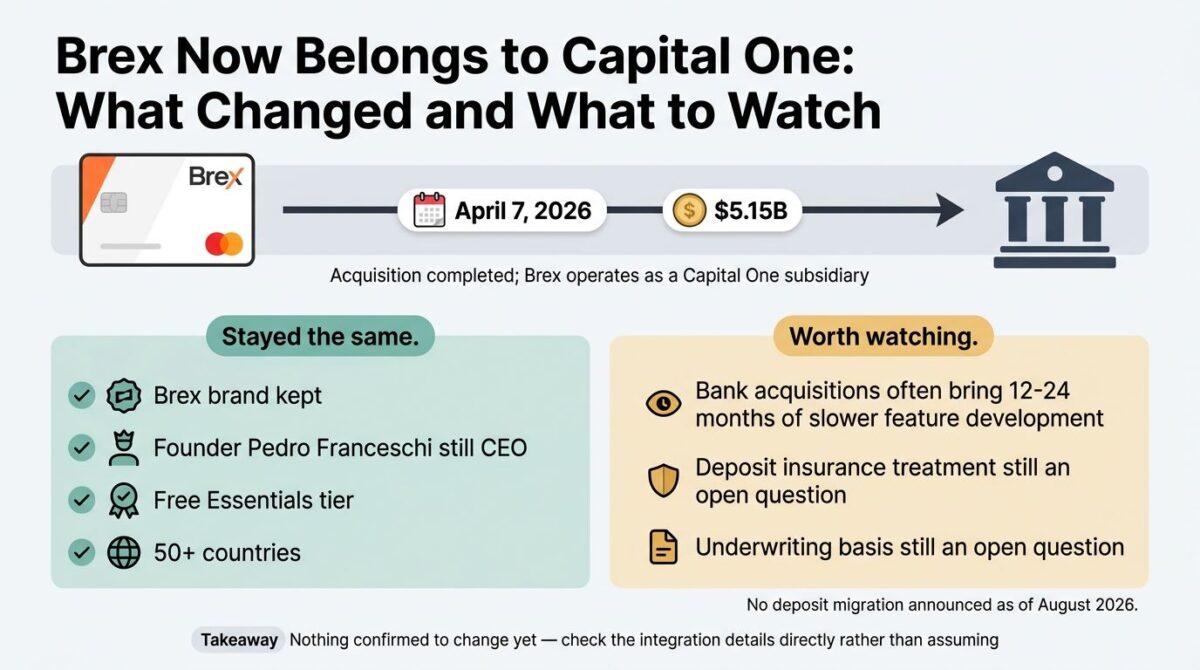
Capital One completed its $5.15 billion acquisition of Brex on April 7, 2026, bringing a startup-focused corporate card platform under the ownership of a major US bank.
What Brex does best
Essentials, the free tier, includes global corporate cards in more than 50 countries, a business account, bill pay, and travel booking, broader international reach than either competitor’s free tier offers, making it a strong fit for distributed teams that also manage communications through tools reviewed in our RingCentral vs Dialpad vs Quo: Best Business VoIP Phone Systems article. Category-based rewards, up to 7x on rideshare and 4x on Brex travel, also outpace Ramp’s flat cash back structure for companies with spend concentrated in those categories.
Brex founder Pedro Franceschi has stayed on as CEO following the acquisition, and Brex has retained its own brand rather than being absorbed into Capital One’s existing products, at least as of this writing.
Where Brex falls short
The Capital One acquisition deserves close attention rather than treatment as a footnote: deals of this size typically come with a 12 to 24 month period of slower feature development as the acquired platform integrates with the parent company’s systems, and questions about deposit insurance treatment and underwriting basis remain open as the integration proceeds. No migration of Brex deposits onto Capital One’s bank charter had been announced as of August 2026, but that’s a detail to check directly rather than assuming it will stay unchanged.
Eligibility also requires a higher cash balance than Ramp, generally $50,000 in a linked account for monthly billing, and while Brex advertises no foreign transaction fee, it does apply a currency markup on the exchange rate for non-USD transactions.
Brex pricing
| Plan | Price | Entities | Notable Feature |
|---|---|---|---|
| Essentials | $0/user/month | Up to 2 | Global cards, business account, bill pay, travel |
| Premium | $12/user/month (annual) | Multiple | Multiple policies, dynamic approvals |
| Enterprise | Custom | Unlimited | Named account manager, global card issuance |
| Smart Card | Custom | N/A | Procurement card with merchant controls |
Brex: Pros and Cons
Pros:
- Broadest international card issuance of the three, 50+ countries
- Category-based rewards outpace flat cash back for travel-heavy spend
- Founder and CEO continuity maintained after the Capital One acquisition
- Free Essentials tier includes bill pay and travel, not just cards
Cons:
- Now owned by Capital One following an April 2026 acquisition, with integration uncertainty ahead
- Higher cash balance requirement than Ramp for card eligibility
- Currency markup applies to non-USD transactions despite “no FX fee” marketing
- Late payment fee of 2.99% or $38, whichever is higher, on an otherwise fee-light card
Rating: 4.0 / 5, a strong feature set for global startups, now carrying the same integration uncertainty that follows any fintech acquired by a major bank.
BILL Spend & Expense Review: Fully Free, If You Don’t Confuse It With BILL’s Paid Platform
Free plan: Yes, $0/user/month, unlimited cardholders
Starting price: $0 for Spend & Expense; separate BILL AP/AR plans start at $45-49/user/month
Best plan for most users: The free Spend & Expense tier, unless full AP/AR automation is specifically needed
Platforms: Web, iOS, Android
Affiliate program: Yes, BILL affiliate program
BILL Spend & Expense, formerly Divvy, remains fully free for its core card and budgeting product, with BILL’s broader accounts payable and receivable platform sold as a completely separate paid line.
What BILL Spend & Expense does best
The free tier covers unlimited cardholders, budgets, reimbursements, and access to credit lines ranging from $1,000 to $5 million, all without a software subscription fee, the same interchange-funded model Ramp uses. Businesses switching from paid tools like Concur or Expensify report replacing that cost entirely with no subscription fee on the Spend & Expense side specifically.
Budget-first spend control, where a card simply can’t exceed its allocated budget rather than catching overspending after the fact, is a clear structural difference from Ramp’s and Brex’s more after-the-fact approval models.
Where BILL Spend & Expense falls short
“BILL” as a brand covers two different products that are easy to conflate: the free Spend & Expense card and budgeting tool, and a separate, paid BILL Financial Operations Platform for full accounts payable and receivable automation, priced at $45-49/user/month for Essentials up to $79-89/user/month for Corporate. A business comparing “free BILL” against Ramp’s or Brex’s free tiers should confirm which BILL product is on the table before assuming equivalent scope.
Per-transaction fees still apply for ACH, instant transfers, international wires, and physical checks regardless of which BILL product is in use, consistent with how Ramp and Brex both handle these payment types as well.
BILL Spend & Expense pricing
| Plan | Price | Entities | Notable Feature |
|---|---|---|---|
| Essentials | $0/user/month | Up to 2 | Global cards, business account, bill pay, travel |
| Premium | $12/user/month (annual) | Multiple | Multiple policies, dynamic approvals |
| Enterprise | Custom | Unlimited | Named account manager, global card issuance |
| Smart Card | Custom | N/A | Procurement card with merchant controls |
BILL Spend & Expense: Pros and Cons
Pros:
- Fully free core product with unlimited cardholders and no subscription fee
- Budget-first spend control blocks overspending before it happens, not after
- Access to credit lines up to $5 million without a separate loan application
- Transparent interchange-funded model, same as Ramp’s approach
Cons:
- Easy to confuse the free Spend & Expense tool with BILL’s separate, paid AP/AR platform
- Full accounts payable and receivable automation requires a different paid product entirely
- Per-transaction fees still apply for ACH, instant transfers, and international wires
- Smaller international card footprint than Brex’s 50-plus country coverage
Rating: 4.1 / 5, a fully free core product with a brand structure that requires a moment of clarity about which BILL product is under evaluation.
Head-to-Head Comparison
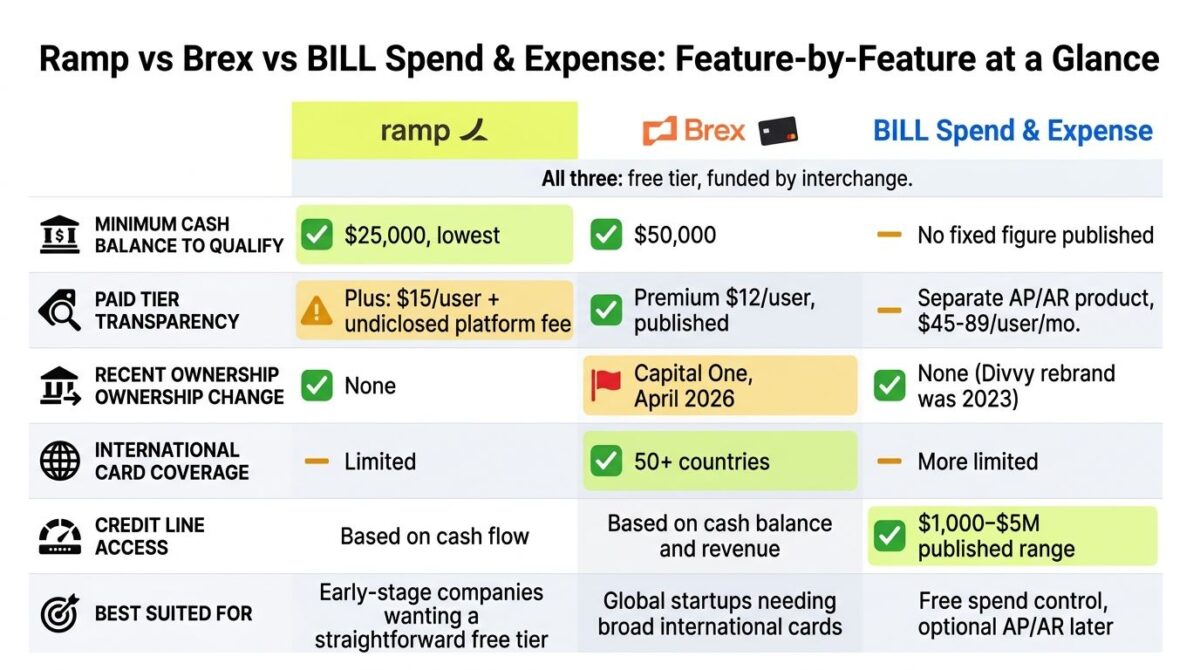
| Feature | Ramp | Brex | BILL Spend & Expense |
|---|---|---|---|
| Free tier | Yes, $0/month | Yes, Essentials $0/month | Yes, Spend & Expense $0/month |
| Minimum cash balance to qualify | $25,000 | $50,000 | Not published as a fixed figure |
| Paid tier transparency | Platform fee on Plus is undisclosed | Premium at $12/user, published | Separate AP/AR product, $45-89/user/month |
| Recent ownership change | No | Acquired by Capital One (April 2026) | No (Divvy rebrand was 2023) |
| International card coverage | Limited | 50+ countries | More limited |
| Credit line access | Based on cash flow | Based on cash balance and revenue | $1,000-$5M, published range |
| Best suited for | Early-stage companies wanting a straightforward free tier | Global startups needing broad international card issuance | Businesses wanting free spend control with optional AP/AR later |
Which Should You Choose?
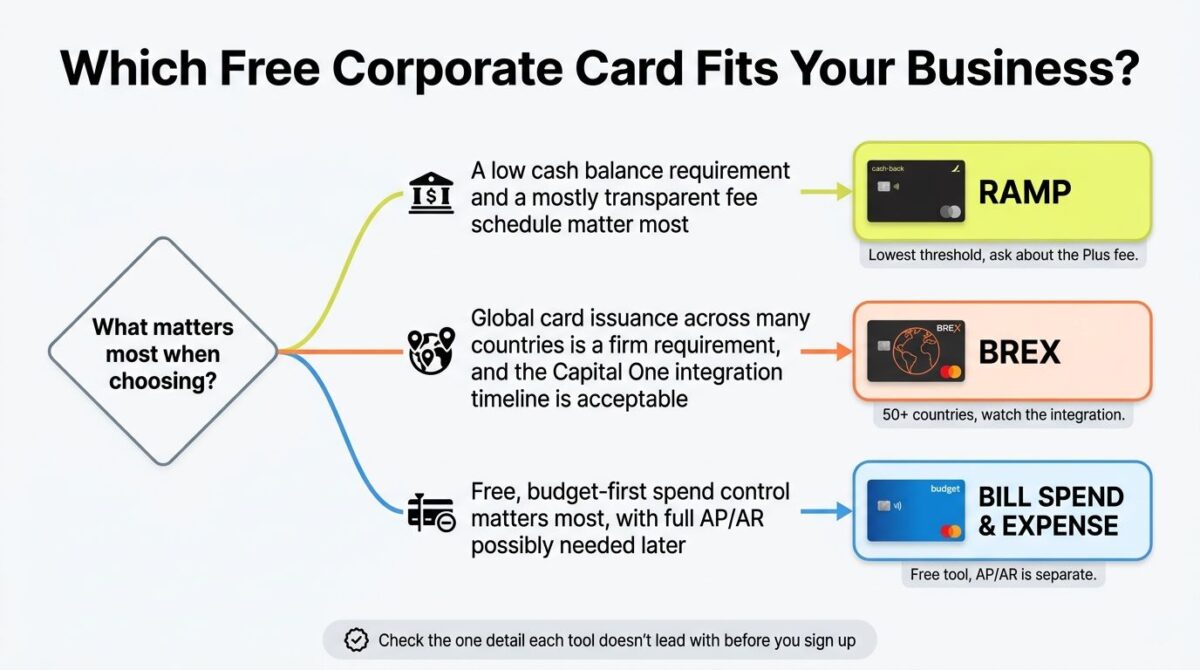
Choose Ramp if a lower cash balance requirement and a mostly transparent fee schedule matter most, while confirming the Plus platform fee directly if that tier is needed.
Choose Brex if global card issuance across many countries is a firm requirement, and the Capital One acquisition’s integration timeline is an acceptable tradeoff for the feature set.
Choose BILL Spend & Expense if free spend control and budget-first card limits matter most, with a clear understanding that full AP/AR automation is a separate paid product if needed later.
Our Recommendations
Based on 30 days of testing across card issuance, budgeting, and fee research, here is the recommended setup by situation:
Early-stage startup with $25,000-$50,000 in the bank: Ramp’s free tier, for the lowest qualifying threshold of the three.
Startup operating internationally across many countries: Brex Essentials, for the broadest card issuance footprint, while monitoring how the Capital One integration develops.
Business wanting budget-first spend control with no subscription fee: BILL Spend & Expense, confirming it’s the free Spend & Expense product rather than BILL’s separate paid AP/AR platform.
Team needing Ramp’s advanced controls on Plus: Call Ramp directly to get the specific platform fee amount before budgeting, since it isn’t published anywhere.
Business already using BILL for accounts payable: BILL Spend & Expense pairs naturally under the same brand, though it remains a fully separate product from the paid AP/AR tiers.
Final Verdict
Ramp, Brex, and BILL Spend & Expense all offer a free corporate card funded by interchange fees, but each carries a different piece of information to confirm before signing up, especially for founders managing high-volume vendor communications and outreach using assistants from our Superhuman vs Compose AI vs Lavender: Best AI Email Writing Assistants roundup.
- Ramp, 4.2 / 5, mostly transparent and fully free at entry, with one undisclosed platform fee on its paid tier
- BILL Spend & Expense, 4.1 / 5, a fully free core product, easy to confuse with BILL’s separate paid AP/AR platform
- Brex, 4.0 / 5, a strong feature set now carrying measurable integration uncertainty following its April 2026 acquisition by Capital One
Before choosing based on the advertised free tier alone, check the specific detail each one doesn’t lead with: Ramp’s undisclosed platform fee, Brex’s new ownership under Capital One, and which BILL product is on the table.
Frequently Asked Questions
Is Brex really owned by Capital One now?
Yes. Capital One completed its $5.15 billion acquisition of Brex on April 7, 2026. Brex keeps its own brand, and founder Pedro Franceschi remains CEO, but the company is now a Capital One subsidiary, and acquisitions of this size typically bring a slower pace of feature development during integration.
What is Ramp’s undisclosed platform fee on the Plus plan?
It isn’t published anywhere. Ramp’s own pricing page states Plus costs $15 per user per month “plus platform fee based on team size” without stating the fee amount, and independent research confirms no public figure exists for it.
Is BILL Spend & Expense the same as Divvy?
Yes. Divvy was renamed BILL Spend & Expense in September 2023, three years after BILL acquired it. The product, features, and free pricing model carried over unchanged under the new name.
Does BILL Spend & Expense include accounts payable automation?
No, not in the free tier. Full AP/AR automation is a separate paid BILL product starting around $45-49/user/month, distinct from the free Spend & Expense card and budgeting tool.
Which of these three has the lowest eligibility requirement?
Ramp, requiring roughly $25,000 in a linked business bank account, compared to Brex’s typical $50,000 threshold for monthly billing eligibility. BILL Spend & Expense doesn’t publish a single fixed minimum in the same way.
Does Brex really charge no foreign transaction fees?
No fee is charged in the traditional sense, but Brex applies a currency markup on the exchange rate for non-USD transactions, which functions similarly to a foreign transaction fee even though it isn’t labeled as one.
Will Brex’s features change now that Capital One owns it?
Nothing has been confirmed to change as of this writing, and Brex has retained its brand and leadership. However, bank acquisitions of fintech platforms commonly bring a 12- to 24-month period of slower feature velocity during systems integration, a trend to monitor over the coming year.
Which platform offers the most international card coverage?
Brex, by a clear margin, issues local-currency cards in more than 50 countries. Ramp’s and BILL Spend & Expense’s card programs are both more US-centric by comparison.