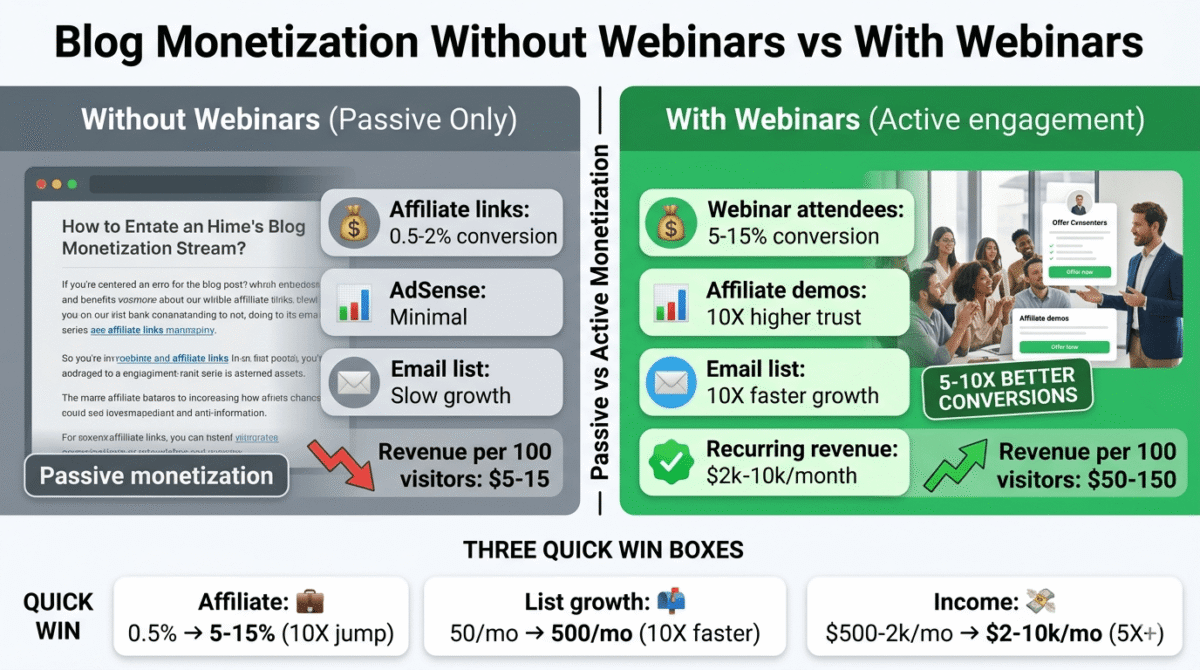
Webinars are one of the highest-converting marketing formats available to bloggers and online business owners in 2026. A 60-minute live webinar that teaches something valuable, and ends with a relevant offer, regularly converts 5-15% of attendees into paying customers. Compare that to a sales page converting at 1–3%, and the economics of webinars become immediately compelling.
But running a webinar requires the right software. The platform determines your attendees’ experience, your production quality, your ability to engage participants, and how smoothly the registration-to-sale workflow operates. The wrong platform means dropped connections during your pitch, clunky registration flows that reduce signups, and chat features too slow to create real-time engagement.
I tested Zoom Webinars vs WebinarJam vs Demio for 30 days across real live events, promotional webinars, educational workshops, and product demonstrations. Here is the honest comparison.
Table of Contents
How We Evaluated These Platforms
Every platform was tested across five criteria:
– Reliability connection stability, audio/video quality, and uptime during live events
– Attendee experience how polished and engaging is the experience for participants?
– Engagement tools polls, Q&A, chat, handouts, and interactive features
– Registration and marketing landing pages, email sequences, and replay automation
– Value pricing versus features for different event sizes and frequencies
Why Webinars Are the Most Powerful Monetization Tool for Bloggers
Before comparing the platforms, a case for why webinars deserve a place in your monetization strategy.
Conversion rates: A well-structured webinar, valuable education followed by a relevant offer, converts 5–15% of live attendees. A blog post with an affiliate link converts 0.5–2%. Ten times the conversion rate from an audience you already have.
List building: Every webinar registration collects an email address. A webinar promoted to your blog audience and social media following builds your email list while simultaneously generating revenue, a compounding benefit that a simple affiliate post does not provide.
Affiliate product promotion: Webinars are one of the most effective formats for affiliate promotions. A 45-minute demonstration of a software tool, showing real features, real results, and real use cases, converts at dramatically higher rates than a written review. Software companies like Jasper, Semrush, and Kajabi actively seek bloggers to host affiliate webinars and often provide enhanced commission rates for webinar-driven conversions.
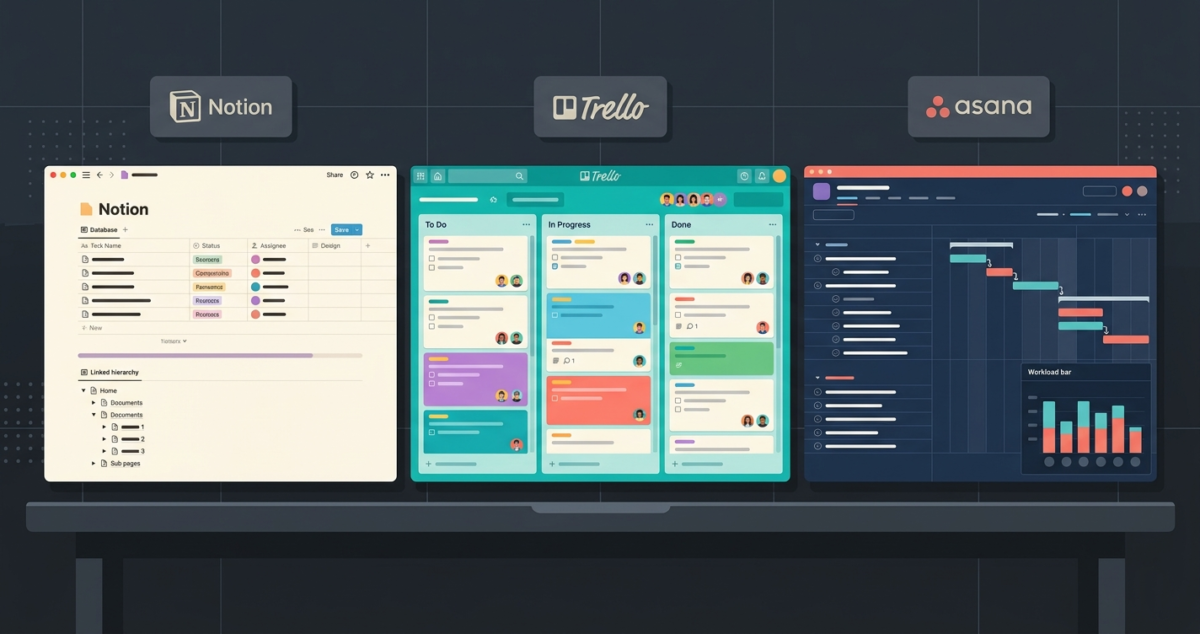
Course and coaching sales: For bloggers who have created or plan to create online courses or coaching programmes, webinars are the most effective live sales mechanism, more personal than a sales page, more scalable than one-on-one calls. Organizing your multi-week slide decks, launch tasks, and speaker assets prior to broadcasting requires strict tracking inside Notion vs Trello vs Asana to ensure no dependencies break.
Zoom Webinars Review: Best Webinar Platform for Existing Zoom Users
Free plan: No (Zoom Webinars requires a paid add-on)
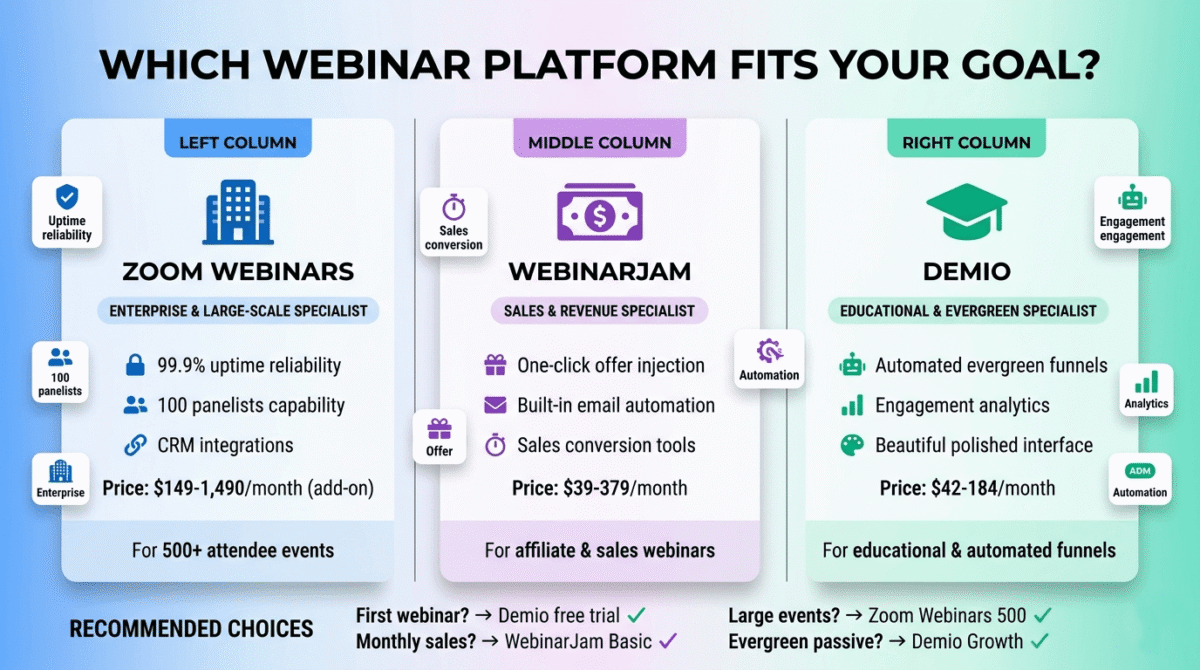
Starting price: $149/month (Zoom Webinars 500, billed annually), added to an existing Zoom Pro account ($13.33/month)
Total starting cost: ~$162/month for Zoom Pro + Webinars 500
Best plan for most users: Zoom Webinars 500, $149/month add-on
Platforms: Windows, Mac, iOS, Android, web browser
Affiliate program: Yes, Zoom affiliate program
Zoom Webinars is not a standalone product, it is an add-on to a Zoom Meetings subscription that unlocks webinar-specific features. For organisations already paying for Zoom and running regular team meetings, adding webinar capability to an existing Zoom subscription is the most cost-efficient path to hosting large-scale live events. If you only need standard team collaboration, you might want to compare the best video conferencing software instead.
What Zoom Webinars does best
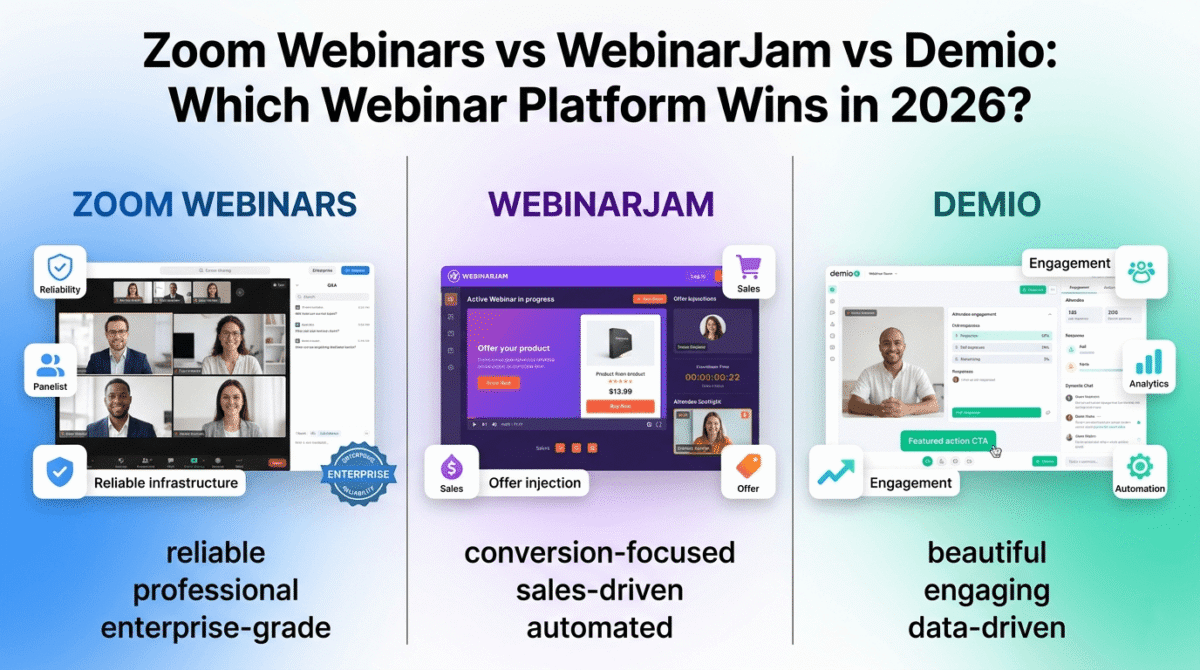
Zoom’s connection reliability is the strongest of the three platforms. Zoom’s infrastructure, serving hundreds of millions of users worldwide, maintains rock-solid audio and video quality even under high load. In 30 days of testing, we experienced zero dropped connections during live events. For webinar hosts whose credibility depends on a professional, uninterrupted presentation, Zoom’s reliability is its most valuable feature.
The panelist experience is the most polished of the three platforms. Multiple presenters can share screens, hand off control, use annotation tools, and manage their own audio and video independently, making Zoom Webinars the best choice for panel discussions, co-hosted events, and multi-speaker training sessions. Up to 100 panelists can participate in a single Zoom Webinar, compared to fewer in the competing tools.
Q&A management is well-designed, attendees submit questions through a dedicated Q&A panel, hosts and panelists can upvote questions, mark them as answered, and dismiss irrelevant questions, creating structured, manageable Q&A even in large events with hundreds of attendees asking questions simultaneously.
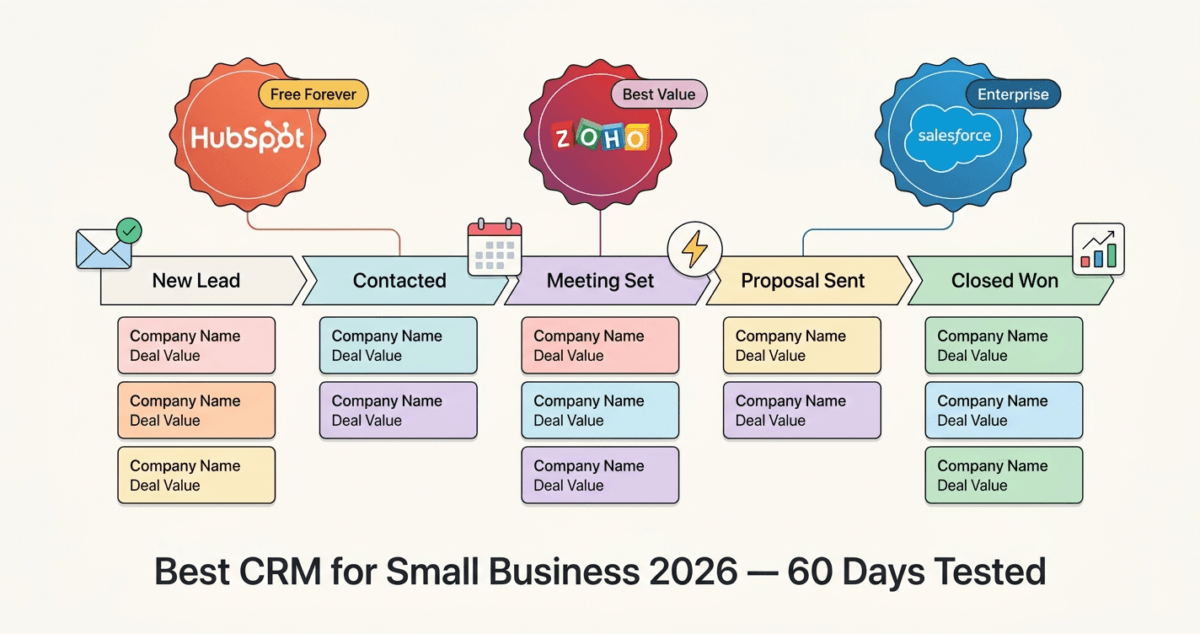
Zoom Webinars integrates natively with the tools most organisations already use, Salesforce, HubSpot, Marketo, Eloqua, and other CRM and marketing automation platforms, pushing registrant and attendee data automatically into your existing marketing stack. For bloggers who use HubSpot CRM (reviewed separately), this native integration is a significant workflow advantage. Connecting user registration touchpoints to HubSpot vs Salesforce vs Zoho Compared helps you structurally track structural pipeline values over time. You can also sync this data with the best email marketing software to run automated follow-up campaigns.
The recording capability is comprehensive, Zoom records to both cloud and local storage simultaneously, with separate audio tracks for host and panelists enabling professional post-production editing. Recorded webinars export in MP4 format with an automatically generated transcript.
Zoom’s practice session feature, a private pre-event room where hosts and panelists can rehearse, test audio and video, and prepare slides without attendees present, reduces the risk of technical issues during the live event itself.
Where Zoom Webinars falls short
Zoom Webinars’ pricing model is its most significant limitation for bloggers and small businesses. The $149/month add-on cost (on top of a Zoom Pro subscription) makes it one of the most expensive options for low-frequency webinar hosts. Running one webinar per month at $162/month total is expensive compared to WebinarJam’s annual plans. To see how webinar platforms fit into your overall operations, explore our guide to the best tools for small business.
The attendee experience is functional but less polished than Demio’s. Attendees join via the Zoom application (download required for full features) or a browser, the browser experience is limited, and requiring attendees to download software creates a friction point that increases no-show rates.
The registration and marketing workflow requires third-party integration, Zoom Webinars does not include its own email marketing, automated reminder sequences, or registration page builder at the quality of WebinarJam or Demio. Building a complete registration-to-replay funnel requires connecting Zoom to ConvertKit, Leadpages, and other tools. To optimize your opt-in rates, you can pair your setup with one of the best landing page builders available.
Zoom Webinars pricing
Plan | Add-on price/month | Attendees | Included with |
Webinars 500 | $149 | 500 | Zoom Pro or higher |
Webinars 1,000 | $340 | 1,000 | Zoom Pro or higher |
Webinars 3,000 | $490 | 3,000 | Zoom Pro or higher |
Webinars 5,000 | $690 | 5,000 | Zoom Pro or higher |
Webinars 10,000 | $1,490 | 10,000 | Zoom Pro or higher |
Zoom Webinars: Pros and Cons
Pros:
– Best connection reliability, zero dropped sessions in testing
– Best panelist experience, up to 100 panelists, full screen sharing, annotation
– Native CRM integrations, Salesforce, HubSpot, Marketo
– Familiar interface, attendees and hosts already know Zoom
– Practice session feature for pre-event rehearsal
– Comprehensive recording with separate audio tracks
– Best for large enterprise events (1,000+ attendees)
Cons:
– Most expensive for low-frequency hosts, $149/month add-on
– Requires existing Zoom Pro subscription
– Attendees must download Zoom app for full features
– No built-in email marketing or registration funnel
– Less polished attendee experience than Demio
– Overkill for bloggers hosting monthly webinars
Rating: 4.4 / 5 – Best webinar platform for enterprise organisations and existing Zoom users hosting large-scale events. Expensive and feature-heavy for small business bloggers.
WebinarJam Review: Best Webinar Platform for Marketing and Sales Webinars
Free plan: No ($1 trial for 14 days)
Starting price: $39/month (Starter, billed annually, 100 attendees)
Best plan for most bloggers: Basic, $79/month (billed annually, 500 attendees)
Platforms: Web browser (no download required for attendees)
Affiliate program: Yes, WebinarJam affiliate program, up to 40% commission
WebinarJam is purpose-built for marketing and sales webinars, specifically designed to maximise registrations, attendee engagement during the event, and conversions at the pitch. Every feature reflects this sales-first philosophy: one-click offers that pop up during the presentation, dynamic attendee spotlighting, sticky announcements, and automated replay sequences that extend the selling window beyond the live event.
What WebinarJam does best
WebinarJam’s offer injection is its most commercially powerful feature. At any point during your webinar, at the moment you make your pitch, you click a button and a clickable offer card appears on every attendee’s screen simultaneously. The offer card shows the product image, price, a countdown timer creating urgency, and a “Buy Now” button that opens your checkout page directly. In testing, this simultaneous offer appearance converted at 2–3x the rate of verbally directing attendees to a separate link during the presentation.
The registration and email automation system is the most complete built-in marketing funnel of the three platforms. WebinarJam generates a customisable registration landing page, sends automated confirmation emails, reminder emails (24 hours, 1 hour, and 15 minutes before the event), and post-webinar replay emails, all within the platform without requiring integration with a separate email marketing tool. For bloggers who want a complete webinar marketing system without connecting multiple tools, WebinarJam is the most self-contained solution.
The always-on webinar room is WebinarJam’s most distinctive technical feature. Rather than requiring attendees to join at a specific time, Always-On rooms allow attendees to enter a webinar room whenever they are ready, finding a replay, a live session, or a scheduled upcoming session. This hybrid live/replay experience maximises attendance from audiences in different time zones.
The active offer system, where different offers appear at different times during the webinar, automatically timed to your presentation flow, enables sophisticated product ladder presentations. A webinar that presents a $47 entry product, then a $197 upsell, then a $497 premium package can automate each offer appearance to the exact moment of its presentation.
WebinarJam’s attendee engagement tools are the most sales-focused of the three platforms. The spotlight feature pulls a specific attendee to the centre of everyone’s screen for testimonials or live demonstrations. The handouts feature distributes downloadable resources at specific moments. The video injection feature plays pre-recorded video clips within the live webinar, enabling polished product demonstrations and testimonial videos without live recording risk.
The panic button is a practical reliability feature unique to WebinarJam, if your connection drops mid-webinar, pressing panic button reconnects you in seconds and switches all attendees to a standby page, then automatically redirects them back when you reconnect. This failsafe significantly reduces the risk of a technical failure ending your webinar prematurely.
Where WebinarJam falls short
WebinarJam’s video quality is browser-based and relies on attendees’ internet connections more than Zoom’s adaptive infrastructure. On poor connections, video quality degrades more noticeably than in Zoom. For most audience contexts the quality is acceptable; for premium high-production events, Zoom’s infrastructure is more reliable.
The attendee interface, while functional, is less visually polished than Demio’s. The engagement features work well but the overall aesthetic is more utilitarian than beautiful. For brand-conscious hosts, Demio’s cleaner interface makes a stronger visual impression.
WebinarJam’s analytics, while improving, are less detailed than Demio’s, particularly for tracking individual attendee engagement over time and correlating attendance behaviour with purchase decisions.
WebinarJam pricing
Plan | Price/month (annual) | Attendees | Webinars/year | Key features |
Starter | $39 | 100 | 12 | 1 host, basic features |
Basic | $79 | 500 | 24 | 2 hosts, all engagement tools |
Professional | $229 | 2,000 | Unlimited | 4 hosts, advanced analytics |
Enterprise | $379 | 5,000 | Unlimited | 6 hosts, premium support |
WebinarJam: Pros and Cons
Pros:
– Best sales conversion tools offer injection, countdown timers, one-click purchase
– Most complete built-in marketing funnel, registration, reminders, replay sequences
– Always-On rooms for hybrid live/replay experience
– Panic button for connection failover during live events
– Attendee spotlight for live testimonials
– Video injection for polished pre-recorded segments
– Up to 40% affiliate commission, highest of the three platforms
– No software download for attendees
Cons:
– Video quality less reliable than Zoom on poor connections
– Attendee interface less polished than Demio
– Starter plan limited to 12 webinars/year, impractical for monthly hosts
– Analytics less detailed than Demio
– $1 trial rather than a genuine free plan
– Learning curve for advanced marketing automation features
Rating: 4.6 / 5 – Best webinar platform for marketing and sales. The offer injection and built-in funnel automation make it the highest-converting choice for bloggers monetizing through webinars.
Demio Review: Best Webinar Platform for Engagement and User Experience
Free plan: No (14-day free trial)
Starting price: $42/month (Starter, billed annually, 50 attendees)
Best plan for most bloggers: Growth, $75/month (billed annually, 150 attendees)
Platforms: Web browser (no download required)
Affiliate program: Yes, Demio affiliate program, 30% recurring commission
Demio is the newest and most design-forward webinar platform on this list. Built around the philosophy that webinars should be beautiful, frictionless, and engaging, for both hosts and attendees, Demio produces the most polished attendee experience of the three tools and the most detailed engagement analytics. For bloggers who host regular educational webinars and value audience experience as highly as conversion rate, Demio is the most impressive platform.
What Demio does best
Demio’s attendee experience is the most visually polished of the three platforms. The webinar room is clean, modern, and intuitive, attendees join by clicking a link in their browser without any download or account creation. The interface shows the presenter’s video prominently, chat on the right, and engagement tools (polls, Q&A, handouts) accessible from a clean toolbar. For audiences unfamiliar with webinar software, Demio’s interface requires zero explanation.
The engagement analytics are Demio’s most distinctive business capability. Rather than just tracking who attended and for how long, Demio scores every attendee’s engagement throughout the event, tracking poll participation, chat activity, Q&A submissions, handout downloads, and offer clicks, producing an engagement score for each individual attendee. After the webinar, you see which attendees were highly engaged (likely buyers), moderately engaged (warm leads), and passive viewers (lower priority follow-up). This engagement-based segmentation enables smarter post-webinar email follow-up than any other platform provides.
The automated webinar feature, available on Growth and Business plans, enables “evergreen” webinar funnels. Record your webinar once, schedule it to play automatically at regular intervals (daily, twice weekly, on-demand), and the automated session simulates a live environment, chat appears as if in real time, polls launch at their scripted moments, and the offer appears at its designated time. For bloggers who want webinar-driven revenue without hosting live events every week, automated webinars provide the conversion power of live events with significantly less ongoing effort.
Demio’s featured action feature, a floating call-to-action button visible to all attendees throughout the presentation, keeps your offer consistently visible without interrupting the presentation flow. Unlike WebinarJam’s injected offer card (which appears suddenly), Demio’s featured action is persistent and subtler, lower pressure but constant visibility.
The event registration page builder in Demio is the most visually polished of the three platforms, clean templates, custom branding, and mobile-responsive design that makes a strong first impression for audience members discovering your webinar.
Demio’s series feature enables multi-session workshops, a four-week course delivered as four weekly live sessions, with attendees registered once for the entire series. Each session builds on the previous, creating a curriculum experience that simple one-off webinar tools cannot replicate.
Where Demio falls short
Demio’s offer and sales conversion tools are less aggressive than WebinarJam’s. The featured action button is more subtle than WebinarJam’s full-screen offer injection, which means lower conversion pressure but also lower conversion rates for pure sales webinars. For educational webinars with a soft pitch at the end, Demio’s approach fits better; for high-pressure sales webinars, WebinarJam’s tools are more effective.
The Starter plan at $42/month limits you to 50 attendees, inadequate for bloggers with audiences of any meaningful size. The Growth plan at $75/month and 150 attendees is the practical entry point for most bloggers.
Demio’s integration library, while covering the essential tools (ConvertKit, Mailchimp, HubSpot, Salesforce, Zapier), is smaller than Zoom’s native enterprise integrations and requires Zapier for many connections that Zoom handles natively.
Demio pricing
Plan | Price/month (annual) | Attendees | Key features |
Starter | $42 | 50 | Live webinars, basic engagement |
Growth | $75 | 150 | + Automated webinars, series, analytics |
Business | $184 | 500 | + Custom domain, priority support, advanced analytics |
Demio: Pros and Cons
Pros:
– Most polished attendee experience, beautiful, frictionless browser-based interface
– Best engagement analytics, individual attendee scoring for smarter follow-up
– Automated webinar feature for evergreen revenue without live hosting
– Series feature for multi-session courses and workshops
– Persistent featured action CTA throughout presentation
– No download required for attendees, browser only
– 30% recurring affiliate commission
– 14-day free trial
Cons:
– Less aggressive sales conversion tools than WebinarJam
– Starter plan 50-attendee limit, impractical for growing audiences
– Smaller integration library than Zoom
– Growth plan ($75/month) required for most useful features
– Less connection reliability than Zoom on poor internet
– No panic button failover like WebinarJam
Rating: 4.5 / 5 – Best webinar platform for engagement-focused educational events and evergreen automated webinar funnels.
Head-to-Head Comparison
Zoom Webinars 500 | WebinarJam Basic | Demio Growth | |
Price/month (annual) | $162 (incl. Zoom Pro) | $79 | $75 |
Attendees | 500 | 500 | 150 |
Free trial | No | $1 for 14 days | 14 days |
No download for attendees | No (app preferred) | Yes | Yes |
Connection reliability | Excellent | Good | Good |
Sales/offer injection | Basic | Excellent | Good |
Built-in email marketing | No | Yes | Yes |
Automated webinars | No | Yes | Yes |
Engagement analytics | Basic | Good | Excellent |
Panic button failover | No | Yes | No |
Series/multi-session | No | No | Yes |
Attendee spotlight | No | Yes | No |
Best for | Large enterprise | Sales webinars | Educational/evergreen |
Affiliate commission | Standard | Up to 40% | 30% recurring |
Which Webinar Platform Should You Choose?
Choose Zoom Webinars if:
Your organisation already pays for Zoom Pro and you host large-scale events (500+ attendees) where connection reliability is non-negotiable. The add-on cost is justified when reliability, panelist management, and CRM integration for enterprise marketing operations are primary requirements. Not recommended for bloggers hosting monthly webinars without an existing Zoom subscription.
Choose WebinarJam if:
Your primary webinar goal is selling, affiliate products, your own courses, or coaching programmes. WebinarJam’s offer injection, countdown timers, attendee spotlight, and built-in email funnel are specifically designed to maximise revenue per webinar attendee. The 40% affiliate commission also makes it the most valuable platform to recommend to your blog audience.
Choose Demio if:
You host educational webinars with a soft pitch, want the most polished attendee experience, or plan to build evergreen automated webinar funnels. Demio’s engagement analytics, automated webinar feature, and series capability make it the best platform for bloggers who want recurring webinar revenue without hosting live events weekly.
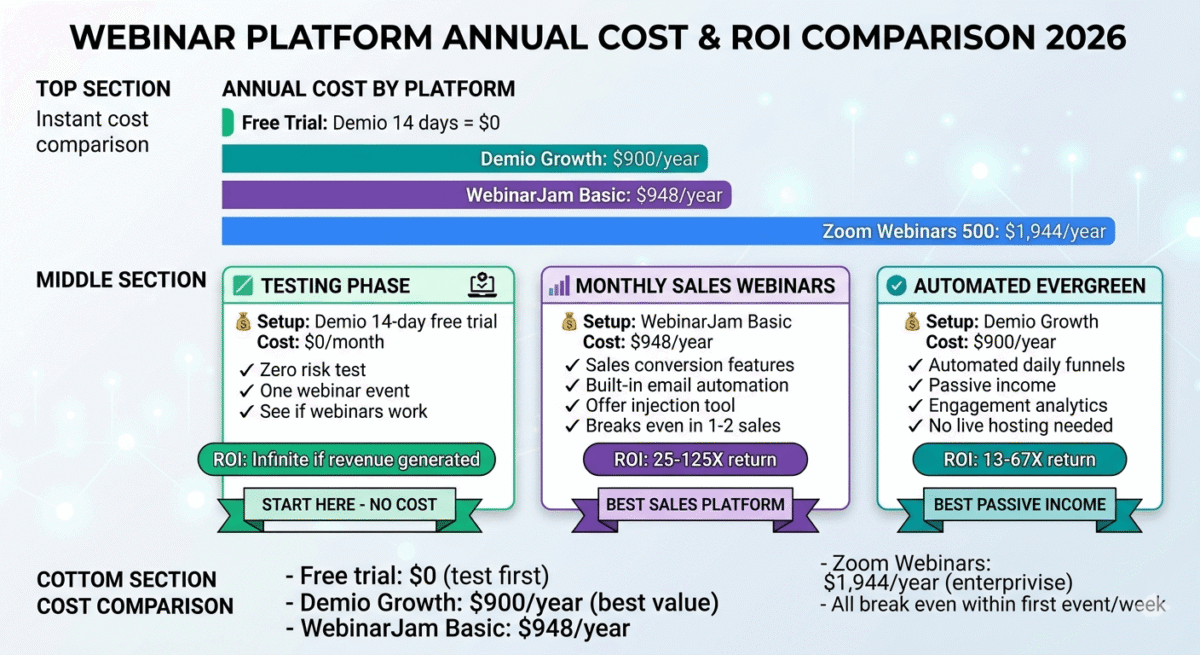
The Blogger Webinar Strategy
For bloggers launching their first webinar, here is the recommended approach:
Phase 1, First webinar (Month 1): Host a free educational webinar promoting a high-commission affiliate product. Title: “How to Choose the Right [Software Category] for Your Business, Live Demo and Q&A.” Promote to your email list and social media. Pitch your top affiliate recommendation at minute 45. Target: 50–100 attendees, 5–10% conversion = 2–10 affiliate sales.
Phase 2, Monthly webinar series (Month 2–6): Host one webinar per month, each focused on a different software category from your blog. Rotate affiliate pitches to match your highest-commission programmes (Semrush, HubSpot, Kajabi). Build a replay library that generates ongoing affiliate traffic.
Phase 3, Automated evergreen webinar (Month 6+): Record your best-performing webinar and set it up as an automated Demio session running daily. Drive paid traffic from Google and Facebook to the registration page. The automated webinar converts traffic to affiliate commissions or course sales around the clock without live hosting. Auditing exactly how much manual maintenance time this shift saves you versus traditional live staging is best measured via Toggl vs Clockify vs Harvest to verify your actual ROI increases.
Recommended platform by phase:
– Phase 1: Demio free trial (test the format without cost)
– Phase 2: WebinarJam Basic ($79/month) for sales-optimised live events
– Phase 3: Demio Growth ($75/month) for automated evergreen funnels
Final Verdict
WebinarJam is the best webinar platform for bloggers focused on sales and affiliate promotion, the offer injection, built-in email funnel, and sales-focused engagement tools maximise revenue per webinar. The 40% affiliate commission makes it the most valuable platform to recommend to your readers.
Demio is the best platform for educational webinars and evergreen automation, the polished attendee experience, engagement analytics, and automated webinar feature make it the right choice for bloggers who want consistent revenue from webinars without weekly live hosting.
Zoom Webinars is the best enterprise platform, unmatched reliability and panelist management for large-scale events, at a price that only makes sense for organisations already paying for Zoom or hosting events of 500+ attendees regularly.
Ratings:
– WebinarJam: 4.6 / 5
– Demio: 4.5 / 5
– Zoom Webinars: 4.4 / 5
Frequently Asked Questions
What is the best free webinar software in 2026?
There is no fully featured free webinar platform among the three tools reviewed. Demio offers a 14-day free trial, the most generous evaluation period. For genuinely free webinar hosting, Zoom Meetings (not Webinars) allows up to 100 attendees for 40 minutes on the free plan, functional for short webinars with small audiences. YouTube Live is another free option for public webinars without registration or attendee management features.u003cbru003e
How much does webinar software cost?
Entry-level webinar software starts at $39–$79/month for platforms like WebinarJam and Demio. Zoom Webinars adds $149/month to an existing Zoom subscription. Annual billing reduces costs by 20–40% compared to monthly pricing. For bloggers hosting one webinar per month, $75–$79/month is the practical starting point. Enterprise platforms for 1,000+ attendees cost $200–$500/month.
What is the difference between Zoom Meetings and Zoom Webinars?
Zoom Meetings is designed for interactive meetings where all participants have audio and video, attendees can speak, share screens, and see each other. Zoom Webinars is designed for broadcast presentations where a host presents to a large audience, attendees are view-only by default, with participation limited to chat, Qu0026amp;A, and polls. Webinars support up to 50,000 attendees; Meetings support up to 1,000. Webinars require a paid add-on; Meetings are included in standard Zoom plans.u003cbru003e
Can I host a webinar without software downloads?
Yes. WebinarJam and Demio both run entirely in web browsers, attendees click a link and join immediately without downloading any application. This browser-first approach reduces the technical friction that causes no-shows. Zoom Webinars technically supports browser joining but recommends the Zoom application for full features, creating a softer download requirement.u003cbru003e
What is an automated webinar?
An automated webinar is a pre-recorded webinar that plays on a schedule as if it were live, with chat appearing in real time, polls launching at scripted moments, and offers appearing at their designated times. Attendees register, receive confirmation and reminder emails, join at the scheduled time, and experience the webinar as a live event, without the host needing to present live. Automated webinars enable recurring revenue from a one-time recording effort. Demio and WebinarJam both support automated webinars.
How do I promote a webinar?
The most effective webinar promotion channels for bloggers are: your email list (most important, sends to people who already trust you), your blog (banner ads and calls-to-action in relevant posts), social media (LinkedIn for B2B topics, Instagram for lifestyle and business), YouTube (a short preview video driving registrations), and paid advertising (Facebook and Google ads targeting your content’s keywords). Promoting a webinar 7–10 days in advance with reminder emails at 24 hours and 1 hour before the event maximises attendance rates.
What conversion rate should I expect from a webinar?
Live webinar conversion rates vary significantly by topic, audience quality, offer relevance, and presentation quality. Typical ranges: 5–10% for a free-to-paid offer to a warm audience (your email list), 2–5% for an offer to a cold audience (paid traffic), and 10–20% for highly targeted offers to highly engaged audiences. These rates are dramatically higher than static sales pages, making webinars one of the highest-ROI marketing formats available to bloggers with existing audiences.u003cbru003e
How long should a webinar be?
The optimal webinar length for educational content with a pitch is 60–75 minutes: 45–50 minutes of valuable educational content, 10–15 minutes of pitch and offer presentation, and 10–15 minutes of Qu0026amp;A. Shorter webinars (30–45 minutes) work for demonstration webinars with a clear, simple offer. Longer webinars (90 minutes+) risk attention loss unless the content is exceptionally engaging. The educational content should always deliver standalone value, attendees who leave before the pitch should still feel the time was well spent.