Mercury vs Novo vs Relay all advertise the same headline: no monthly fees, no minimum balance, a business checking account built for a digital-first company setting up early web funnels and lead generation tools like those featured in OptinMonster vs BDOW vs Poptin.
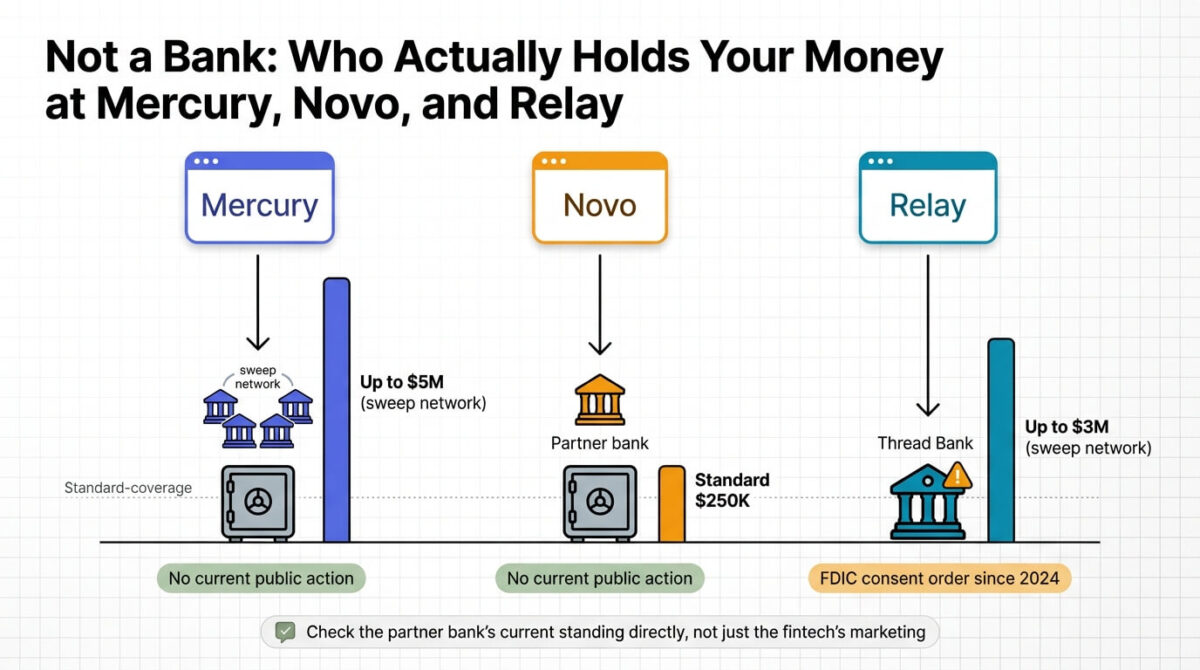
None of the three is a bank in the traditional sense; each is a fintech company partnering with a specific FDIC-insured bank behind the scenes, and which partner bank sits behind which fintech is something to know before committing.
All three skip cash deposits entirely, all three work well with modern accounting software and workflow automation tools like those covered in Zapier vs Make vs n8n, and all three target a similar customer: a startup, freelancer, or small business that doesn’t need a branch to walk into.
I tested Mercury vs Novo vs Relay for 30 days, opening an account with each, moving money through ACH and wire transfers, and checking what each one’s partner bank relationship means for account safety in practice. Here is the honest comparison, including a regulatory detail about one platform’s banking partner to know before you move meaningful money through it.
Table of Contents
How We Tested
Five criteria shaped the testing:
- Fee structure, monthly fees, wire costs, foreign transaction fees, and what triggers them
- Partner bank status, which specific bank holds the funds, and that bank’s current regulatory standing
- Account structure, how many sub-accounts or checking accounts are available, and at what tier
- Built-in tools, invoicing, bookkeeping, and accounting software integration included without an add-on
- Growth path: What a business gets in practice by moving to a higher tier as it scales
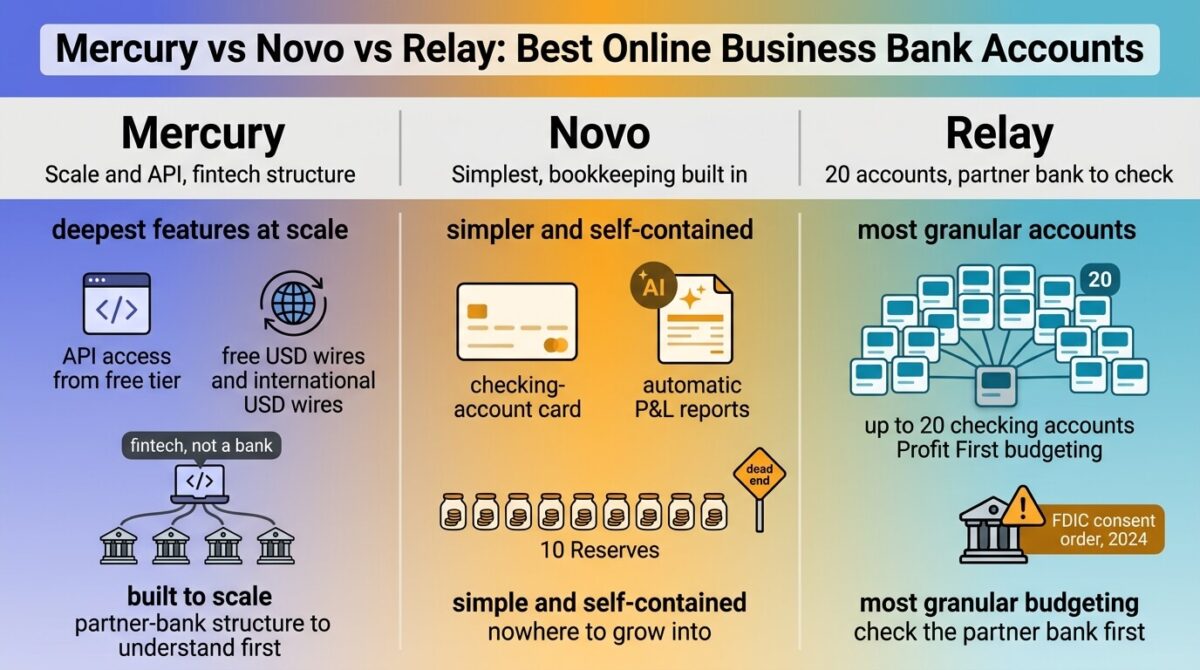
Mercury Review: The Deepest Feature Set at Scale, Without Being a Bank Itself
Free plan: Yes, $0/month, no minimum balance, no overdraft fees
Starting price: $0; Plus $35/month; Pro $299-350/month
Best plan for most users: Free tier, until NetSuite integration or advanced treasury tools are needed
Platforms: Web, iOS, Android, API access
Affiliate program: Yes, Mercury referral program
Mercury is a fintech platform, not a chartered bank, holding funds through partner banks and a multi-bank sweep network rather than a single FDIC-insured institution directly.
What Mercury does best
Free USD wire transfers, both domestic and international, are rare among business banking products and can save meaningful money for any business that sends wires regularly, since traditional banks typically charge $20-35 per wire. The multi-bank sweep network also extends FDIC coverage up to $5 million, well beyond the standard $250,000 limit, a meaningful safety margin for a business holding significant cash.
API access from the free tier, alongside Pro’s NetSuite integration, which connects enterprise financial data similarly to the systems evaluated in Sage Business Cloud vs Patriot Accounting vs NetSuite and recurring invoicing, make Mercury the most developed of the three for a tech company or scaling startup that wants to build custom financial workflows rather than rely on off-the-shelf tools.
Where Mercury falls short
Mercury is explicitly not an FDIC-insured bank itself; it’s a technology company that routes deposits through partner banks. That distinction matters for how deposit insurance applies in practice, and it’s a structure to understand rather than assume Mercury functions exactly like a traditional bank. No cash deposits are accepted at all, ruling it out as a sole banking relationship for any business that handles physical cash.
International wires in a non-USD currency carry a 1% foreign exchange fee, and non-USD card purchases cost 3%, both costs that add up for a business with regular international spending.
Mercury pricing
| Plan | Price | FDIC Coverage | Notable Feature |
|---|---|---|---|
| Mercury (Free) | $0/month | Up to $5M (sweep network) | API access, free USD wires |
| Mercury Plus | $35/month ($29.90 annual) | Up to $5M | Recurring invoicing, ACH debit collection |
| Mercury Pro | $350/month ($299 annual) | Up to $5M | NetSuite integration, dedicated RM |
Mercury: Pros and Cons
Pros:
- Free domestic and international USD wire transfers
- FDIC coverage up to $5M through its sweep network
- API access included from the free tier
- Most developed tier for scaling into NetSuite and advanced treasury tools
Cons:
- Not an FDIC-insured bank itself, a fintech using partner banks
- No cash deposits accepted under any plan
- 1% FX fee on non-USD wires, 3% on non-USD card purchases
- Pro tier’s $299-350/month cost is a meaningful jump from Plus
Rating: 4.2 / 5, the most developed platform for scaling tech companies, with a partner-bank structure and no cash deposit support to understand upfront.
Novo Review: The Simplest Option, With Built-In Bookkeeping Tools
Free plan: Yes, $0/month, the account’s only tier for most users
Starting price: $0/month, no minimum balance
Best plan for most users: The standard account, since Novo doesn’t tier by feature the way Mercury or Relay do
Platforms: Web, iOS, Android
Affiliate program: Yes, Novo referral program
Novo keeps its structure simple: one core checking account with built-in budgeting sub-accounts and AI-assisted bookkeeping that syncs smoothly with leading platforms detailed in our comparison of QuickBooks vs Xero vs Zoho Books, rather than multiple paid tiers to compare.
What Novo does best
AI-powered transaction categorization and automatically generated profit-and-loss reports give a solo freelancer or small business a lightweight bookkeeping layer without a separate subscription, exporting in tax-friendly categories suited to Schedule C preparation. Up to 10 Novo Reserves let a business set aside money for taxes or specific expenses automatically, and broad integrations with Stripe, Shopify, Square, and QuickBooks cover most small e-commerce and service business workflows.
The Novo perks program, including $5,000 in waived Stripe processing fees, adds tangible value beyond the banking relationship itself for a business already using those platforms.
Where Novo falls short
ATM fee reimbursement is capped at roughly $7 per month, a firm limit rather than the unlimited reimbursement some marketing language implies, something to know for a business that withdraws cash from ATMs regularly. There’s also no live phone support in the traditional sense, a frustration multiple reviewers specifically note when account issues need faster resolution than chat or email provides.
With no paid tier to grow into, a business that eventually needs NetSuite integration, advanced treasury management, or multiple sub-entities will need to look elsewhere, since Novo’s single-tier structure doesn’t offer an upgrade path the way Mercury’s or Relay’s do.
Novo pricing
| Plan | Price | Sub-Accounts | Notable Feature |
|---|---|---|---|
| Novo (only tier) | $0/month | Up to 20 Reserves | AI bookkeeping, Stripe/Shopify/QuickBooks integration |
Novo: Pros and Cons
Pros:
- AI-powered bookkeeping and P&L reports built in at no extra cost
- Up to 10 Reserves for automated budgeting by category
- Strong integrations with common small-business and e-commerce platforms
- $5,000 in waived Stripe fees through the Novo perks program
Cons:
- ATM fee reimbursement capped at roughly $7/month, not unlimited
- No live phone support, only chat and email channels
- Single-tier structure with no upgrade path for advanced treasury needs
- No APY on standard checking balances
Rating: 4.0 / 5, the simplest, most bookkeeping-friendly option for a solo business, with no room to grow into more advanced banking needs later.
Relay Review: The Best Multi-Account Structure, With a Partner Bank Under Regulatory Scrutiny
Free plan: Yes, Starter plan, $0/month, up to 20 checking accounts
Starting price: $0 (Starter); Grow $30/month; Scale $90-120/month
Best plan for most users: Starter, unless bill pay automation or advanced permissions are needed
Platforms: Web, iOS, Android
Affiliate program: Yes, Relay referral program
Relay structures its account around multiple sub-accounts rather than one, built specifically for cash flow systems like Profit First where money is deliberately split by purpose.
What Relay does best
Up to 20 individual checking accounts plus 2 savings accounts on the free Starter plan, with up to 50 debit cards assignable by role and spending limit, give the most granular account-splitting of the three tools tested. Native two-way sync with QuickBooks Online and Xero, combined with automated transfer rules between accounts, makes Profit First-style budgeting far easier to maintain than manually moving money between a single account’s sub-ledgers.
FDIC coverage up to $3 million through Relay’s banking partner, Thread Bank, extends well past the standard $250,000 limit, similar in spirit to Mercury’s sweep network approach.
Where Relay falls short
Thread Bank, the partner bank holding Relay’s deposits, has been under an FDIC consent order since 2024, a regulatory enforcement action to know about directly rather than discovering after funds are already moved. Some reviewers report account freezes and slower support specifically tied to the partner bank relationship, a pattern to weigh against Relay’s own features, which function well independent of that concern.
Bill pay automation and accounts payable tools are both locked to the $30/month Grow plan and above, so the free Starter tier covers account structure and basic banking but not the deeper AP automation some growing businesses need.
Relay pricing
| Plan | Price | Checking Accounts | Notable Feature |
|---|---|---|---|
| Starter | $0/month | Up to 20 | Debit cards by role, Profit First structure |
| Grow | $30/month | Up to 20 | Bill pay automation, AP tools |
| Scale | $90-120/month | Up to 20 | Advanced permissions, higher limits |
Relay: Pros and Cons
Pros:
- Most granular multi-account structure of the three, up to 20 checking accounts
- Native two-way QuickBooks Online and Xero sync
- FDIC coverage up to $3M through its partner bank’s sweep network
- Cheapest paid tier for bill pay automation among businesses needing that specific feature
Cons:
- Partner bank Thread Bank has been under an FDIC consent order since 2024
- Some reported account freezes and support friction tied to the partner bank
- Bill pay and AP automation require the $30/month Grow tier or higher
- No cash deposits accepted, consistent with both competitors
Rating: 3.9 / 5, the strongest multi-account structure for Profit First-style budgeting, with a partner bank regulatory status that deserves a direct look before moving significant funds.
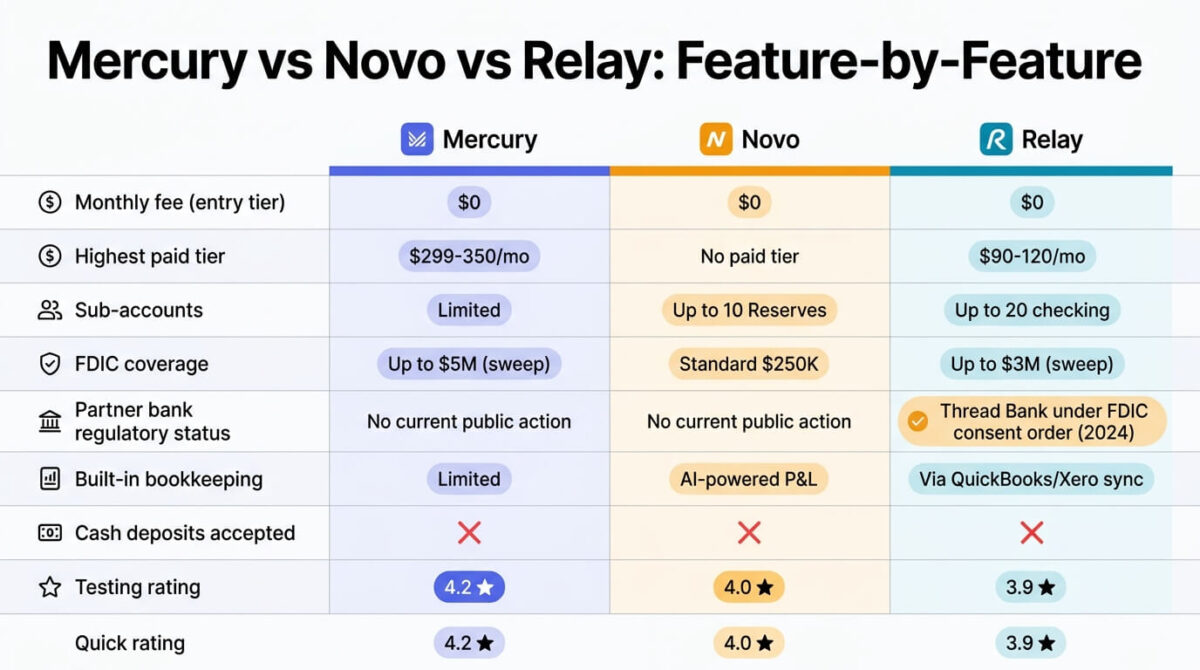
Head-to-Head Comparison
| Feature | Mercury | Novo | Relay |
|---|---|---|---|
| Monthly fee (entry tier) | $0 | $0 | $0 |
| Highest paid tier | $299-350/month | No paid tier | $90-120/month |
| Sub-accounts | Limited | Up to 20 Reserves | Up to 20 checking accounts |
| FDIC coverage | Up to $5M (sweep) | Standard $250K | Up to $3M (sweep) |
| Partner bank regulatory status | No current public action | No current public action | Thread Bank under FDIC consent order (2024) |
| Built-in bookkeeping | Limited | AI-powered P&L and categorization | Via QuickBooks/Xero sync |
| Best suited for | Scaling tech startups needing API/NetSuite | Solo freelancers wanting built-in bookkeeping | Profit First-style multi-account budgeting |
Which Should You Choose?
Choose Mercury if API access, NetSuite integration, or scaling treasury needs are on the roadmap, and the fintech-not-bank structure is understood upfront.
Choose Novo if a single, simple account with built-in AI bookkeeping covers the need, and growing into advanced treasury features isn’t expected.
Choose Relay if Profit First-style multi-account budgeting is the day-to-day workflow, with Thread Bank’s regulatory status factored into the decision rather than discovered afterward.
Our Recommendations
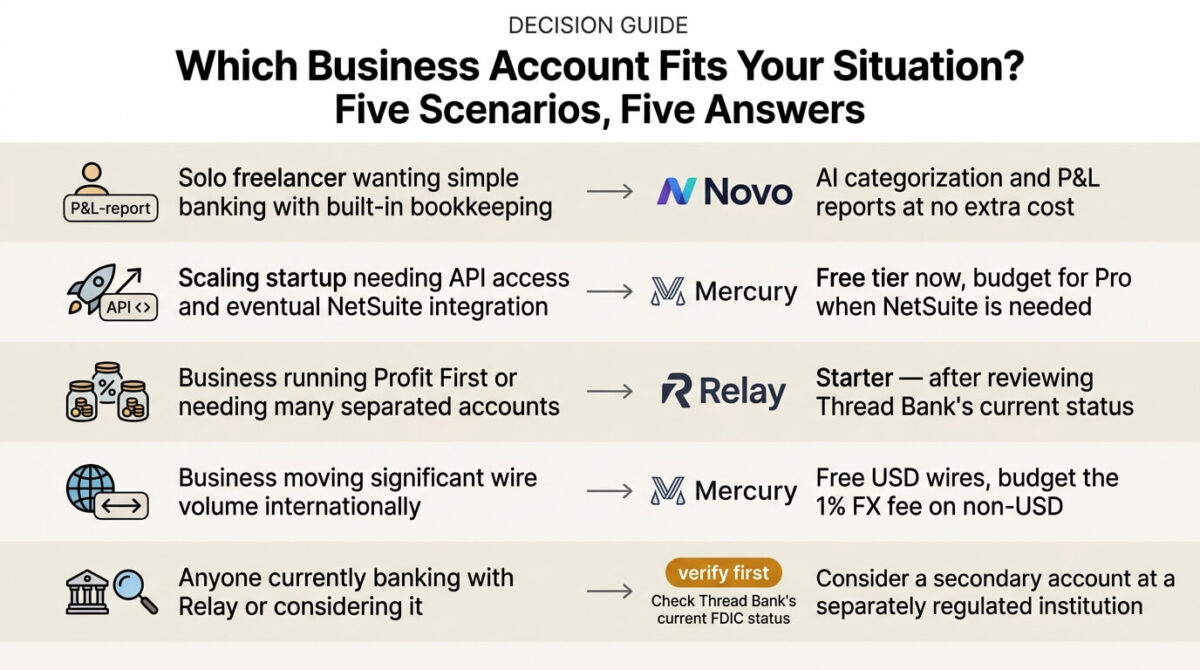
Based on 30 days of testing across account opening, fund transfers, and sub-account management, here is the recommended setup by situation:
Solo freelancer wanting simple banking with built-in bookkeeping: Novo, for the AI categorization and P&L reports at no extra cost.
Scaling startup needing API access and eventual NetSuite integration: Mercury, budgeting for Pro once those specific features become necessary.
Business running Profit First or needing many separated accounts: Relay Starter, after reviewing Thread Bank’s current regulatory status directly.
Business moving significant wire volume internationally: Mercury, for free USD wires, while budgeting the 1% FX fee on non-USD transfers.
Anyone currently banking with Relay or considering it: Check Thread Bank’s current FDIC status directly before moving a large balance, and consider keeping a secondary account at a separately-regulated institution as a safeguard.
Final Verdict
Mercury, Novo, and Relay all solve the same core problem for a digital-first business, but each carries a different structural consideration beyond the advertised fee-free headline.
- Mercury, 4.2 / 5, the most developed platform for scaling needs, built on a fintech-not-bank structure to understand first
- Novo, 4.0 / 5, the simplest option with built-in bookkeeping that holds up well, with no path to grow into advanced features
- Relay, 3.9 / 5, the best multi-account structure, paired with a partner bank currently under regulatory scrutiny
None of these three is a traditional bank, and all three route deposits through a partner institution behind the scenes. Checking that partner’s current standing directly, not just the fintech’s own marketing, is a reasonable step before moving meaningful funds through any of them.
Frequently Asked Questions
Is Relay’s banking partner currently under an FDIC enforcement action?
Yes, according to multiple independent reports, Thread Bank, which holds Relay’s deposits, has been under an FDIC consent order since 2024. This is a regulatory matter concerning the partner bank, not Relay’s own technology platform, but it’s a detail to check directly before relying on the account for significant funds.
Is Mercury an FDIC-insured bank?
No, not directly. Mercury is a financial technology company that partners with FDIC-insured banks and uses a sweep network to extend coverage up to $5 million. This is a common structure among fintech banking products, but it differs from banking directly with a single chartered institution.
Can I deposit cash into any of these three accounts?
No. Mercury, Novo, and Relay all decline cash deposits entirely. A business that regularly handles physical cash will need a secondary account at a traditional bank alongside any of these three.
Which of these three has the best built-in bookkeeping?
Novo, with AI-powered transaction categorization and automatically generated profit-and-loss reports built into the free account. Mercury and Relay both rely more on integration with external accounting software like QuickBooks or Xero rather than built-in categorization.
Which account offers the most sub-accounts for budgeting?
Relay, with up to 20 individual checking accounts plus 2 savings accounts on its free Starter plan, more than Novo’s 10 Reserves or Mercury’s more limited sub-account structure.
Does Mercury charge for international transactions?
USD-denominated domestic and international wires are free, but non-USD wires carry a 1% foreign exchange fee, and non-USD card purchases cost 3%. A business regularly transacting in foreign currencies should factor these into total cost.
Why does Novo cap ATM fee reimbursement?
Novo reimburses ATM fees up to roughly $7 per month, not unlimited despite some marketing language suggesting broad reimbursement. A business withdrawing cash frequently from out-of-network ATMs should check this limit against its own usage pattern.
Should I avoid Relay entirely because of Thread Bank’s regulatory status?
Not necessarily, but it’s a factor to weigh rather than ignore. Many businesses continue using Relay successfully, and the consent order concerns the partner bank’s compliance history rather than a confirmed loss of funds. Checking Thread Bank’s current status directly and considering a secondary account elsewhere is a reasonable precaution for larger balances.