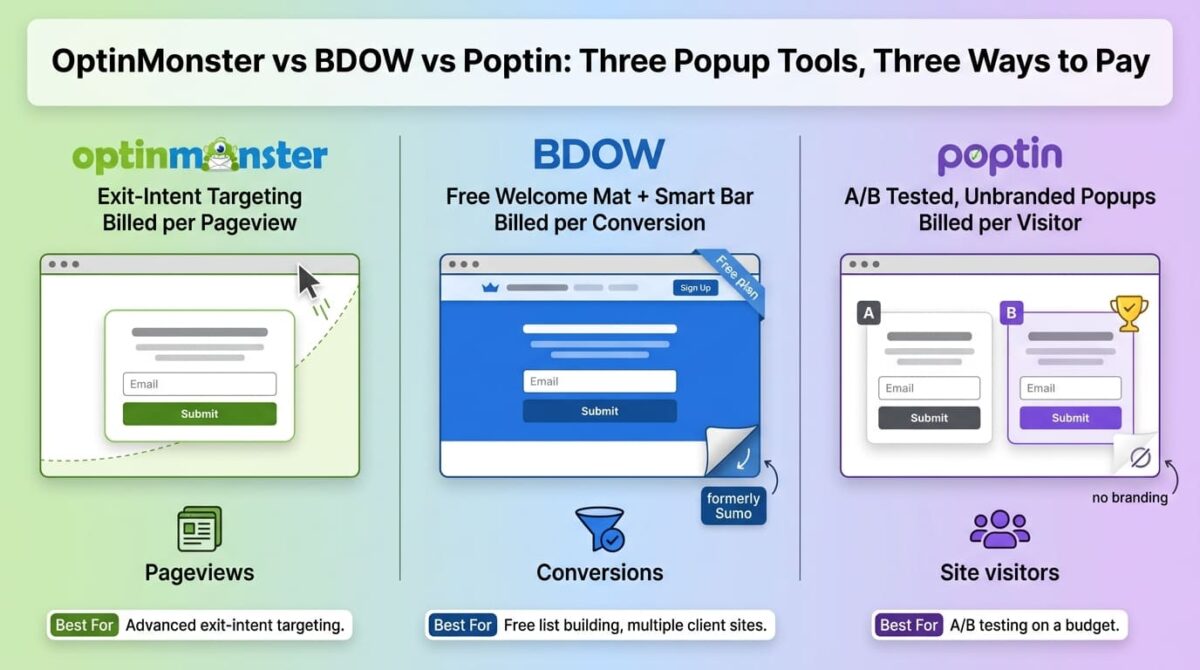
OptinMonster vs BDOW vs Poptin all build the same kind of popup, but each one meters its price against a different number: pageviews, conversions, or total site visitors when collecting subscribers for your Substack vs Ghost vs Beehiiv: Best Newsletter Platforms for Paid Subscriptions in 2026. That choice of metric matters more than it sounds, since a high-traffic content site and a low-traffic store with high purchase intent can end up paying very different amounts for the exact same popup behavior.
One quick note before comparing: BDOW is the current name for Sumo, which Showit acquired and relaunched in 2024. Same free list-building tool, new name, since Sumo as a brand no longer sells popups.
I tested OptinMonster vs BDOW vs Poptin for 30 days, building the same exit-intent email capture popup in all three and tracking what each one charged in practice once typical traffic and conversion numbers were applied. Here is the honest comparison, including a documented renewal price on one platform that runs roughly double the first-year promotional rate.
Table of Contents
How We Tested
Five criteria shaped the testing:
- Pricing metric: whether cost scales by pageviews, conversions, or total site visitors
- Signature feature placement: which tier unlocks exit-intent detection and A/B testing
- Renewal pricing: whether the first-year rate holds or jumps significantly afterward
- Free tier usability: whether the free plan supports ongoing use or just a quick test
- Design quality and setup speed: how polished the templates looked and how fast a popup went live
OptinMonster Review: The Most Polished Targeting, With a Renewal Price That Roughly Doubles
Free plan: No, only a limited free WordPress plugin, not the full platform
Starting price: $9/month (Basic, first-year promotional rate, billed annually)
Best plan for most users: Pro, $37/month first year, since Exit-Intent technology requires this tier
Platforms: WordPress, Shopify, and any website via script
Affiliate program: Yes, OptinMonster affiliate program
OptinMonster built its reputation on Exit-Intent Technology, detecting when a visitor is about to leave and triggering a targeted popup before they go, which works hand-in-hand with campaigns analyzed in Instantly vs Smartlead vs Apollo: Best AI Cold Email Outreach Tools.
What OptinMonster does best
Exit-Intent Technology and onsite retargeting, available from Pro upward, are more refined than either competitor’s exit-based triggers, tracking cursor movement and timing to catch a visitor before they navigate away.The template library, over 700 designs, and page-level targeting rules also give more granular control over which popup shows to which visitor than Poptin’s or BDOW’s simpler targeting options, especially when matching your site’s visual identity created with Looka vs Tailor Brands vs Brandmark: Best AI Logo and Brand Identity Generators.
The 14-day money-back guarantee is stated plainly and applies across every plan, giving a fair window to test the platform’s full feature set before the first renewal arrives.
Where OptinMonster falls short
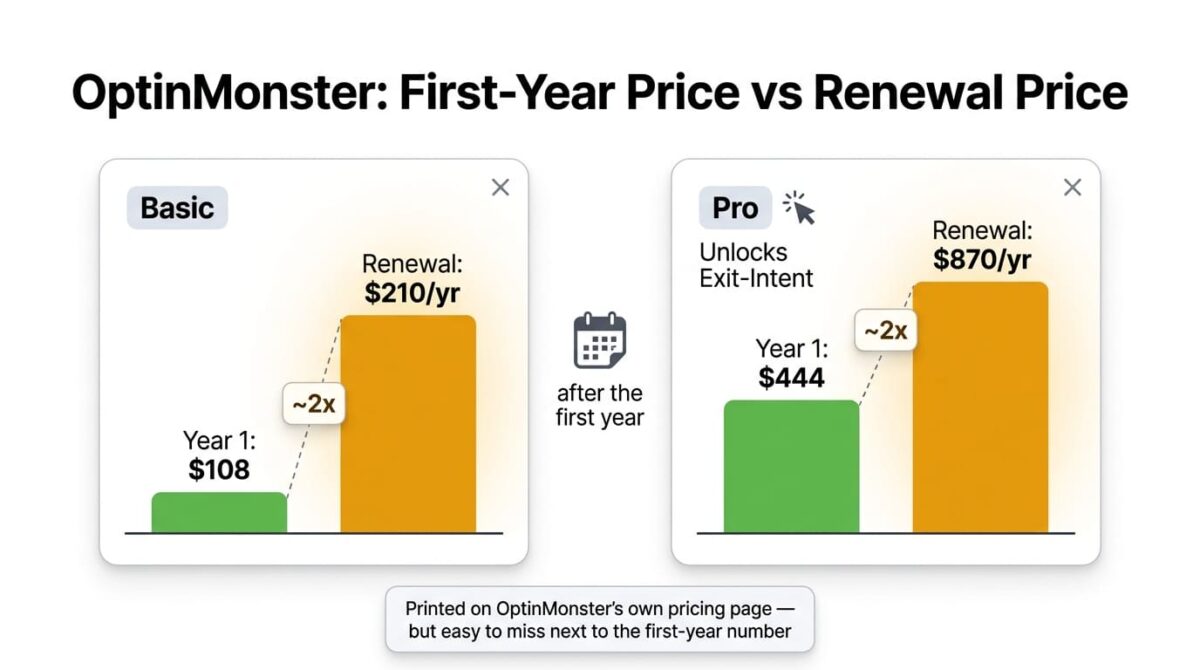
OptinMonster’s own pricing page lists Basic at $9/month ($108 billed annually) renewing at $210 a year, and Pro at $37/month ($444 billed annually) renewing at $870, both close to double the first-year promotional rate. OptinMonster does print this renewal figure on its own pricing page, which deserves some credit, but it’s easy to miss when comparing the attractive first-year number against competitors.
There’s also no permanent free plan with full platform access, only a stripped-down free WordPress plugin, and Exit-Intent Technology, the platform’s signature feature, is locked out of both Basic and Plus entirely.
OptinMonster pricing
| Plan | First-Year Price | Renewal Price | Notable Feature |
|---|---|---|---|
| Basic | $9/month ($108/year) | $210/year | 2,500 pageviews, 1 site |
| Plus | $27/month ($324/year) | Higher at renewal | A/B testing, advanced integrations |
| Pro | $37/month ($444/year) | $870/year | Exit-Intent Technology unlocked |
| Growth | $67/month ($804/year) | Higher at renewal | Highest pageview allowance |
OptinMonster: Pros and Cons
Pros:
- Most developed Exit-Intent Technology and onsite retargeting of the three
- Over 700 templates and the most granular page-level targeting
- 14-day money-back guarantee across every plan
- Renewal pricing is disclosed on OptinMonster’s own pricing page, not hidden
Cons:
- Renewal price runs close to double the first-year promotional rate
- No permanent free plan with full platform access
- Exit-Intent Technology, the headline feature, requires Pro or above
- No refund policy stated for mid-term cancellation on annual plans
Rating: 4.0 / 5, the most polished targeting and exit-intent detection of the three, with a renewal price that catches buyers comparing only the first-year rate.
BDOW Review: A Working Free Tier, With Core Features Locked to Pro
Free plan: Yes, roughly 100 conversions/month
Starting price: $19/month (Plus, billed annually)
Best plan for most users: Pro, around $49/month, for A/B testing and advanced targeting
Platforms: WordPress, JavaScript embed; no native Shopify app currently
Affiliate program: Yes, BDOW affiliate program
BDOW, the product formerly known as Sumo, keeps a fully free entry point for basic email capture, with more advanced features reserved for its Pro tier.
What BDOW does best
The free plan is usable for a small site’s basic list-building needs, welcome mats, smart bars, and scroll boxes, without a time limit, though ensuring those captured emails are valid is crucial, as explored in NeverBounce vs ZeroBounce vs Hunter: Best Email Verification Tools. Built-in email broadcast and autoresponder tools also cover some functionality that OptinMonster and Poptin both expect to be handled by a separate email platform.
For an agency or designer managing several client sites, a single dashboard covering multiple properties keeps setup and monitoring centralized.
Where BDOW falls short
A/B testing and advanced visitor targeting are both locked to the Pro tier, and social proof popups are priced as a separate add-on, around $25/month for a 25,000 pageview allowance, on top of whichever core plan is chosen. Several independent reviews also describe the popup designs as feeling dated compared to OptinMonster’s or Poptin’s more current template libraries.
There’s currently no native Shopify app, a meaningful gap for any e-commerce store that isn’t running on WordPress or a custom site, and the brand’s post-rebrand presence is still smaller than OptinMonster’s or Poptin’s.
BDOW pricing
| Plan | Price | Conversions/Month | Notable Feature |
|---|---|---|---|
| Free | $0 | ~100 | Welcome mats, smart bars, basic popups |
| Plus | $19/month (annual) | Higher | Removes BDOW branding |
| Pro | ~$49/month | Higher | A/B testing, advanced targeting |
| Social Proof add-on | ~$25/month | 25,000 pageviews | Separate from core popup pricing |
BDOW: Pros and Cons
Pros:
- Free tier that holds up for ongoing use, with no time limit
- Built-in email broadcasts and autoresponders reduce reliance on a separate tool
- Single dashboard suited to managing multiple client sites
- Lower entry price than OptinMonster’s comparable renewal rate
Cons:
- A/B testing and advanced targeting both locked behind Pro
- Social proof popups cost extra as a separate add-on
- No native Shopify app currently available
- Template designs described as dated compared to both competitors
Rating: 3.9 / 5, the most usable free tier of the three, with core optimization features reserved for a higher tier than either competitor requires.
Poptin Review: Unbranded Features at a Lower Price, With Pricing Tied to Total Site Traffic
Free plan: Yes, 1,000 visitors/month, 1 domain
Starting price: $25/month (Basic, billed annually), 10,000 visitors/month
Best plan for most users: Basic, for most small to mid-traffic sites
Platforms: WordPress, Shopify, any website via script
Affiliate program: Yes, Poptin affiliate program
Poptin includes A/B testing and unbranded popups starting at its lowest paid tier, a lower price point for that combination than either OptinMonster’s or BDOW’s equivalent unlock.
What Poptin does best
A/B testing, unbranded popups, and autoresponders all come included at Basic, $25/month annually, a combination that costs more or requires a higher tier on both competitors. The free plan, while capped at 1,000 monthly visitors, includes every feature rather than a stripped subset, letting a very small site use the full toolset at no cost.
Smart behavioral triggers, including exit-intent, work reliably across the tiers tested, without needing to jump to the most expensive plan the way OptinMonster requires for its signature exit feature.
Where Poptin falls short
Pricing is metered by total monthly site visitors, not popup impressions or conversions, which means a high-traffic content site pays based on overall traffic even if only a small fraction ever sees or interacts with a popup. A site with 60,000 monthly visitors needs the $59/month Pro tier regardless of how focused or minimal its popup campaign turns out to be.
The template library, while solid, reads as thinner than OptinMonster’s 700-plus designs, and paid plans above Basic can escalate quickly for a growing site that doesn’t need more popup features at all, just more traffic headroom.
Poptin pricing
| Plan | Price | Visitors/Month | Notable Feature |
|---|---|---|---|
| Free | $0 | 1,000 | 1 domain, full feature set, branded |
| Basic | $25/month (annual) | 10,000 | A/B testing, unbranded, autoresponders |
| Pro | $59/month (annual) | 50,000 | 3 domains |
| Agency | $119/month (annual) | 150,000 | Highest visitor allowance |
Poptin: Pros and Cons
Pros:
- A/B testing and unbranded popups included at the lowest paid tier
- Free plan includes the full feature set, not a stripped subset
- Reliable exit-intent triggers without needing the most expensive tier
- Lower cost than competitors for feature parity at matching traffic levels
Cons:
- Pricing scales with total site visitors, not popup engagement specifically
- High-traffic content sites pay more regardless of how minimal their popup use is
- Smaller template library than OptinMonster’s
- Visitor tiers can require an upgrade driven by traffic growth alone, unrelated to popup needs
Rating: 4.1 / 5, the best feature-to-price ratio of the three, with a pricing model that penalizes high-traffic sites more than popup-heavy ones.
Head-to-Head Comparison
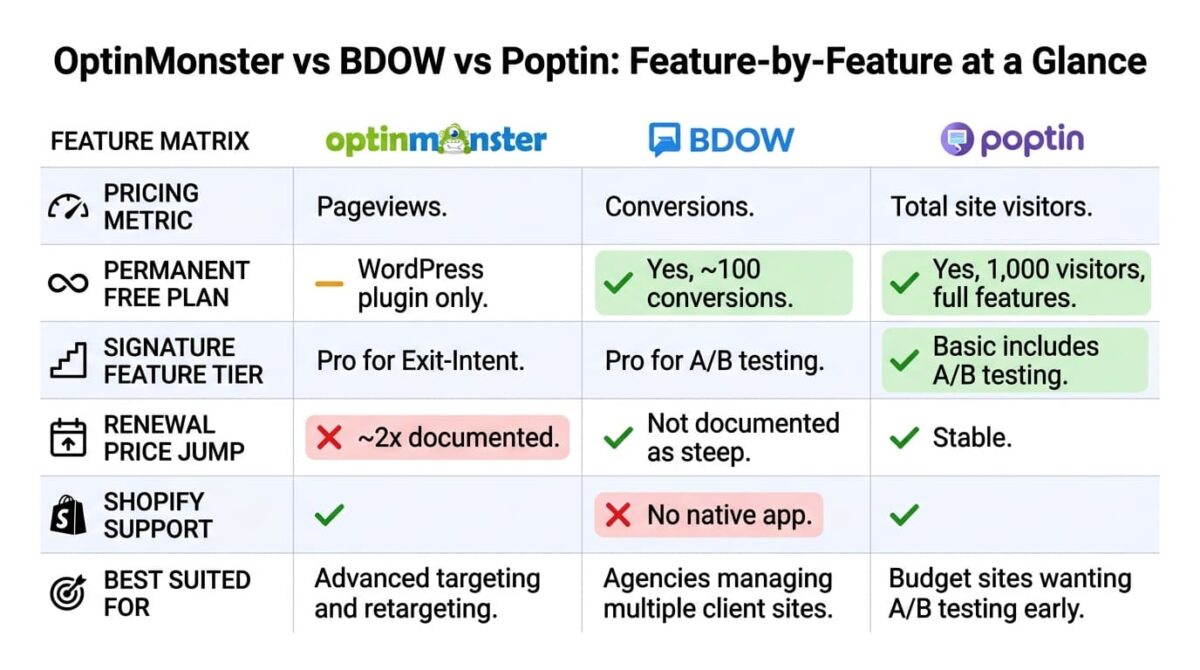
| Feature | OptinMonster | BDOW | Poptin |
|---|---|---|---|
| Pricing metric | Pageviews | Conversions | Total site visitors |
| Permanent free plan | No (plugin only) | Yes (~100 conversions) | Yes (1,000 visitors) |
| Signature feature tier | Pro (Exit-Intent) | Pro (A/B testing) | Basic (A/B testing included) |
| Renewal price jump | Roughly 2x documented | Not documented as steeply | Stable |
| Shopify support | Yes | No native app | Yes |
| Template library | Largest (700+) | Smaller, dated | Moderate |
| Best suited for | Advanced targeting and retargeting | Agencies managing multiple client sites | Budget-conscious sites wanting A/B testing early |
Which Should You Choose?
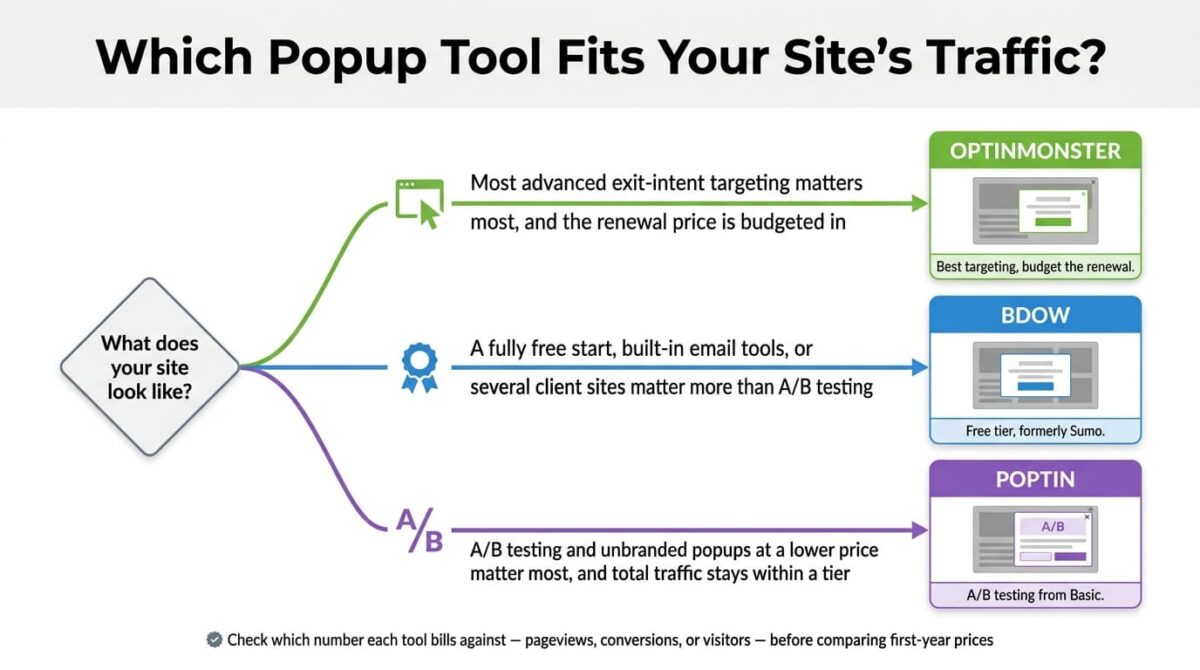
Choose OptinMonster if the most advanced exit-intent targeting and the largest template library matter most, and the renewal price is budgeted in from the start.
Choose BDOW if a fully free entry point and built-in email broadcast tools matter more than A/B testing or the newest template designs.
Choose Poptin if A/B testing and unbranded popups at a lower price point matter most, and the site’s total traffic stays within a tier’s visitor allowance regardless of popup usage.
Our Recommendations
Based on 30 days of testing across setup, targeting, and renewal-cost scenarios, here is the recommended setup by situation:
Small site wanting A/B testing without a big budget: Poptin Basic, for unbranded testing included at the lowest comparable price.
E-commerce store needing the most refined exit-intent targeting: OptinMonster Pro, budgeting for the documented renewal price rather than the first-year promotional rate.
Agency managing popups across several client sites for free: BDOW’s free tier, accepting the tradeoff of fewer advanced features.
High-traffic content site with modest popup needs: BDOW or OptinMonster, since Poptin’s visitor-based pricing would charge more for traffic that has nothing to do with popup engagement.
Anyone renewing an OptinMonster Basic or Pro plan soon: Check the renewal price against the first-year rate before it charges automatically, since the jump is documented at roughly double on both tiers.
Final Verdict
OptinMonster, BDOW, and Poptin all build functional popups, but the number each one bills against, pageviews, conversions, or total visitors, changes which is cheapest for a given site’s traffic pattern.
- Poptin (4.1 / 5): the best feature-to-price ratio, with a visitor-based model that costs more for high-traffic sites
- OptinMonster (4.0 / 5): the most advanced targeting, with a renewal price that roughly doubles the first-year rate
- BDOW (3.9 / 5): the most usable free tier, with core optimization features reserved for a higher tier
Before comparing first-year prices across these three, check which number each one bills against and whether that matches the site’s typical traffic shape. A high-traffic blog and a low-traffic, high-intent store will land on different “cheapest” answers even with identical popup needs.
Frequently Asked Questions
Does OptinMonster’s price really double at renewal?
Based on figures published on OptinMonster’s own pricing page, yes, closely. Basic renews at $210/year against a $108 first-year rate, and Pro renews at $870/year against $444 first year, both close to a 2x increase once the promotional period ends.
Is BDOW the same company as Sumo?
Yes. Showit acquired Sumo and relaunched it as BDOW in 2024. The core list-building tools and free plan carried over under the new name; Sumo as a standalone brand no longer sells popup software.
Why does Poptin charge based on visitors instead of popup views?
Poptin meters its plans by total monthly site visitors rather than popup impressions or conversions. This means a high-traffic site pays based on its overall audience size even if a popup campaign only targets a small segment of that traffic.
Does OptinMonster have a free plan?
Not a full one. OptinMonster offers a limited free WordPress plugin with basic popup functionality, but the full platform, including Exit-Intent Technology, requires a paid plan starting at Basic.
Which tool includes A/B testing at the lowest price?
Poptin, with A/B testing included at its $25/month Basic tier. Both OptinMonster and BDOW require a higher tier, Plus or Pro respectively, to access comparable testing features.
Is BDOW missing anything e-commerce stores typically need?
Yes, currently no native Shopify app, which both OptinMonster and Poptin offer. An e-commerce store not running on WordPress or a compatible custom site would need to rely on a generic script embed instead.
Which tool is cheapest for a high-traffic content site?
BDOW or OptinMonster, generally, since both meter by conversions or pageviews rather than total site visitors. Poptin’s visitor-based pricing would charge a high-traffic site more regardless of how limited its popup usage turns out to be.
Does any of these three lock exit-intent behind a high-priced tier?
OptinMonster does, reserving its most developed Exit-Intent Technology for Pro and above. Poptin includes reliable exit-intent triggers starting at Basic, and BDOW offers exit-intent as part of its core popup toolkit at a lower tier than OptinMonster requires.