The math on selling digital products looks deceptively simple until you actually run a sale and watch a chunk of it disappear into platform fees. A $20 ebook sounds like $20 in your pocket, until you discover that one platform takes 10% plus a flat fee, another takes a flat monthly subscription and almost nothing per sale, and a third charges nothing at all until you cross a certain volume. The platform you choose to sell templates, ebooks, presets, or any other digital download is quietly one of the highest-leverage decisions a blogger or creator makes, because the fee structure compounds with every single sale for as long as you use it.
I tested Gumroad vs Payhip vs SendOwl for 30 days, listing real digital products (a Notion template, a short ebook, and a set of design assets) and running them through actual checkout flows to see what each platform really costs once a sale happens. Here is the honest comparison.
Table of Contents
How We Tested These Platforms
Every platform was evaluated against five criteria:
- Real cost per sale, not the advertised price, but what you actually keep after platform fees, payment processing, and any plan subscription
- Setup speed, how long it takes to list a product and have a working checkout link
- File delivery and protection, how downloads are delivered, and what protects your product from casual piracy
- Tax handling, does the platform calculate and remit VAT/sales tax automatically, or is that left to you
- Growth ceiling, what happens to your costs and limitations as sales volume increases
Why the Platform You Choose Matters More for Digital Products Than Physical Ones
Selling a digital download is structurally different from selling a physical product, and the platforms built for it reflect that. There is no shipping, no inventory, and no fulfillment delay, which means the entire value a platform provides comes down to three things: getting paid reliably, delivering the file securely, and not taking too large a cut while doing it.
This is also where pricing traps hide most easily. A platform that looks free because it charges no monthly fee can quietly cost far more than a $29/month subscription once you are doing meaningful volume, the percentage-based fee model that feels safe at low volume becomes the expensive option as you scale. Reading the fee structure carefully before you commit matters more here than almost any other software category we have reviewed.
Gumroad Review: Best for Beginners Who Want to Start Selling Today With Zero Upfront Cost
Free plan: Yes, no subscription fee, pay-as-you-sell only
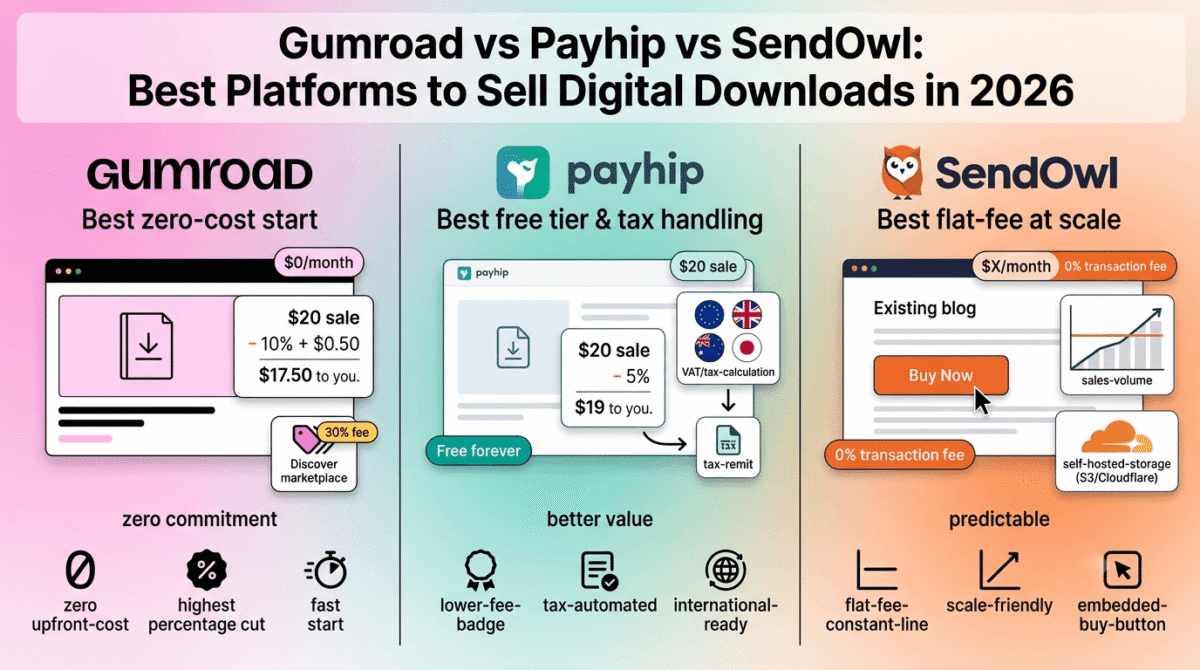
Transaction fee: 10% + $0.50 per sale (standard), 30% on sales from Gumroad’s Discover marketplace
Best for: Creators making their first digital product sale who don’t want to commit to a subscription before validating demand
Platforms: Web only, with a mobile app for sales tracking
Affiliate program: No public affiliate program at the time of testing
Gumroad is the platform most people think of first when they hear “sell a digital download,” and for good reason, it has the lowest barrier to entry of any tool in this comparison. You can list a product and have a working checkout link within minutes, with no subscription commitment required before your first sale.
What Gumroad does best
The zero-upfront-cost model is Gumroad’s defining feature. There is no monthly fee, no tier you need to choose, and no commitment before you have validated that anyone wants to buy your product. For a blogger testing their first digital product, a template, a swipe file, a short guide, this removes the single biggest piece of friction: paying for software before you know if the product will sell at all.
Gumroad supports an unusually wide range of product types from one interface, ebooks, software, courses, audio, memberships, and recurring subscriptions can all be sold through the same dashboard without separate tools or plugins. The license key generation feature, useful for selling software or templates that need activation, is a feature most competitors in this price range don’t offer at all.
Gumroad’s Discover marketplace gives products organic discovery exposure beyond your own audience, which can generate sales you would not have gotten otherwise, though, as covered below, that exposure comes at a meaningfully higher fee.
Where Gumroad falls short
The 10% + $0.50 per-sale fee is the highest percentage-based cost of the three platforms tested, and it does not decrease as your volume grows. A creator doing $5,000/month in sales pays roughly $500/month in fees indefinitely, there is no tier to graduate into that lowers the percentage. This is the single biggest reason creators eventually migrate off Gumroad once they have validated a product and want to scale it.
The 30% fee on Discover marketplace sales is a number worth reading twice before assuming Gumroad’s marketplace exposure is free marketing, it is marketing you pay nearly a third of your revenue for.
Gumroad offers no self-hosting option for your files; everything lives on Gumroad’s infrastructure, which means you have less control over backups and access logs than platforms like Payhip or SendOwl that support custom file hosting.
There is no website builder beyond a basic product page, Gumroad expects you to drive your own traffic from an existing blog or audience, which fits the RateTheTool reader profile well, but is worth knowing if you expected a full storefront.
Gumroad pricing
| Plan | Monthly fee | Transaction fee |
|---|---|---|
| Standard | $0 | 10% + $0.50 per sale |
| Discover marketplace sales | $0 | 30% per sale |
There is no paid tier that reduces the percentage fee, the cost structure is the same whether you sell $50 or $50,000 per month.
Gumroad: Pros and Cons
Pros:
- No subscription fee, genuinely free to start selling
- Supports the widest range of product types (ebooks, software, courses, subscriptions, license keys)
- Fastest setup of the three platforms tested
- Discover marketplace offers organic exposure beyond your own audience
- No technical skill required to launch a product page
Cons:
- Highest percentage-based fee of the three platforms, with no volume discount tier
- 30% fee on marketplace-driven sales
- No self-hosting option for files
- No website builder or storefront customization beyond a basic product page
- Costs scale up indefinitely with revenue, unlike flat-fee competitors
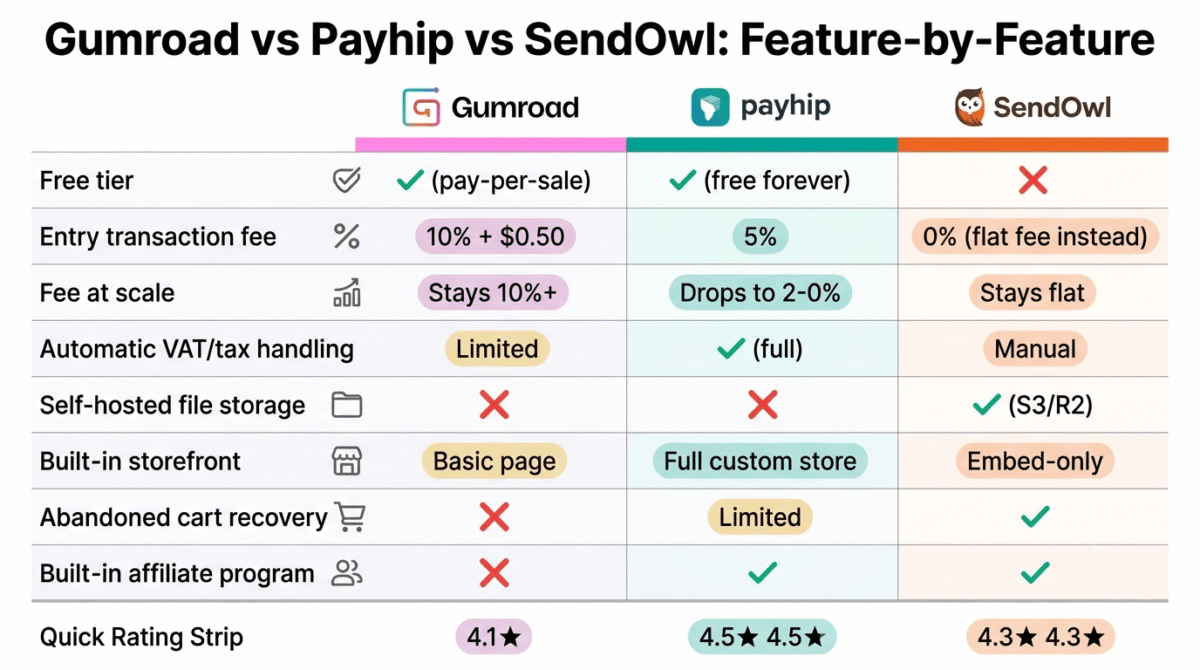
Rating: 4.1 / 5, Best for creators making their first sale who want zero upfront cost. Plan to evaluate alternatives once you have validated demand and are doing consistent monthly volume.
Payhip Review: Best Free Plan and Best Built-In Tax Handling
Free plan: Yes, free forever, 5% transaction fee
Starting paid price: Plus plan around $29/month with a 2% transaction fee; Pro plan around $99/month with 0% transaction fee
Best for: Creators who want a genuinely free starting tier with lower percentage fees than Gumroad, plus automatic VAT handling
Platforms: Web
Affiliate program: Yes, Payhip affiliate program
Payhip positions itself directly against Gumroad, and the comparison is favorable in almost every category except brand recognition. Where Gumroad charges 10% indefinitely, Payhip’s free tier charges half that, and its paid tiers can bring the percentage fee to zero entirely.
What Payhip does best
Payhip’s free-forever plan charges a 5% transaction fee, half of Gumroad’s standard rate, with no monthly subscription required. For creators who want to start selling without committing to a subscription but also don’t want Gumroad’s higher percentage cut, Payhip’s free tier is the more economical starting point.
Automatic VAT and sales tax handling is Payhip’s most underrated feature. If you sell to customers in the EU, UK, Australia, Japan, or Canada, you are legally required to collect and remit tax in many cases, Payhip calculates and handles this automatically, while several competitors, including Gumroad, leave more of this burden on the seller. For a blogger with an international audience, this single feature can save hours of manual tax research and meaningfully reduce legal risk.
The built-in affiliate program lets other creators promote your products for a commission you set, directly within Payhip’s dashboard, a feature that would otherwise require a separate tool like ThirstyAffiliates configured for your own digital products, not just outbound affiliate links. See our ThirstyAffiliates vs Pretty Links vs Lasso comparison if you’re managing affiliate links outside of Payhip’s built-in system.
Payhip’s storefront customization is meaningfully better than Gumroad’s basic product page, you can build a more complete branded store, not just individual product links, which matters if you plan to sell multiple products as a catalog rather than one-off downloads.
Where Payhip falls short
Payhip’s Pro plan, the tier that eliminates transaction fees entirely, costs $99/month, a significant jump from the Plus plan, and one that only makes financial sense once your sales volume is high enough that 2% (the Plus plan’s fee) would exceed the gap between the two plans. Calculate your break-even point before assuming the top tier is worth it.
Payhip is not well suited to selling physical products alongside digital ones, if you eventually want to bundle a digital download with a printed companion or merchandise, you will likely need a different platform or a second tool for that side of the business.
The platform’s design templates, while improved over recent years, are still less polished than dedicated e-commerce platforms like Shopify, acceptable for a focused digital product storefront, but not a replacement for a full online store if that is your long-term goal.
Payhip pricing
| Plan | Monthly fee | Transaction fee |
|---|---|---|
| Free | $0 | 5% per sale |
| Plus | $29/month | 2% per sale |
| Pro | $99/month | 0% (No platform fees) |
Payhip: Pros and Cons
Pros:
- Genuinely free-forever plan with a lower fee than Gumroad’s free tier
- Automatic VAT/sales tax calculation and remittance for international sales
- Built-in affiliate program for your own products
- Better storefront customization than Gumroad
- Pro plan eliminates transaction fees entirely at higher volume
Cons:
- Pro plan’s $99/month only pays for itself at meaningful sales volume, calculate your break-even first
- Not well suited to selling physical products alongside digital ones
- Design templates are functional but less polished than dedicated e-commerce platforms
- Smaller brand recognition than Gumroad, which may matter slightly for buyer trust
Rating: 4.5 / 5, Best overall value for most bloggers and creators selling digital products. The combination of a genuinely free tier, automatic tax handling, and a clear path to zero fees at scale makes it the strongest all-around choice.
SendOwl Review: Best for Predictable Flat-Fee Pricing as You Scale
Free plan: No, flat monthly fee starting at a low entry price, no free tier
Starting paid price: Entry plan priced lower than most streaming subscriptions per month, scaling up with feature tiers (not sales volume)
Best for: Creators with consistent, growing sales volume who want predictable costs that don’t increase as a percentage of revenue
Platforms: Web, designed to embed into a site you already own
Affiliate program: Yes, SendOwl affiliate program
SendOwl takes a fundamentally different approach from Gumroad and Payhip: instead of taking a percentage of each sale, it charges a flat monthly subscription with no transaction fee at all on most plans. This makes it the most predictable option financially, and the best one for creators who already have traffic and just need reliable checkout and delivery.
What SendOwl does best
The flat-fee, no-percentage pricing model is SendOwl’s defining advantage. Once you are selling more than a small amount per month, a flat subscription with zero transaction fee will always beat a percentage-based competitor, the math simply favors flat pricing as volume grows, and SendOwl is built entirely around that principle.
SendOwl supports self-hosted file storage through S3, Cloudflare R2, or a custom origin, giving you direct control over backups and access logs rather than trusting a third party’s infrastructure exclusively. For creators who treat their digital product library as a real business asset, this control matters.
The platform includes genuine e-commerce features beyond basic delivery, abandoned cart recovery emails, one-click upsells, and discount codes are all built in, which puts SendOwl closer to a lightweight e-commerce platform than a simple file-delivery tool.
SendOwl is explicitly designed to embed into a website you already own rather than replace it with its own storefront, for a blogger who already has traffic and just needs “buy now” buttons that work reliably, this is the right architecture, and it avoids the awkwardness of sending readers to a separate marketplace-style page.
Where SendOwl falls short
There is no free tier, you commit to a monthly subscription before your first sale, which is a real disadvantage compared to Gumroad’s and Payhip’s zero-cost starting points if you have not yet validated that your product will sell.
SendOwl has no built-in website builder or storefront beyond embeddable buy buttons, if you do not already have a website with traffic, you have nothing to embed buttons into, and SendOwl alone will not solve that problem.
The interface, while functional, feels less modern than Payhip’s or Gumroad’s, it prioritizes function over visual polish, which matters less for the checkout experience itself but is noticeable when managing your product catalog day to day.
SendOwl pricing
SendOwl’s plans scale by feature set and product count rather than by sales volume, with no percentage transaction fee on standard plans. Exact tier pricing should be confirmed directly on SendOwl’s site, as it has shifted in recent years, but the structural advantage holds regardless of the specific numbers: a flat fee with no percentage cut becomes cheaper than Gumroad or Payhip’s percentage model once your monthly sales exceed a moderate threshold.
SendOwl: Pros and Cons
Pros:
- Flat monthly fee with no percentage transaction fee on standard plans
- Self-hosted file storage options (S3, Cloudflare R2, custom origin)
- Genuine e-commerce features, abandoned cart recovery, upsells, discount codes
- Built to embed into an existing site rather than replace it
- Most cost-effective option at consistent, growing sales volume
Cons:
- No free tier, you pay before your first sale
- No website builder or storefront, you need existing traffic to embed buttons into
- Less polished interface than Payhip or Gumroad
- Less beginner-friendly than the zero-commitment alternatives
Rating: 4.3 / 5, Best for creators with an existing audience and consistent sales volume who want predictable, flat costs instead of a percentage that grows with revenue.
Head-to-Head Comparison
| Features | Gumroad | Payhip | SendOwl |
|---|---|---|---|
| Free tier | Yes (pay-per-sale) | Yes (free forever) | No |
| Entry transaction fee | 10% + $0.50 | 5% | 0% (flat fee instead) |
| Fee at scale | Stays 10%+ indefinitely | Drops to 2% or 0% (on paid plans) | Stays flat (scales by tier limits) |
| Automatic VAT/tax handling | Limited | Yes | Manual configuration |
| Self-hosted file storage | No | No | Yes (S3, Cloudflare R2) |
| Built-in storefront | Basic product page | Full customizable store | Embeds into existing site |
| Abandoned cart recovery | No | Limited | Yes |
| Built-in affiliate program | No | Yes | Yes |
| Best for | First-time sellers | Most bloggers and creators | High-volume sellers with existing traffic |
Which Platform Should You Choose?
Choose Gumroad if:
You are making your first digital product and want to validate demand with zero upfront cost before committing to anything. Gumroad’s brand recognition and Discover marketplace can also bring in sales you would not get from your own audience alone, accept the higher fee as the cost of that exposure, and plan to reassess once you have consistent monthly sales.
Choose Payhip if:
You want the best overall balance of low cost, real features, and automatic tax handling. For most bloggers selling templates, ebooks, or presets to a primarily international audience, Payhip’s combination of a genuinely free tier and automatic VAT handling makes it the most defensible default choice, which is why it is our top pick.
Choose SendOwl if:
You already have a website with traffic and consistent monthly sales, and you want predictable flat costs instead of a percentage fee that grows alongside your revenue. The self-hosted file storage option also matters if you treat your digital product catalog as a long-term business asset rather than a side experiment.
The Blogger Setup Recommendation
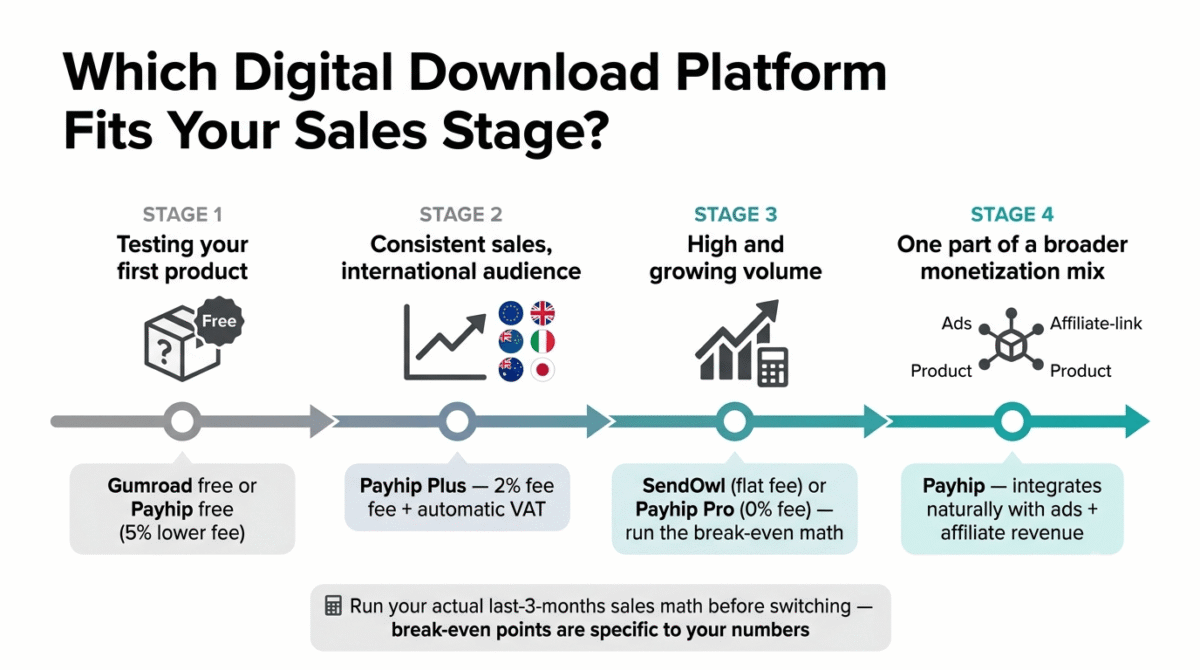
Based on 30 days of testing across real product listings, here is the recommended setup by creator stage:
Testing your first digital product, unsure if it will sell: Gumroad’s free tier or Payhip’s free tier. Either lets you launch with zero upfront cost; Payhip’s lower 5% fee makes it the slightly better choice if you can spare the few extra minutes of setup.
Selling consistently with growing monthly revenue, international audience: Payhip Plus. The 2% fee plus automatic VAT handling pays for itself in saved administrative time alone, well before you consider the cost savings versus Gumroad.
High and growing sales volume with an existing audience: SendOwl, or Payhip’s Pro plan once your volume makes the $99/month flat fee cheaper than a percentage cut. Run the actual math on your last three months of sales before switching, the break-even point is specific to your numbers, not a general rule.
Selling digital products as one part of a larger blog monetization strategy: Payhip remains the best default, since the affiliate program and storefront customization integrate more naturally alongside ad revenue and affiliate marketing than SendOwl’s embed-only approach. See our full guide on how to make money blogging for the rest of the income mix digital product sales typically sit alongside.
Final Verdict
Payhip is the best overall platform for most bloggers and creators selling digital products in 2026, its free-forever tier undercuts Gumroad’s fee, its automatic VAT handling removes a genuine legal and administrative burden, and its paid tiers offer a clear, calculable path to zero transaction fees as you scale.
Gumroad remains the best zero-risk starting point for a first-time seller who wants to test demand before committing to anything, even though its fee structure becomes the most expensive of the three once you are selling consistently.
SendOwl is the best choice once your volume is consistent and growing, the flat-fee model is mathematically the cheapest option at scale, provided you already have the traffic to embed its buttons into.
Ratings:
- Payhip: 4.5 / 5
- SendOwl: 4.3 / 5
- Gumroad: 4.1 / 5
Frequently Asked Questions
What is the best platform to sell digital downloads in 2026?
Payhip offers the best overall balance for most bloggers and creators, combining a genuinely free tier, lower transaction fees than Gumroad, and automatic VAT/tax handling. Gumroad is the better choice for testing a first product with zero risk, and SendOwl is the better choice once you have consistent volume and want predictable flat costs instead of a percentage fee.
Is Gumroad still worth it in 2026?
Yes, for first-time sellers who want to validate a product idea with zero upfront cost. The 10% + $0.50 fee is the highest of the platforms compared here and does not decrease with volume, so most sellers eventually outgrow Gumroad once they have consistent monthly sales and should reassess alternatives at that point.
Does Payhip really have a free plan?
Yes, with no time limit and no required upgrade. Payhip’s free tier charges a 5% transaction fee per sale with no monthly subscription cost, which is meaningfully lower than Gumroad’s 10% fee on its equivalent free tier.
How do platform fees affect my actual profit on a digital product?
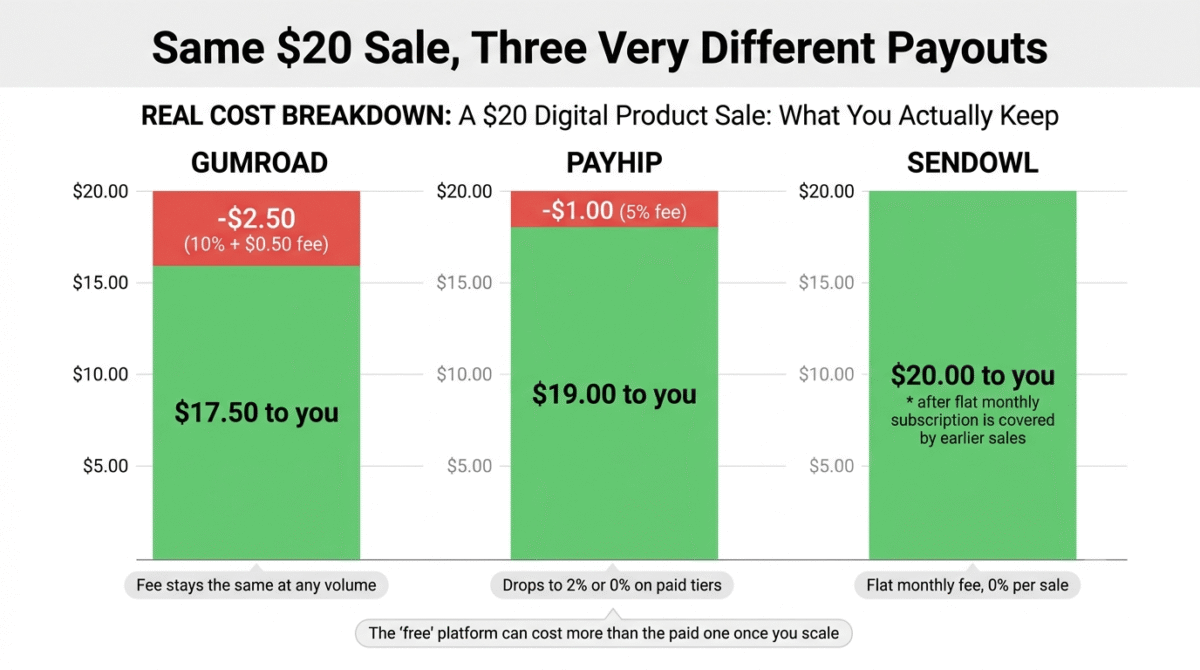
Significantly, and the effect compounds with volume. A $20 product sold through Gumroad nets roughly $17.50 after the 10% + $0.50 fee. The same product through Payhip’s free tier nets $19. Through SendOwl’s flat-fee model, once you exceed the monthly subscription cost in total sales, every additional sale keeps effectively 100% of the price. Calculating your actual take-home at your expected volume, not just the headline fee percentage, is the only way to compare these platforms accurately. Once sales are coming in consistently, tracking that actual take-home properly means recording it in real accounting software, see our QuickBooks vs FreshBooks vs Wave comparison.
Do I need to handle VAT or sales tax myself when selling digital downloads?
It depends on the platform. Payhip automatically calculates and remits VAT and sales tax for sales to the EU, UK, Australia, Japan, and Canada. Gumroad and SendOwl offer less automatic coverage, which means you may need to research your specific tax obligations and configure collection manually, or consult an accountant familiar with digital product sales across jurisdictions.
Can I sell courses through these platforms, or do I need a dedicated course platform?
Gumroad and Payhip both support basic course-style content delivery, including drip content and modules, but neither matches the dedicated learning management features of platforms built specifically for courses, such as Teachable or Kajabi. If your primary product is a multi-module course rather than a single download, a dedicated course platform is usually the better fit; these three tools are strongest for single-purchase downloads like ebooks, templates, and presets. See our Teachable vs Thinkific vs Kajabi comparison for dedicated course platforms if that’s your primary product.
Which platform is best for selling WordPress themes or plugins?
SendOwl’s license key support and self-hosted file storage make it a strong fit for software sellers who need to manage activation and licensing. Gumroad also supports license key generation. Payhip is less suited to software-specific needs like license management, making it the weaker choice of the three specifically for theme or plugin sales.