Building a profitable online store in 2026 requires more than just choosing between Shopify and WooCommerce. Both platforms are capable of powering multi-million dollar stores, the difference in outcomes between successful and struggling e-commerce stores is almost never the platform choice. It is the ecosystem of apps, plugins, and tools built around that platform.
This guide covers the best e-commerce tools across both Shopify vs WooCommerce Apps and Plugins that drive more traffic, convert more visitors, recover more abandoned carts, retain more customers, and automate the operations that consume store owners’ time. Every tool has been tested on real stores generating real revenue.
Table of Contents
The Platform Question First: Shopify vs WooCommerce in 2026
Before diving into apps and plugins, a clear-eyed answer to the platform question:
Choose Shopify if:
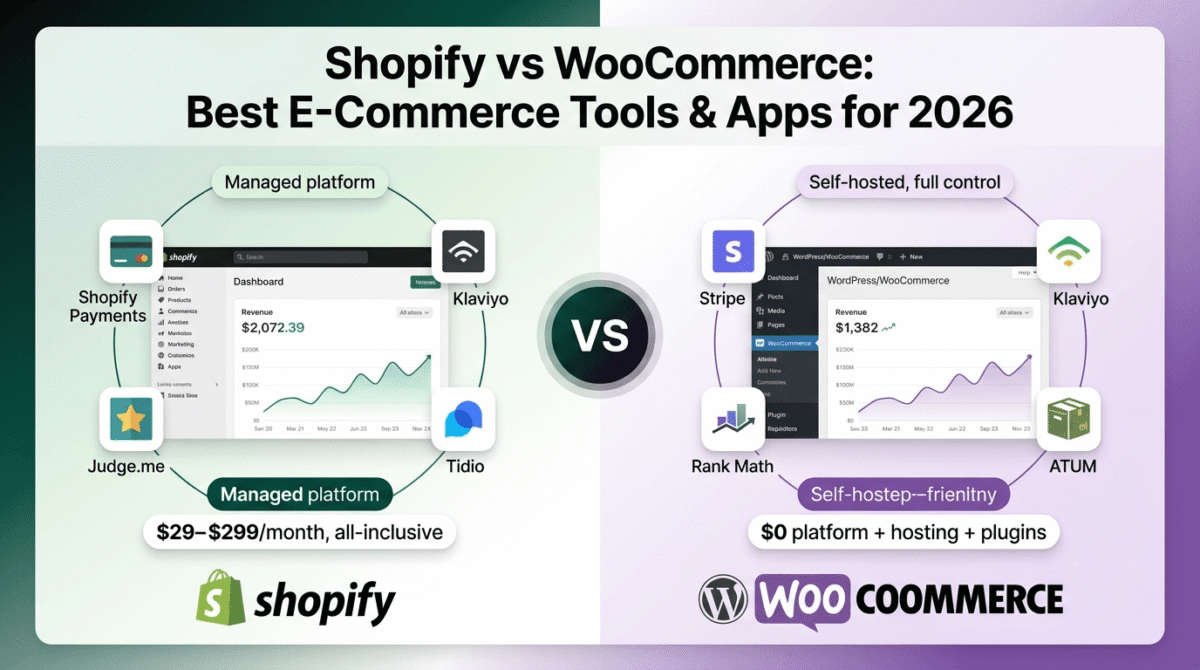
You want a fully managed platform where hosting, security, updates, and technical infrastructure are handled for you. Shopify is the right choice for merchants who want to focus entirely on products, marketing, and customers without managing server infrastructure. The predictable monthly cost ($29–$299/month) covers everything, hosting, SSL, PCI compliance, and updates included.
Choose WooCommerce if:
You are already on WordPress, have WordPress development experience (as a developer yourself or with access to one), and want maximum flexibility over your store’s functionality and costs. WooCommerce itself is free, you pay for hosting, premium plugins, and extensions rather than a monthly platform fee. For a WordPress developer launching an e-commerce blog, WooCommerce’s integration with your existing skills and infrastructure is a natural fit.
The honest cost comparison:
- Shopify Basic: $29/month + 2.9% + $0.30 per transaction (Shopify Payments) or 2% additional fee with external payment processors
- WooCommerce: $0 (plugin) + $4–$25/month hosting + $0–$200/year in premium plugins + $0 transaction fees with Stripe directly
For high-volume stores, WooCommerce’s zero-transaction-fee model with direct Stripe integration is significantly cheaper than Shopify at scale. For beginners who want simplicity, Shopify’s managed infrastructure eliminates technical complexity at a known monthly cost.
Section 1: Payment and Checkout Tools
1. Shopify Payments, Best Payment Processing for Shopify Stores
Price: Included with Shopify (2.9% + $0.30 per transaction on Basic)
Affiliate: $150 per merchant referral
Shopify Payments, Shopify’s built-in payment processor powered by Stripe, is the simplest payment setup for Shopify stores. No external payment gateway configuration, no additional transaction fees (Shopify charges 0.5–2% additional fees when using external processors), and seamless integration with Shopify’s analytics and reporting.
For new Shopify merchants, enabling Shopify Payments is a 2-minute setup, enter your banking details and start accepting credit cards, Apple Pay, and Google Pay immediately. The fraud analysis built into Shopify Payments flags suspicious orders automatically.
2. Stripe, Best Payment Processing for WooCommerce Stores
Price: 2.9% + $0.30 per transaction (no monthly fee)
No affiliate, essential tool
Stripe’s WooCommerce plugin enables credit card, Apple Pay, Google Pay, and BNPL (Buy Now Pay Later) payment acceptance with zero setup complexity, install the plugin, connect your Stripe account, and your store accepts payments within minutes. The direct Stripe integration means no additional transaction fees beyond Stripe’s processing rate, unlike Shopify, which charges additional fees for external payment processors.
The Stripe Radar fraud detection, included at no additional cost, analyses every transaction for fraud signals, automatically blocking high-risk charges and flagging suspicious patterns for review.
3. WooCommerce Payments, Best Native Payment Solution for WooCommerce
Price: 2.9% + $0.30 per transaction (US); country rates vary
No affiliate
WooCommerce Payments is Automattic’s native payment solution, built on Stripe’s infrastructure but integrated directly into the WooCommerce dashboard for seamless payment management without leaving WordPress. The ability to view transactions, issue refunds, and dispute chargebacks from within WooCommerce admin eliminates the need to switch between WordPress and Stripe’s dashboard for payment management.
4. Bold Checkout (Shopify), Best Checkout Customisation for Shopify Plus
Price: Shopify Plus required ($2,000/month+)
Affiliate: Bold Commerce affiliate
For high-volume Shopify stores on Shopify Plus, Bold Checkout enables complete checkout customisation, adding upsell offers, custom fields, subscription options, and conditional logic to the checkout flow that standard Shopify checkout does not support. The checkout conversion improvement from strategic upsells at checkout typically justifies the Shopify Plus investment for stores exceeding $500,000 annual revenue.
Section 2: Email Marketing and Customer Retention
5. Klaviyo, Best Email Marketing for E-Commerce Stores
Price: Free (up to 250 contacts) | $20/month (500 contacts) | scales with list size
Affiliate: Klaviyo affiliate program
Klaviyo is the most powerful e-commerce email marketing platform, used by over 100,000 online stores and trusted by major DTC brands. The deep Shopify and WooCommerce integration pulls real-time purchase data, browsing behaviour, cart abandonment events, and customer lifetime value into Klaviyo’s segmentation engine, enabling email campaigns targeted with a precision that generic email tools cannot match.
The e-commerce email flows every store needs (all automatable in Klaviyo):
Welcome series, 3–5 emails introducing your brand to new subscribers, typically generating 3–9x the revenue per email of standard campaigns.
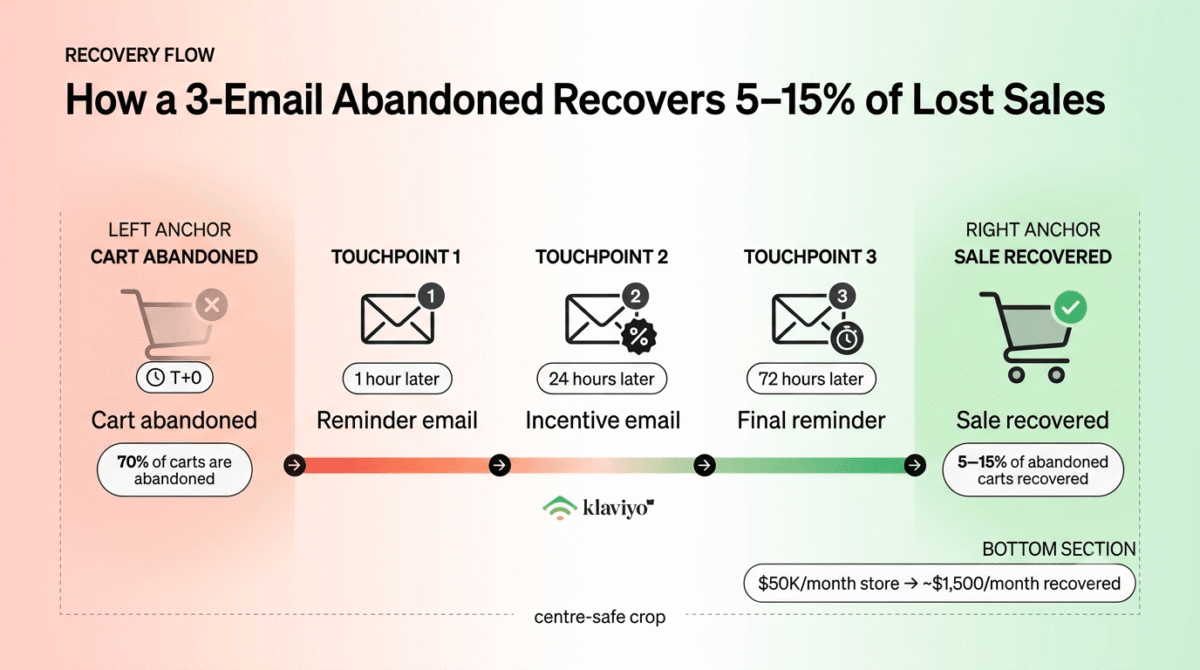
Abandoned cart recovery, triggered when a customer adds items to cart but does not purchase. A 3-email sequence (1 hour, 24 hours, 72 hours after abandonment) recovers 5–15% of abandoned carts that would otherwise be lost revenue. For a store with $50,000/month in sales, a 10% cart recovery rate from a $15,000/month abandonment volume generates $1,500/month in recovered revenue, often exceeding Klaviyo’s subscription cost many times over.
Post-purchase sequences, order confirmation, shipping notification, delivery confirmation, review request, and repeat purchase encouragement. The review request email (sent 7–14 days after delivery) generates the product reviews that drive conversion for new visitors.
Win-back campaigns, targeting customers who have not purchased in 90, 180, or 365 days with re-engagement offers and personalised product recommendations based on purchase history.
Browse abandonment, triggered when a logged-in customer views a product multiple times without purchasing, sending a targeted email featuring the viewed product.
Klaviyo vs Mailchimp for e-commerce: Klaviyo’s e-commerce data integration and revenue attribution are significantly more sophisticated than Mailchimp’s. Klaviyo shows exactly how much revenue each email campaign and automation generated, a level of attribution Mailchimp cannot match. For stores where email marketing is a primary revenue channel, Klaviyo’s e-commerce specialisation justifies its higher cost.
6. Omnisend, Best Email and SMS Marketing for Mid-Size E-Commerce Stores
Price: Free (250 contacts, 500 emails/month) | $16/month (Standard)
Affiliate: Omnisend affiliate, 20% recurring
Omnisend combines email and SMS marketing in one platform, enabling coordinated multi-channel campaigns where email and text message sequences work together. The abandoned cart recovery via SMS (response rates of 10–20% versus 3–5% for email) combined with email sequences produces higher recovery rates than either channel alone.
For smaller stores where Klaviyo’s pricing scales uncomfortably with list growth, Omnisend’s more predictable pricing model provides comparable e-commerce email functionality at lower cost.
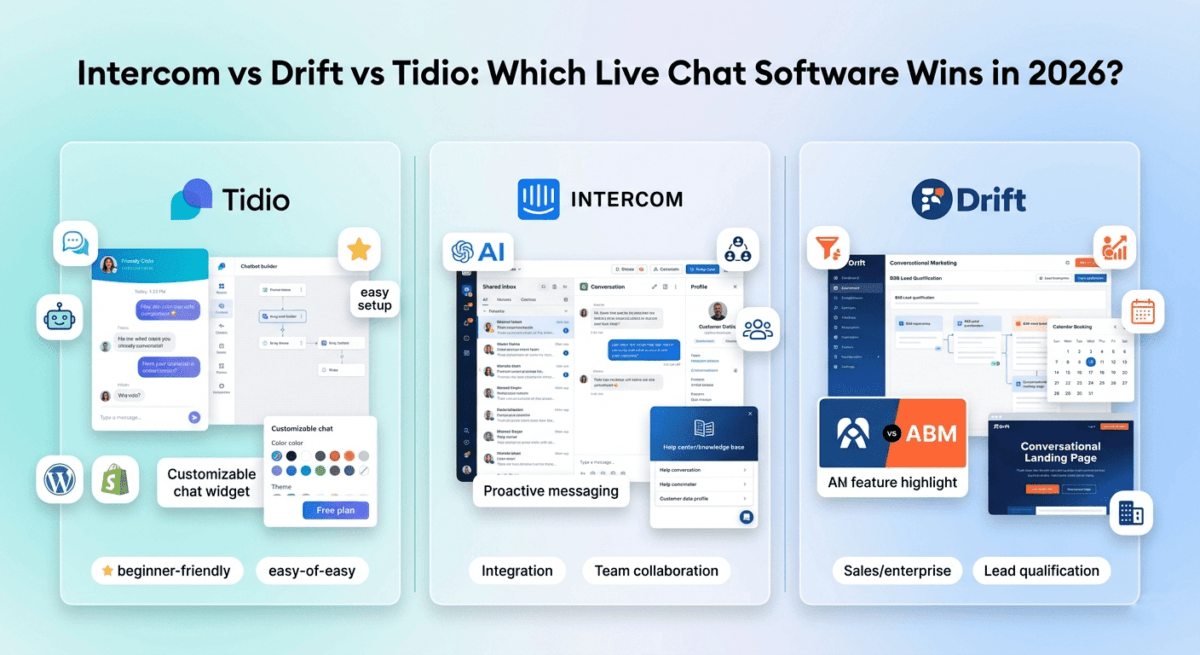
7. Tidio, Best Live Chat and Chatbot for E-Commerce Stores
Price: Free (50 chats/month) | $29/month (Starter)
Affiliate: 30% recurring commission
Full review: Best Live Chat Software →
Live chat directly increases e-commerce conversion rates, visitors who chat with a store convert at 3–5x the rate of visitors who do not. Tidio’s Lyro AI chatbot answers pre-purchase questions automatically (“what is your return policy?”, “does this come in size XL?”), reducing the response burden on store owners while maintaining the conversion benefit of answered questions.
The Shopify integration shows each visitor’s cart contents, order history, and browsing behaviour alongside their chat conversation, enabling personalised product recommendations and targeted upsell suggestions during live conversations.
Section 3: SEO and Traffic Tools
8. Semrush, Best SEO Tool for E-Commerce Stores
Price: $117.33/month (Pro, billed annually)
Affiliate: 40% recurring lifetime commission
Full review: Best SEO Tools →
E-commerce SEO, ranking product pages and category pages for commercial search terms, is the highest-ROI marketing channel for most online stores. A product page ranking on page 1 of Google for “best wireless headphones under $100” receives free, high-intent traffic indefinitely, without ongoing advertising spend.
Semrush’s keyword research identifies commercial search terms with high purchase intent and manageable competition for your specific product categories. The competitor analysis reveals which pages drive the most organic traffic for competing stores, showing exactly which content and product page optimisation strategies are working in your niche.
The Site Audit, identifying technical SEO issues (broken links, missing meta descriptions, duplicate content, slow page load), ensures your store’s technical foundation supports rather than undermines your SEO efforts.
9. Rank Math SEO (WooCommerce), Best Free SEO Plugin for WooCommerce
Price: Free | $59/year (Pro)
Affiliate: Rank Math affiliate
Full review: Best WordPress Plugins →
Rank Math’s WooCommerce module automatically adds Product schema markup to every product page, enabling rich results in Google search (star ratings, price, availability displayed directly in search results). Product rich results increase click-through rates by 20–30% compared to standard blue links, free additional clicks from the same rankings.
The bulk SEO editing feature, updating title tags, meta descriptions, and focus keywords for hundreds of product pages simultaneously, saves hours of manual optimisation for stores with large catalogues.
10. Yoast SEO for WooCommerce, Best Alternative WooCommerce SEO Plugin
Price: $69/year (WooCommerce SEO extension, requires Yoast SEO Premium at $99/year)
Affiliate: Yoast affiliate
Yoast’s WooCommerce extension adds structured data optimisation, breadcrumb management, and internal linking suggestions specifically for e-commerce stores. For WooCommerce developers already familiar with Yoast from WordPress blog management, the WooCommerce extension extends the known tool to cover e-commerce SEO without learning a new interface.
Section 4: Conversion Rate Optimisation Tools
11. Privy, Best Pop-Up and Email Capture for Shopify
Price: Free (up to 200 contacts) | $30/month (Basic)
Affiliate: Privy affiliate
Privy is the most widely used pop-up and email capture tool for Shopify stores, exit-intent pop-ups that trigger when a visitor moves to close the browser tab capture last-moment email addresses and discount codes that recover visitors who would otherwise leave without purchasing or subscribing.
The spin-to-win wheel, a gamified discount mechanism where visitors enter their email for a chance to win a discount, generates email capture rates of 5–15% from qualifying traffic, significantly above the 1–3% typical of standard pop-up forms.
For WooCommerce stores, OptinMonster provides comparable functionality with deeper WordPress integration.
12. ReConvert, Best Post-Purchase Upsell Tool for Shopify
Price: Free (up to 49 orders/month) | $4.99/month (Starter)
Affiliate: ReConvert affiliate, 10% recurring
The thank you page, displayed after a customer completes a purchase, is the highest-converting page in any e-commerce store. The customer has just proven their willingness to buy; the trust threshold has been crossed; their credit card is already out. ReConvert customises the Shopify thank you page with one-click upsells, cross-sells, birthday collection, and personalised product recommendations.
The revenue generated from thank you page optimisation consistently exceeds the cost of the tool within the first month, even a 5% upsell conversion rate on a $15 cross-sell offer at 100 monthly orders generates $75 in incremental monthly revenue.
13. Hotjar, Best Behaviour Analytics for E-Commerce Stores
Price: Free (unlimited heatmaps, 35 daily sessions) | $32/month (Plus)
Affiliate: 25% recurring commission
Full review: Best Website Analytics →
Hotjar’s heatmaps reveal why visitors add products to cart but do not purchase, where they click, how far they scroll on product pages, and where they abandon the checkout flow. Session recordings of abandoned cart users consistently surface specific friction points: a shipping cost that appears late in checkout, a required account creation before purchase, a confusing coupon code field.
For e-commerce stores where improving conversion rate from 2% to 3% represents a 50% revenue increase from the same traffic, Hotjar’s conversion diagnosis is the highest-ROI analytics investment available.
14. Judge.me, Best Product Review App for Shopify
Price: Free (unlimited reviews) | $15/month (Awesome, for advanced features)
Affiliate: Judge.me affiliate
Product reviews are the most significant conversion factor for e-commerce stores, products with 5+ reviews convert at 4x the rate of products with no reviews. Judge.me automatically emails customers requesting reviews after delivery, displays star ratings on product pages and in Google search results (via Product schema), and imports reviews from Amazon, AliExpress, and other platforms.
The free plan covers unlimited review collection and display, remarkable generosity for a tool with this direct impact on revenue. The paid plan adds Google Shopping integration, video reviews, and Q&A functionality.
Section 5: Inventory and Operations Tools
15. Stocky (Shopify), Best Free Inventory Management for Shopify
Price: Free for Shopify merchants
No affiliate, Shopify-built tool
Stocky provides demand forecasting, purchase order management, and low-stock alerts for Shopify stores managing physical inventory. The demand forecasting, predicting how much of each SKU to reorder based on sales velocity and lead time, reduces both stockout lost sales and overstock carrying costs.
16. ATUM Inventory Management, Best Free WooCommerce Inventory Plugin
Price: Free | $3.99/month (Premium)
No affiliate
ATUM provides comprehensive inventory management for WooCommerce, stock tracking across multiple locations, purchase order management, inventory logs, and the Stock Central dashboard giving a complete inventory overview in one view. The free version covers the needs of most small to mid-size WooCommerce stores.
17. ShipStation, Best Shipping Management for E-Commerce Stores
Price: $9.99/month (Starter) | $29.99/month (Bronze)
Affiliate: ShipStation affiliate, 30% commission
ShipStation connects Shopify and WooCommerce stores to every major carrier (USPS, UPS, FedEx, DHL, and international carriers), generating shipping labels, comparing carrier rates, tracking shipments, and automating order fulfilment from a single dashboard. The discounted carrier rates (up to 89% off retail shipping rates on some carriers) frequently justify ShipStation’s subscription cost entirely through shipping savings.
For e-commerce stores shipping 50+ orders per month, ShipStation’s automation, printing labels, updating order status, and sending tracking notifications automatically, saves hours of manual fulfilment work per week.
18. Gorgias, Best Customer Support Platform for E-Commerce
Price: $10/month (Starter, 50 tickets) | $60/month (Basic, 300 tickets)
Affiliate: Gorgias affiliate
Gorgias centralises all customer communication, email, live chat, social media messages, and phone, in one helpdesk with full Shopify or WooCommerce order data visible alongside every conversation. The integration means support agents see order status, tracking information, and purchase history without switching tabs, resolving “where is my order?” questions in seconds rather than minutes.
The AI response feature generates draft replies to common questions, a support agent reviews and sends the AI-generated response with one click rather than typing each reply from scratch.
Section 6: Analytics and Reporting
19. Google Analytics 4 with E-Commerce Tracking, Best Free E-Commerce Analytics
Price: Free
No affiliate, essential tool
Full review: Best Website Analytics →
GA4’s e-commerce tracking, available via MonsterInsights (WooCommerce) or Shopify’s GA4 integration, provides revenue attribution by traffic source, product performance, checkout funnel analysis, and customer acquisition cost data that native platform analytics cannot match. Understanding that your Google Ads traffic converts at 3% while your organic SEO traffic converts at 1.5%, but organic visitors have 40% higher average order value, informs budget allocation decisions that improve overall profitability.
20. Triple Whale, Best E-Commerce Analytics for Shopify Stores
Price: $129/month (Founders)
Affiliate: Triple Whale affiliate
Triple Whale provides pixel-level multi-touch attribution, tracking exactly which ads, emails, and organic content contributed to each conversion, accounting for iOS privacy changes that broke Facebook’s native attribution. For Shopify stores spending $10,000+/month on paid advertising, accurate attribution data that answers “which campaigns are actually profitable?” is worth Triple Whale’s subscription cost many times over.
Section 7: Marketing and Growth Tools
21. Loox, Best Visual Review and UGC Tool for Shopify
Price: $9.99/month (Basic)
Affiliate: Loox affiliate
Loox collects photo and video reviews from customers, user-generated content that displays on product pages and converts new visitors more effectively than text reviews alone. The referral programme built into Loox, offering existing customers a discount for referring friends, turns review collection into a customer acquisition channel.
22. Yotpo, Best Enterprise Review and Loyalty Platform for E-Commerce
Price: Free (basic reviews) | $15/month (Starter) | scales significantly
Affiliate: Yotpo affiliate
Yotpo combines product reviews, loyalty programmes, referrals, visual UGC, and SMS marketing in one platform, the most comprehensive customer retention ecosystem for growing e-commerce brands. The loyalty programme, points, tiers, and rewards, increases repeat purchase rates by 15–30% for brands where customer lifetime value is a primary growth lever.
23. Canva, Best Design Tool for E-Commerce Marketing
Price: Free | $12.99/month (Pro)
Affiliate: Up to $36 per Pro signup
Full review: Canva vs Adobe Express →
Every e-commerce store needs consistent visual content, product social media posts, promotional banners, email headers, and ad creative. Canva’s e-commerce templates, brand kit, and Magic Resize (converting one design to all social media formats simultaneously) make consistent branded content achievable without a design team.
24. Later, Best Social Media Scheduling for E-Commerce
Price: Free | $16.67/month (Starter)
Affiliate: 30% recurring commission
Full review: Best Social Media Scheduling →
Later’s Shopify integration, displaying your product catalogue within the scheduling interface for easy product tagging in Instagram posts, creates a direct path from social media browsing to product purchase. The linkin.bio shopping feature turns your Instagram bio link into a shoppable page matching your latest posts.
25. Google Shopping, Best Free Product Discovery Channel
Price: Free (organic listings) | Pay-per-click (paid ads)
No affiliate, Google product
Google Shopping’s free product listings, showing your products in Google’s Shopping tab without advertising spend, provide incremental traffic for any store that submits a product feed. The Merchant Center integration (free) enables both free listings and paid Google Shopping campaigns from one dashboard.
The Complete E-Commerce Tool Stack by Store Stage
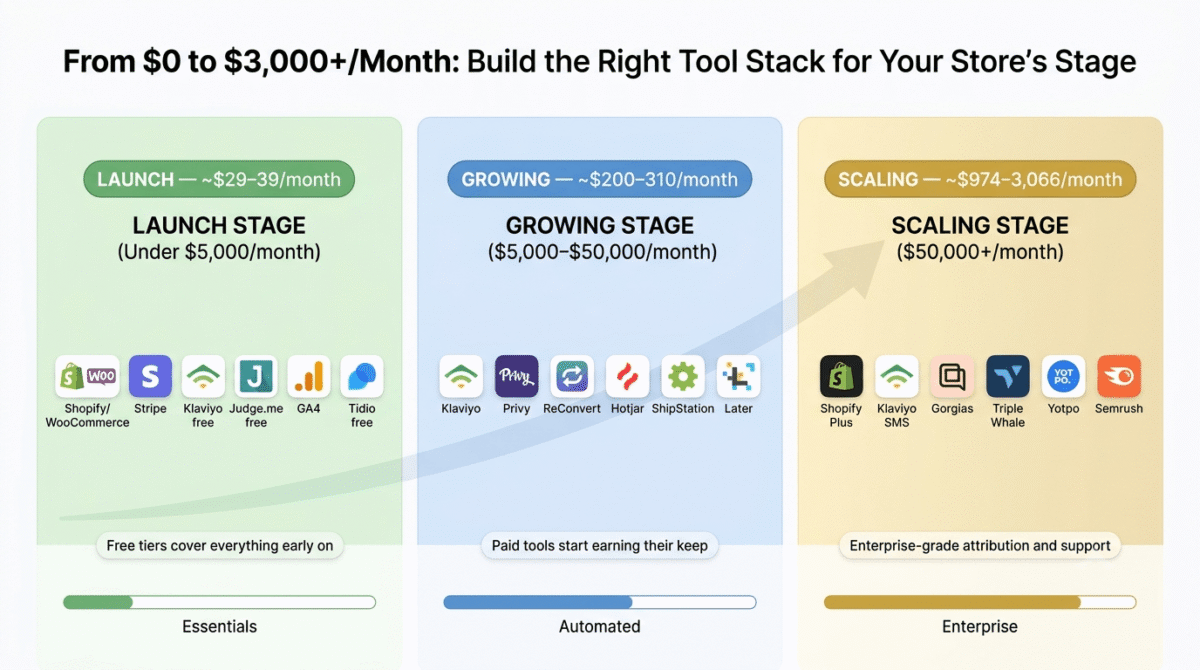
Stage 1: Launch (Under $5,000/month revenue)
Tool | Purpose | Monthly Cost |
Shopify Basic or WooCommerce | Platform | $29 or ~$10 |
Stripe or Shopify Payments | Payment processing | % of sales |
Klaviyo free | Email marketing | Free |
Judge.me free | Product reviews | Free |
Google Analytics 4 | Analytics | Free |
Canva free | Design | Free |
Tidio free | Live chat | Free |
Rank Math (WooCommerce) | SEO | Free |
Total | ~$29–$39/month + % of sales |
Stage 2: Growing ($5,000–$50,000/month revenue)
Tool | Purpose | Monthly Cost |
Shopify Basic or WooCommerce | Platform | $29–$79 |
Klaviyo | Email marketing | $45–$100 |
Privy or OptinMonster | Email capture | $30 |
ReConvert | Post-purchase upsell | $4.99 |
Hotjar Plus | Behaviour analytics | $32 |
ShipStation | Shipping management | $29.99 |
Judge.me Awesome | Advanced reviews | $15 |
Later Starter | Social scheduling | $16.67 |
Total | ~$200–$310/month |
Stage 3: Scaling ($50,000+/month revenue)
Tool | Purpose | Monthly Cost |
Shopify Advanced or Shopify Plus | Platform | $299–$2,000 |
Klaviyo | Email + SMS | $150–$500 |
Gorgias | Customer support | $60–$120 |
Triple Whale | Attribution analytics | $129 |
Yotpo | Reviews + loyalty | $119+ |
Semrush | SEO intelligence | $117.33 |
ShipStation | Shipping | $99.99 |
Total | ~$974–$3,066/month |
Shopify App Store vs WooCommerce Plugin Repository, Key Differences
Shopify App Store:
- Apps are vetted by Shopify before listing, higher average quality but less variety
- Pricing is subscription-based, ongoing monthly costs for most apps
- Apps install in minutes with one-click authentication
- Support quality is higher on average, commercial app developers with revenue incentive to maintain quality
- 8,000+ available apps
WooCommerce Plugin Repository:
- WordPress.org repository is community-vetted, variable quality
- Many premium plugins available as one-time purchases rather than subscriptions, lower long-term cost
- Plugin conflicts are more common, requires more technical management
- 59,000+ WordPress plugins (not all WooCommerce-specific)
- Free plugins are more capable on average than Shopify’s free apps
The practical implication: Shopify’s ecosystem costs more on average (monthly app fees versus one-time plugin purchases) but requires less technical management. WooCommerce’s ecosystem is cheaper long-term but requires more development knowledge to manage effectively.
Frequently Asked Questions
What is the best e-commerce platform in 2026, Shopify or WooCommerce?
Neither is universally better, the right choice depends on your technical capability and business model. Shopify is better for merchants who want managed infrastructure, predictable monthly costs, and maximum simplicity. WooCommerce is better for WordPress developers, merchants who want zero transaction fees with direct Stripe integration, and businesses where maximum flexibility and lower long-term costs outweigh setup simplicity. For a WordPress developer launching an online store, WooCommerce’s integration with existing skills and infrastructure is the natural starting point.
What are the must-have Shopify apps for a new store?
The essential apps for a new Shopify store are: Klaviyo (email marketing, start free), Judge.me (product reviews, free plan covers everything initially), Tidio (live chat, free plan sufficient for early stage), ReConvert (post-purchase upsell, pays for itself immediately), and a shipping management tool once order volume justifies it. Avoid installing more than 10 apps simultaneously, each app adds page load time that affects conversion rates.
What are the must-have WooCommerce plugins for a new store?
Essential WooCommerce plugins: WooCommerce Payments or Stripe for WooCommerce (payment processing), Rank Math SEO (with WooCommerce module enabled), Klaviyo for WooCommerce (email marketing), WooCommerce Google Analytics (e-commerce tracking), a caching plugin (WP Rocket or LiteSpeed Cache for performance), and Wordfence Security. The free versions of these plugins cover all new store needs.
How many Shopify apps should I install?
Fewer than you think. Each Shopify app adds JavaScript that loads on every page, too many apps slow your store significantly, hurting both user experience and SEO. A well-performing Shopify store typically runs 5–15 apps. Audit your installed apps quarterly and remove any that are not actively generating measurable value, the performance improvement from removing unused apps often improves conversion rates more than any individual app addition.
Is Klaviyo worth the cost for small e-commerce stores?
Yes, once your email list reaches 500+ subscribers and you have automated abandoned cart recovery running. The abandoned cart flow alone typically generates enough revenue to cover Klaviyo’s subscription cost, for a store with 100 monthly cart abandonments averaging $75 order value, a 10% recovery rate generates $750/month in recovered revenue. The free plan (250 contacts) provides full access to test this before paying anything.
What is the best way to reduce cart abandonment?
The three highest-impact cart abandonment reduction strategies are: (1) Klaviyo abandoned cart email sequence, three emails at 1 hour, 24 hours, and 72 hours post-abandonment recover 5–15% of abandoned carts. (2) Exit-intent pop-up with discount, Privy’s exit-intent trigger offers a small discount when a visitor attempts to leave the cart page, converting last-moment leavers. (3) Guest checkout, removing the mandatory account creation requirement before checkout typically reduces abandonment by 15–30% for stores that previously required registration.