A blogger publishing AI-assisted content wants to know one specific thing before it goes live: will this get flagged, by Google, by a client, or by a reader who has gotten good at spotting AI writing. If you’re using AI writing tools like Jasper, Copy.ai, or Writesonic to draft that content, running it through a detector afterward closes the loop on exactly that concern. A freelance writer hiring contractors wants the opposite confirmation, that the work they paid for is genuinely the contractor’s own. Both needs point to the same category of tool, and both are quietly let down by a problem most marketing pages for these tools do not advertise: accuracy varies enormously between them, and the gap is large enough that choosing the wrong one means trusting a coin flip dressed up as a confident percentage score.
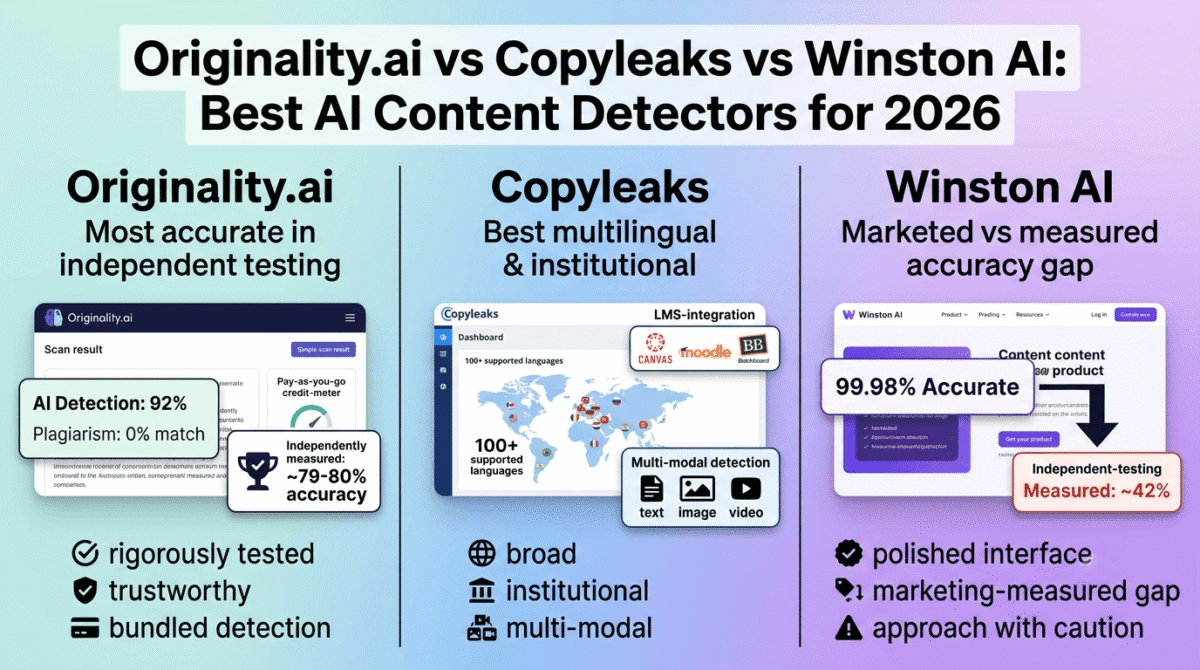
This is one of the more uncomfortable categories we have reviewed on this site specifically because the marketing claims are so often disconnected from independent test results. Multiple tools claim accuracy rates above 95%, and independent head-to-head testing against known AI-generated and known human-written text samples tells a very different story for at least one of them. I tested Originality.ai vs Copyleaks vs Winston AI for 30 days against a controlled set of known-AI and known-human text. Here is the honest comparison.
Table of Contents
How We Tested These Tools
Every platform was evaluated against five criteria:
- Detection accuracy against known samples, run text we know is AI-generated and text we know is human-written through each tool, and check what it actually reports
- False positive rate, how often does the tool flag genuinely human-written content as AI-generated, which is the failure mode with the most real-world consequences for a freelancer or student
- Plagiarism detection quality, separate from AI detection, how well does the tool catch traditional copied content
- Workflow fit, does the tool integrate into how a blogger, editor, or agency actually works, via browser extension, bulk upload, or API
- Pricing transparency, is the cost structure clear, and what do you actually get for the price advertised
Why Accuracy Claims in This Category Deserve Real Skepticism
It is worth being direct about something most comparison articles in this space gloss over: AI detection is fundamentally a probabilistic guess based on statistical patterns in writing, not a definitive forensic test. No tool in this category can tell you with certainty that a specific piece of text was or was not written by AI, they all produce a probability score based on patterns common in AI-generated text, and those patterns shift every time a new AI model is released. See our ChatGPT vs Claude vs Gemini comparison of the leading AI chatbots whose outputs these detectors are actually trying to catch.
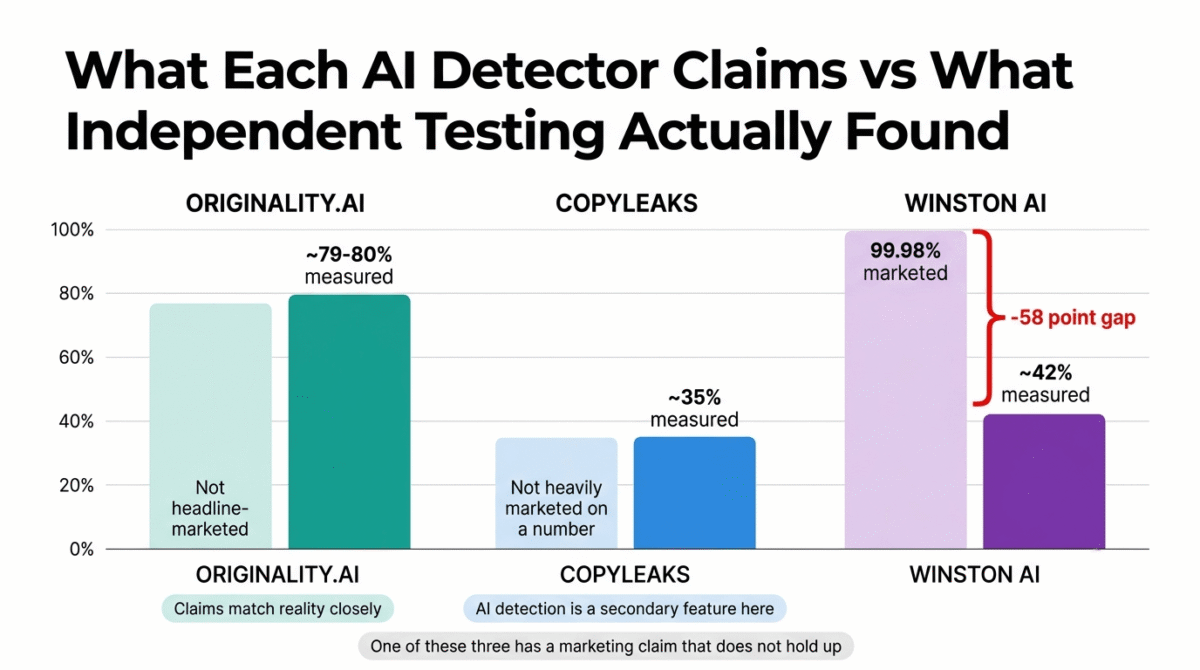
This is exactly why marketing claims of “99.98% accuracy” deserve scrutiny rather than acceptance at face value. Independent testing that runs multiple detectors against the same controlled set of known AI and known human text has repeatedly found wide gaps between advertised accuracy and actual measured accuracy, and the gap is not small. Treating a single tool’s score as gospel, in either direction, is a mistake regardless of which tool you use.
Originality.ai Review: The Most Accurate Detector in Independent Testing, by a Wide Margin
Free plan: No free plan, but a pay-as-you-go credit option with a low minimum spend to test before committing
Starting paid price: Pro plan around $14.95/month (with credits), or pay-as-you-go credits without a subscription
Best plan for most bloggers and content teams: Pro, for the bundled plagiarism detection and transparent credit model
Platforms: Web, Chrome extension, API
Affiliate program: Yes, Originality.ai affiliate program
Originality.ai has built its reputation specifically around independent, repeatable accuracy testing rather than relying solely on its own marketing claims, and the results from third-party comparisons back that positioning up in a way few competitors in this category can match.
What Originality.ai does best
Independent head-to-head accuracy testing is where Originality.ai separates itself most clearly from the rest of this category. In controlled comparisons against the same sample text, Originality.ai scored an average AI-detection accuracy around 79–80%, meaningfully ahead of competitors tested on the identical sample set, a gap large enough that it should be the deciding factor for anyone choosing a detector specifically to make a real decision about content, not just a curiosity check.
The bundled plagiarism detection alongside AI detection means a single scan gives you both signals at once, whether text was AI-generated and whether it was copied from an existing source, which matters specifically for blog content, where both forms of originality matter for SEO and for avoiding Google’s content-quality penalties.
The credit-based, pay-as-you-go pricing model is unusually transparent for this category. You can test the tool with a small initial spend before committing to a subscription, which is a meaningful contrast to tools that require a recurring commitment before you have any real sense of whether the detection quality matches your needs.
Originality.ai’s browser extension allows scanning live web pages directly, without copying and pasting text into a separate interface, useful for a blogger checking competitor content or verifying their own published posts after the fact.
For content teams managing freelance writers at any real volume, Originality.ai’s combination of accuracy, bundled plagiarism checking, and transparent per-scan pricing makes it the tool most directly built for exactly this site’s audience: bloggers and small content operations that need a reliable, affordable originality check, not an enterprise compliance system.
Where Originality.ai falls short
There is no meaningfully usable free plan, you need to spend at least a small amount on credits to use the tool at all, which is a real, if minor, barrier compared to Copyleaks’ limited free daily scans.
Originality.ai is explicitly built for web publishers and content teams rather than the classroom or enterprise compliance use cases that Copyleaks and Winston AI also serve, if your need is specifically institutional (a university, a large enterprise’s compliance department), the broader integration ecosystem of those tools may matter more than Originality.ai’s narrower, sharper focus.
Like every tool in this category, Originality.ai’s detection accuracy is not perfect and will shift as new AI models are released, a high accuracy score in current independent testing is not a permanent guarantee, and the tool’s developers must continue updating detection methods as the underlying AI models they are detecting continue to change.
Originality.ai pricing
| Plan | Price | Key features |
|---|---|---|
| Pay-as-you-go | $30 one-time ($0.01/credit) | 3,000 credits (2-year expiry), AI detection, plagiarism checking, readability analysis, 30-day scan history |
| Pro | ~$14.95 / month ($12.95/mo annual) | 2,000 monthly credits, team seat management, Chrome extension with document replay, full site URL scanning, auto-renewing credits |
Originality.ai: Pros and Cons
Pros:
- Highest independently measured AI-detection accuracy in head-to-head testing (around 79–80%)
- Bundles AI detection and plagiarism checking in a single scan
- Transparent, low-commitment pay-as-you-go pricing to test before subscribing
- Browser extension for scanning live web pages directly
- Best fit specifically for bloggers and content teams, not just academic or enterprise use cases
Cons:
- No meaningfully usable free plan
- Narrower focus than Copyleaks’ broader academic and enterprise integration ecosystem
- Detection accuracy, while currently the strongest tested, is not a permanent guarantee as AI models evolve
- Less suited to institutional use cases needing LMS integrations
Rating: 4.6 / 5, The most accurate AI detector in independent testing among the three tools compared, and the best fit for bloggers and content teams who need a reliable originality check at a reasonable price.
Copyleaks Review: Best for Institutional Trust, Multilingual Support, and Multi-Modal Detection
Free plan: Yes, limited number of free daily scans
Starting paid price: Individual plans starting around $10.99/month
Best plan for most freelance writers: The entry individual plan, unless you need the deeper enterprise or LMS integrations
Platforms: Web, browser extension, API, LMS integrations (Canvas, Moodle, Blackboard, and others)
Affiliate program: Check current availability directly
Copyleaks has the longest track record in this specific category, having operated in the plagiarism detection space since 2015 before expanding into AI content detection more recently. That history gives it institutional credibility and integration depth that newer, AI-detection-first tools have not had time to build, even though its AI-specific detection accuracy lags behind the category leader in independent testing.
What Copyleaks does best
Copyleaks’ multilingual support, covering more than 100 languages, is the broadest of the three tools tested, making it the clear choice for writers and content teams working across languages rather than English exclusively.
The platform’s deep LMS integrations (Canvas, Moodle, Blackboard, D2L, Schoology, and Google Classroom) reflect its institutional roots and give it genuine value for any reader running an online course or educational content business who needs to verify student or contributor submissions within an existing teaching platform.
Multi-modal detection, covering text, image, and video, extends Copyleaks’ capability beyond what either Originality.ai or Winston AI offers in this comparison, which matters specifically for content teams dealing with AI-generated images alongside AI-generated text.
Copyleaks’ free tier, while limited to a small number of daily scans, is genuinely accessible without any payment information, useful for occasional, low-volume checking before committing to a paid plan.
The browser extension allows checking web pages for AI-written content without manually copying and pasting, similar to Originality.ai’s equivalent feature, and the platform holds ISO 27001 and SOC 2 certifications relevant to enterprises with formal compliance requirements.
Where Copyleaks falls short
This is the section that matters most: in the same independent head-to-head testing that found Originality.ai scoring around 79–80% AI-detection accuracy, Copyleaks scored substantially lower, reported around 35% on the identical sample set. That is a significant gap, and it means a Copyleaks AI-detection score should be treated with real caution if you are making a meaningful decision based on it, rather than trusted as a precise, reliable verdict.
Copyleaks’ core strength remains traditional plagiarism detection, where its longer history gives it real credibility, its AI-detection layer is a newer addition to that established platform, and the independent accuracy numbers suggest it has not yet caught up to purpose-built AI detectors on that specific capability.
The interface and overall workflow can feel more enterprise-oriented than a solo blogger or freelance writer needs, reflecting the platform’s institutional and educational customer base more than an individual content creator’s simpler use case.
Copyleaks pricing
| Plan | Price | Key features |
|---|---|---|
| Free | $0 forever | Limited daily web scans, basic AI detection preview, web page checking |
| Individual | ~$10.99 / month (page quota) | Combined AI detection & plagiarism reporting, Chrome extension for on-page scans, source code plagiarism detection, 30+ language support |
| Enterprise / Education | Custom quote-based | Native LMS integrations (Canvas, Moodle, Blackboard), developer API access, single sign-on (SSO), SOC 2 Type II, FERPA, & GDPR compliance certifications |
Copyleaks: Pros and Cons
Pros:
- Broadest multilingual support of the three tools (100+ languages)
- Deepest LMS integrations for educational use cases
- Multi-modal detection covering text, image, and video
- Usable free tier with daily scans, no payment required
- Long track record and institutional trust in traditional plagiarism detection
Cons:
- Substantially lower AI-detection accuracy than Originality.ai in independent head-to-head testing (around 35% vs. 79–80%)
- AI detection is a newer addition to an older plagiarism-focused platform
- Interface skews more enterprise/institutional than individual-creator-friendly
- Stronger as a plagiarism tool than as a dedicated AI detector specifically
Rating: 4.0 / 5, Best for multilingual content, educational use cases, and traditional plagiarism detection specifically. Treat its AI-detection scores with real caution given the measured accuracy gap against the category leader.
Winston AI Review: Easy to Use, but Treat the Accuracy Claims With Real Caution
Free plan: Yes, limited free word allowance for a trial period
Starting paid price: Essential plan around $12–15/month, Advanced around $23/month
Best plan for most users: Essential, if you choose to use this tool, though the accuracy concerns below should factor heavily into that decision
Platforms: Web
Affiliate program: Check current availability directly
Winston AI markets itself prominently as “the most trusted AI detector,” with claimed accuracy rates as high as 99.98%. The honest verdict, based on independent testing rather than the platform’s own marketing, is that this claim does not hold up well against controlled comparison, and that gap is significant enough to be the central fact a reader needs before choosing this tool.
What Winston AI does best
Winston AI’s interface is genuinely simple and approachable, paste, upload, or import text from a URL, and receive a score within seconds, with a design that multiple reviewers describe as easier to navigate than Copyleaks’ more enterprise-feeling dashboard.
The bundled feature set is broad for the price, alongside AI detection, Winston AI includes a traditional plagiarism checker, an AI image detector capable of flagging deepfakes, and a writing feedback assistant, all within a single subscription rather than requiring separate tools.
Team management features, including project organization and shared reporting, make Winston AI a reasonable fit for a small agency or business that needs multiple people checking content and sharing results, without needing Copyleaks’ more institution-scaled infrastructure.
Bulk pricing at the higher Advanced and Elite tiers is reported as competitive for agencies screening freelancer content at volume, and the platform’s shareable client-facing PDF reports are a genuinely useful feature for an agency that needs to document originality checks for a client relationship.
Where Winston AI falls short
This is the most important finding from our research, and it deserves direct, unambiguous statement: independent head-to-head testing against known AI and human text samples found Winston AI’s actual AI-detection accuracy around 42%, despite the platform’s own marketing claim of 99.98% accuracy. That is an enormous gap between advertised and measured performance, and it is the single most important fact in this entire comparison for any reader considering Winston AI specifically for AI detection rather than its other bundled features.
A roughly 42% accuracy rate is not meaningfully better than chance for many practical purposes, which means relying on Winston AI’s AI-detection score as the basis for a real decision, accusing a freelancer of submitting AI-generated work, or deciding whether your own content is safe to publish, carries real risk of being wrong in either direction, a false accusation or a false reassurance.
Winston AI’s plagiarism checker and other bundled features (AI image detection, writing feedback) may still have standalone value, but the core AI-detection capability that gives the platform its name and its marketing claim is the part independent testing found least reliable among the tools compared in this post.
Winston AI pricing
| Plan | Price | Key features |
|---|---|---|
| Free trial | $0 (14 days) | 2,000 word allowance, basic AI detection preview, plagiarism checker trial access |
| Essential | ~$12–15 / month ($10/mo annual) | 80,000 monthly credits/words, AI content & image detection, plagiarism scanning, shareable PDF reports |
| Advanced | ~$23 / month ($16/mo annual) | 200,000 monthly credits/words, multi-seat access (up to 5 team members), OCR image & handwriting scanning, HUMN-1 human verification badge |
Winston AI: Pros and Cons
Pros:
- Simple, approachable interface, easier to navigate than more enterprise-feeling competitors
- Broad bundled feature set, plagiarism, AI image detection, writing feedback in one subscription
- Team management features for agencies and small businesses
- Competitive bulk pricing at higher tiers for high-volume freelancer screening
- Shareable client-facing PDF reports
Cons:
- Independently measured AI-detection accuracy (~42%) falls dramatically short of the platform’s own marketed claim (99.98%)
- The accuracy gap is large enough to undermine confidence in the tool’s core advertised function
- Not the right tool to rely on for a high-stakes originality decision based on current independent testing
- Bundled features may have value, but the namesake AI-detection capability is the category’s weakest tested performer among the three tools here
Rating: 3.2 / 5, A polished, feature-rich product let down by a significant, independently documented gap between its marketed accuracy and its measured real-world performance. Approach any AI-detection score from this tool with real skepticism.
Head-to-Head Comparison
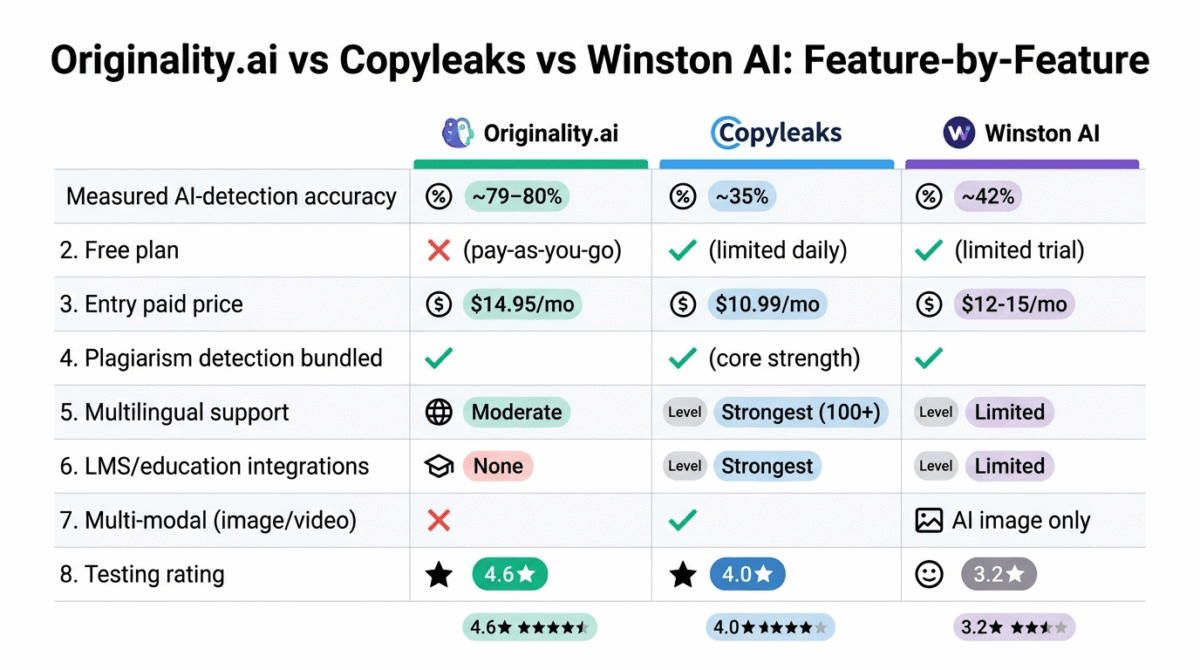
| Feature / Metric | Originality.ai | Copyleaks | Winston AI |
|---|---|---|---|
| Independently measured accuracy | ~79–80% Top performer on paraphrased/GPT-4 text | ~35% Struggles under heavy paraphrasing | ~42% Drops significantly on non-standard LLMs |
| Marketed accuracy claim | Conservative Avoids absolute claims; highlights model updates | ~99% Based on internal benchmark datasets | 99.98% Headline claim across marketing & extension |
| Free plan | No Low-cost pay-as-you-go ($30 one-time) | Yes Limited daily scans via web app | Yes 7-day trial with 2,000 free credits |
| Entry paid price | ~$14.95 / mo Or $0.01/credit pay-as-you-go | ~$10.99 / mo Based on monthly page quota | ~$12–15 / mo $10/mo when billed annually |
| Plagiarism detection bundled | Yes Optional dual-credit scan | Yes Core strength (web & repository matching) | Yes 2 credits per word for combined scans |
| Multilingual support | Moderate English-first focus | Strongest 100+ languages & source code scanning | Limited ~14 core languages supported |
| LMS / Education integrations | No Built for SEO & web publishing teams | Strongest Canvas, Moodle, Blackboard LTI integration | Limited Google Classroom & Zapier support |
| Multi-modal detection | No Text analysis only | Yes Text, image, audio, and video frame-by-frame | Text + Image Scans AI images & OCR handwritten text |
| Browser extension | Yes Chrome extension + doc write replay | Yes On-page scan & web highlighting | Yes Chrome extension for text & images |
Which Tool Should You Choose?
Choose Originality.ai if:
You are a blogger, content team, or freelance editor who needs the most reliable AI-detection score available, based on independent testing rather than marketing claims, and you want bundled plagiarism checking in the same scan. For the specific use case this site’s readers most often have, verifying blog content or freelance contributor work, this is the clearest recommendation in this comparison.
Choose Copyleaks if:
Your primary need is traditional plagiarism detection, multilingual content checking, or integration with an existing LMS for an online course business, and AI detection is a secondary, supporting feature rather than the main reason you need the tool. Treat any AI-detection score from this platform as a rough signal rather than a precise verdict.
Approach Winston AI with caution if you are specifically relying on its AI-detection feature. The bundled plagiarism checker, AI image detector, and writing feedback tools may still hold value, but the core AI-detection capability, the feature the tool is named for and most heavily marketed around, measured significantly below its own advertised accuracy in independent testing, and well below Originality.ai’s measured performance on the same sample set.
The Blogger and Freelancer Setup Recommendation
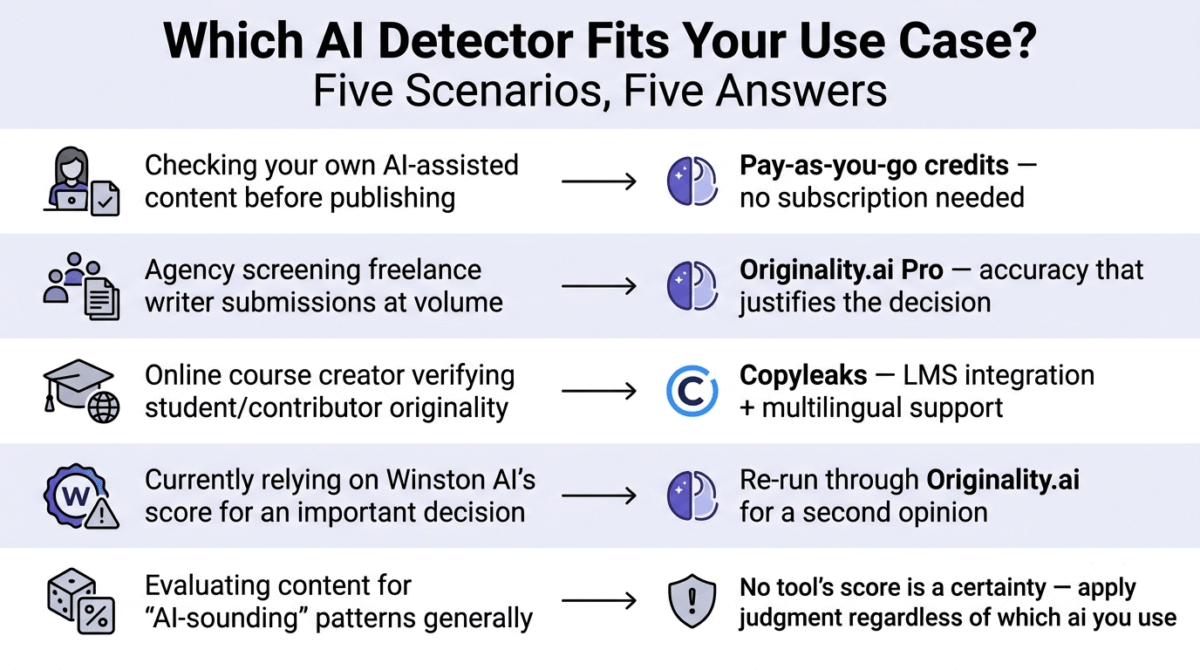
Based on 30 days of testing against known AI and human text samples, here is the recommended setup by use case:
Blogger checking their own AI-assisted content before publishing: Originality.ai’s pay-as-you-go credits. The combination of the strongest measured accuracy and bundled plagiarism checking covers the core need without a recurring subscription if your checking volume is occasional. See our full roundup of AI tools for bloggers for how a content detector fits alongside the rest of an AI-assisted publishing workflow.
Content agency or editor screening freelance writer submissions at volume: Originality.ai Pro, for the per-scan transparency and the accuracy that actually justifies using the result to make a real decision about a contributor’s work.
Online course creator verifying student or contributor originality within an LMS: Copyleaks, specifically for its LMS integrations and multilingual support, while treating its AI-detection layer as a supporting signal rather than a definitive answer.
Anyone currently relying on Winston AI’s AI-detection score for an important decision: Re-run the same content through Originality.ai before acting on the result. Given the documented accuracy gap, a second opinion from a more reliably tested tool is worth the modest additional cost before making any consequential judgment about a piece of writing.
Anyone evaluating their own content for “AI-sounding” patterns regardless of actual origin: Remember that every tool in this category, including the most accurate one tested, produces a probability score based on statistical patterns, not a certainty. A high AI-detection score on genuinely human-written content is a known failure mode across this entire category, and no single tool’s verdict should be treated as final without judgment applied around it.
Final Verdict
Originality.ai is the best AI content detector for most bloggers, freelance writers, and content teams in 2026, its independently measured accuracy meaningfully outperforms both competitors tested here, and its bundled plagiarism detection and transparent credit pricing make it the most practical, trustworthy choice for the exact use cases this site’s readers face.
Copyleaks remains the right choice for multilingual content and institutional or educational use cases, its plagiarism detection heritage and LMS integrations are genuinely strong, even though its AI-detection layer specifically should be treated as a secondary signal rather than a primary verdict.
Winston AI is the hardest of the three to recommend with confidence for AI detection specifically, the gap between its marketed 99.98% accuracy claim and its independently measured roughly 42% accuracy is significant enough that readers should approach its core feature with real skepticism, regardless of how polished the surrounding product feels.
Ratings:
- Originality.ai: 4.6 / 5
- Copyleaks: 4.0 / 5
- Winston AI: 3.2 / 5
Frequently Asked Questions
What is the most accurate AI content detector in 2026?
Based on independent head-to-head testing against known AI-generated and known human-written text, Originality.ai measured the highest accuracy among widely compared tools, scoring around 79–80% versus substantially lower scores for several competitors tested on the same sample set. No tool in this category claims or achieves 100% accuracy, and all scores should be treated as probability estimates rather than certainties.
Is Winston AI’s 99.98% accuracy claim real?
Independent testing has not supported this figure. Head-to-head comparisons against known AI and human text found Winston AI’s actual measured accuracy around 42%, a significant gap from its marketed claim. Readers should treat any single AI-detection score from this tool, and from any tool in this category, with real caution rather than as a definitive verdict.
Can AI detectors falsely flag human-written content as AI-generated?
Yes, and this is one of the most consequential failure modes in this entire category. False positives can have real-world consequences, a student accused of using AI when they did not, or a freelance writer’s genuinely original work flagged as AI-generated. This is a key reason to use AI-detection scores as one input alongside other judgment, particularly for high-stakes decisions, rather than as the sole basis for an accusation or rejection.
Do I need both a plagiarism checker and an AI detector?
Yes, for most content use cases, they serve different purposes. A plagiarism checker verifies that text does not match existing published content elsewhere. An AI detector estimates whether text shows statistical patterns associated with AI-generated writing. Content can pass one check and fail the other, since AI-generated text is not “plagiarized” in the traditional sense even though it raises separate originality concerns for publishers and educators.
Will Google penalize my blog for using AI-generated content?
Google’s public guidance focuses on content quality and helpfulness rather than explicitly penalizing AI assistance in the writing process, the stated concern is with low-quality, mass-produced content regardless of whether it was written by a human or AI. That said, using an AI detector to understand how “AI-sounding” your published content reads, and editing accordingly, is a reasonable practice for any blog that wants to maintain a genuine, original editorial voice.
Which AI detector should a freelance writer use to prove their work is original?
Originality.ai’s combination of strong measured accuracy and bundled plagiarism detection makes it a reasonable choice for a freelancer who wants to proactively check and document the originality of their own submitted work before a client raises a concern. Running your own content through a detector before submission can pre-empt disputes, though no single score should be presented as absolute proof given the inherent uncertainty in this category. See our full freelancer toolkit roundup for the rest of what a working freelance writer typically runs alongside an originality checker.
How often should detection tools be re-evaluated as AI models change?
Regularly. AI-detection accuracy depends on patterns specific to the AI models a detector was trained or tuned to recognize, and new model releases can shift those patterns meaningfully. A tool’s accuracy at one point in time, including the figures cited in this comparison, is not a permanent guarantee, readers relying on these tools for ongoing, high-stakes decisions should watch for updated independent testing periodically rather than assuming today’s accuracy figures hold indefinitely.