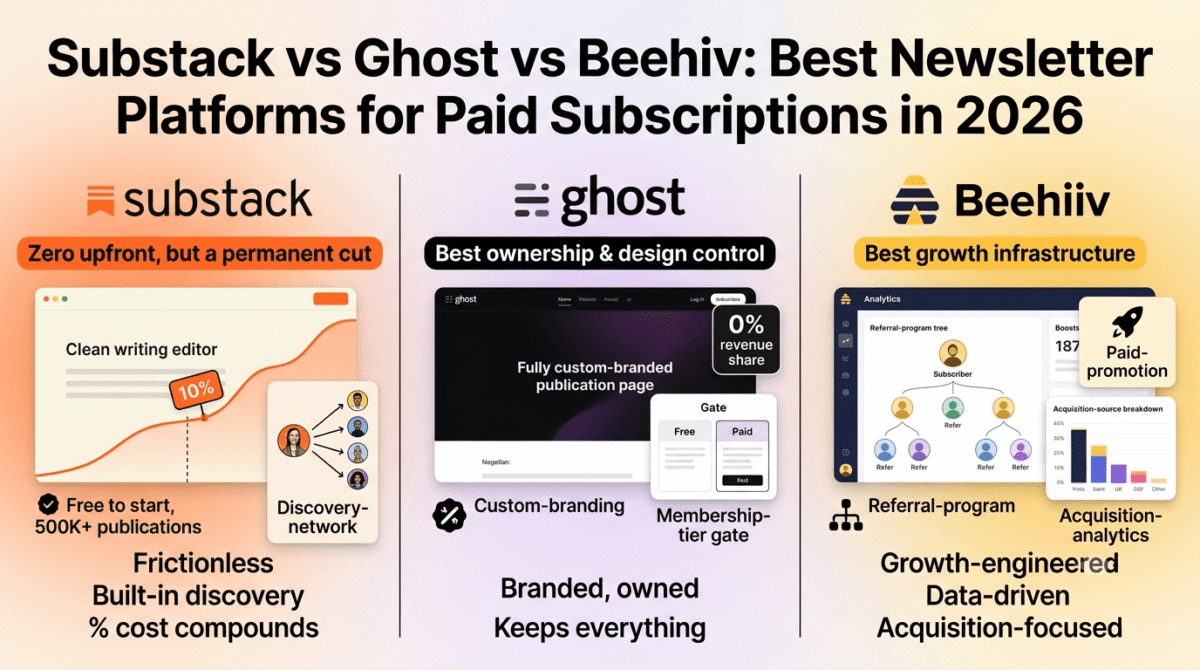
A paid newsletter is one of the cleanest businesses a blogger can build, readers pay you directly, on a recurring basis, with no algorithm deciding who sees your work and no advertiser dictating what you can say. Paid subscriptions are one income stream among several, see our full guide on how to make money blogging for the rest of the mix newsletter writers typically stack alongside it. The platform you choose to run that newsletter on, however, has an outsized effect on how much of that recurring revenue you actually keep, and the three biggest names in this category have made fundamentally different bets about how they get paid for hosting your publication.
Substack takes a percentage of every dollar your readers pay you. Ghost and Beehiiv charge a flat subscription fee and let you keep everything your readers pay. At low revenue, this difference barely matters. At meaningful revenue, it can mean thousands of dollars a year, which is exactly the kind of math this site exists to walk through honestly before you build a business on top of one of these platforms. I tested Substack vs Ghost vs Beehiiv for 30 days, setting up real paid-tier newsletters on each. Here is the honest comparison.
Table of Contents
How We Tested These Platforms
Every platform was evaluated against five criteria:
- Real cost at different revenue levels, not just the headline pricing, but what each platform actually costs once you are earning $500, $2,000, and $10,000 a month from paid subscriptions
- Writing and editing experience, how does it feel to actually write and publish an issue
- Audience growth tools, does the platform help you find new readers, or only manage the ones you already have
- Ownership and portability, if you wanted to leave the platform, how easily could you take your subscriber list and revenue relationship with you
- Design and customization control, how much can the publication look like your own brand rather than a platform template
Why the Business Model Behind Each Platform Matters More Than the Feature List
It is tempting to compare these tools purely on features, does it have a referral program, how good is the editor, does it support podcasts. The detail that actually determines your long-term profitability is the underlying business model each platform has chosen, and it is worth being explicit about it before going feature by feature.
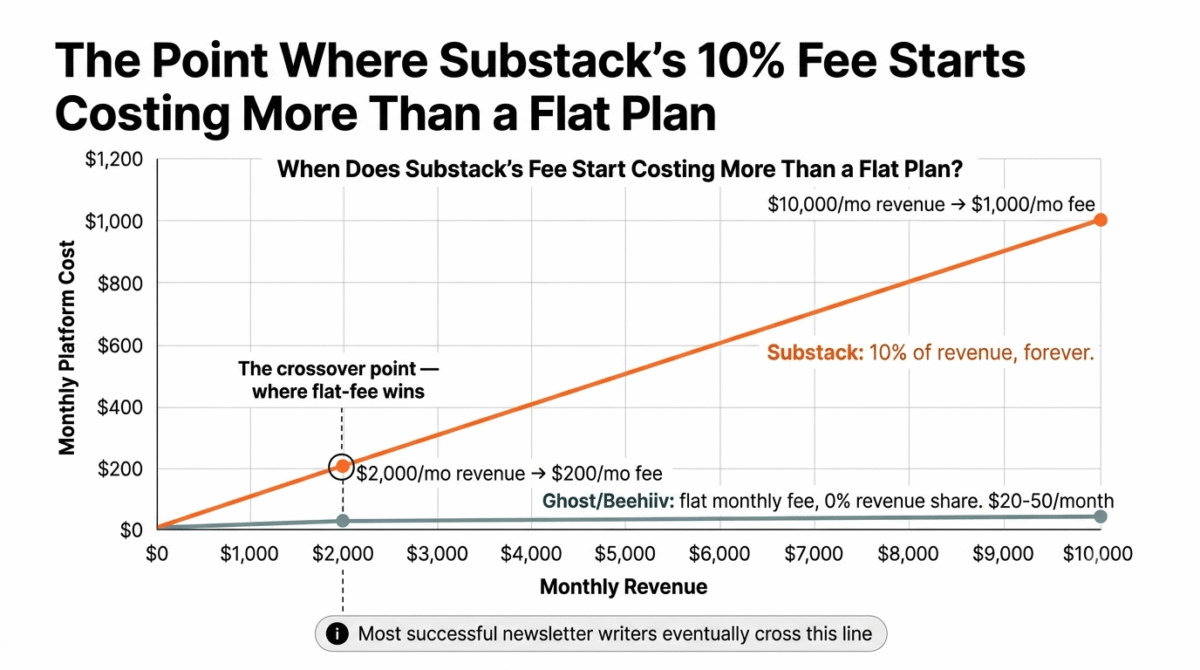
Substack takes 10% of your paid subscription revenue, on top of standard Stripe payment processing fees. That is not a setup fee or a tier you can upgrade out of, it is permanent, scaling with your success indefinitely. Ghost and Beehiiv both work the opposite way: you pay a flat monthly subscription fee for the platform itself, and you keep 100% of whatever your readers pay you beyond standard payment processing costs. At low revenue, Substack’s free entry point is genuinely cheaper. At higher, sustained revenue, the math flips decisively, and most successful newsletter writers eventually cross that line.
Substack Review: The Simplest Way to Start, With a Revenue Share That Compounds
Free plan: Yes, free to publish, no subscription fee for the platform itself
Cost structure: 10% of paid subscription revenue, plus standard payment processing fees
Best for: Writers who want to start publishing today with zero upfront cost and value Substack’s built-in discovery network
Platforms: Web, iOS, Android
Affiliate program: Not a traditional affiliate model, Substack’s growth mechanism is its built-in recommendation network instead
Substack remains the largest platform in this category, hosting more than half a million publications and reportedly over five million people paying for at least one Substack subscription. Its core appeal has not changed: you can start writing today, for free, with no platform fee standing between you and your first subscriber.
What Substack does best
The zero-upfront-cost model removes every piece of friction between deciding to start a newsletter and actually publishing your first issue. There is no subscription to commit to, no plan to select, and no platform fee charged unless and until readers actually pay you, Substack only takes its cut once you are earning, which makes the platform genuinely risk-free to try.
Substack’s built-in discovery network is its most distinctive growth advantage. Recommendations from other Substack writers, the platform’s own discovery surfaces, and a built-in reader app all work to surface your publication to people who have never heard of you, a meaningful advantage for a brand-new newsletter with no existing audience to draw from elsewhere.
The writing and publishing experience is clean and genuinely frictionless, Substack’s editor gets out of the way and lets you focus on writing, with monetization, payment processing, and subscriber management all handled automatically in the background without any setup on your part.
For writers whose primary goal is reaching readers rather than building a fully branded media business, Substack’s tradeoff of platform dependency for discovery and simplicity is a legitimate, reasonable choice, not every newsletter needs to become an independent brand.
Where Substack falls short
The 10% revenue share is the central fact to understand about Substack, and it is worth running the actual numbers. A newsletter earning $2,000/month in paid subscriptions pays Substack $200/month, or $2,400/year, indefinitely, with no tier or threshold that reduces the percentage as you grow. A newsletter earning $10,000/month pays $1,000/month, or $12,000/year. Compare that to Ghost’s or Beehiiv’s flat monthly fee, and the gap becomes substantial well before a creator reaches what most would consider significant income.
Substack’s design customization is limited compared to Ghost specifically, your publication looks recognizably like a Substack, which works against the goal of building a distinct, ownable brand identity separate from the platform itself.
Building a subscriber base on Substack means building on someone else’s infrastructure, with real switching costs if you ever decide to leave. While Substack does allow exporting your subscriber list, the deeper relationship, payment processing setup, the discovery traffic, the platform-native reading habits of your audience, does not transfer cleanly to a new platform.
Substack offers no Google AdSense integration or broader ad-network monetization in the way Ghost supports, your revenue options are essentially limited to paid subscriptions, with fewer alternative income streams built into the platform itself.
Substack: Pros and Cons
Pros:
- Zero upfront cost, completely free until you start earning
- Built-in discovery network and recommendation system for finding new readers
- Cleanest, most frictionless writing and publishing experience
- Largest existing platform with the most subscribers familiar with the format
- No setup required for payments, works immediately
Cons:
- 10% revenue share on paid subscriptions, permanently, with no reduction at scale
- Limited design customization compared to Ghost
- Building your audience on Substack’s infrastructure creates real switching costs
- No AdSense or broader ad-network monetization options
- The percentage fee becomes a significant ongoing cost as revenue grows
Rating: 4.3 / 5, Best for writers starting from zero who value discovery and simplicity over long-term revenue optimization. Reassess once your paid subscription revenue becomes substantial.
Ghost Review: Best for Full Ownership and a Branded Publication, Not Just a Newsletter
Free plan: No, Ghost(Pro) hosted plans start around $9–12/month for a small audience; self-hosting is free but requires technical setup
Starting paid price: Ghost(Pro) entry tier around $9–12/month, scaling with subscriber count
Best for: Writers and bloggers who want a fully branded publication website with a newsletter layered on top, and who keep 100% of subscription revenue
Platforms: Web
Affiliate program: Yes, Ghost affiliate program
Ghost takes a fundamentally different starting position than Substack: it is publication-first, not newsletter-first. Where Substack and Beehiiv both center the email as the primary product, Ghost produces a complete, fully featured website with newsletter delivery layered on top, closer to a standalone media brand than an email list with a web archive attached.
What Ghost does best
Zero revenue share is Ghost’s core financial advantage. You pay a flat monthly hosting fee and keep 100% of whatever your readers pay beyond standard Stripe processing costs, at any revenue level, this structure outperforms Substack’s 10% cut once your flat fee is covered, which happens quickly even at modest subscription revenue.
Ghost’s design control is the deepest of the three platforms. Because it produces a full website rather than primarily an email-delivery system, you have genuine control over layout, branding, navigation, and the overall look of your publication, the result can look like an entirely independent media brand rather than a page hosted on someone else’s platform.
The membership system supports flexible free and paid tiers with content gating by tier, giving you granular control over what free versus paying subscribers can access, useful for a tiered monetization strategy where some content is open and some is reserved specifically for paying members.
Beyond paid subscriptions, Ghost supports Google AdSense integration and affiliate marketing as additional revenue streams within the same publication, a meaningfully broader monetization toolkit than Substack offers, letting a Ghost-hosted blog combine subscription revenue with the same ad and affiliate income streams covered elsewhere on this site.
Self-hosting Ghost, while requiring more technical setup, gives complete infrastructure control at a lower ongoing cost than the hosted Ghost(Pro) plans, a genuinely appealing option for the WordPress-developer-minded reader who is comfortable managing their own server and email delivery provider.
Where Ghost falls short
Ghost lacks Substack’s built-in discovery network entirely. There is no equivalent recommendation system surfacing your publication to readers who have never heard of you, all audience growth has to come from your own marketing efforts, SEO, or external promotion, which is a real disadvantage for a brand-new newsletter with no existing following. If SEO is your main growth lever on Ghost, see our Ahrefs vs Semrush vs Moz comparison of SEO tools to build that organic traffic.
The self-hosted option, while cost-effective, requires a Node.js server and a separate transactional email provider like Mailgun or Postmark configured correctly, genuinely more complex than Substack’s or Beehiiv’s fully managed approach, and not a realistic option for a non-technical blogger without development help.
Ghost(Pro)’s hosted pricing scales with subscriber count, which means a growing publication’s flat fee increases over time, not as steeply as Substack’s percentage-based model in most cases, but worth modeling against your expected growth rather than assuming the entry-tier price stays fixed indefinitely.
The overall platform has a steeper learning curve than Substack’s intentionally simple writing experience, Ghost’s additional control comes with additional configuration decisions that a writer who just wants to start publishing immediately may find unnecessary friction.
Ghost: Pros and Cons
Pros:
- Zero revenue share, keep 100% of subscription revenue beyond payment processing costs
- Deepest design and branding control of the three platforms
- Flexible membership tiers with granular content gating
- Supports AdSense and affiliate revenue alongside subscriptions
- Self-hosting option for full infrastructure control at lower ongoing cost
Cons:
- No built-in discovery network, all growth is self-driven
- Self-hosting requires real technical setup (Node.js, separate email provider)
- Hosted plan pricing scales with subscriber count over time
- Steeper learning curve than Substack’s simplified writing experience
- Less out-of-the-box than Beehiiv for creators wanting growth tools specifically
Rating: 4.5 / 5, Best for writers building a long-term, fully branded publication who want to keep all their subscription revenue and are comfortable with more setup in exchange for more control.
Beehiiv Review: Best for Growth-Focused Creators Building a Newsletter Business
Free plan: Yes, supports a limited subscriber count with core features, no paid newsletter functionality on the free tier
Starting paid price: Scale plan in the $20–50/month range, unlocking paid subscriptions and growth tools
Best for: Creators who want dedicated growth infrastructure, referrals, cross-promotion, and acquisition tools, built specifically for newsletters
Platforms: Web
Affiliate program: Yes, Beehiiv affiliate program
Beehiiv was built by former Morning Brew team members specifically to solve the growth problem that a media company like Morning Brew had already solved internally, and it shows in the product. Where Ghost is publication-first and Substack is discovery-via-network, Beehiiv is growth-mechanics-first, with referral and acquisition tools baked into the core platform rather than added as an afterthought.
What Beehiiv does best
Beehiiv operates on the same flat-SaaS-fee model as Ghost, you pay a monthly subscription for the platform and keep all of your subscription revenue, avoiding Substack’s permanent 10% cut entirely. This puts Beehiiv in the same favorable cost position as Ghost once your revenue exceeds the flat fee, which happens quickly for any newsletter earning a meaningful, consistent income.
The referral program and recommendation network are Beehiiv’s standout growth features. The referral program lets you incentivize existing subscribers to share your newsletter in exchange for rewards, while the recommendation network enables cross-promotion with other Beehiiv-hosted newsletters, a more structured, deliberate growth mechanism than Ghost offers, and a reasonable analog to what makes Substack’s discovery network valuable, but built around explicit incentive structures rather than algorithmic surfacing.
“Boosts”, Beehiiv’s paid subscriber acquisition feature, letting you pay to be promoted within other newsletters in the network, give growth-focused creators a direct paid-acquisition channel that neither Substack nor Ghost offers in comparable form.
Beehiiv’s analytics, including subscriber acquisition source tracking, are more detailed than what either competitor provides out of the box, useful for a creator who wants to understand precisely which growth channels are actually working, not just how many total subscribers they have.
The built-in ad network connects publishers with advertisers directly through the platform, giving Beehiiv-hosted newsletters an additional, platform-facilitated revenue stream beyond paid subscriptions, a meaningful option for newsletters with a free tier that still want to monetize a large non-paying audience.
Where Beehiiv falls short
Beehiiv’s free tier is more restrictive than Substack’s in one important respect, it does not support paid newsletter or membership functionality at all on the free plan, meaning any creator who wants to charge for subscriptions needs to commit to a paid platform tier from the start, unlike Substack’s “start free, pay nothing until you earn” model.
Beehiiv’s interface, while modern, has been described by some reviewers as feeling slightly more “growth-tool-heavy” than Ghost’s clean publication focus, appropriate for a creator whose explicit goal is audience growth, but potentially more than a writer who simply wants to publish needs to navigate.
Design customization, while solid, does not reach the depth of control Ghost offers for creators who want their publication to look like a fully independent, custom-branded website rather than a newsletter with a web archive, Beehiiv sits between Substack’s simplicity and Ghost’s full design control rather than matching Ghost’s ceiling.
Beehiiv: Pros and Cons
Pros:
- Flat SaaS pricing, keep 100% of subscription revenue like Ghost, unlike Substack
- Strongest dedicated growth tools of the three platforms (referrals, cross-promotion, boosts)
- Detailed subscriber acquisition analytics
- Built-in ad network for monetizing free-tier readers
- Built specifically by people with direct newsletter-growth experience at scale
Cons:
- No paid subscription functionality at all on the free tier, must upgrade to charge readers anything
- Interface can feel more growth-tool-focused than purely writing-focused
- Design control does not match Ghost’s depth for fully custom branding
- Newer platform with a shorter track record than Substack’s longer history
- Less suited to a writer who wants minimal setup and just wants to publish
Rating: 4.5 / 5, Best for creators explicitly building a newsletter as a growth-oriented business, with dedicated acquisition tools that neither Substack nor Ghost match.
Head-to-Head Comparison
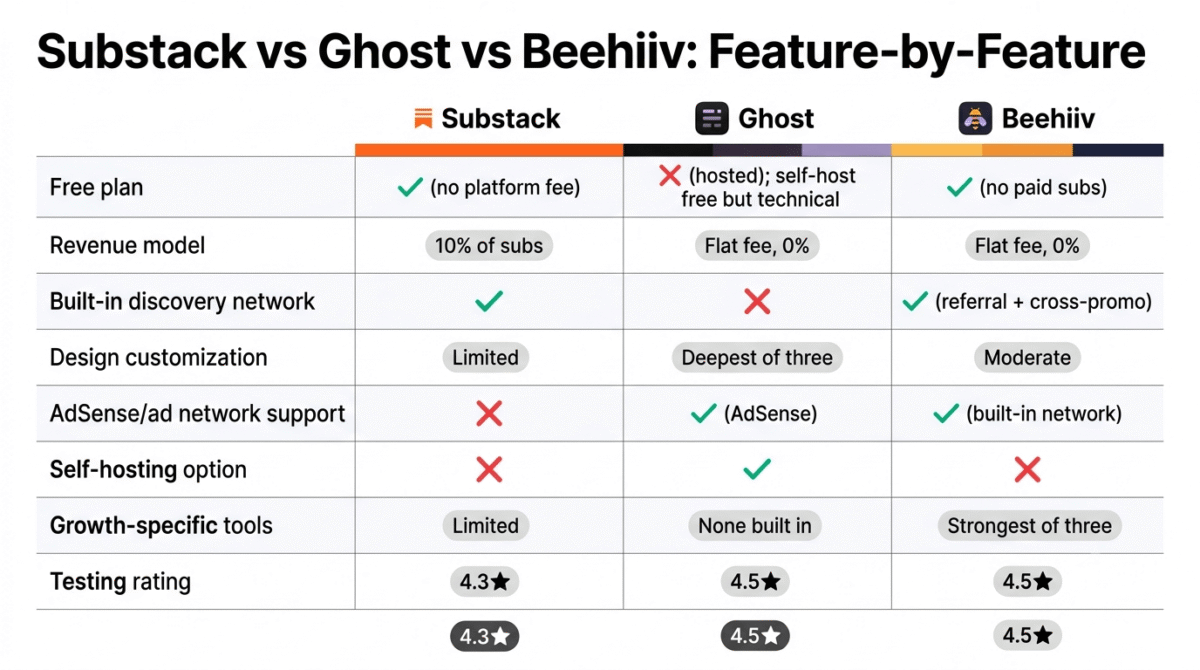
| Feature / Metric | Substack | Ghost | Beehiiv |
|---|---|---|---|
| Free plan | Yes No platform fee | No (hosted) Self-host is free but technical | Yes Up to 2,500 subs (no monetization) |
| Revenue model | 10% cut On paid subscriptions | Flat fee 0% revenue share | Flat fee 0% revenue share |
| Built-in discovery network | Yes Substack Notes & Recommendations | No Purely self-driven distribution | Yes Referrals & cross-promotion network |
| Design customization | Limited Standardized template layout | Deepest Full Handlebars themes & custom code | Moderate Flexible web & email editor |
| AdSense / Ad network support | No Subscription revenue only | Yes Custom HTML / AdSense integration | Yes Built-in programmatic ad network |
| Self-hosting option | No Proprietary hosted platform | Yes Open-source Node.js app | No Proprietary hosted SaaS |
| Growth-specific tools | Limited Basic recommendations | None built in Requires third-party integrations | Strongest Referral program, Boosts, automations |
| Best for | Starting from zero & organic discovery | Full branded publications & total ownership | Growth-focused newsletter businesses |
Which Platform Should You Choose?
Choose Substack if:
You are just starting out, want zero upfront cost, and value Substack’s built-in discovery network for finding your first readers without any existing audience. Plan to revisit this decision once your paid subscription revenue becomes substantial, the 10% fee is the right tradeoff at low revenue and the wrong one at high revenue.
Choose Ghost if:
You want to build a fully branded, independently owned publication and keep 100% of your subscription revenue, and you are comfortable with more setup, or you are technically inclined enough to self-host, in exchange for the deepest design control in this comparison.
Choose Beehiiv if:
Growth is your explicit priority and you want dedicated referral programs, cross-promotion, and acquisition analytics built into the platform itself, while still keeping all of your subscription revenue. Beehiiv is the right choice for a creator treating the newsletter as a deliberate growth business from day one.
The Blogger Setup Recommendation
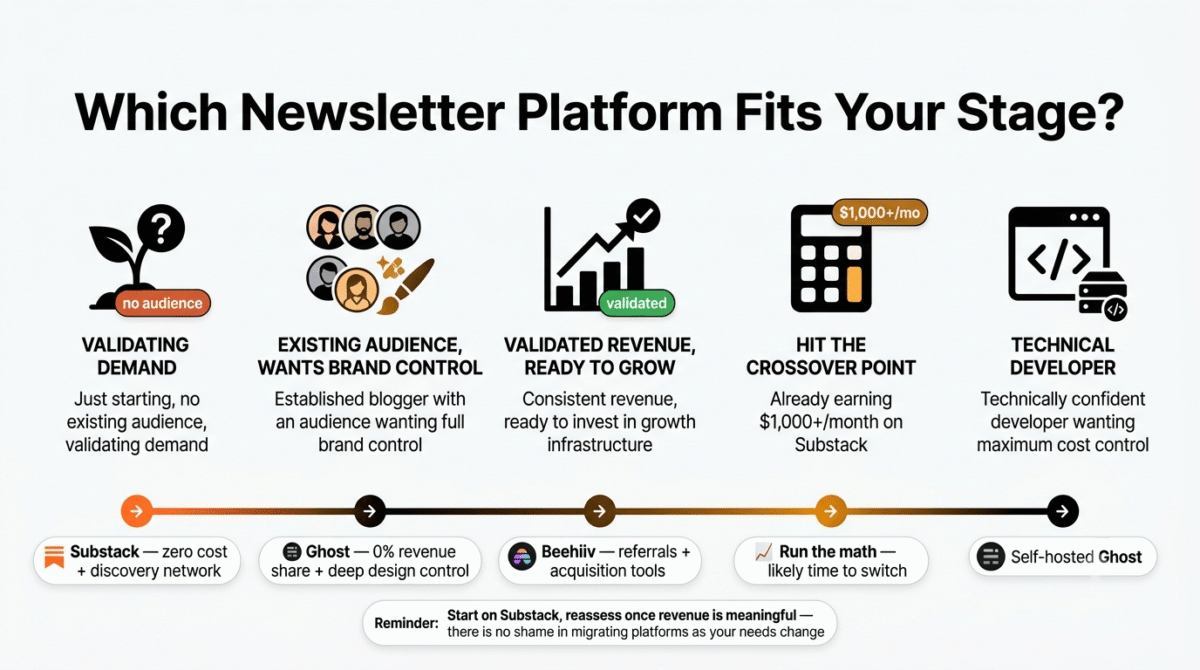
Based on 30 days of testing across real paid-tier setups, here is the recommended setup by creator stage:
Just starting a newsletter, no existing audience, want to validate demand: Substack. The zero-cost entry point and built-in discovery network give you the best chance of finding initial readers without spending anything.
Established blogger with an existing audience wanting full brand control: Ghost. Since you already have readers to migrate rather than needing Substack’s discovery network, the zero revenue share and deep design control are worth the additional setup.
Newsletter earning consistent revenue, ready to invest in growth infrastructure: Beehiiv. Once you have validated that people will pay for your content, the referral programs and acquisition tools are built specifically to compound that early traction into faster growth.
Newsletter already earning $1,000+/month in paid subscriptions on Substack: Run the actual math. At $1,000/month, Substack’s fee is $100/month, or $1,200/year, likely more than a Ghost or Beehiiv flat-fee plan at this subscriber count. This is the point at which switching platforms starts to make clear financial sense, even accounting for the migration effort.
Technically confident WordPress developer who wants maximum cost control: Self-hosted Ghost. The technical setup is real, but for a reader who already manages their own hosting and security hardening as a matter of course, it is a familiar kind of complexity rather than an unreasonable barrier.
Final Verdict
Ghost and Beehiiv are effectively tied as the best long-term platforms for serious paid newsletter businesses in 2026, both let you keep 100% of subscription revenue, which becomes a decisive advantage over Substack once your revenue moves beyond a starting trickle. Ghost wins on design ownership and AdSense flexibility; Beehiiv wins on dedicated growth tooling.
Substack remains the best starting point for a brand-new newsletter with no existing audience, the built-in discovery network and zero upfront cost solve the hardest problem a new publication faces, which is finding readers at all, even though the 10% fee becomes a real cost once you succeed.
The right answer for most readers is to start on Substack and reassess once revenue is meaningful, there is no shame in migrating platforms as your needs change, and the math genuinely favors switching once your paid subscription revenue crosses the point where a flat fee beats a percentage.
Ratings:
- Ghost: 4.5 / 5
- Beehiiv: 4.5 / 5
- Substack: 4.3 / 5
Frequently Asked Questions
What is the best newsletter platform for paid subscriptions in 2026?
Ghost and Beehiiv are the strongest choices for a serious, growing paid newsletter business, since both let you keep 100% of subscription revenue rather than paying Substack’s 10% fee. Substack remains the best starting point for a brand-new newsletter with no existing audience, due to its built-in discovery network and zero upfront cost.
How much does Substack’s 10% fee actually cost me?
It scales directly with your revenue, permanently. A newsletter earning $2,000/month in paid subscriptions pays Substack $200/month, or $2,400/year. A newsletter earning $10,000/month pays $1,000/month, or $12,000/year. There is no tier or threshold that reduces this percentage as your revenue grows, which is the central reason many successful Substack writers eventually migrate to a flat-fee platform.
Is it worth switching from Substack to Ghost or Beehiiv once I’m earning money?
Generally, yes, once your monthly paid subscription revenue exceeds what a comparable flat-fee plan on Ghost or Beehiiv would cost, which happens at a relatively modest revenue level. The migration requires effort, including exporting your subscriber list and reconnecting payment processing, but the long-term financial benefit of eliminating a permanent percentage fee usually outweighs that one-time switching cost.
Does Ghost or Beehiiv help me find new readers the way Substack does?
Beehiiv comes closest, with its referral program and cross-promotion network functioning as a structured alternative to Substack’s algorithmic discovery. Ghost has no equivalent built-in discovery mechanism at all, growth on Ghost depends entirely on your own marketing, SEO, and external promotion efforts. See our Buffer vs Publer vs Sprout Social comparison if social media scheduling is the promotion channel you’re leaning on to replace that missing discovery network.
Can I run ads on my newsletter in addition to charging for subscriptions?
Ghost explicitly supports Google AdSense integration alongside paid subscriptions, and Beehiiv offers its own built-in ad network connecting publishers with advertisers directly. Substack does not offer a comparable built-in ad monetization option, limiting Substack creators primarily to subscription revenue and any external affiliate arrangements they set up independently.
Do I need technical skills to use Ghost?
Not if you use Ghost(Pro), the fully hosted version, which handles server management and email delivery for you in exchange for a monthly fee, similar in simplicity to Substack or Beehiiv. Self-hosting Ghost, which offers lower ongoing costs and full infrastructure control, does require setting up a Node.js server and a separate transactional email provider, which is a meaningfully more technical undertaking.
Which platform is best if I want to combine a paid newsletter with a blog?
Ghost is the strongest fit for this specific combination, since it is built publication-first, producing a complete website with the newsletter layered on top, rather than an email tool with a secondary web archive. This makes it the most natural choice for a blogger who wants their existing site and their paid newsletter to feel like one unified, fully branded publication. Worth noting: a newsletter platform like these three is not the same as a general-purpose email marketing platform like Mailchimp, ConvertKit, or Brevo, see our comparison if you also need automated email sequences and list segmentation beyond just publishing issues.