Buying a domain name is most bloggers’ very first software purchase, made before the blog has a single post, a single reader, or a single dollar of revenue. If you haven’t started that blog yet, see our complete guide to starting a blog and making money before you register the domain that will house it. It is also one of the easiest purchases in this entire industry to get wrong in a way that quietly costs money every single year for as long as you own the domain, because the price you see at checkout is frequently not the price you will pay starting in year two.
This is a foundational, surprisingly under-covered category for a site built entirely on WordPress blogs, and it deserves the same scrutiny we apply to hosting or software subscriptions. There is also a genuinely significant, dated development worth knowing before you register your next domain: in February 2026, GoDaddy updated its Terms of Service to reclassify every customer, including someone running a personal hobby blog, as a “business customer,” a change that multiple independent domain-industry publications report was designed specifically to limit the application of consumer protection law to GoDaddy’s millions of personal-site users.
We tested Namecheap vs GoDaddy vs Porkbun directly, with particular attention to real five-year cost rather than the first-year price you see at checkout. Here is the honest comparison.
Table of Contents
How We Tested These Registrars
Every platform was evaluated against five criteria:
- Real cost over five years, not just year one, since renewal pricing, not registration pricing, is what most owners actually pay across most of the years they hold a domain
- WHOIS privacy and what it actually costs, is genuine ownership privacy included free, or sold as an upsell
- Checkout experience and upselling pressure, how many add-ons does the platform attempt to sell during purchase, and how clearly are they presented
- DNS management and developer features, how capable and fast is the DNS panel, and does the registrar offer API access for managing multiple domains
- Current terms of service and policy direction, a newer criterion this category specifically requires given recent developments, covered in detail below
Why the Renewal Price Matters More Than the Registration Price
This is the single most important mechanic to understand before buying any domain, and it deserves to be stated plainly before we go registrar by registrar: across this industry, a domain’s first-year promotional price is frequently set well below cost specifically to win the sale, with the real, sustained price only appearing at renewal, every year after that, for as long as you keep the domain.
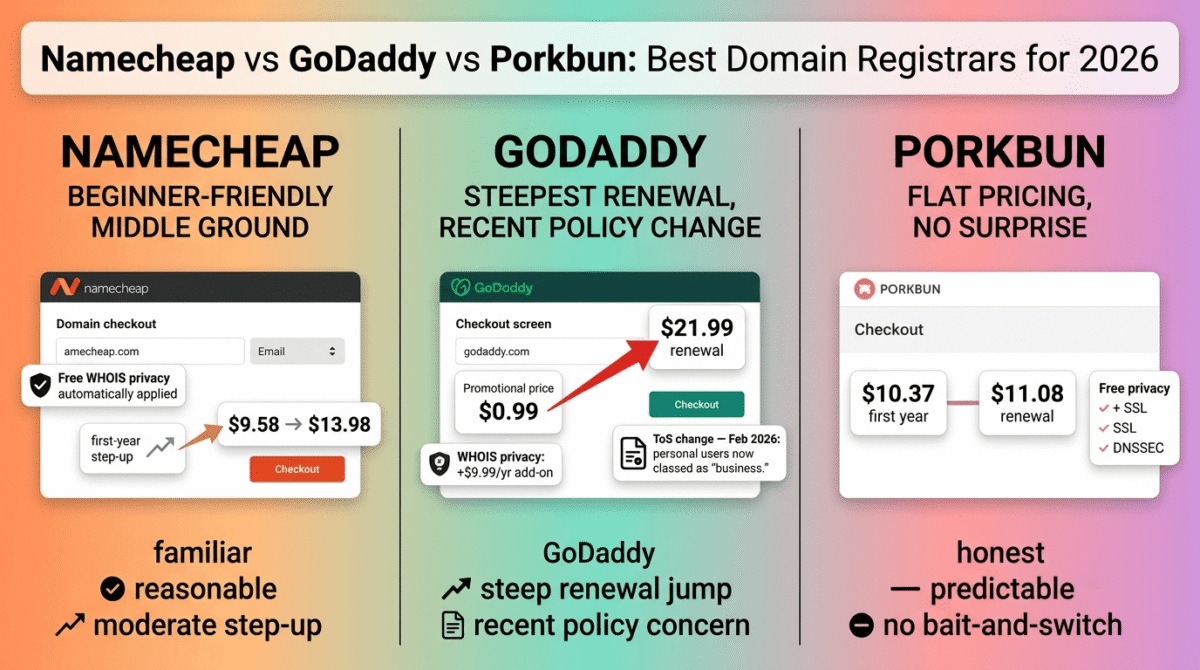
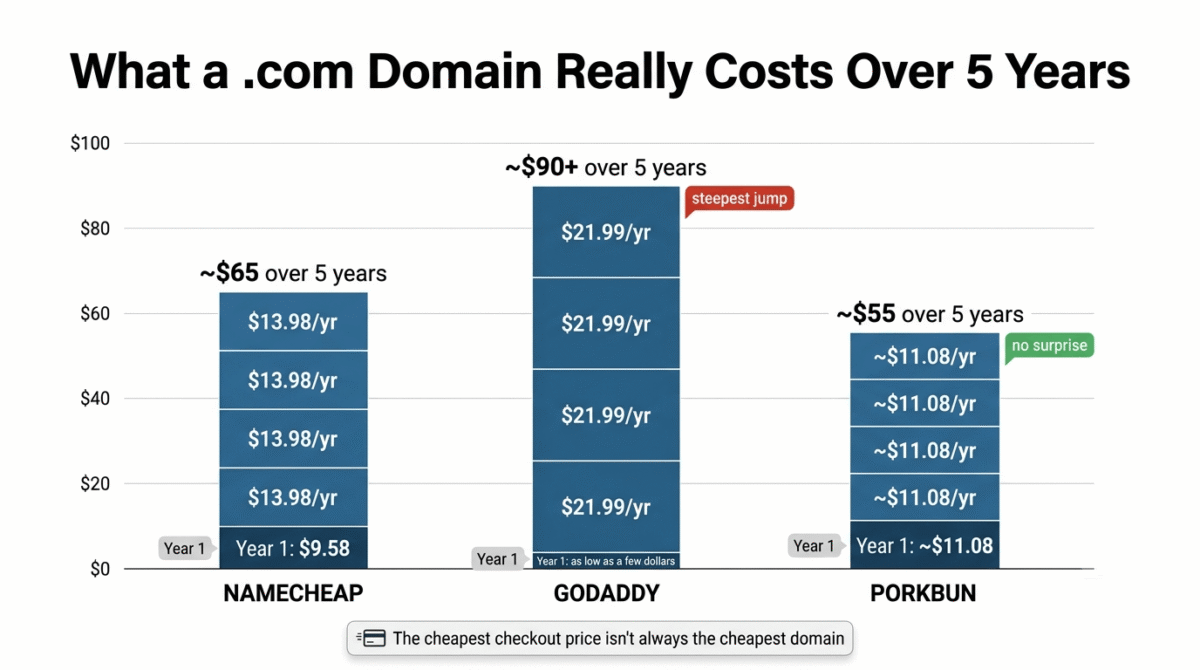
The numbers make this concrete. A typical .com domain at GoDaddy can be discounted to a few dollars in year one on a promotional offer, and renews at roughly $21.99 every year after. Namecheap follows a similar pattern at a smaller scale, a .com commonly starts around $9.58 and renews around $13.98.
Compare that against Porkbun, where the registration price and the renewal price are close to identical, commonly cited around $11.08 for both, meaning the “cheaper” first-year option at GoDaddy can become the more expensive option by year three, once the renewal gap compounds. The single most useful thing a domain buyer can do before purchasing is calculate the five-year total cost, not just compare the number shown at checkout.
The GoDaddy Terms of Service Change You Should Know About Before Buying
This deserves direct, dedicated attention rather than a brief mention, because it is recent, well-documented, and directly relevant to a meaningful share of this site’s readers, anyone running a personal project, hobby blog, or small side business rather than a formally structured company.
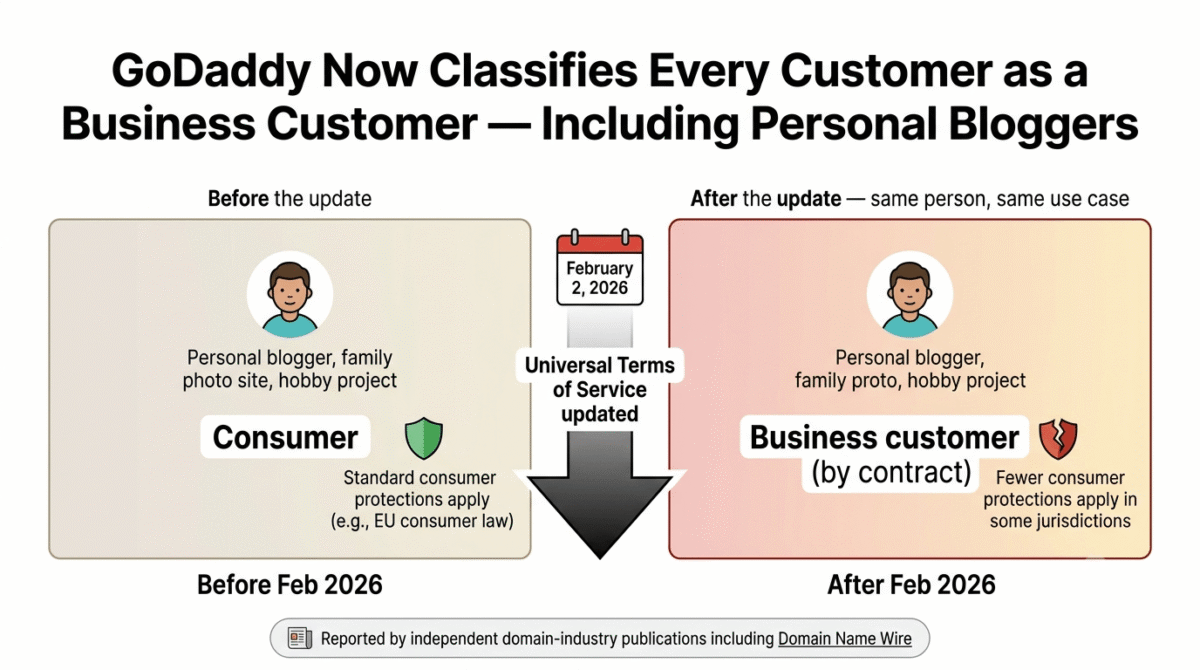
On February 2, 2026, GoDaddy updated its Universal Terms of Service to state that its services “are not intended for private, personal or household use,” and that this limitation overrides any conflicting policy or product description elsewhere on the site. In plain terms, independent domain-industry publications including Domain Name Wire and longtime domain consultant Bill Hartzer reported that this means GoDaddy now treats every customer as a business customer by default, even someone registering a domain for a family photo album, a personal travel blog, or any other clearly non-commercial purpose.
The reporting on why this matters is consistent across sources: business customers are generally covered by fewer consumer protection laws than individual consumers in many jurisdictions, particularly in the EU, where specific statutes provide rights to consumers that do not automatically extend to business-to-business transactions. By contractually defining every customer as a business customer regardless of actual use, the practical effect, as reported by Domain Name Wire, is a reduction in the legal protections available to GoDaddy’s millions of personal-site customers, without requiring any of those customers to do anything or even necessarily notice the change.
We want to be precise about what we do and do not know here: GoDaddy’s own help documentation frames the update as better reflecting its “long-standing focus on supporting entrepreneurs, small businesses, and professionals,” and we have not independently verified every legal consequence this change may have in every jurisdiction. What we can say with confidence is that multiple independent, established domain-industry publications reported on this change with concern at the time it occurred, and that it is a genuinely relevant fact for anyone considering GoDaddy for a personal project, that deserves to be part of your decision rather than something you discover after registering.
Namecheap Review: The Familiar, Beginner-Friendly Middle Ground
Starting price: Commonly cited around $9.58 for a .com in the first year
Renewal price: Commonly cited around $13.98 for a .com
WHOIS privacy: Free, included by default on eligible domains
Best for: Beginners who want a recognizable, established registrar with a one-stop-shop feature set, without GoDaddy’s scale of upselling or its recent policy direction
Namecheap has spent years building a reputation as the sensible, slightly cheaper alternative to GoDaddy, recognizable enough that beginners trust it, while avoiding the most aggressive upselling and pricing patterns associated with the larger competitor.
What Namecheap does best
Free WHOIS privacy, included by default rather than sold as an add-on, is a meaningful and consistent advantage, domain ownership information is public by default through ICANN’s WHOIS database unless privacy protection is applied, and Namecheap including this for free on eligible domains avoids a common upsell tactic used elsewhere in the industry.
Namecheap’s renewal pricing, while it does increase from the first-year promotional rate, increases by a meaningfully smaller margin than GoDaddy’s, roughly a 46% increase from $9.58 to $13.98 on a standard .com, compared to GoDaddy’s far steeper jump from promotional pricing to roughly $21.99.
The platform bundles a genuinely useful set of related services, email hosting, SSL certificates, and basic website tools, into a single account and invoice, which is convenient for a beginner who wants to manage a domain and a few adjacent needs without juggling multiple vendor relationships and billing cycles.
Namecheap’s customer support and educational content are generally well-regarded, and the platform’s bulk search tools and API access make it a reasonable choice even for someone managing a small portfolio of domains beyond a single personal blog.
Where Namecheap falls short
The dashboard interface is consistently described across independent reviews as busier and more marketing-funnel-like than cleaner competitors such as Porkbun or the newer Spaceship platform, functional, but not the most pleasant day-to-day experience for someone who just wants to manage DNS settings without navigating upsell prompts.
While Namecheap’s renewal increase is smaller than GoDaddy’s, it is still a real increase, not the flat or near-flat renewal pricing that Porkbun and a few other competitors offer, a five-year cost comparison still favors Porkbun’s model for a buyer planning to hold the domain long-term.
Namecheap’s premium and specialty top-level domains (TLDs), particularly newer or niche extensions, can carry meaningfully higher renewal costs that are easy to overlook at the point of purchase, since the promotional first-year price for an unusual TLD is sometimes set especially low to drive that specific sale.
Namecheap pricing snapshot
| Domain Item / Extension | Price Schedule | Features & Terms |
|---|---|---|
| .com Registration | ~$9.58 First year introductory rate | Standard top-level domain for commercial websites; includes basic DNS management |
| .com Renewal | ~$13.98 / year recurring | Annual renewal fee following initial promo term (+ $0.18 ICANN fee) |
| .net Registration | ~$12.98 First year introductory rate | Popular technical and networking top-level domain alternative |
| .net Renewal | ~$15.98 / year recurring | Annual renewal rate reflecting wholesale registry fee adjustments |
| WHOIS Privacy Protection | Free (Included) | Permanently masks registrant contact details (address, phone, email) on public lookup databases |
Namecheap: Pros and Cons
Pros:
- Free WHOIS privacy included by default on eligible domains
- Smaller renewal price increase than GoDaddy’s
- Bundles email, SSL, and basic website tools into one account
- Well-regarded customer support and educational resources
- Solid choice for managing a small portfolio with bulk search and API access
Cons:
- Dashboard interface busier and more upsell-oriented than cleaner competitors
- Renewal pricing still increases meaningfully from the first-year promotional rate
- Premium and niche TLDs can carry renewal surprises beyond standard .com pricing
- Not the cheapest option for a buyer planning to hold a domain long-term
Rating: 4.4 / 5, Best for beginners who want an established, trustworthy registrar with useful bundled features, while avoiding GoDaddy’s steeper renewal pricing and recent policy direction.
GoDaddy Review: The Biggest Name, With Real Cautions Worth Weighing Now
Starting price: Can drop to a few dollars on aggressive multi-year promotional offers
Renewal price: Commonly cited around $21.99 for a .com, the steepest increase among the three registrars compared here
WHOIS privacy: Sold as an add-on (commonly cited around $9.99/year) rather than included free
Best for: Buyers who specifically need GoDaddy’s TLD coverage or existing ecosystem, going in with full awareness of its pricing pattern and recent terms changes
GoDaddy remains the largest domain registrar on Earth by a wide margin, with tens of millions of domains under management, and it genuinely offers the broadest combination of brand recognition, marketing reach, and bundled services of any registrar in this comparison. That scale, however, comes with real, well-documented tradeoffs that deserve full weight in 2026.
What GoDaddy does best
Brand familiarity is real and has practical value for some buyers, GoDaddy is a name many small business owners and their clients already recognize, which can matter slightly for trust in specific contexts, such as transferring domain management to a client who is more comfortable with a familiar name than an unfamiliar discount registrar.
The aggressive first-year promotional pricing genuinely can produce the lowest possible cost for a domain you plan to test briefly or hold for only one year, multi-year promotional bundles have, at times, brought a .com down to a few dollars total for the first term, which is difficult for any competitor to beat on a pure first-year basis.
GoDaddy’s broader ecosystem, hosting, website builders, e-commerce tools, email, and a large domain aftermarket and auction platform, gives a buyer who wants everything under one roof a genuinely comprehensive set of options, even if, as covered elsewhere on this site, those individual products are not always the best value in their own category.
Where GoDaddy falls short
The renewal price jump is the steepest and most consistently documented pricing trap among the three registrars in this comparison. A .com that drops to a few dollars in year one commonly renews around $21.99 every year after, for a buyer planning to hold the domain for five years or more, this is a substantially worse total cost than Porkbun’s or Cloudflare’s near-flat pricing, and meaningfully worse than Namecheap’s smaller renewal increase.
WHOIS privacy is sold as a separate add-on rather than included by default, commonly cited around an additional $9.99 per year, a real, recurring cost that Namecheap and Porkbun both include free, adding further to GoDaddy’s actual total cost of ownership beyond the headline renewal price alone.
The checkout experience is widely described across independent reviews as the most aggressively upsold in this comparison, with add-ons for privacy, security products, website builder trials, and other services presented throughout the purchase flow, a real source of friction and unplanned spending for a buyer not paying close attention.
Most significantly, the February 2026 Terms of Service change reclassifying all customers as business customers, detailed above, represents a real and recent shift in how GoDaddy frames its legal relationship with personal-use customers specifically, independent domain-industry reporting has raised genuine concern about the consumer protection implications of this change, and it is a fact we believe every personal-site buyer deserves to know before choosing GoDaddy in 2026.
GoDaddy pricing snapshot
| Domain Item / Service | Price Schedule | Conditions & Strategic Notes |
|---|---|---|
| .com Promotional First Year | As low as $0.99–$2.99 Introductory rate | Requires multi-year registration commitment (e.g., 2+ years); discounted promo applies to year 1 only |
| .com Renewal Rate | ~$21.99 / year recurring | Standard annual renewal rate levied after promotional period expires (+ ICANN fee) |
| WHOIS Privacy Protection | ~$9.99 / year (Paid Add-On) | Billed separately as an optional security add-on; required to prevent public exposure of contact details |
GoDaddy: Pros and Cons
Pros:
- Strongest brand recognition of the three registrars, which can matter for client-facing trust
- Aggressive promotional pricing can produce the lowest possible first-year cost
- Broadest bundled ecosystem (hosting, builders, email, domain marketplace) under one account
- Largest domain registrar globally, with extensive TLD coverage
Cons:
- Steepest renewal price increase of the three registrars (~$21.99/year on a .com)
- WHOIS privacy sold as an add-on rather than included free
- Most aggressive upselling at checkout among the registrars compared
- February 2026 Terms of Service change reclassifying personal users as business customers, with reported consumer protection implications, a fact worth weighing directly before purchasing
Rating: 3.7 / 5, Capable and familiar, but the combination of the steepest renewal pricing in this comparison and a recent, well-documented policy change affecting personal-use customers makes it the hardest of the three to recommend without real reservations in 2026.
Porkbun Review: Best for Honest, Predictable Pricing With No Renewal Surprise
Starting price: Commonly cited around $10.37–11.08 for a .com
Renewal price: Matches or nearly matches the registration price, commonly cited at the same $10.37–11.08 figure
WHOIS privacy: Free, included by default
Best for: Anyone who wants to know their actual cost for the entire time they own a domain, not just the first year
Porkbun has built its entire reputation around a single, simple commitment that stands in direct contrast to the renewal-price-jump pattern common across this industry: the price you pay to register a domain is close to the price you will pay to renew it, every year, for as long as you own it.
What Porkbun does best
Matching, near-flat renewal pricing is Porkbun’s defining and most important feature in this comparison. There is no promotional bait-and-switch, the registration price and the renewal price sit close together, commonly cited around $11.08 for a standard .com in both cases, which means the cost you calculate at checkout is genuinely the cost you should expect to pay every year after, not a temporary number that triples by year two.
Free WHOIS privacy, free SSL via Let’s Encrypt, free URL and email forwarding, and free DNSSEC are all included by default rather than upsold, a meaningfully more generous free feature set than GoDaddy’s add-on-heavy model, and broadly comparable to or better than Namecheap’s included features.
Porkbun’s interface is widely regarded across independent reviews as the cleanest and least cluttered in this category, a real, practical advantage for a buyer who wants to register a domain, point its DNS, and move on without navigating upsell prompts at every step.
API access and developer-friendly tooling make Porkbun a reasonable choice even for a freelance WordPress developer managing several client domains, not just a single personal blog, the platform’s transparency extends to its programmatic tools as well as its consumer-facing dashboard.
Where Porkbun falls short
Porkbun explicitly does not offer refunds on registrations or renewals, a real and unusual policy worth understanding clearly before purchasing, since competitors more commonly offer at least a short refund window for a clearly mistaken purchase.
Brand recognition is far lower than GoDaddy’s or even Namecheap’s, which is irrelevant for most personal use cases but worth noting if you are registering a domain on behalf of a client who may feel more comfortable seeing a more widely known registrar’s name during a handoff or account transfer.
Porkbun’s bundled ecosystem, hosting, website builders, broader business tools, is far thinner than GoDaddy’s, which is by design rather than a flaw, but means a buyer who specifically wants a one-stop shop for domain plus hosting plus email will need to look elsewhere for those additional pieces, pairing Porkbun’s domain registration with a separate hosting provider like the options covered in our web hosting comparison.
Porkbun pricing snapshot
| Domain Item / Service | Price Schedule | Features & Strategic Notes |
|---|---|---|
| .com Registration (First Year) | ~$10.37 – $11.08 Transparent base rate | At-cost registration passing through Verisign registry base fees plus minimal transaction overhead |
| .com Annual Renewal | ~$11.08 Matches registration price | Flat-rate pricing structure with zero renewal markups or introductory discount traps |
| WHOIS Privacy Protection | Free (Included) | Permanent WHOIS privacy shielding to conceal contact information from scrapers and spammers |
| SSL Certificate | Free (Included) | Automated Let’s Encrypt / Cloudflare SSL certificate provisioning with automatic HTTPS renewal |
Porkbun: Pros and Cons
Pros:
- Renewal price matches or nearly matches registration price, no bait-and-switch
- Free WHOIS privacy, SSL, forwarding, and DNSSEC included by default
- Cleanest, least cluttered interface in this comparison
- Developer-friendly API access suitable for managing multiple client domains
- Best real five-year cost of the three registrars on a standard .com
Cons:
- No refunds on registrations or renewals, confirm your purchase carefully before completing it
- Lower brand recognition than GoDaddy or Namecheap
- Thinner bundled ecosystem, no comparable hosting, builder, or business tool suite
- Smaller company than GoDaddy or Namecheap, with a shorter overall track record at scale
Rating: 4.7 / 5, Best honest, predictable pricing of the three registrars, and the strongest real five-year value for anyone planning to hold a domain long-term.
Head-to-Head Comparison
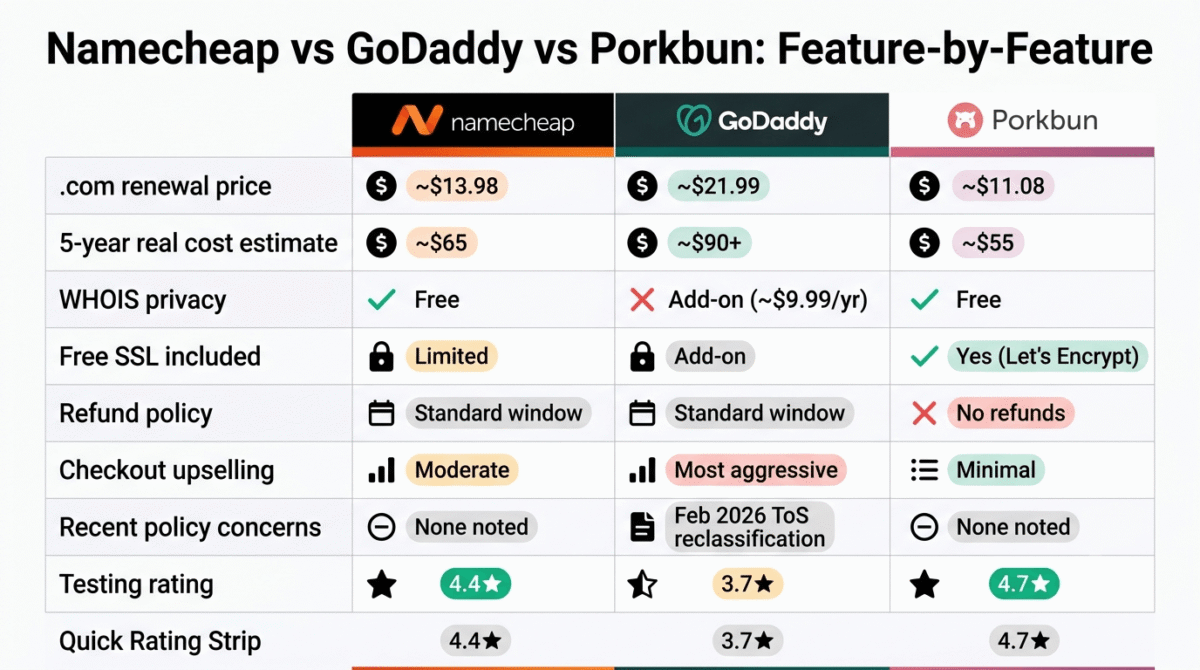
| Criteria / Metric | Namecheap | GoDaddy | Porkbun |
|---|---|---|---|
| .com First Year | ~$9.58 Moderate initial discount | As low as $0.99–$2.99 Requires multi-year lock-in | ~$10.37 – $11.08 Near-wholesale entry price |
| .com Renewal Rate | ~$13.98 / year Fair retail renewal rate | ~$21.99 / year High markup + ICANN fees | ~$11.08 / year Matches registration rate (at-cost) |
| 5-Year Real Cost (.com) | ~$65.50 Includes free privacy | ~$90.00 – $140.00+ Drastically higher with paid WHOIS | ~$55.00 Lowest total 5-year outlay |
| WHOIS Privacy Protection | Free (Included) With PrivacyGuardian for life | Paid Add-on ~$9.99 / year per domain | Free (Included) Automatic WHOIS redaction |
| Free SSL Included | Limited Trial PositiveSSL for year 1 only | Paid Add-on Up to $80+/year standalone SSL | Yes Free automated Let’s Encrypt SSL |
| Refund Policy | Standard Window 5-day grace period on domains | Standard Window 5-day registration refund policy | Strict Policy No domain refunds due to registry costs |
| Checkout & UX Friction | Moderate Some hosting/email upsell popups | Aggressive Heavy pre-selected add-ons in cart | Minimal Clean, zero-upsell checkout flow |
| Ecosystem & Add-ons | Moderate Shared hosting, EasyWP, VPN, business email | Broadest Stack Websites, hosting, Office 365, domain auctions | Thin by Design Focuses purely on DNS, WHOIS & domain tools |
| Recent Policy Notes | Standard Consistent terms & community trust | Feb 2026 ToS Change Reclassified users as “Business” to strip consumer protections | Standard High indie-developer community trust |
| Best For | Beginners & Solo Pros Familiar brand with good support & hosting options | Enterprise & Auctions Buyers needing domain aftermarket/auctions & phone support | Long-Term Domain Holders Developers & webmasters seeking honest, flat pricing |
Which Registrar Should You Choose?
Choose Namecheap if:
You want a recognizable, established registrar with useful bundled features and a smaller renewal price increase than GoDaddy’s, and the slightly busier dashboard is an acceptable tradeoff for that familiarity.
Choose GoDaddy if:
You specifically need its TLD coverage, an existing ecosystem relationship, or a name your clients will recognize during a handoff, and you go in with full awareness of both its steep renewal pricing and the February 2026 Terms of Service change affecting personal-use customers. We would encourage most readers registering a domain for a personal blog or small side project to weigh that policy change seriously before choosing GoDaddy in 2026.
Choose Porkbun if:
You want to know your actual cost for as long as you hold the domain, with no renewal-price surprise, free privacy and SSL included by default, and the cleanest checkout experience of the three. For most of this site’s readers, bloggers and freelancers planning to hold a domain for years, not months, this is the most defensible default choice.
The Blogger Setup Recommendation
Based on direct testing and real five-year cost modeling, here is the recommended setup by situation:
New blogger registering their first domain: Porkbun. The combination of honest, near-flat pricing, free privacy and SSL, and a clean interface makes it the easiest registrar to recommend without reservation for someone just starting out.
Freelance WordPress developer managing multiple client domains: Porkbun’s API access for the registrar itself, paired with whichever hosting provider best fits each specific client project, keeping domain registration and hosting as separate, deliberately chosen decisions rather than defaulting to a single bundled provider. See our full freelancer toolkit roundup for the rest of the stack a freelance developer typically runs alongside domain and hosting management.
Buyer who specifically wants domain, hosting, and email under one bill: Consider a hosting-bundled option like Hostinger’s domain registration, covered in our hosting comparison, rather than GoDaddy specifically, several hosting providers now offer competitive bundled domain registration without GoDaddy’s renewal pricing pattern or recent policy direction.
Anyone with an existing GoDaddy domain approaching renewal: Calculate the actual cost of transferring to Porkbun or Namecheap before automatically renewing. Domain transfers are generally straightforward, and the five-year savings from switching away from GoDaddy’s renewal pricing alone often justify the modest effort involved.
Domain investor or portfolio manager with many domains: Look beyond the three registrars in this comparison specifically toward bulk-management-focused platforms like NameSilo or Dynadot, which several independent sources identify as better suited to managing ten or more domains with consistent registration-to-renewal pricing at scale.
Final Verdict
Porkbun is the best domain registrar for most of RateTheTool’s readers in 2026, its near-flat renewal pricing, free privacy and SSL, and clean, low-pressure checkout experience produce the best real five-year cost of the three registrars compared here, with no bait-and-switch pricing pattern to watch for.
Namecheap remains a solid, trustworthy middle ground, its smaller renewal increase than GoDaddy’s, free WHOIS privacy, and useful bundled features make it a reasonable choice for a beginner who specifically values an established, recognizable name over Porkbun’s leaner but less widely known platform.
GoDaddy is the hardest of the three to recommend without reservation in 2026, the steepest renewal pricing in this comparison, WHOIS privacy sold as an add-on, the most aggressive checkout upselling, and a recent, well-documented Terms of Service change affecting personal-use customers all weigh against it for most of this site’s readers, even though its scale and brand recognition remain real.
Ratings:
- Porkbun: 4.7 / 5
- Namecheap: 4.4 / 5
- GoDaddy: 3.7 / 5
Frequently Asked Questions
What is the best domain registrar in 2026?
Porkbun offers the best overall value for most bloggers and freelancers, with near-flat renewal pricing and free privacy and SSL included by default. Namecheap is a solid, more recognizable alternative with a smaller renewal increase than GoDaddy’s. GoDaddy’s steep renewal pricing and recent Terms of Service changes make it harder to recommend without reservation in 2026.
Why did my domain renewal cost so much more than what I paid last year?
This is extremely common and is the central pricing pattern this entire post is built around: many registrars, GoDaddy most prominently, set an aggressively low first-year promotional price specifically to win the initial sale, with the real, sustained renewal price only appearing starting in year two. Always calculate the renewal price, not just the registration price, before choosing a registrar.
What did GoDaddy’s February 2026 Terms of Service change actually do?
GoDaddy updated its Universal Terms of Service to state that its services are not intended for personal, private, or household use, and that this provision overrides any conflicting product description elsewhere on its site. Independent domain-industry publications reported that this effectively reclassifies all GoDaddy customers, including personal hobby site owners, as business customers, a status that may reduce the consumer protections available to them in certain jurisdictions, particularly the EU.
Is WHOIS privacy actually necessary?
Yes, in most cases. Without WHOIS privacy, your name, address, phone number, and email are published in a publicly searchable database when you register a domain, unless your registrar masks this information. Free WHOIS privacy, included by default at Namecheap and Porkbun, is a meaningful protection against spam, unsolicited marketing calls, and in some cases harassment, and should generally be considered close to a requirement rather than an optional extra. If you’re registering a domain alongside forming a business entity for the first time, see our Rocket Lawyer vs LegalZoom vs LawDepot comparison, the two often happen around the same time.
Should I buy my domain from the same company as my hosting?
Not necessarily, and there are real advantages to keeping them separate. Registering your domain at one provider and hosting your site at another means a problem with one service, a billing dispute, an account lockout, or a policy change like GoDaddy’s, does not put both your domain and your website at risk simultaneously. Many experienced WordPress developers deliberately keep domain registration and hosting with different providers for exactly this reason.
Can I transfer my domain away from GoDaddy if I already have one registered there?
Yes. Domain transfers between registrars are a standard, well-supported process, generally requiring an unlock code from your current registrar and a transfer request at the new one, with the process typically completing within about a week. Most registrars, including Namecheap and Porkbun, offer guidance and sometimes a discounted transfer rate to help offset the small remaining-term cost involved.
Is the cheapest first-year price always the worst long-term deal?
Not always, but it correlates closely enough across this industry that it deserves real scrutiny every time. The right question is always the five-year total cost, not the first-year number, a domain you genuinely plan to hold for only a single year may reasonably justify chasing the lowest promotional price, but for any domain intended to be a long-term blog or business address, the renewal price matters more than the registration price.