A bounced email does more than fail to land; enough of them in a short window can get a sending domain flagged and tank deliverability for every email after it, meaning the newsletters and repurposed content you worked so hard to distribute will never reach your audience. NeverBounce vs ZeroBounce vs Hunter are three of the names that come up when a list needs cleaning before a send, though only two of them do the same specific job.
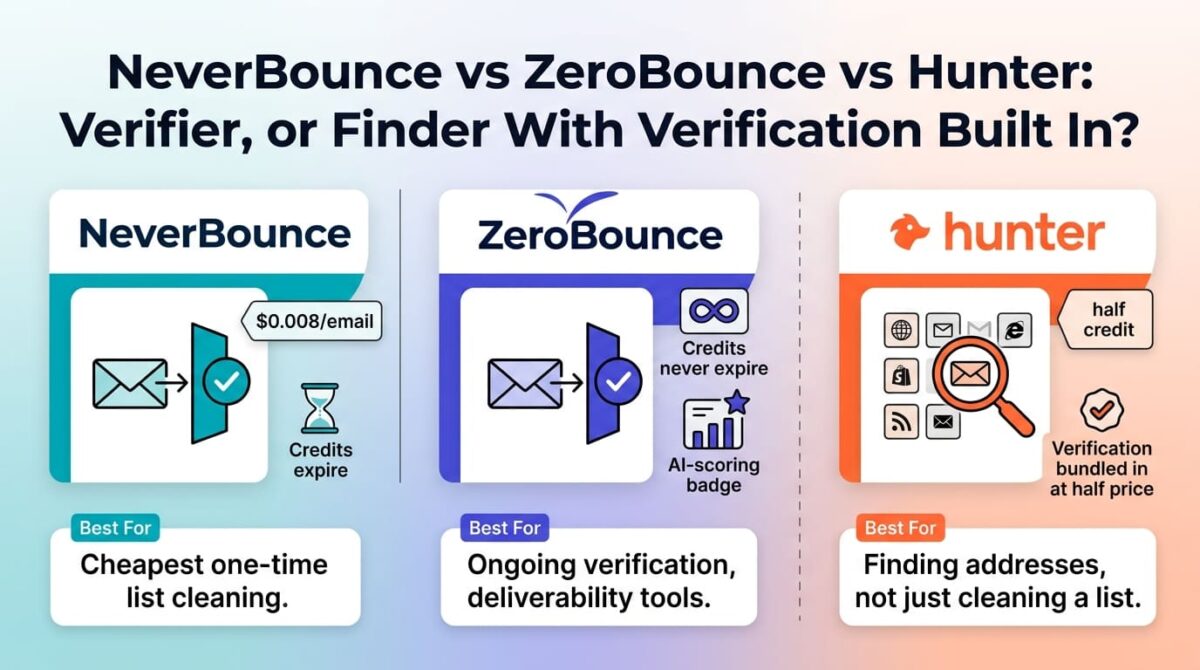
NeverBounce and ZeroBounce are pure verification tools: feed in an email, get back a deliverability verdict, nothing more. Hunter does that too, but verification is a secondary feature layered onto what’s primarily an email-finding tool, with a credit system that prices the two differently.
I tested NeverBounce vs ZeroBounce vs Hunter for 30 days, running the same list of a few thousand addresses through all three and tracking accuracy, true cost per verification, and what happened to unused credits over time. Here is the honest comparison, including a NeverBounce plan that costs more per email than the company’s own pay-as-you-go option.
Table of Contents
How We Tested
Five criteria shaped the testing:
- Verification accuracy: how each tool classified the same batch of valid, invalid, and risky addresses
- True cost per verification: price at the volume a typical small business sends in practice, not just the headline rate
- Credit expiration policy: whether unused credits disappear after a fixed window or carry forward indefinitely
- Category fit: whether the tool verifies only, or also finds email addresses in the first place
- Setup and integration: how easily each tool connected to existing email marketing or CRM platforms
NeverBounce Review: The Cheapest Entry Rate, With Credits That Expire
Free plan: No, new accounts receive 3-10 free test credits
Starting price: $8 per 1,000 credits ($0.008/email), pay-as-you-go
Best plan for most users: Pay-as-you-go, since the monthly subscription option costs more per email
Platforms: Web, API, 85+ native integrations
Affiliate program: Yes, NeverBounce affiliate program
NeverBounce, now backed by ZoomInfo’s data infrastructure, verifies email addresses in bulk, via API, or on the fly, with no email-finding capability built in.
What NeverBounce does best
The pay-as-you-go rate is the cheapest entry point of the three tools compared here: $0.008 per email under 10,000 credits, dropping to $0.003 per email above 250,000. For a business that occasionally needs to clean a list before a campaign rather than verify continuously, that per-use pricing avoids paying for a subscription between sends.
The 85-plus native integrations, including direct connections to Mailchimp, HubSpot, and ActiveCampaign, make NeverBounce straightforward to plug into an existing marketing stack, pairing seamlessly alongside your social media scheduling tools, without custom API work.
Where NeverBounce falls short
Credits expire 12 months after purchase, a meaningful constraint for anyone who buys in bulk for a lower per-email rate but doesn’t send consistently enough to use them before they lapse. ZeroBounce’s credits, by comparison, never expire.
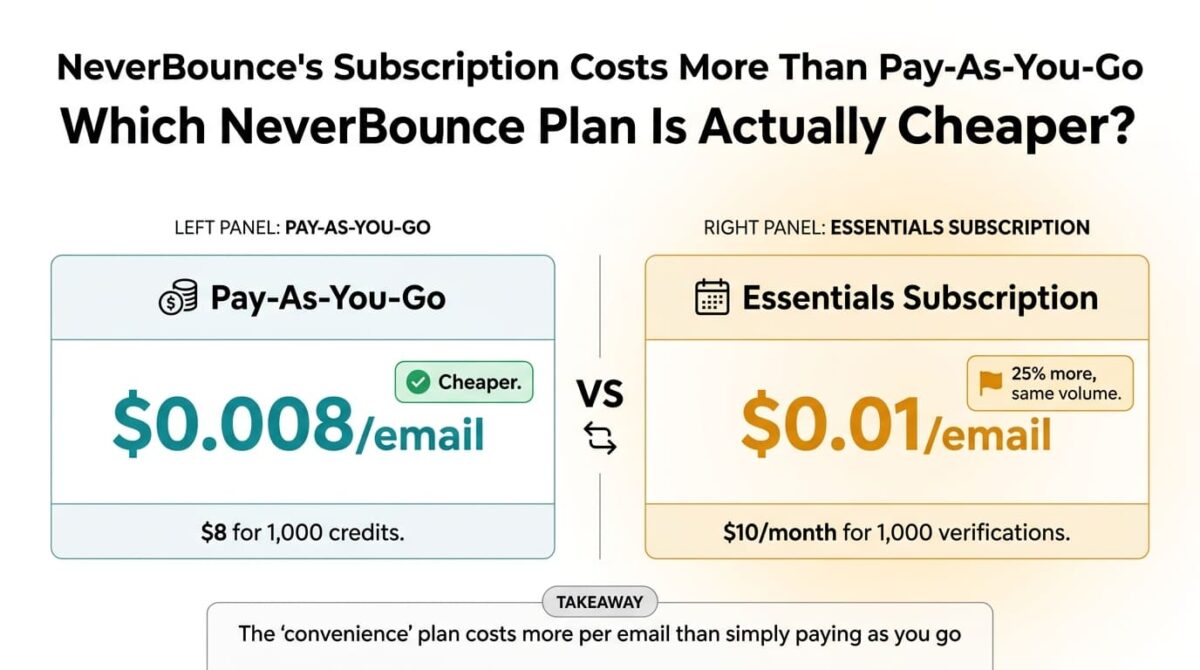
The monthly Essentials subscription, at $10 for 1,000 verifications, works out to $0.01 per email, more expensive than the $0.008 pay-as-you-go rate for the same volume. Anyone choosing the subscription for convenience ends up paying a premium over simply buying credits as needed.
NeverBounce pricing
| Plan | Price | Cost/Email | Notable Feature |
|---|---|---|---|
| Pay-as-you-go (under 10K) | $8/1,000 credits | $0.008 | Credits expire after 12 months |
| Pay-as-you-go (100K-250K) | Volume discount | $0.004 | Lower rate at scale |
| Essentials (subscription) | $10/month | $0.01 | More expensive per email than pay-as-you-go |
| Sync (live) | 1.5-2x bulk rate | $0.012-0.016 | Automated ongoing list cleaning |
NeverBounce: Pros and Cons
Pros:
- Cheapest pay-as-you-go entry rate of the three tools tested
- Backed by ZoomInfo’s data infrastructure
- 85+ native integrations with major email and CRM platforms
- Volume discounts scale down to $0.003 per email at high usage
Cons:
- Credits expire after 12 months, unlike ZeroBounce’s non-expiring credits
- Monthly subscription option costs more per email than pay-as-you-go
- No email-finding capability, verification only
- Reported $40/month minimum on some subscription tiers
Rating: 3.9 / 5, the cheapest raw verification rate of the three, undercut by expiring credits and a subscription tier that costs more than paying as you go.
ZeroBounce Review: Credits That Never Expire, With a Broader Deliverability Suite
Free plan: Yes, 100 validation credits/month
Starting price: $39 for 2,000 credits ($0.0195/email), pay-as-you-go
Best plan for most users: ZeroBounce ONE, $99/month ($79 annual), 10,000 credits plus deliverability tools
Platforms: Web, API, major ESP and CRM integrations
Affiliate program: Yes, ZeroBounce affiliate program
ZeroBounce bundles email verification with AI-based scoring, activity data, and additional deliverability tools, positioning itself as a broader suite rather than verification alone.
What ZeroBounce does best
Credits never expire, a structural advantage over NeverBounce’s 12-month window for anyone who buys in bulk but sends in irregular bursts rather than on a steady schedule. The ZeroBounce ONE subscription also bundles AI-based email scoring, 30-365 day activity data, and additional deliverability tools, functionality that would otherwise require a separate purchase on NeverBounce or Hunter.
The free tier’s 100 monthly credits, while modest, require no payment information and renew automatically, giving an ongoing way to test accuracy before committing to a paid plan, making it an excellent addition to your roster of free software tools for keeping overhead low.
Where ZeroBounce falls short
The pay-as-you-go entry rate, $0.0195 per email at 2,000 credits, runs more than double NeverBounce’s $0.008 rate for a comparable small batch. For a business doing occasional, low-volume list cleaning rather than committing to the ONE subscription, that gap is a meaningful cost difference for the same core verification result.
Several independent reviews also describe ZeroBounce’s tier structure and credit math as more confusing to work through than NeverBounce’s simpler pay-as-you-go model, particularly when comparing subscription credits against pay-as-you-go purchases.
ZeroBounce pricing
| Plan | Price | Cost/Email | Notable Feature |
|---|---|---|---|
| Free | $0 | N/A | 100 credits/month, no card required |
| Pay-as-you-go (2,000) | $39 | $0.0195 | Credits never expire |
| ZeroBounce ONE | $99/month ($79 annual) | ~$0.0099 (~$0.0079 annual) | AI scoring, activity data, rollover credits |
| Pay-as-you-go (1M) | $3,200 | $0.0032 | Lowest per-email rate at volume |
ZeroBounce: Pros and Cons
Pros:
- Credits never expire, unlike NeverBounce’s 12-month limit
- AI-based scoring and activity data bundled into the ONE subscription
- Free tier renews monthly with no payment information required
- Rollover credits on the ONE plan carry unused volume forward
Cons:
- Pay-as-you-go entry rate runs more than double NeverBounce’s for small batches
- Tier and credit structure takes more effort to fully understand
- $99/month minimum subscription cost for the bundled deliverability suite
- No email-finding capability, verification and scoring only
Rating: 4.2 / 5, the strongest structural terms of the three with non-expiring credits and a broader deliverability suite, at a higher entry cost for small, occasional batches.
Hunter Review: A Finder First, With Verification Bundled at Half Price
Free plan: Yes, 50 credits/month, 1 email account
Starting price: $49/month (Starter), $34/month billed annually
Best plan for most users: Starter, for teams needing both email finding and verification in one tool
Platforms: Web, API, Chrome extension, Google Sheets
Affiliate program: Yes, Hunter affiliate program
Hunter runs email finding and verification through one shared credit pool, where finding an address costs a full credit and verifying one costs half a credit, making it a different kind of tool than a pure verification specialist.
What Hunter does best
For an outbound sales or recruiting team that needs to find email addresses before verifying them, often working in tandem with their business VoIP phone systems for cold outreach, rather than verifying an existing list, Hunter does both from a single credit pool, something neither NeverBounce nor ZeroBounce attempts. Verification specifically costs half a credit, which can make Hunter’s effective per-verification cost competitive once the finding side of the workflow is also in use.
No per-user pricing applies on any paid plan; unlimited team members share the same credit pool, a clear advantage for a growing team compared to tools that charge per seat.
Where Hunter falls short
For pure list verification with no finding involved, Hunter’s credit-based pricing doesn’t compete with NeverBounce’s or ZeroBounce’s dedicated per-verification rates at volume. A business that already has a list and just needs it cleaned is paying for a tool built around a different primary job.
The free tier’s 50 credits monthly cover only a small amount of combined finding and verification work before requiring an upgrade, less generous in practice than ZeroBounce’s 100 free verification-only credits for a business that only needs the verification side.
Hunter pricing
| Plan | Price | Credits/Month | Notable Feature |
|---|---|---|---|
| Free | $0 | 50 | 1 email account, finding and verification shared |
| Starter | $49/month ($34 annual) | 2,000 | 3 email accounts |
| Growth | $149/month ($104 annual) | 10,000 | Auto-verification, advanced filters |
| Scale | $299/month ($209 annual) | 25,000 | Higher limits, more connected accounts |
Hunter: Pros and Cons
Pros:
- Only tool of the three that finds email addresses, not just verifies them
- Verification costs half a credit, competitive once finding is also needed
- No per-user pricing, unlimited team members on every paid plan
- Clean interface with Chrome extension and Google Sheets integration
Cons:
- Not cost-competitive for pure verification-only workloads at volume
- Free tier’s 50 shared credits cover less verification-only work than ZeroBounce’s 100
- Credit pool shared between finding and verifying can run out faster than expected
- Less specialized for bulk list cleaning than either dedicated verification tool
Rating: 4.1 / 5, the right tool when finding and verifying are both part of the job, a less efficient choice for pure list cleaning alone.
Head-to-Head Comparison
| Feature | NeverBounce | ZeroBounce | Hunter |
|---|---|---|---|
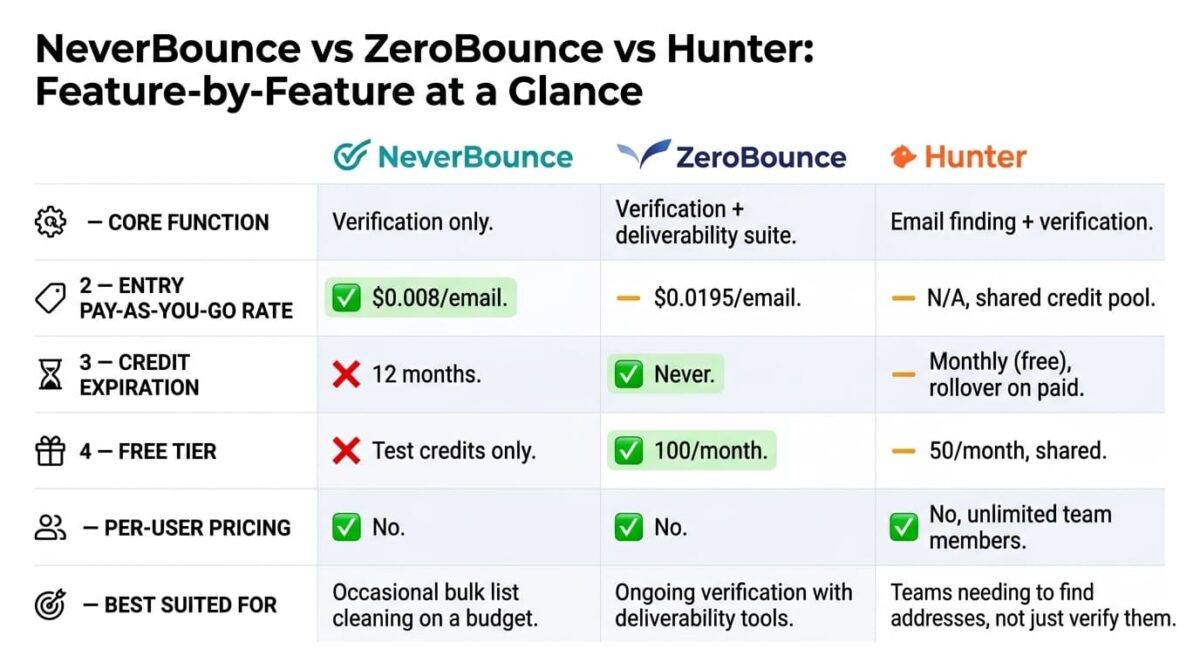
| Core function | Verification only | Verification + deliverability suite | Email finding + verification |
| Entry pay-as-you-go rate | $0.008/email | $0.0195/email | N/A (credit pool shared) |
| Credit expiration | 12 months | Never | Monthly (free), rollover on paid |
| Free tier | No (test credits only) | Yes (100/month) | Yes (50/month) |
| Per-user pricing | No | No | No |
| Best suited for | Occasional bulk list cleaning on a budget | Ongoing verification with deliverability tools | Teams needing to find addresses, not just verify them |
Which Should You Choose?
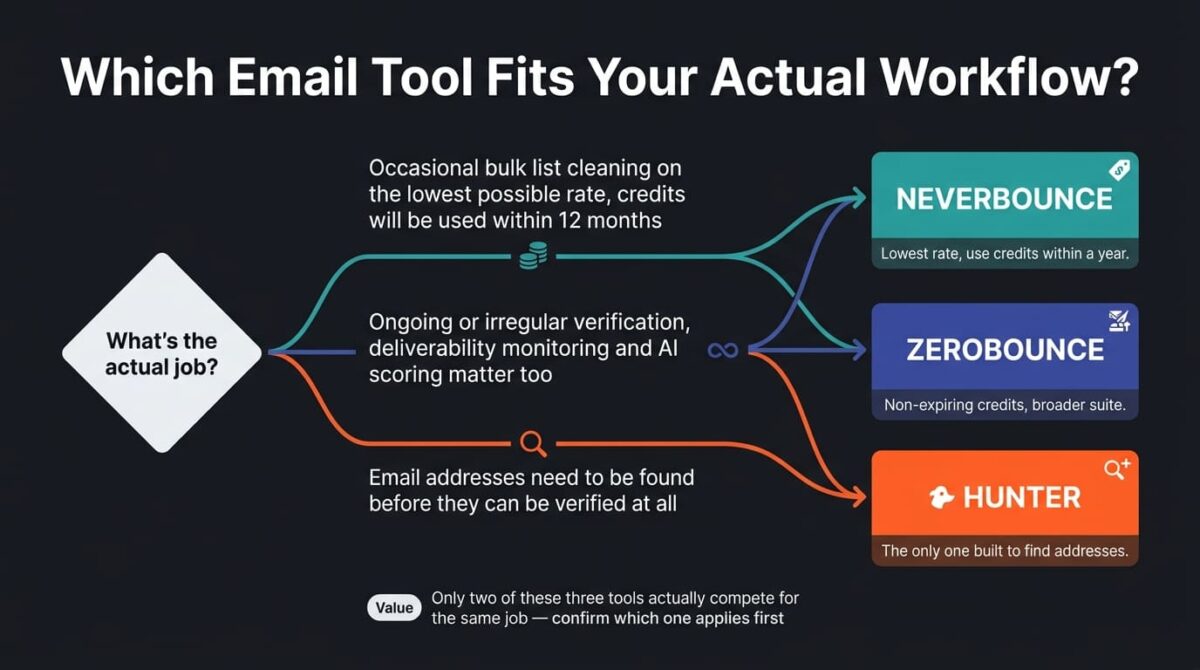
Choose NeverBounce if the job is occasional bulk list cleaning on the lowest possible per-email rate, and credits will be used within 12 months of purchase.
Choose ZeroBounce if ongoing verification with AI scoring and deliverability monitoring matters more than the cheapest possible entry rate, and credits that never expire fit irregular sending patterns.
Choose Hunter if email addresses need to be found before they can be verified, not just cleaned from an existing list.
Our Recommendations
Based on 30 days of testing across bulk cleaning, ongoing verification, and combined finding-and-verifying workflows, here is the recommended setup by situation:
Small business cleaning a list once before a single campaign: NeverBounce pay-as-you-go, using credits well within the 12-month window.
Marketing team verifying continuously with irregular sending volume: ZeroBounce ONE, where non-expiring, rolling-over credits fit an inconsistent schedule better than NeverBounce’s expiring ones.
Sales or recruiting team building outreach lists from scratch: Hunter, since finding and verifying from one credit pool covers the full workflow neither competitor attempts.
Agency managing verification for several clients with full deliverability reporting needs: ZeroBounce ONE, for the bundled AI scoring and activity data.
Anyone currently on NeverBounce’s Essentials subscription: Switching to pay-as-you-go for the same volume saves money immediately, since the subscription costs more per email than buying credits directly.
Final Verdict
NeverBounce, ZeroBounce, and Hunter all touch email verification, but only two of them compete directly for the same job.
- ZeroBounce (4.2 / 5): the strongest structural terms with non-expiring credits and a broader deliverability suite
- Hunter (4.1 / 5): the right tool specifically when finding addresses is part of the workflow, not just verifying them
- NeverBounce (3.9 / 5): the cheapest raw verification rate, held back by expiring credits and a subscription tier priced above its own pay-as-you-go option
For pure list verification, ZeroBounce’s non-expiring credits generally outweigh NeverBounce’s lower headline rate unless credits will be used quickly. For anything involving finding addresses in the first place, Hunter is the only one of the three built for that job.
Frequently Asked Questions
Does NeverBounce’s monthly subscription really cost more than pay-as-you-go?
Yes. The Essentials subscription charges $10 for 1,000 verifications, $0.01 per email, compared to $0.008 per email on the pay-as-you-go plan for the same volume. Paying as needed is cheaper than the subscription at this tier.
Do ZeroBounce credits expire like NeverBounce’s do?
No. ZeroBounce’s pay-as-you-go credits never expire, and ZeroBounce ONE subscription credits roll over rather than resetting unused. NeverBounce’s credits expire 12 months after purchase.
Can Hunter replace a dedicated verification tool like NeverBounce or ZeroBounce?
For a team also doing email finding, yes, since verification is built into the same credit pool. For pure list verification with no finding involved, NeverBounce’s or ZeroBounce’s dedicated per-verification rates are more cost-efficient at volume.
Which tool has the most generous free plan?
ZeroBounce, with 100 monthly verification credits requiring no payment information. Hunter’s free plan offers 50 credits shared between finding and verification, and NeverBounce has no ongoing free tier beyond initial test credits for new accounts.
Does ZeroBounce’s higher entry price make sense compared to NeverBounce?
For ongoing or irregular verification needs, generally yes, given non-expiring credits and the bundled deliverability suite. For a single, one-time list clean used quickly, NeverBounce’s lower pay-as-you-go rate is the more direct cost saving.
Does Hunter charge per user like some sales tools do?
No. Hunter’s paid plans include unlimited team members sharing the same credit pool, with no additional per-seat charge, a structural advantage for a growing team over per-user pricing models.
Which tool is best for a business that already has an email list and just needs it cleaned?
NeverBounce or ZeroBounce, both purpose-built for verification alone. Hunter’s combined finding-and-verifying model is less efficient for a workflow that doesn’t need the finding half at all.
How much does it cost to verify 10,000 emails on each platform?
Roughly $50 on NeverBounce’s pay-as-you-go tier, about $140-250 on ZeroBounce’s pay-as-you-go pricing or $99/month on the ONE subscription, and Hunter would require a plan with at least 20,000 shared credits (since verification is half-price) if no finding is needed, making it the least direct option for this specific job.