You pay a freelancer for a post, or you edit an AI-assisted draft, and you want proof it is not lifted from somewhere else before it goes live. Comparing Copyscape vs Quetext vs Scribbr is the usual route. The three are built for different jobs, and only one is priced for a blogger who publishes every week.
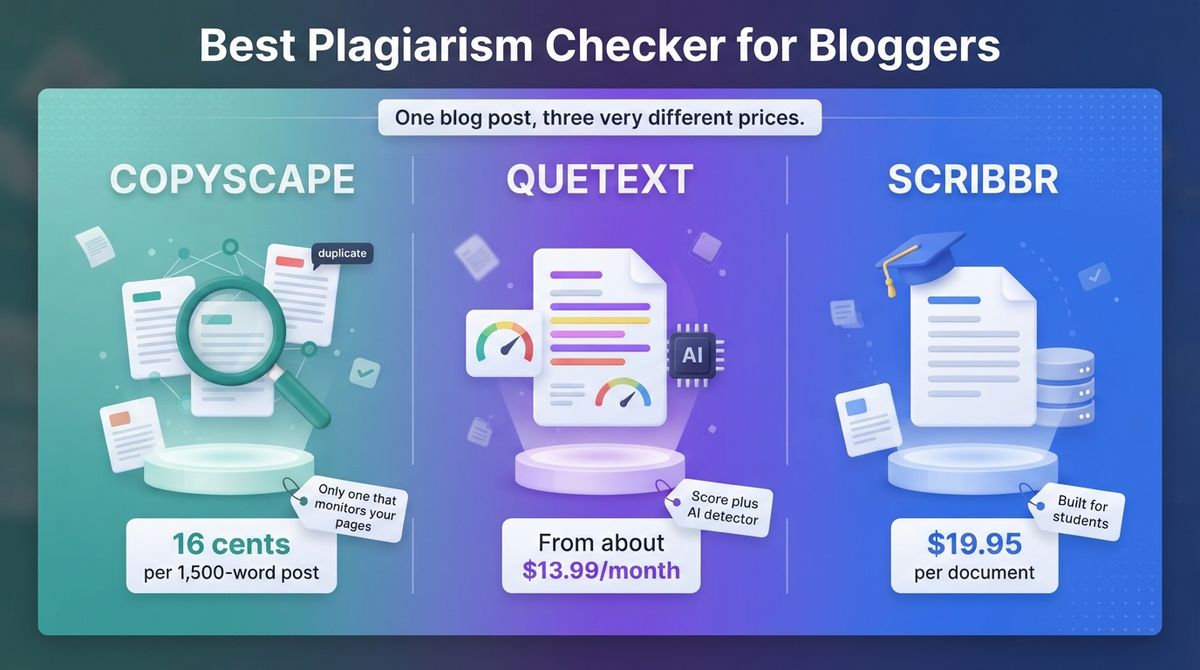
A plagiarism checker compares your text with other published sources and shows what matches. Students are the main market, so many tools charge per paper or per month. For bloggers the price gap is large: a 1,500-word post costs 16 cents on Copyscape and $19.95 on Scribbr. Quetext’s prices also changed several times in 2026.
I tested Copyscape vs Quetext vs Scribbr for 30 days, checking the same five items with each: one original post, one lightly reworded copy of a published article, one freelancer-style draft with a pasted paragraph, one AI-assisted draft, and one published URL. Here is the honest comparison, including the catch most bloggers miss: Scribbr charges per document, Quetext charges a monthly subscription for word volume, and only Copyscape monitors your published pages for copies.
Table of Contents
How We Tested
I scored each tool on five criteria:
- Match accuracy and report clarity: whether it finds copied and reworded passages and shows them clearly.
- Cost per post at blogging volume: what eight posts a month costs on each pricing model.
- Free-plan usefulness: whether a free check covers a full blog post.
- Extras for site owners: monitoring, batch audits, API access, and WordPress support.
- Pricing stability and three-year cost: how much prices moved and what 36 months costs.
Copyscape Review: The Web-Focused Checker Priced Per Post
- Free plan: Yes, a free URL check for published pages with basic results
- Starting price: 3 cents per search up to 200 words, plus 1 cent per extra 100 words (Premium)
- Best plan for most users: Premium, plus Copysentry for monitoring
- Platforms: Web, API, WordPress plugin
- Affiliate program: Unconfirmed, no public affiliate program found
Copyscape launched in 2004 and is run by Indigo Stream Technologies. It searches the public web for copies of a page or pasted text. The free tool checks a published URL. Premium is pay-per-search from prepaid credit, and Copysentry is a separate monitoring subscription.
What Copyscape does best
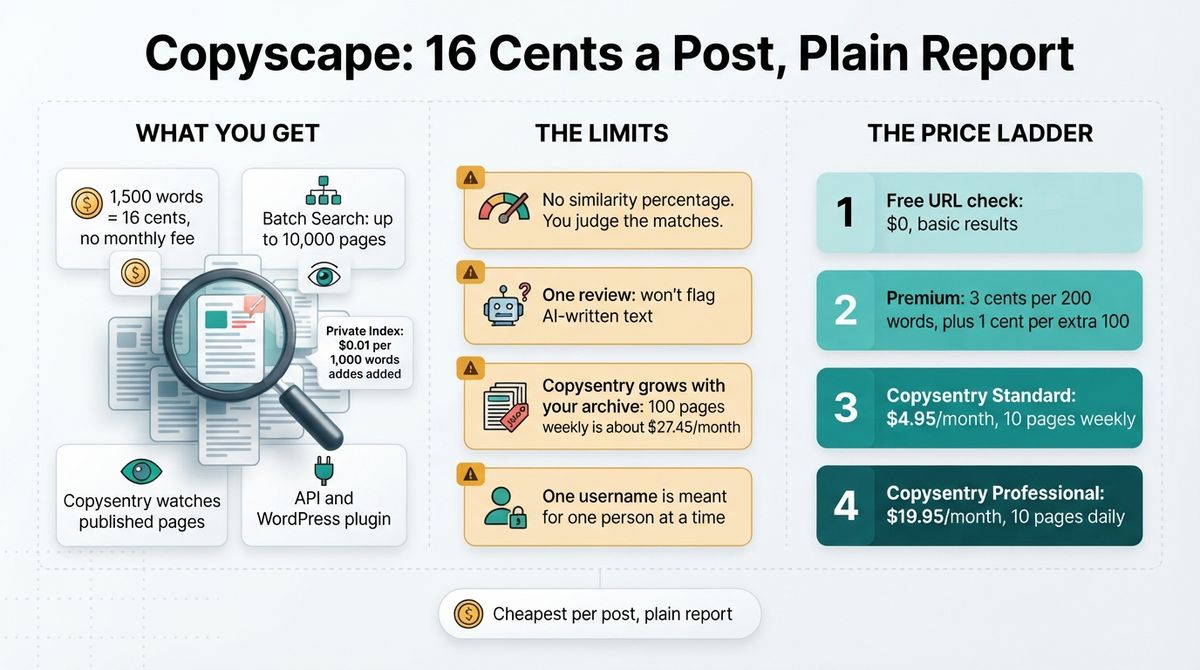
The price per post is hard to beat. Premium costs 3 cents for the first 200 words plus 1 cent for each extra 100. A 1,500-word post costs 16 cents and a 2,000-word post costs 21 cents. There is no monthly fee, so eight posts a month cost $1.28.
It also offers tools built for site owners. Batch Search checks up to 10,000 pages from a URL list or XML sitemap. A Private Index lets you compare new drafts against unpublished content for $0.01 per 1,000 words added. Copysentry watches your published pages for copies, from $4.95 a month for 10 pages checked weekly. No other tool in this comparison offers monitoring.
Where Copyscape falls short
Copyscape gives no similarity percentage, and one review notes it will not flag AI-written text meaning editors who also need to screen freelancer submissions for synthetic prose will want one of the best AI content detectors alongside it. You read a list of matching pages and judge them yourself. The interface is plain, and the tool is aimed at web duplicates, not at ranking a document with a single risk score. Bloggers reviewing multilingual sources may also need the best translation tools for bloggers and freelancers to translate references accurately.
Copysentry is priced per page, so it grows with your archive. Monitoring 100 pages weekly costs about $27.45 a month on Standard, and 100 pages daily costs about $109.95 on Professional. Under its terms, one username is meant for one person at a time, which matters if an editor and a writer share a login.
Copyscape pricing
| Item | Price | Notes |
|---|---|---|
| Free search | $0 | Checks a published URL against the web with basic results |
| Premium | 3 cents per search up to 200 words, plus 1 cent per extra 100 words | Pasted text, PDF and Word uploads, batch search, API; prepaid credit |
| Example costs | 16 cents for 1,500 words; 21 cents for 2,000 words | No monthly fee |
| Batch Search | Premium rates | Up to 10,000 pages from a URL list or XML sitemap |
| Private Index | $0.01 per 1,000 words added | Searching costs the same as a Premium search |
| Copysentry Standard | $4.95/month for up to 10 pages | Weekly checks; $0.25/month per extra page |
| Copysentry Professional | $19.95/month for up to 10 pages | Daily checks; $1.00/month per extra page |
Copyscape: Pros and Cons
Pros:
- A 1,500-word post costs 16 cents, with no monthly fee.
- Batch Search checks up to 10,000 pages from your sitemap.
- Copysentry monitors published pages for copies.
- API and WordPress plugin for automated checks.
Cons:
- No similarity percentage score.
- Copysentry costs grow with every page you monitor.
- Plain interface that lists matches without a risk score.
- One username is meant for one person at a time.
Rating: 4.6 / 5, the best choice for bloggers.
Quetext Review: Percentage Scores and AI Detection, With Shifting Prices
- Free plan: Yes, a plagiarism check of about 1,000 words with no time limit (some sources say 500)
- Starting price: About $13.99/month billed annually for 100,000 words (Essential); one May capture shows $19.99 on monthly billing
- Best plan for most users: Essential
- Platforms: Web, Chrome extension, Google Workspace add-on, API on paid plans
- Affiliate program: Yes, 40% commission for up to 12 months with a 60-day cookie
Quetext is a New York-based plagiarism and AI-content checker founded in 2016. Its DeepSearch technology scans billions of web sources, and ColorGrade highlights matches by risk. Plans are priced by words per month, not by search.
What Quetext does best
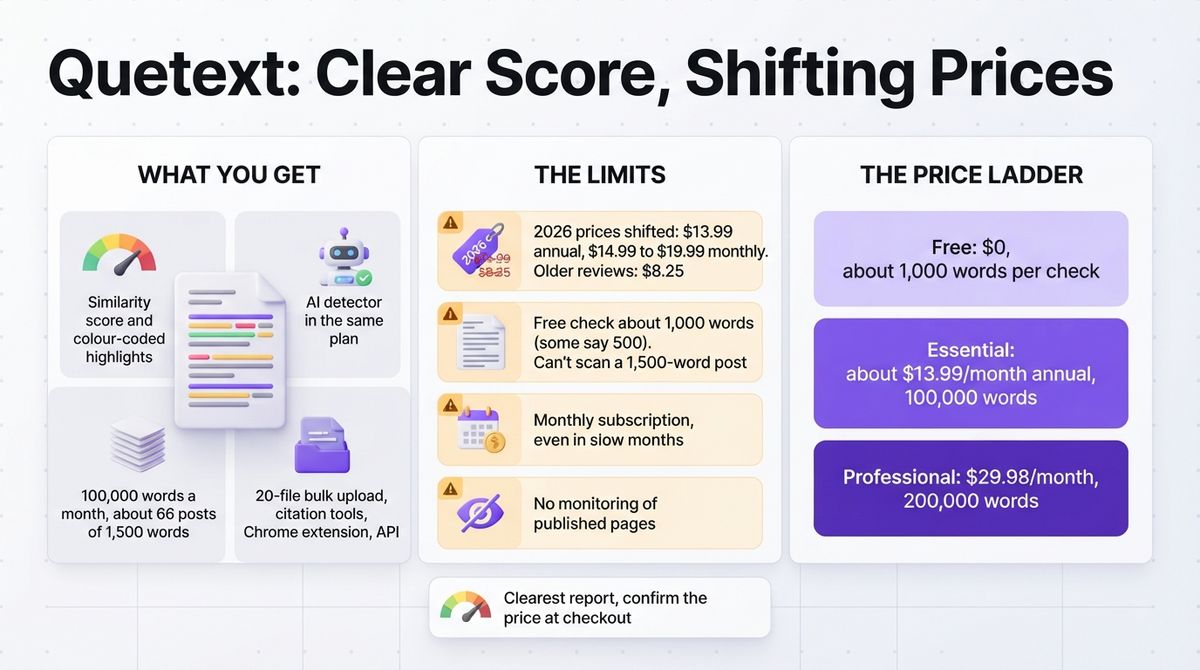
Quetext produces the clearest report of the three. It gives a similarity score and color-coded highlights, so you see at a glance which passages need attention. Essential covers 100,000 words a month for both plagiarism checks and the AI detector, enough for about 66 posts of 1,500 words.
The extras suit writers who check often. Essential includes bulk uploads of up to 20 files, a citation generator, grammar and spell check, a Chrome extension, and API access. The free plan has no time limit, which makes it easy to try the report format before paying. Content managers handling large contributor networks often pair these editing features with top AI email writing assistants for outreach.
Where Quetext falls short
Pricing has moved repeatedly in 2026. Essential is listed from $13.99 a month billed annually, near $14.99 on some monthly listings, $19.99 on monthly billing in a May capture, and $8.25 in older reviews and in one vendor FAQ. Professional is listed at $29.98. Bundles run $15.99 to $24.99 per user a month billed annually. Confirm the price at checkout.
The free check covers about 1,000 words, with some sources reporting 500, so it cannot scan a 1,500-word post in one go. Quetext is a monthly subscription, so you pay even in months you publish little. It also offers no monitoring of your published pages.
Quetext pricing
| Plan | Price | Words per month | What you get |
|---|---|---|---|
| Free | $0 | About 1,000 words per check (some sources say 500) | Plagiarism check, AI detector, citation tools |
| Essential | About $13.99/month billed annually; $14.99 to $19.99 on monthly billing | 100,000 | DeepSearch, AI detector, 20-file bulk upload, API access, grammar check |
| Professional | $29.98/month | 200,000 | Unlimited users, 100-file bulk upload, API, remarks tool |
| Bundles | $15.99 to $24.99 per user/month billed annually | Varies | Silver, Gold, and Platinum combinations |
| Older reviews | $8.25/month for Essential | 100,000 | Not a current price |
Quetext: Pros and Cons
Pros:
- Similarity score and color-coded highlights.
- Plagiarism and AI detection in one plan.
- 100,000 words a month covers about 66 posts of 1,500 words.
- Free plan with no time limit.
Cons:
- Prices changed several times in 2026, and sources disagree.
- The free check cannot scan a full 1,500-word post.
- Monthly subscription, even in slow months.
- No monitoring of published pages.
Rating: 4.0 / 5, a clear report held back by shifting prices.
Scribbr Review: Turnitin-Powered, But Priced Per Paper
- Free plan: Yes, limited: a plagiarism risk assessment and the top matching sources, with no exact score
- Starting price: $19.95 per document up to 7,499 words, with no subscription
- Best plan for most users: The per-document check, for a one-off ebook or manuscript
- Platforms: Web
- Affiliate program: Unconfirmed; Scribbr lists partnerships by contact only
Scribbr is an academic writing service whose plagiarism checker runs on licensed Turnitin technology. It checks against more than 99 billion current and historical web pages and 8 million publications from over 1,700 publishers. Scribbr says documents are never added to a shared database.
What Scribbr does best
Scribbr has the deepest database of the three, and it is the closest an individual can get to a university-grade check. The report compares passages against sources side by side. Because your document is not added to a shared database, a check will not create a false match when you later submit it elsewhere.
The paid report includes a precise AI writing percentage, and a separate free AI detector checks up to 1,200 words at a time. There is no subscription, so you pay only when you check. For a single long document, such as an ebook, that is a fair deal. Before running plagiarism checks, many authors use dedicated writing apps for bloggers to draft content efficiently.
Where Scribbr falls short
Per-document pricing is costly for regular publishing. The price is $19.95 up to 7,499 words, $29.95 for 7,500 to 49,999 words, and $39.95 for 50,000 or more. A blogger checking eight posts a month pays about $160, against $1.28 on Copyscape.
It is designed for students, and its extras reflect that. There is no monitoring, no batch search, and no API. The free version shows a risk level and the top matches but no exact score, and there is no volume discount for frequent use.
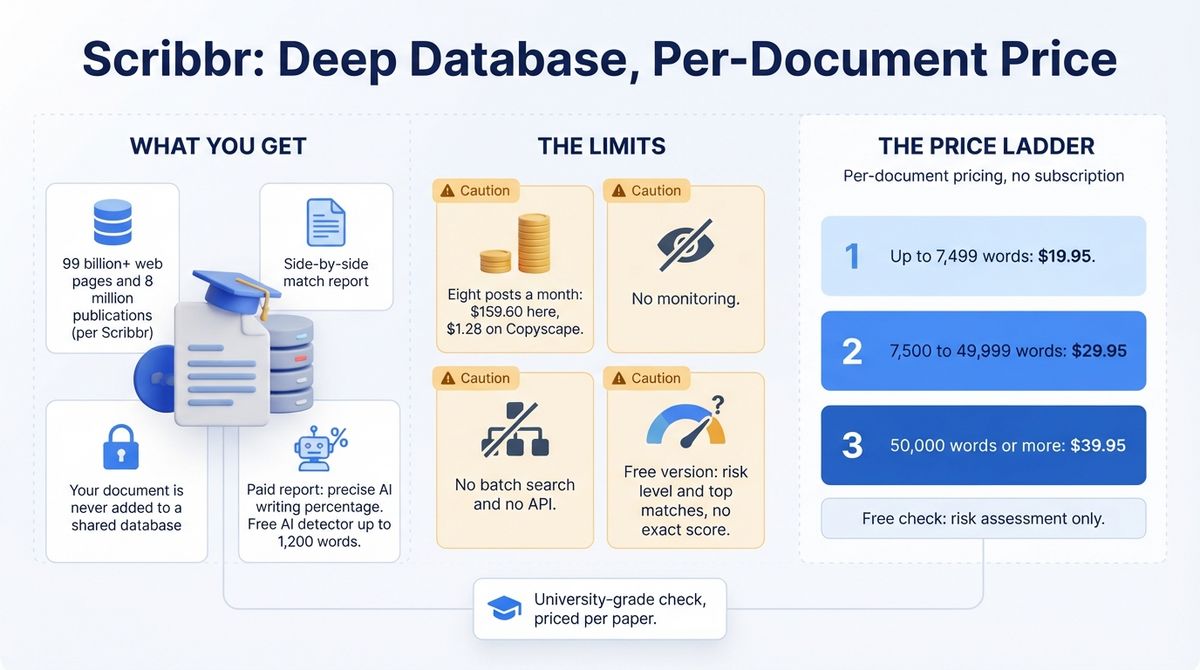
Scribbr pricing
| Item | Price | Notes |
|---|---|---|
| Free check | $0 | Risk assessment and top matching sources, no exact score |
| Up to 7,499 words | $19.95 | Essay or article |
| 7,500 to 49,999 words | $29.95 | Ebook, thesis |
| 50,000 words or more | $39.95 | Book manuscript |
| Subscription | None | Pay per check |
Scribbr: Pros and Cons
Pros:
- The largest stated source database of the three.
- Turnitin-licensed matching technology.
- No subscription, and your document is not shared.
- Paid report includes a precise AI writing percentage.
Cons:
- $19.95 per post up to 7,499 words.
- No monitoring, batch search, or API.
- Built for academic papers, not weekly publishing.
- The free version gives no exact score.
Rating: 3.2 / 5, strong technology priced for one-off academic checks.
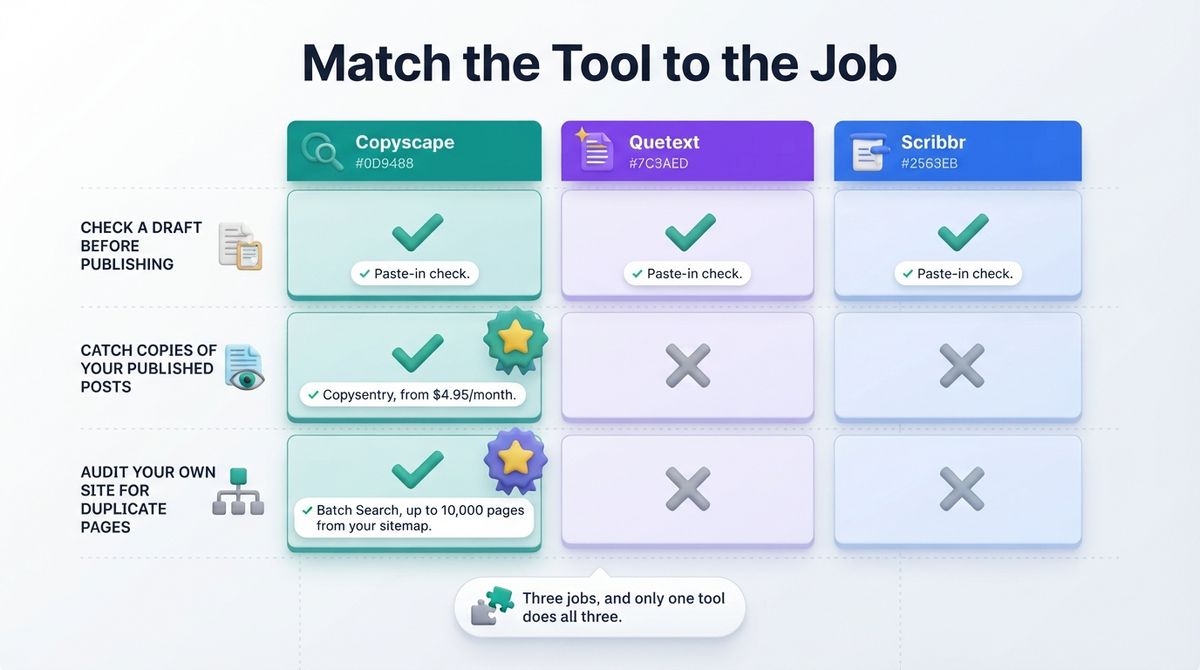
Head-to-Head Comparison Table
| Feature | Copyscape | Quetext | Scribbr |
|---|---|---|---|
| Pricing model | Pay per search | Monthly word-based subscription | Pay per document |
| Cost of a 1,500-word post | 16 cents | $1.75 to $2.50 at eight posts a month | $19.95 |
| Cost for eight posts a month | $1.28 | $13.99 to $19.99 | $159.60 |
| Free option | Free URL check | About 1,000-word check | Risk assessment, no score |
| Similarity percentage | No | Yes | Yes, in the paid report |
| Monitors published pages | Yes, Copysentry from $4.95/month | No | No |
| Batch or sitemap audit | Up to 10,000 pages | Bulk upload of 20 files | No |
| API | Yes | Paid plans | Not stated |
| WordPress plugin | Yes | Not stated | No |
| AI detection | Not stated | Yes, 100,000 words/month | Free up to 1,200 words; precise percentage with paid check |
| Best for | Bloggers who publish regularly | Writers who want a score and AI detection | One-off ebooks and manuscripts |
| Rating | 4.6 / 5 | 4.0 / 5 | 3.2 / 5 |
Which Should You Choose?
The right tool depends on the job: checking a draft, watching for copies, or auditing your site.
- Choose Copyscape if you publish regularly and want the lowest cost per post, plus monitoring and site audits.
- Choose Quetext if you want a similarity score and an AI detector in one report and you check often enough to use the monthly allowance.
- Choose Scribbr if you have one long document, such as an ebook or manuscript, and want a university-grade check without a subscription.
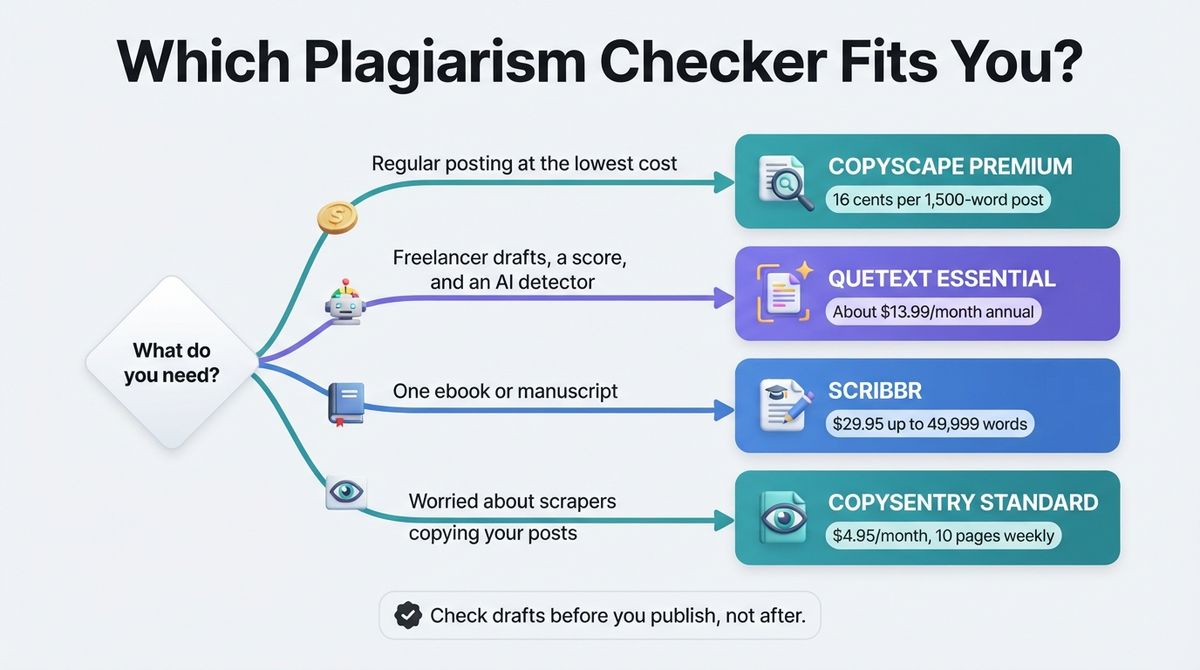
Match the tool to the job
Three jobs come up. Checking a draft before publishing needs a paste-in check, which every tool offers. Catching copies of your published posts needs monitoring, which only Copysentry offers. Auditing your own site for duplicate pages needs a sitemap-based scan, which only Copyscape’s Batch Search offers.
What each costs over three years
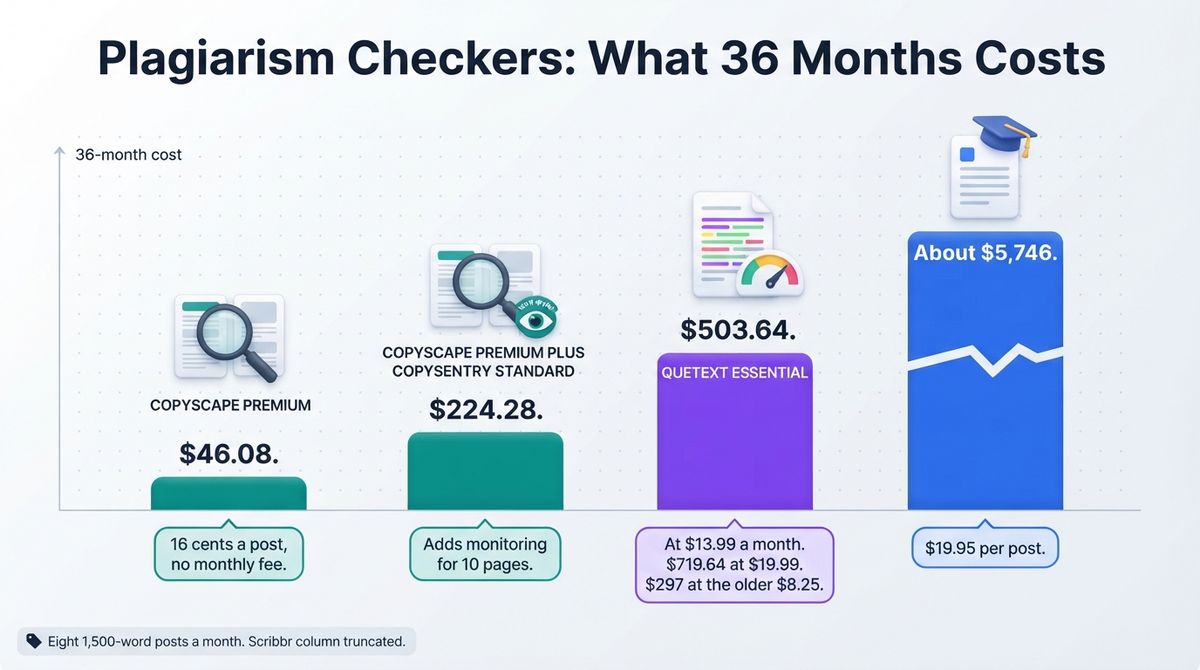
Take a blogger publishing eight 1,500-word posts a month. Copyscape Premium costs $46.08 over 36 months, or $224.28 with Copysentry Standard added for 10 pages. Quetext Essential costs $503.64 at $13.99 a month and $719.64 at $19.99, and it would cost $297 at the older $8.25 price. Scribbr costs about $5,746 at $19.95 per post.
The gap comes from the pricing model, not from detection quality. Per-search and per-word pricing suits regular checking. Per-document pricing suits a single large file.
Our Recommendations
- Solo blogger checking your own drafts: Use Copyscape Premium. A 1,500-word post costs 16 cents, with no monthly fee.
- Blogger who buys freelancer drafts and wants a score: Use Quetext Essential for the similarity percentage, color-coded highlights, and AI detector.
- Blogger worried about scrapers: Use Copysentry Standard at $4.95 a month for 10 pages, or run the free URL check on your top posts each month.
- Author writing an ebook or long guide: Use Scribbr once, at $29.95 for up to 49,999 words, rather than a subscription.
- Editor or agency checking many posts: Use Copyscape Batch Search and the API, or Quetext Professional for 200,000 words a month.
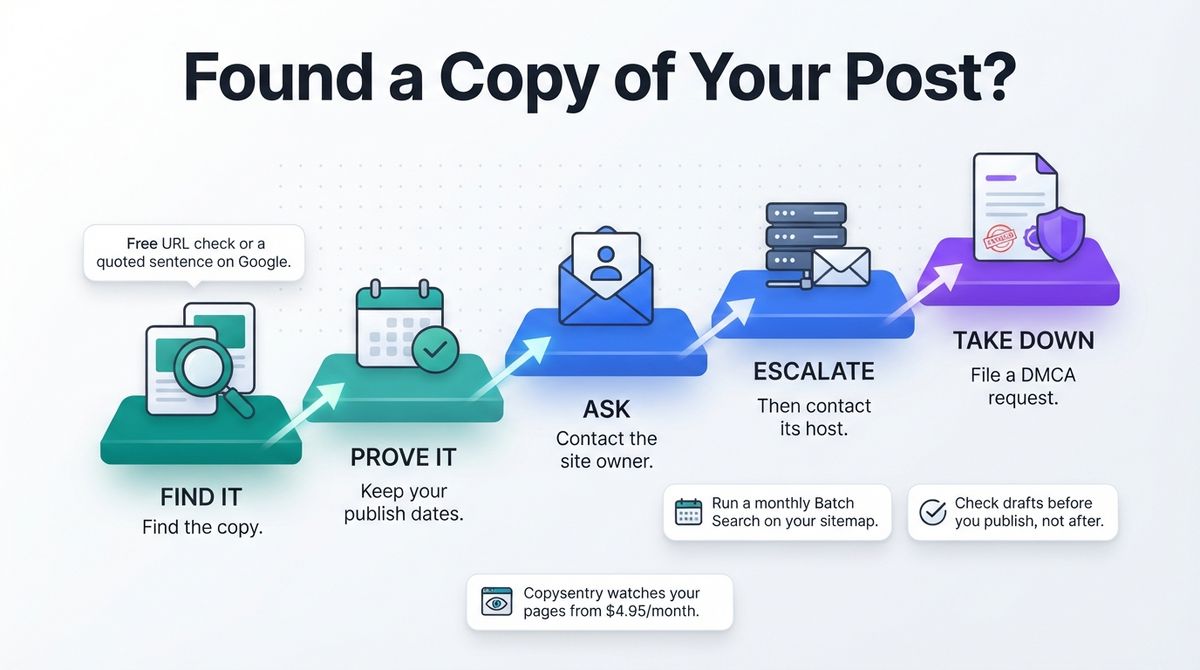
WordPress note: Check drafts before you publish, not after. Run a monthly Batch Search on your XML sitemap to catch pages that duplicate each other, and keep a record of the dates you published. If you find a copy of your post, contact the site owner, then its host, then file a DMCA request.
Final Verdict
Copyscape is the best choice for bloggers. A 1,500-word post costs 16 cents, there is no monthly fee, and it is the only tool here that monitors your published pages and audits a whole sitemap. Quetext is the better pick if you want a similarity score and an AI detector in one report, but its prices shifted repeatedly in 2026. Scribbr has strong technology, but at $19.95 per document, it suits one-off manuscripts, not weekly publishing.
In the Copyscape vs Quetext vs Scribbr decision, pick Copyscape for regular checking, Quetext for scores and AI detection, and Scribbr for a single long document.
- Copyscape: 4.6 / 5, best for bloggers who publish regularly.
- Quetext: 4.0 / 5, best for a score and AI detection in one report.
- Scribbr: 3.2 / 5, best for one-off ebooks and manuscripts.
Frequently Asked Questions
What is the best plagiarism checker for bloggers?
Copyscape is the best fit for most bloggers. Premium costs 3 cents for the first 200 words plus 1 cent per extra 100, so a 1,500-word post costs 16 cents. It also offers a free URL check, Batch Search for whole sites, and Copysentry monitoring. Quetext adds a percentage score and AI detection.
Is Copyscape free?
Partly. Copyscape’s free tool checks a published page by URL against the public web, with basic results. Pasting unpublished text, uploading files, running batch searches, and using the API need Copyscape Premium, which is pay-per-search from prepaid credit. Copysentry monitoring is a separate monthly subscription from $4.95.
How much does Quetext cost?
Quetext’s free plan checks about 1,000 words with no time limit. Essential covers 100,000 words a month and is listed from $13.99 a month billed annually, with monthly billing near $14.99 to $19.99. Professional is $29.98 for 200,000 words. Prices changed several times in 2026, and older reviews quote $8.25, so confirm at checkout.
How much does Scribbr’s plagiarism checker cost?
Scribbr charges per document with no subscription: $19.95 for up to 7,499 words, $29.95 for 7,500 to 49,999 words, and $39.95 for 50,000 words or more. A free version shows a plagiarism risk assessment and the top matching sources but no exact score. A blogger checking eight posts a month would pay about $160.
Can a plagiarism checker catch AI-written text?
Not by itself. A plagiarism checker finds text that matches other published sources, and AI-generated text is usually new wording that matches nothing. Quetext and Scribbr’s paid check include a separate AI detector, but detectors make errors, so treat their scores as a prompt for review, not proof.
How do I find out if someone copied my blog posts?
Run your post’s URL through Copyscape’s free search, or search a distinctive sentence in quotation marks on Google. For ongoing protection, Copysentry checks up to 10 pages weekly for $4.95 a month, or daily for $19.95. If you find a copy, contact the site owner, then its host, then file a DMCA request.
Does a plagiarism checker help SEO?
Indirectly. Duplicate content across sites can split ranking signals, and a checker lets you catch freelancer drafts that reuse existing text before they go live. It does not boost rankings by itself. Copyscape’s Batch Search can also scan your own sitemap for pages that duplicate each other.
Is Scribbr good for bloggers?
Rarely. Scribbr is built for students checking one academic paper, and its per-document price of $19.95 up to 7,499 words adds up for regular publishing. It is a fair fit for a one-off ebook or long manuscript at $29.95 to $39.95, but it offers no monitoring, batch search, or API.