Research takes up more of a blogger’s week than writing does. Once you finish gathering your facts and outline your structure, you can seamlessly transition to drafting by exploring top AI writing and content generation tools. You open ten tabs, skim vendor pages, check pricing, and lose track of which source said what. AI research assistants promise to shorten that loop, and the choice between Perplexity vs NotebookLM vs Elicit decides how far you can trust the shortcut.
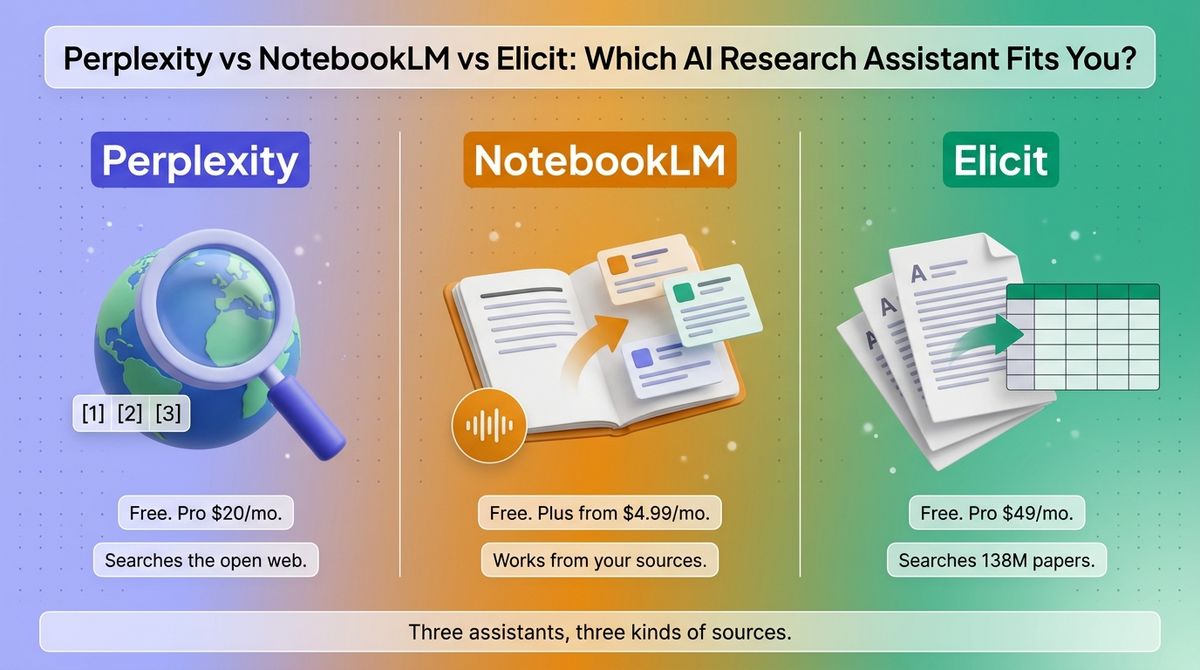
The three tools solve different problems. Perplexity searches the open web and cites its answers. NotebookLM works from the sources you load. Elicit searches academic papers and pulls findings into tables. All three have free plans, and the paid plans start at $4.99 to $49 a month.
I tested Perplexity vs NotebookLM vs Elicit for 30 days, running the same 20 research questions through each and loading 15 saved sources into NotebookLM. I opened every cited source to check the claim. Here is the honest comparison. Two catches to know first: NotebookLM is now called Gemini Notebook, and Elicit’s $12 Plus plan is gone, so its paid plans start at $49 a month.
Table of Contents
How We Tested
I scored each tool on five criteria, using the same questions and the same source set throughout.
- Source quality and citations. I checked whether each answer links to sources and whether those sources are easy to open.
- Accuracy against the original. I compared each cited claim with the page, file, or paper it pointed to.
- Fit for blog research. I tested software pricing checks, how-to topics, and health and finance claims that rely on studies.
- Limits and free-plan usefulness. I measured how far each free plan goes before it asks for a card.
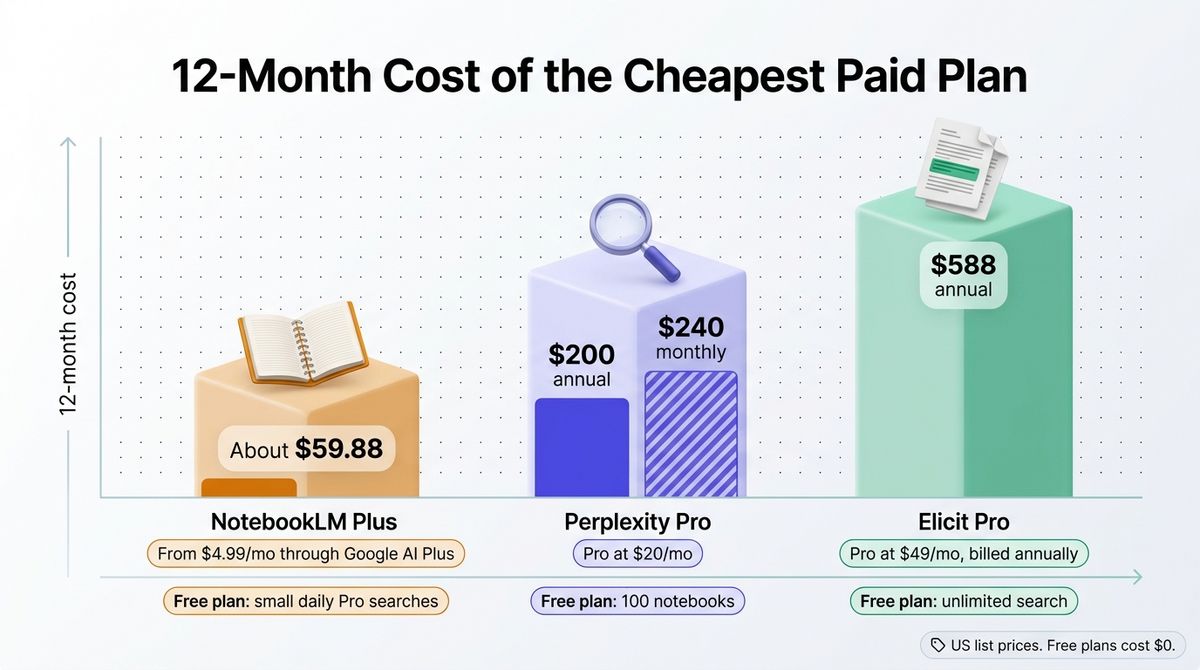
- Total cost over 12 months. I priced the cheapest paid plan on annual and monthly billing.
I also checked how easily each tool exports notes into a draft, since that decides how much time it saves. Once your research phase concludes, you should check out the best writing apps for bloggers.
Perplexity Review: The Fastest Path From Question to Cited Sources
- Free plan: Yes, with a small daily allowance of Pro searches
- Starting price: Pro at $20 a month, or $200 a year
- Best plan for most users: Pro
- Platforms: Web, iOS, Android, Comet browser
- Affiliate program: No standard program confirmed; a limited-time Comet referral program has paid up to $20 per lead
Perplexity is an AI answer engine. You ask a question, it searches the web, and it replies with a short answer and numbered citations. It also offers Research for longer reports, larger file limits on paid plans, and the free Comet browser.
What Perplexity does best
Perplexity is the fastest way to move from a question to a list of sources. Every answer carries numbered citations, so you can open the pricing page or study behind a claim in one click. For software reviews, that cuts the time spent hunting for current plan details, while also pairing well with AI-powered live chat and customer support platforms when scaling visitor engagement.
Pro adds model choice, extended Pro Search, larger file limits, and Research for longer reports. The $200 annual price works out to about $16.67 a month. The free plan is enough to judge whether the citation-first format suits your workflow.
Where Perplexity falls short
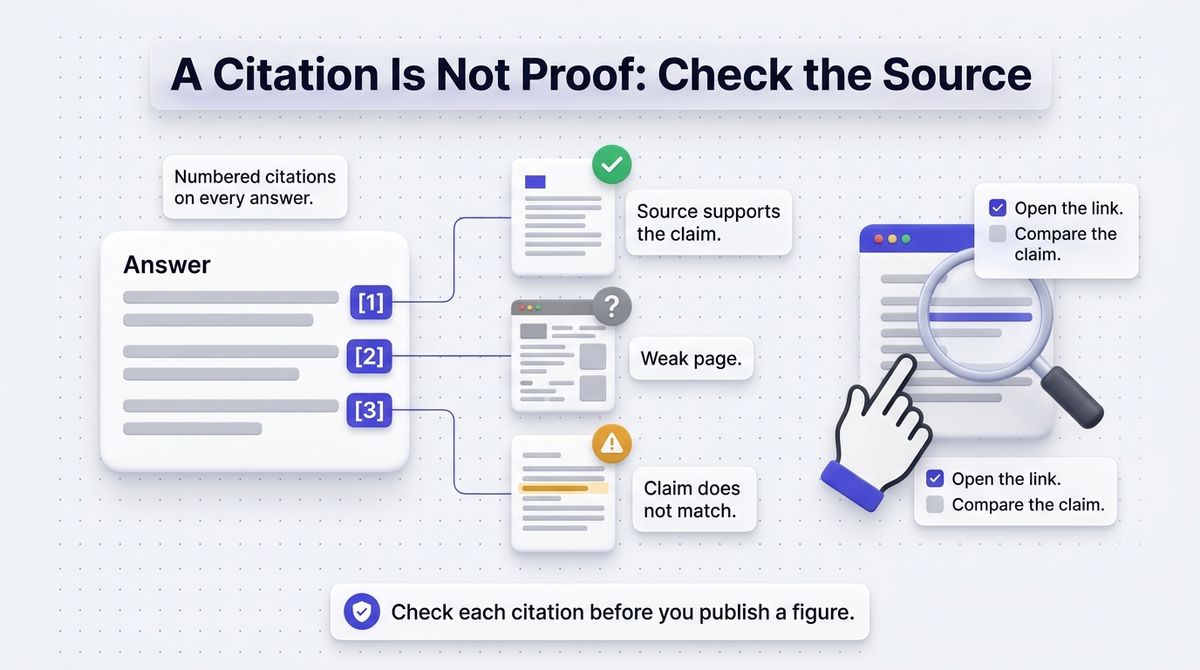
Perplexity answers from whatever the web returns, and that includes weak pages. A numbered link shows where a claim came from, not that the source supports it. Check each citation before you publish a figure.
The limits are vague. Perplexity does not publish Pro’s weekly allowance, and the next tier up, Max, costs $200 a month, ten times the price of Pro. Its Computer agent runs on credits, so costs can rise if you rely on it. Teams pay $40 a seat for Enterprise Pro.
Perplexity pricing
| Plan | Monthly | Annual | Best for | Notes |
|---|---|---|---|---|
| Free | $0 | $0 | Quick cited searches | Small daily allowance of Pro searches |
| Pro | $20 | $200 | Daily research | Model choice, extended Pro Search, Research, larger file limits |
| Max | $200 | $2,000 | Heavy and agent use | Highest consumer limits, 10,000 Computer credits a month |
| Enterprise Pro | $40 per seat | $400 per seat | Teams | Admin controls, SSO, no training on your data |
| Enterprise Max | $325 per seat | $3,250 per seat | Large organizations | Highest limits, 15,000 Computer credits per seat |
Perplexity: Pros and Cons
Pros:
- Numbered citations on every answer
- Fast open-web research for current pricing and product details
- Useful free plan
- Pro at $200 a year
- Research for longer, multi-step reports
Cons:
- Citations need checking before you publish
- Pro’s weekly limits are not published
- Tenfold price jump from Pro to Max
- Answers can draw on weak web pages
Rating: 4.5 / 5, the fastest path from question to cited sources.
NotebookLM Review: The Best Free Tool for Working With Your Own Sources
- Free plan: Yes, with 100 notebooks and 50 sources per notebook
- Starting price: Free; Plus from $4.99 a month through Google AI Plus; Pro at $19.99 a month through Google AI Pro
- Best plan for most users: Free
- Platforms: Web, iOS, Android
- Affiliate program: None confirmed
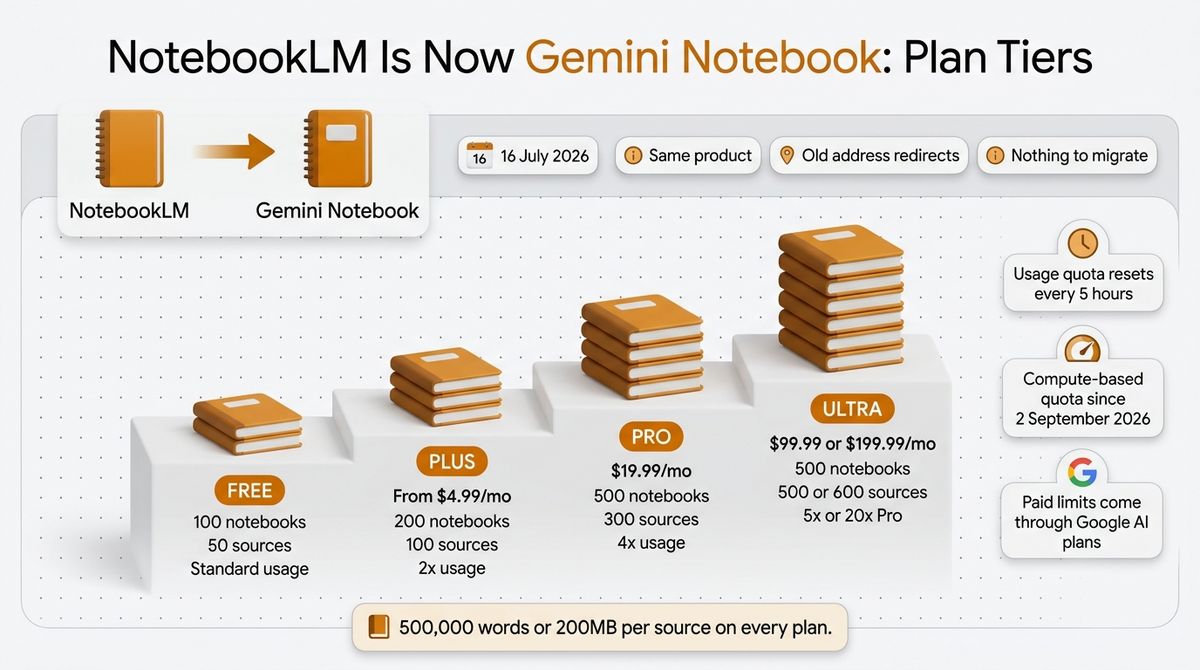
NotebookLM is Google’s source-grounded research tool. You add documents, links, and files, and it answers from those sources with citations. On July 16, 2026, Google renamed it Gemini Notebook. It is the same product at notebook.google.com, and the old address redirects. This review uses the NotebookLM name because most readers still search for it.
What NotebookLM does best
NotebookLM answers from the sources you add, so you control what it can draw on. Load vendor documentation, a pricing page, and a few reviews, then ask where the plans differ. Each answer points back to the passage it used.
The free plan is generous: 100 notebooks and 50 sources per notebook. Each source can hold up to 500,000 words or 200MB. It also builds Audio Overviews, slide decks, infographics, and data tables from your sources.
Where NotebookLM falls short
NotebookLM only knows what you give it. It can help find sources, but it is not an open-web search engine, so you still need Perplexity or Google to gather material first. Since September 2, 2026, usage also runs on a compute-based quota that weighs prompt complexity and chat length.
The rename and the plan structure add some confusion. There is no separate subscription, and paid limits come only through Google AI plans. Reported prices for Plus vary from $4.99 to $7.99 by region and promotion. Each notebook is also separate, so a project split across several notebooks loses answers that span them.
NotebookLM pricing
| Plan | Price | Notebooks | Sources per notebook | Usage budget |
|---|---|---|---|---|
| Free (Standard) | $0 | 100 | 50 | Standard, resets every 5 hours |
| Plus (Google AI Plus) | From $4.99 a month | 200 | 100 | 2x standard |
| Pro (Google AI Pro) | $19.99 a month | 500 | 300 | 4x standard |
| Ultra (Google AI Ultra) | $99.99 or $199.99 a month | 500 | 500 or 600 | 5x or 20x Pro |
NotebookLM: Pros and Cons
Pros:
- Generous free plan
- Answers grounded in the sources you add
- Audio Overviews, slide decks, infographics, and data tables
- 500,000 words per source on every plan
- Apps for web, iOS, and Android
Cons:
- Not an open-web search engine
- Compute-based usage quota since September 2, 2026
- No standalone subscription; paid limits come through Google AI plans
- Renamed Gemini Notebook, which splits search results between two names
- Separate notebooks cannot answer across each other
Rating: 4.4 / 5, the best free tool for studying sources you already have.
Elicit Review: Built for Academic Papers, Priced for Researchers
- Free plan: Yes (Basic), with unlimited search and 2 reports a month
- Starting price: Pro at $49 a month, billed as $588 annually
- Best plan for most users: Basic for occasional use; Pro for systematic reviews
- Platforms: Web
- Affiliate program: None confirmed
Elicit is an AI research assistant for academic literature. It searches more than 138 million papers, summarizes them, and extracts findings into tables. It also includes a systematic review workflow and a Research Agent.
What Elicit does best
Elicit is built for questions that studies answer. Ask about the effect of a supplement or a teaching method, and it returns relevant papers with summaries and sentence-level citations. The free Basic plan includes unlimited search, unlimited summaries, and chat with papers where full text is available.
Pro adds a systematic review workflow that screens up to 5,000 papers, 20 extraction columns, alerts, and API access. Zotero import is included on the free plan too. Exports run to PDF, Word, CSV, Excel, RIS, and BIB files.
Where Elicit falls short
Most blog topics do not rest on papers. For software reviews, pricing checks, or news, Elicit has little to search. It covers academic literature and clinical trials, so its value depends on the topics you write about.
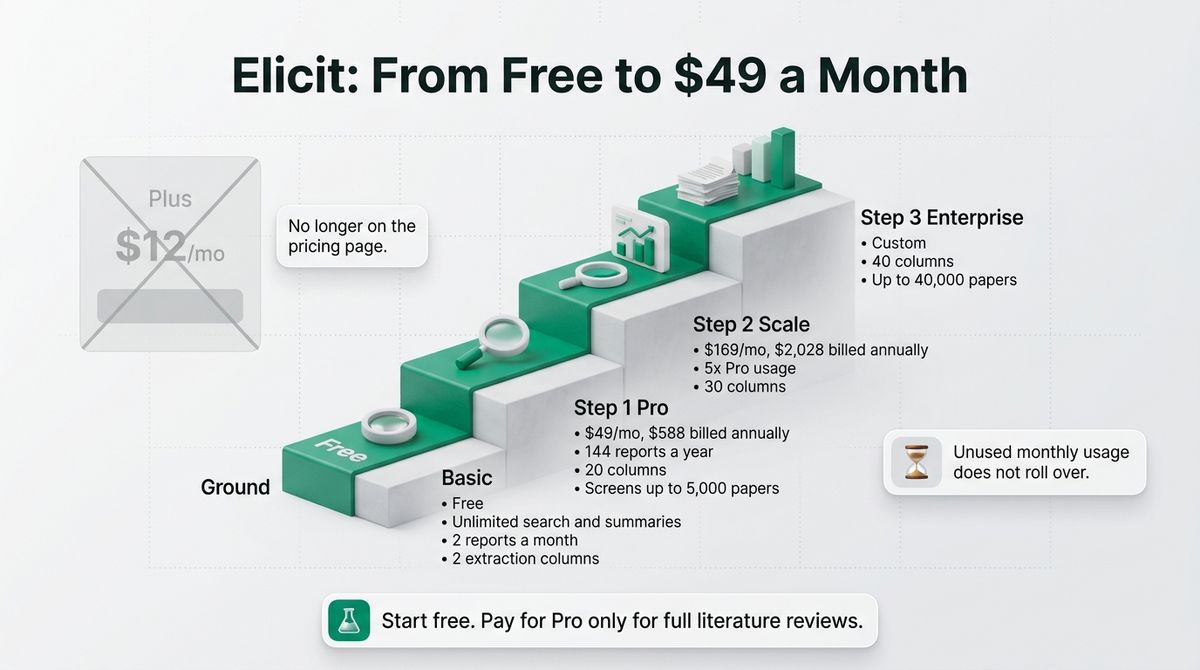
The price gap is steep. Basic allows 2 reports a month and 2 extraction columns, and Pro costs $49 a month on annual billing. The older Plus plan at $12 a month and the Team plan no longer appear on the pricing page. Usage is pooled monthly, and unused usage does not roll over.
Elicit pricing
| Plan | Price | Billing | Reports | Extraction columns | Notes |
|---|---|---|---|---|---|
| Basic | Free | None | 2 a month | 2 | Unlimited search and summaries, limited Research Agent |
| Pro | $49 per user a month | $588 annually | 144 a year | 20 | Systematic review of up to 5,000 papers, alerts, API access |
| Scale | $169 per user a month | $2,028 annually | 5x Pro usage | 30 | Collaboration and figure extraction |
| Enterprise | Custom | Custom | Custom | 40 | SSO and screening of up to 40,000 papers |
Elicit: Pros and Cons
Pros:
- Searches more than 138 million papers
- Sentence-level citations and extraction tables
- Free plan with unlimited searches and summaries
- Systematic review workflow on Pro
- Zotero import and API access
Cons:
- Narrow fit for most blog topics
- Free plan allows only 2 reports a month
- Cheapest paid plan is $49 a month
- Unused monthly usage does not roll over
Rating: 3.9 / 5, the strongest paper search of the three, but narrow for most blogs.
Head-to-Head Comparison Table
| Feature | Perplexity | NotebookLM | Elicit |
|---|---|---|---|
| Best at | Cited open-web research | Analyzing your own sources | Academic literature review |
| Source of answers | The open web | Documents, links, and files you add | 138 million papers and clinical trials |
| Free plan | Yes, small daily Pro search allowance | Yes, 100 notebooks and 50 sources each | Yes, unlimited search and 2 reports a month |
| Cheapest paid plan | Pro, $20 a month | Plus, from $4.99 a month | Pro, $49 a month billed annually |
| 12-month cost, cheapest paid plan | $200 annual, $240 monthly | About $59.88 | $588 annual |
| Citations | Numbered web links | Passages from your sources | Sentence-level links to papers |
| Extra outputs | Research reports, files, and apps | Audio Overviews, slides, infographics, data tables | Extraction tables, reports, exports to PDF, Word, CSV |
| Platforms | Web, iOS, Android, Comet browser | Web, iOS, Android | Web |
| Affiliate program | Comet referral only | None confirmed | None confirmed |
| Best for | Bloggers gathering sources | Bloggers and freelancers studying sources | Science, health, and education writers |
| Our rating | 4.5 / 5 | 4.4 / 5 | 3.9 / 5 |
Which Should You Choose?
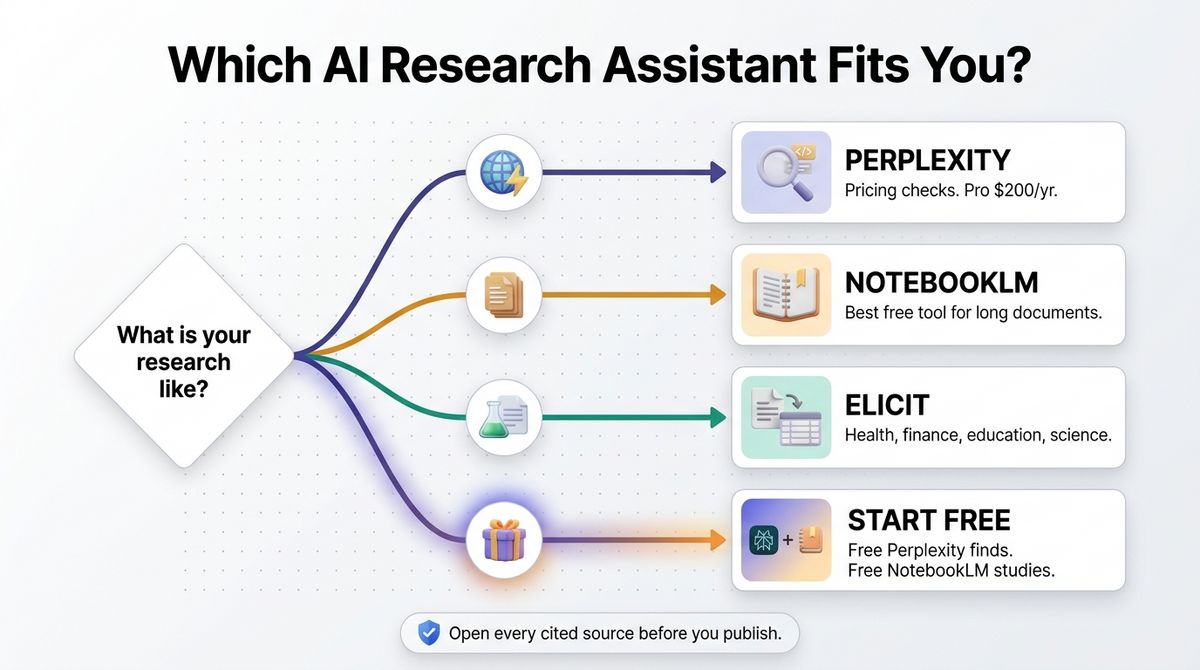
Choose Perplexity if you need to find current sources fast. It suits pricing checks, product comparisons, and background research on topics the web covers well. For automated customer support workflows, readers can evaluate the best AI chatbot builders.
Choose NotebookLM if you already have the sources and need to study them. It is the best free option for long documents, vendor documentation, and client briefs.
Choose Elicit if your posts rest on academic studies. It earns its price only for health, finance, education, or science topics that need a literature search.
Two free tools cover most bloggers. Perplexity’s free plan finds sources, and NotebookLM’s free plan helps you study them. Pay only when a limit slows you down, and test the paid plan for a month before you commit to a year.
Our Recommendations
- Solo blogger on a budget: Use free Perplexity to find sources and free NotebookLM to study them, and pay for neither until the limits bite.
- Blogger publishing software reviews every week: Perplexity Pro at $200 a year handles current pricing research, and free NotebookLM handles vendor documentation.
- Freelance writer working from client briefs and long documents: NotebookLM is the best fit, and Plus from $4.99 a month covers notebooks that need more than 50 sources.
- Small content team that needs admin controls: Perplexity Enterprise Pro at $40 per seat adds SSO and admin settings.
- Health, finance, or education writer: Start with Elicit’s free Basic plan, and move to Pro at $49 a month only when you run full literature reviews.
Final Verdict
For most readers comparing Perplexity vs NotebookLM vs Elicit, Perplexity is the winner. It finds sources on the open web, cites every answer, and costs $200 a year on Pro. NotebookLM is the best free tool for studying sources, and Elicit is the specialist for academic papers.
- Perplexity: 4.5 / 5, the fastest path from question to cited sources.
- NotebookLM: 4.4 / 5, the best free tool for studying sources you already have.
- Elicit: 3.9 / 5, the strongest paper search, but narrow for most blogs.
Frequently Asked Questions
What is the best AI research assistant for bloggers?
Perplexity is the best fit for most bloggers because it searches the open web and cites every claim, with Pro at $20 a month. Gemini Notebook, formerly NotebookLM, is the best free option for working with your own sources. Elicit suits science and health writers who need academic papers.
Is NotebookLM the same as Gemini Notebook?
Yes. Google renamed NotebookLM to Gemini Notebook on July 16, 2026. It is the same standalone research tool, now at notebook.google.com, with the old address redirecting. Notebooks, sources, and links carried over, and the mobile apps were renamed in place, so you do not need to migrate anything.
Should I pay for Perplexity Pro?
Pay for Pro at $20 a month, or $200 a year, only after the free plan’s limits slow you down. Free includes a small daily allowance of Pro searches. Pro adds model choice, larger file limits, and deeper research. Perplexity does not publish Pro’s weekly limits, so test it during your first month.
Is NotebookLM free?
Yes. Gemini Notebook, formerly NotebookLM, is free with a Google account. The free plan allows 100 notebooks, 50 sources per notebook, and a usage budget that resets every five hours. Paid limits come through Google AI plans: Plus from $4.99 a month and Pro at $19.99. Each source is capped at 500,000 words or 200MB.
How much does Elicit cost?
Elicit’s Basic plan is free. Pro costs $49 a month billed as $588 annually, and Scale costs $169 a month billed as $2,028 annually. Enterprise is custom. The older Plus plan at $12 a month no longer appears on the pricing page, so the cheapest paid plan is now $49.
Is Elicit useful for blog research?
Elicit is useful when your posts rely on academic studies, such as health, finance, or education topics. It searches 138 million papers and extracts findings into tables with citations. It is less useful for software reviews or news, where the sources are web pages, not papers. Perplexity or Gemini Notebook fits those jobs better.
Can I trust the citations these tools give?
Not without checking. Perplexity and Elicit link claims to sources, and Gemini Notebook answers only from the files you upload, but any of them can misread a source. Open the cited page or paper before you publish a number, a quote, or a medical or financial claim.
What is the difference between Perplexity and NotebookLM?
Perplexity searches the live web and answers with citations, so it finds sources for you. Gemini Notebook, formerly NotebookLM, works from the documents, links, and files you add, so it analyzes sources you already have. Many bloggers use Perplexity to find sources and Gemini Notebook to study them.