Selling software or digital products worldwide means dealing with VAT, GST, and sales tax in dozens of jurisdictions. Most solo sellers and small teams cannot register and file in all of them. That is the problem merchant of record platforms solve, and it is why the choice between Paddle vs Lemon Squeezy vs FastSpring matters before your first sale. Alongside tax collection, global websites must also configure cookie consent and privacy compliance tools to meet international standards.
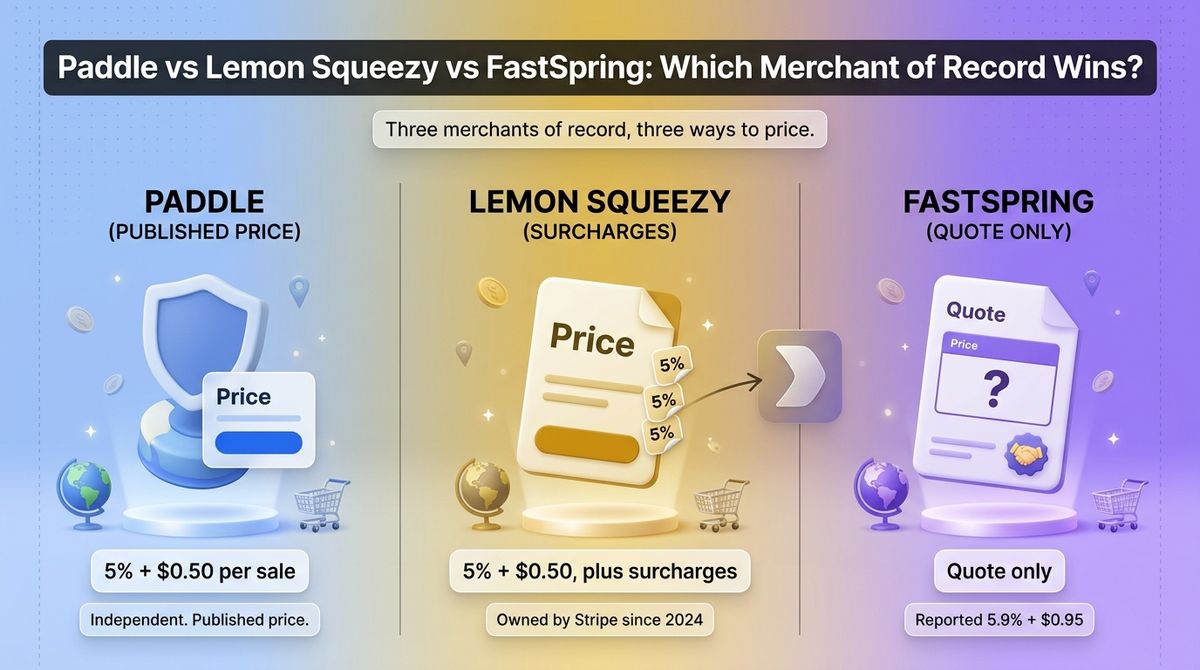
A merchant of record sells your product to the buyer on your behalf. It collects and remits tax, handles chargebacks, and shows its own name on the card statement. All three platforms do that job, but the fees, payout rules, and risks differ. Paddle and Lemon Squeezy list 5% + $0.50 per sale, while FastSpring quotes by sales call. Stripe has also folded Lemon Squeezy’s technology into its own merchant-of-record product, which changes the picture.
I reviewed Paddle vs Lemon Squeezy vs FastSpring for 30 days, reading each platform’s seller terms, using sandbox or test mode where one exists, and running the fee math at five order sizes from $9 to $199. Here is the honest comparison. Two catches to know first: Lemon Squeezy is now owned by Stripe and being steered toward Stripe Managed Payments, and FastSpring publishes no rate.
Table of Contents
How We Tested
I scored each platform on five criteria, using the same set of order sizes and product types throughout.
- Fees and total cost. I calculated the fee on a $9, $19, $49, $99, and $199 order, and on $10,000 of monthly sales.
- Tax and compliance coverage. I checked who registers, collects, and remits VAT, GST, and sales tax, and who carries chargeback liability.
- Payouts and account approval. I read the payout minimums, transfer fees, and the rules for which sellers get approved.
- Checkout and subscriptions. I looked at hosted and embedded checkout, subscription billing, and software features such as license management.
- Stability and risk. I checked ownership changes, regulatory history, contract terms, and how clearly each platform states its own pricing.
As a WordPress developer, I also asked which platform suits someone selling plugins, themes, or templates alongside a blog.
Paddle Review: The Clearest Price From the Most Independent Platform
- Free plan: None; no monthly fee, you pay per sale
- Starting price: 5% + $0.50 per checkout transaction (products under $10 need custom pricing)
- Best plan for most users: Pay-as-you-go
- Platforms: Web, API, Paddle.js, SDKs
- Affiliate program: None confirmed
Paddle is a London-based merchant of record for software, SaaS, and digital products. It has operated since 2012 and owns ProfitWell, the subscription analytics company it acquired. It sells to your customers, files tax on its own returns, and pays you the net amount.
What Paddle does best
Paddle publishes one clear price and covers a lot for it. The 5% + $0.50 rate includes tax compliance in more than 200 countries, fraud protection, chargebacks, and buyer support. There are no monthly, setup, or migration fees, so a new seller can price a product without calling sales.
Paddle Billing handles subscriptions, and the Retain product adds churn analytics and failed-payment recovery. Paddle is also independent. It has a standalone roadmap built around merchant of record services, which matters while Lemon Squeezy is being folded into Stripe. SaaS businesses scaling their revenue alongside churn recovery often integrate affiliate and partner management software to drive new referrals.
Where Paddle falls short
Approval and fit are the main hurdles. Products under $10 need custom pricing, so a $9 ebook falls outside the standard rate. Paddle also reviews each seller, and one report says pure services and consulting businesses get rejected. Creators selling standalone files or ebooks can also evaluate simpler platforms to sell digital downloads with lower transaction complexity.
Paddle’s June 2025 settlement with the US Federal Trade Commission is worth knowing about. It paid $5 million over allegations that it processed payments for tech-support scams, and it agreed to stricter client screening. Paddle said the order required no material change to its business model. Payouts also carry a $100 minimum and a $15 fee on SWIFT transfers, and your buyers see Paddle, not you, on their statements.
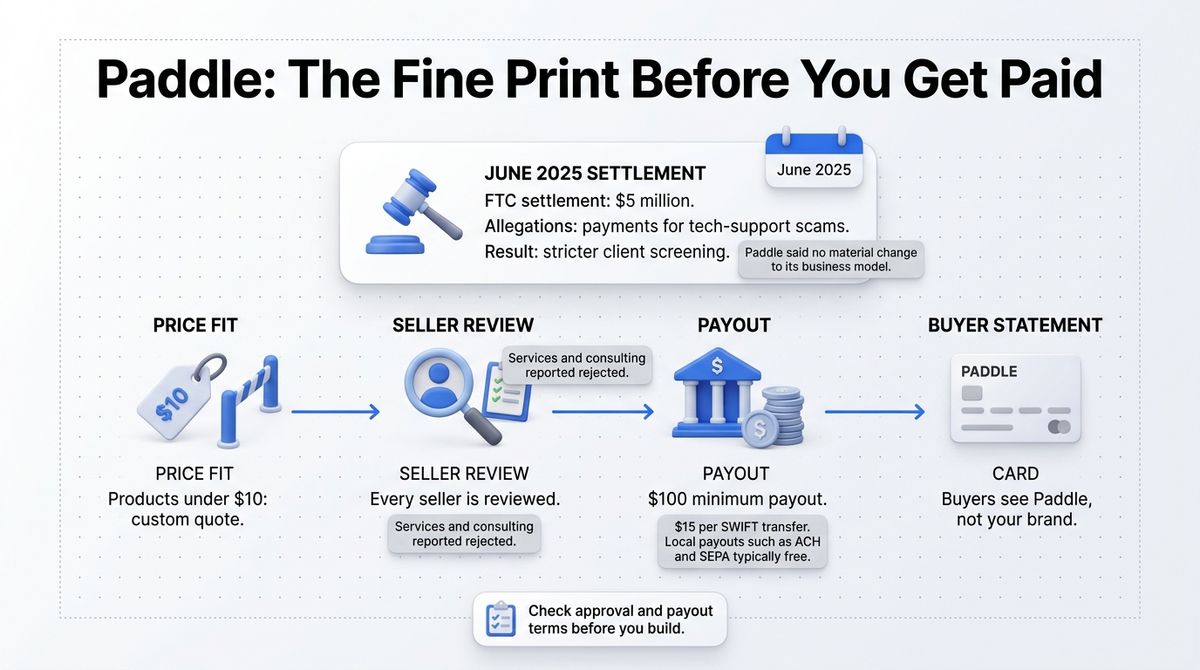
Paddle pricing
| Item | Rate | Notes |
|---|---|---|
| Pay-as-you-go | 5% + $0.50 per checkout transaction | Tax, fraud protection, chargebacks, and billing included; no monthly fee |
| Products under $10 | Custom quote | The standard rate does not apply |
| Invoicing add-on | 3.5% of the price for bank-transfer invoices | Invoices paid through checkout use the standard rate |
| International payout | $15 per SWIFT transfer | Local payouts such as ACH and SEPA are typically free; $100 minimum payout |
| Custom pricing | Quoted | For larger and fast-growing sellers |
Paddle: Pros and Cons
Pros:
- Published rate with no monthly, setup, or migration fees
- Tax, fraud protection, chargebacks, and billing in one price
- Independent since 2012 with a standalone roadmap
- Retain adds churn analytics and failed-payment recovery
Cons:
- Products under $10 need custom pricing
- Seller approval can reject services and consulting
- $5 million FTC settlement in June 2025
- $100 minimum payout and $15 SWIFT fee
- Buyers see Paddle on their statements, not your brand
Rating: 4.4 / 5, the clearest price and the most independent of the three.
Lemon Squeezy Review: A Simple Start With an Uncertain Road Ahead
- Free plan: None; no monthly fee, you pay per sale
- Starting price: 5% + $0.50 per order, plus surcharges
- Best plan for most users: Standard pay-as-you-go
- Platforms: Web, API
- Affiliate program: None confirmed
Lemon Squeezy is a merchant of record built for indie developers, creators, and early-stage software. It offers hosted checkout, subscriptions, and tax handling. Stripe announced its acquisition on July 26, 2024.
What Lemon Squeezy does best
Lemon Squeezy is the simplest of the three to start with. It handles checkout, subscriptions, and tax at 5% + $0.50 with no monthly fee. The published fee list is short, so you can model your costs before you sign up.
Stripe ownership adds stability. Lemon Squeezy has processed payments on Stripe since launch, and no shutdown date has been announced. Existing sellers keep the published rates during the migration.
Where Lemon Squeezy falls short
The direction has changed. In January 2026, the CEO said support would be slower and updates less frequent while the team builds Stripe Managed Payments. The legal entity now trades as Link, LLC, formerly Lemon Squeezy LLC.
Surcharges stack on the base fee. International orders add 1.5%, PayPal adds 1.5%, and subscriptions add 0.5%, which can reach 8.5% + $0.50. Stripe Managed Payments costs 3.5% on top of standard Stripe fees, so a migration could raise your rate. Reports differ on whether new signups are open, so confirm access before you plan around it.
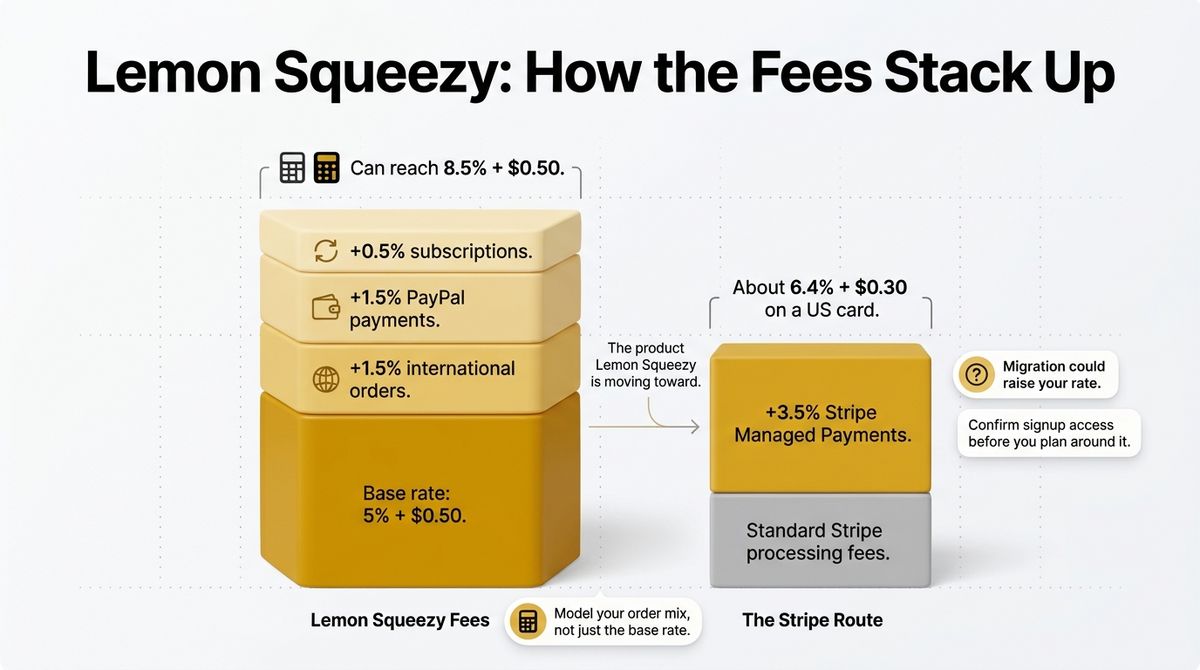
Lemon Squeezy pricing
| Item | Rate | Notes |
|---|---|---|
| Base rate | 5% + $0.50 per order | Tax handling, billing, and chargebacks included |
| International orders | +1.5% | Stacks on the base rate |
| PayPal payments | +1.5% | Stacks on the base rate |
| Subscriptions | +0.5% | Applies to subscription payments |
| Bank payout | Free in the US, 1% outside the US | Paid out through Stripe |
| Stripe Managed Payments | 3.5% on top of standard Stripe fees | About 6.4% + $0.30 on a US card; the product Lemon Squeezy says it is moving toward |
Lemon Squeezy: Pros and Cons
Pros:
- Simple 5% + $0.50 base rate with no monthly fee
- Hosted checkout, subscriptions, and tax handling
- Backed by Stripe, with no shutdown date announced
- Free bank payouts in the US
Cons:
- Slower support and fewer updates, per the CEO’s January 2026 post
- Surcharges can reach 8.5% + $0.50
- Migration to Stripe Managed Payments could raise your rate
- Reports differ on whether new signups are open
Rating: 3.9 / 5, a simple start with an uncertain road ahead.
FastSpring Review: A Mature Platform With No Published Price
- Free plan: None; no monthly fee, quote-based pricing
- Starting price: Quote only; reported 5.9% + $0.95 per transaction or a flat 8.9%
- Best plan for most users: The variable rate above about $32 per order; the flat rate below it
- Platforms: Web, API
- Affiliate program: None confirmed
FastSpring is a merchant of record for software, SaaS, games, and digital products. It was founded in Santa Barbara in 2005 and trades as Bright Market, LLC. Charges appear on statements under its own name.
What FastSpring does best
FastSpring is the most established platform of the three. It acts as merchant of record in more than 200 tax jurisdictions and includes subscription management, popup, embedded, and hosted checkout, dunning, license management for software, and localized pricing in over 20 currencies.
Every customer gets the full platform, with no feature tiers. The sales-led process suits larger catalogs and software sold with licenses or downloads. Pricing starts with a conversation, and large sellers can negotiate a lower rate.
Where FastSpring falls short
FastSpring publishes no rate. Its pricing page says the team will set flat-rate pricing by transaction type and volume. Reported baseline terms are 5.9% + $0.95 per transaction or a flat 8.9%, both higher than Paddle’s published rate.
Small sellers feel it most. Accounts under $5,000 in annual volume pay a $150 yearly risk-verification fee, and the terms run a year. The median reported annual contract is about $3,229. FastSpring is also reported to keep its fees on refunded orders, so confirm that in writing.
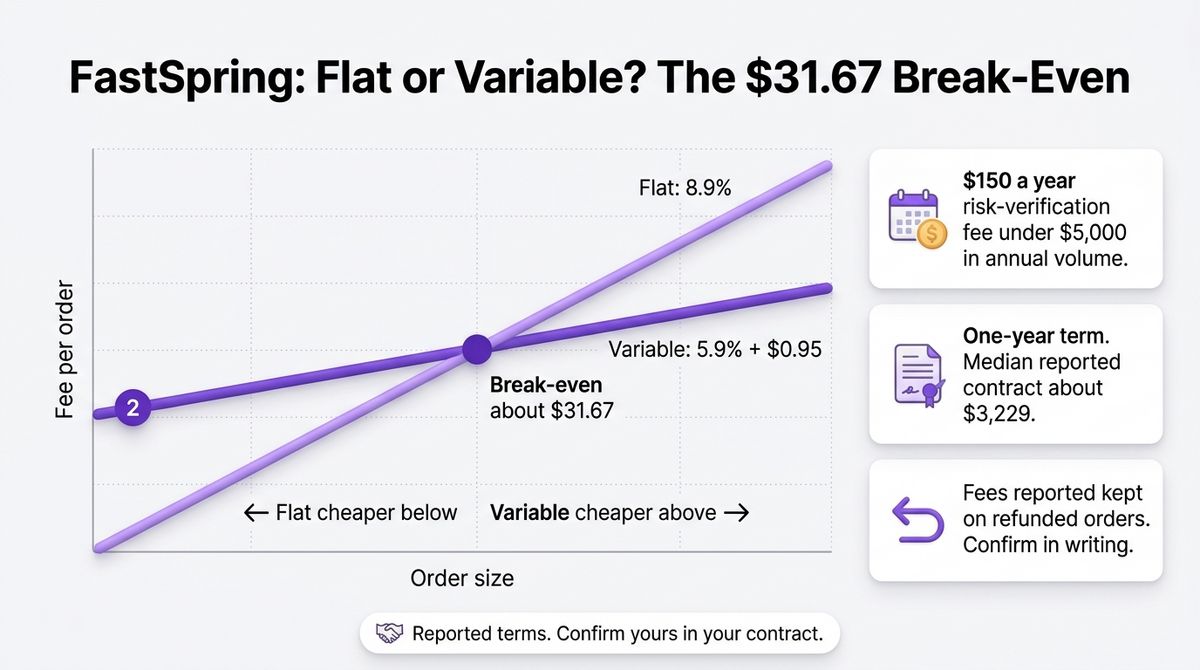
FastSpring pricing
| Item | Rate | Break-even | Notes |
|---|---|---|---|
| Variable plan (reported) | 5.9% + $0.95 per transaction | Cheaper above about $31.67 | Quote-based; confirm in your contract |
| Flat plan (reported) | 8.9% per transaction | Cheaper below about $31.67 | No fixed per-order fee |
| Enterprise | Negotiated | Not applicable | Discounts reported above $1 million in annual volume |
| Risk-verification fee | $150 a year | Not applicable | Accounts under $5,000 in annual volume |
FastSpring: Pros and Cons
Pros:
- Established since 2005 with a full platform on every account
- Tax handling in more than 200 jurisdictions
- License management for software
- Localized pricing in over 20 currencies
Cons:
- No published rate; pricing is by quote
- Reported rates are higher than Paddle’s
- $150 yearly fee under $5,000 in annual volume
- One-year term reported
- Fees reported as kept on refunded orders
Rating: 3.8 / 5, a mature platform with no published price.
Head-to-Head Comparison Table
| Feature | Paddle | Lemon Squeezy | FastSpring |
|---|---|---|---|
| Published rate | 5% + $0.50 | 5% + $0.50 plus surcharges | Quote only; reported 5.9% + $0.95 or 8.9% flat |
| Fee on a $19 order | $1.45 (7.6%) | $1.45 base | About $2.07 variable (10.9%); $1.69 flat (8.9%) |
| Fee on a $49 order | $2.95 (6.0%) | $2.95 base; $4.67 with every surcharge | About $3.84 variable (7.8%); $4.36 flat |
| Monthly fee | $0 | $0 | $0; $150 a year under $5,000 in volume |
| Orders under $10 | Custom quote | Standard rate applies | Flat plan reported |
| Tax handling | Merchant of record, 200+ countries | Merchant of record | Merchant of record, 200+ jurisdictions |
| Subscriptions | Paddle Billing and Retain | Yes, +0.5% | Yes, with dunning and plan changes |
| Payout notes | $100 minimum; $15 SWIFT | Free US bank payout; 1% outside the US | Set by contract |
| Founded | 2012 | 2021, Stripe-owned since 2024 | 2005 |
| Main risk | 2025 FTC settlement; stricter approval | Steered toward Stripe Managed Payments | No public rate; one-year term |
| Affiliate program | None confirmed | None confirmed | None confirmed |
| Best for | Scaling SaaS and apps | Indie developers starting out | Established software sellers |
| Our rating | 4.4 / 5 | 3.9 / 5 | 3.8 / 5 |
Which Should You Choose?
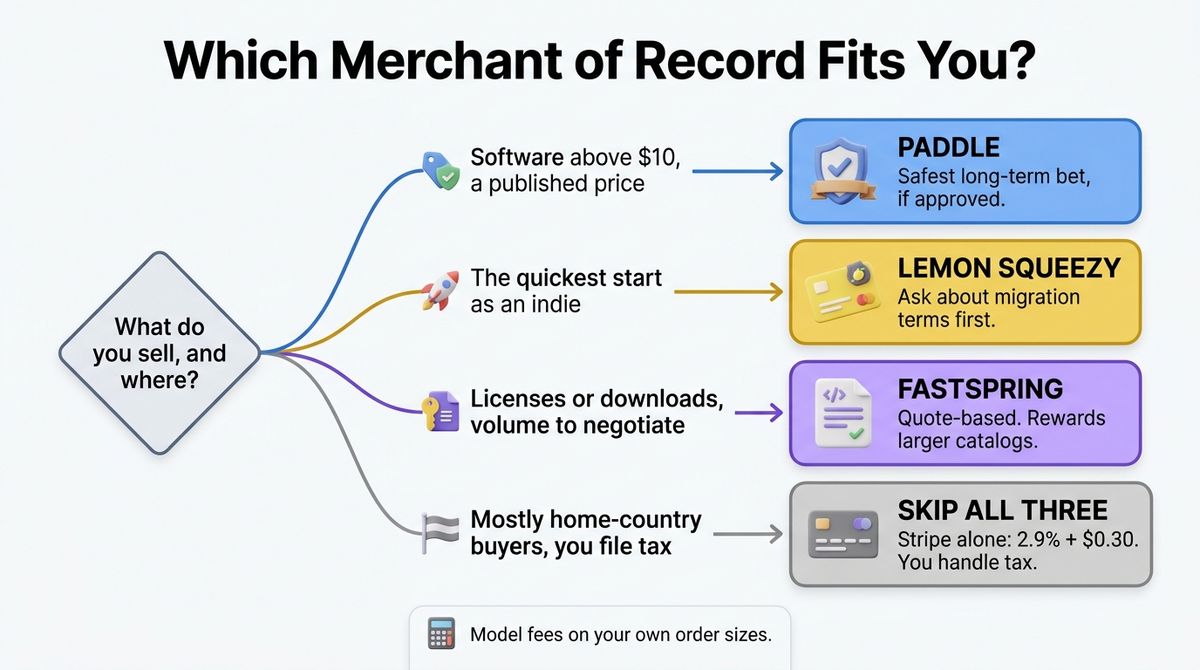
Choose Paddle if you sell software or apps priced above $10 and want a published price with an independent platform behind it. It is the safest long-term bet if your account is approved.
Choose Lemon Squeezy if you want the quickest start as an indie developer or creator. Ask about migration terms to Stripe Managed Payments first, because your rate may rise.
Choose FastSpring if you sell software with licenses or downloads and have the volume to negotiate. The quote-based process rewards larger catalogs.
Skip all three if most buyers are in your home country and you already file tax there. Stripe alone charges 2.9% + $0.30, but you then register and file tax yourself if you compare online payment processors for small business options.
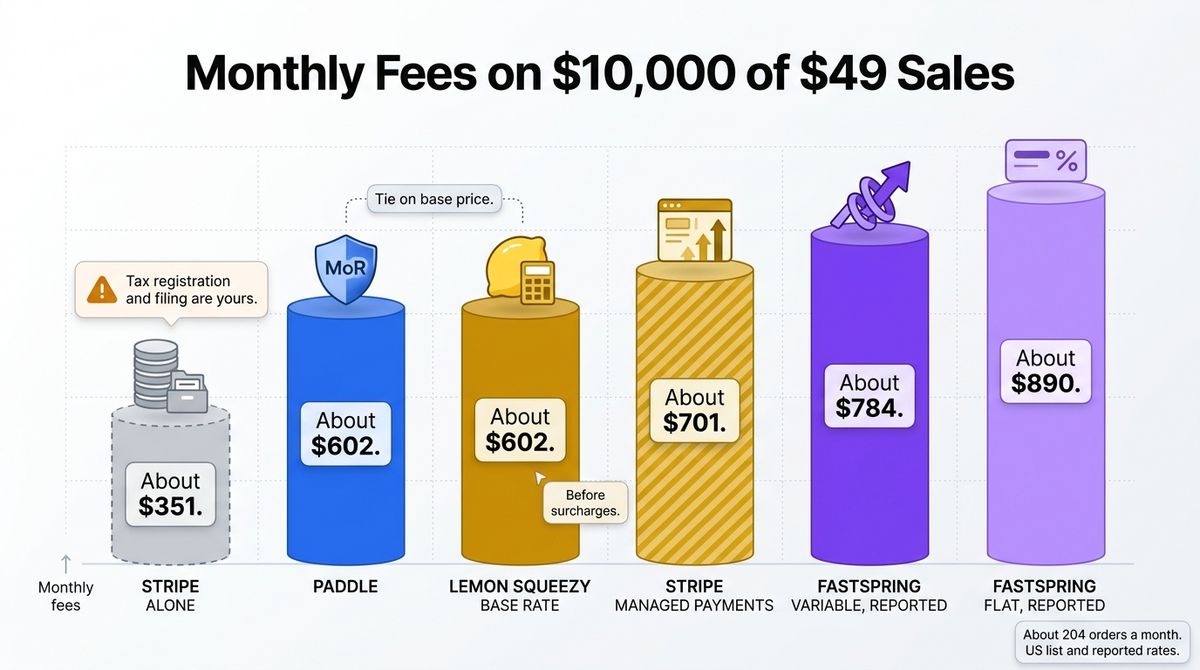
The gap shows up at volume. On $10,000 a month in $49 sales, about 204 orders, Paddle costs about $602, and Lemon Squeezy’s base rate costs the same. Stripe Managed Payments costs about $701, FastSpring’s reported variable rate is about $784, and its flat rate is $890. Stripe alone would cost about $351, but leaves tax to you.
Our Recommendations
- Solo developer or blogger selling a first product at $19 to $99: Paddle, if it approves your account. Use Lemon Squeezy only if you accept the migration uncertainty.
- Seller of ebooks or templates under $10: None of the three fits well. Use a creator-focused checkout built for low prices, such as the platforms in our digital downloads comparison.
- WordPress plugin or theme developer selling licenses: FastSpring’s license management suits a larger catalog. At lower volume, Paddle with your own license server keeps costs predictable.
- Team near $1 million in annual sales: Ask Paddle and FastSpring for quotes. Use Paddle’s published 5% + $0.50 as the baseline for the negotiation.
- Seller with mostly domestic sales who files taxes already: Stripe alone at 2.9% + $0.30 is cheaper.
Final Verdict
For most readers comparing Paddle vs Lemon Squeezy vs FastSpring, Paddle is the winner. It publishes a clear price, covers tax and chargebacks, and remains independent. Lemon Squeezy is the easiest start but is being steered into Stripe, and FastSpring suits larger software sellers who can negotiate.
- Paddle: 4.4 / 5, the clearest price and the most independent of the three.
- Lemon Squeezy: 3.9 / 5, a simple start with an uncertain road ahead.
- FastSpring: 3.8 / 5, a mature platform with no published price.
Frequently Asked Questions
What is a merchant of record?
A merchant of record is the legal seller of your product. It charges the buyer, collects and remits VAT, GST, and sales tax, handles chargebacks, and shows its own name on the card statement. Paddle, Lemon Squeezy, and FastSpring all work this way, which removes tax registration from your to-do list.
How much does Paddle charge?
Paddle charges 5% + $0.50 per checkout transaction with no monthly, setup, or migration fees. The rate includes tax compliance, fraud protection, chargebacks, and billing. Products priced under $10 need custom pricing, and larger sellers can negotiate. Paddle sets payout terms, with a $100 minimum and $15 for SWIFT transfers.
Is Lemon Squeezy shutting down?
Not yet. Stripe acquired Lemon Squeezy in July 2024, and no shutdown date has been announced. In January 2026, the CEO said support would be slower while the team builds Stripe Managed Payments, the product Lemon Squeezy says it is moving toward. Confirm migration terms before building a new store on it.
How much does FastSpring cost?
FastSpring publishes no rate and prices by quote, based on transaction type and volume. Reported baseline terms are 5.9% + $0.95 per transaction or a flat 8.9%. Accounts under $5,000 in annual volume pay a $150 yearly risk-verification fee. Confirm your exact rate, term, and refund treatment in writing before signing.
Which merchant of record is cheapest?
Paddle and Lemon Squeezy tie on base price at 5% + $0.50, but Lemon Squeezy adds surcharges for international orders, PayPal, and subscriptions. FastSpring’s reported rates cost more on orders above about $13. Stripe alone is cheapest at 2.9% + $0.30, though you then handle global tax registration and filing yourself.
Is Paddle or Lemon Squeezy better for indie developers?
Paddle suits indie developers with a product priced above $10 and a plan to scale, thanks to its published rate and independence. Lemon Squeezy is easier to start with but carries migration uncertainty after the Stripe acquisition. Both charge 5% + $0.50 before surcharges. If Paddle approves your account, it is the safer long-term choice.
What is Stripe Managed Payments?
Stripe Managed Payments is Stripe’s own merchant-of-record product, built from the Lemon Squeezy acquisition. It handles indirect tax in more than 80 countries and charges 3.5% on top of standard Stripe processing fees, roughly 6.4% + $0.30 on a US card. It excludes physical goods.
Do I need a merchant of record to sell digital products?
Not always. A merchant of record helps most when you sell to buyers in many countries and cannot register for VAT and sales tax yourself. If your sales are mostly domestic, or you already handle tax filings, Stripe alone costs less at 2.9% + $0.30 per transaction and leaves you as the seller.