A freelancer registering an LLC, or a remote worker who doesn’t want their home address on a public business filing, runs into the same problem almost immediately: most official paperwork, bank applications, IRS correspondence, state filings, vendor accounts, needs a real street address, and a P.O. Box does not satisfy that requirement in most cases. If you haven’t formed that LLC yet, see our Rocket Lawyer vs LegalZoom vs LawDepot comparison for registering an LLC before you need an address to put on the paperwork. A virtual mailbox solves this specific problem by giving you a real, physical street address where mail is received, scanned, and made available online, without you ever needing to visit it in person.
This is also a category where the advertised monthly price tells you almost nothing about your actual annual cost, and that gap is the single most important thing to understand before choosing a provider. I tested Anytime Mailbox vs iPostal1 vs Traveling Mailbox for 30 days, tracking not just the subscription price but the per-scan fees that, for some providers, end up costing more over a year than the entire base subscription. Here is the honest comparison.
Table of Contents
How We Tested These Services
Every platform was evaluated against five criteria:
- Real annual cost at typical mail volume, not the advertised monthly rate, but the total cost including scanning fees for someone receiving 5–10 pieces of mail a month
- Address network size and quality, how many real street address options are available, and in which cities
- Mail handling speed and accuracy, how quickly mail is scanned and made available, and how reliably
- Additional services, check depositing, package forwarding, and shredding, and whether these are included or charged separately
- Pricing transparency, is the actual cost structure clear upfront, or does it depend heavily on which specific location and operator you choose
Why the Advertised Price Is the Least Useful Number in This Category
This is worth stating plainly before going provider by provider, because it is the single biggest source of confusion in this entire category: While Anytime Mailbox operates as a decentralized marketplace where local operators set their own rates, iPostal1 uses standard, centralized pricing across its network. Partner mail centers are not allowed to set subscription rates. Base costs depend on the address type—Virtual Mailing Address ($9.99/mo), Virtual Business Address ($14.99/mo), or Virtual Office ($39.99/mo)—with standard location add-ons based on demand (Select +$10, Premium +$20, Prestige +$30) rather than city location. Both NYC and San Francisco, for instance, offer options at the base $9.99 rate.
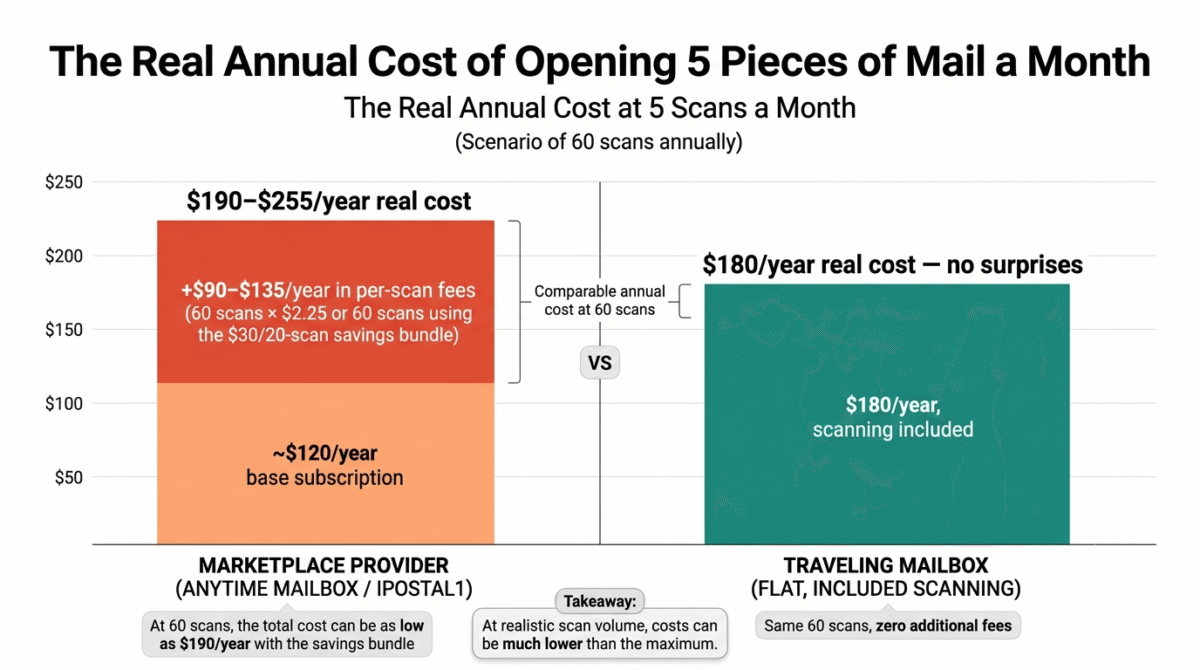
The bigger cost trap, though, is scanning. Every provider in this category scans the outside of an envelope for free. Opening the envelope and scanning its contents- the part you actually need for an IRS notice or a bank statement- frequently costs extra, charged per item. At 60 content scans per year (5 per month), iPostal1’s standalone scanning orders cost $2.25/month ($135/year), while their savings bundle ($30 for 20 scans) brings 60 total scans down to $90/year. When paired with an annual Virtual Mailing Address ($99/year), total annual costs can be as low as $189–$190/year. This makes total pricing directly comparable to Traveling Mailbox, while adding free unlimited cloud storage and optional business services. This is precisely the kind of pricing structure this site exists to walk through honestly before you commit to a provider based on the sticker price alone.
Anytime Mailbox Review: The Most Budget-Friendly Sticker Price, With a Real Catch
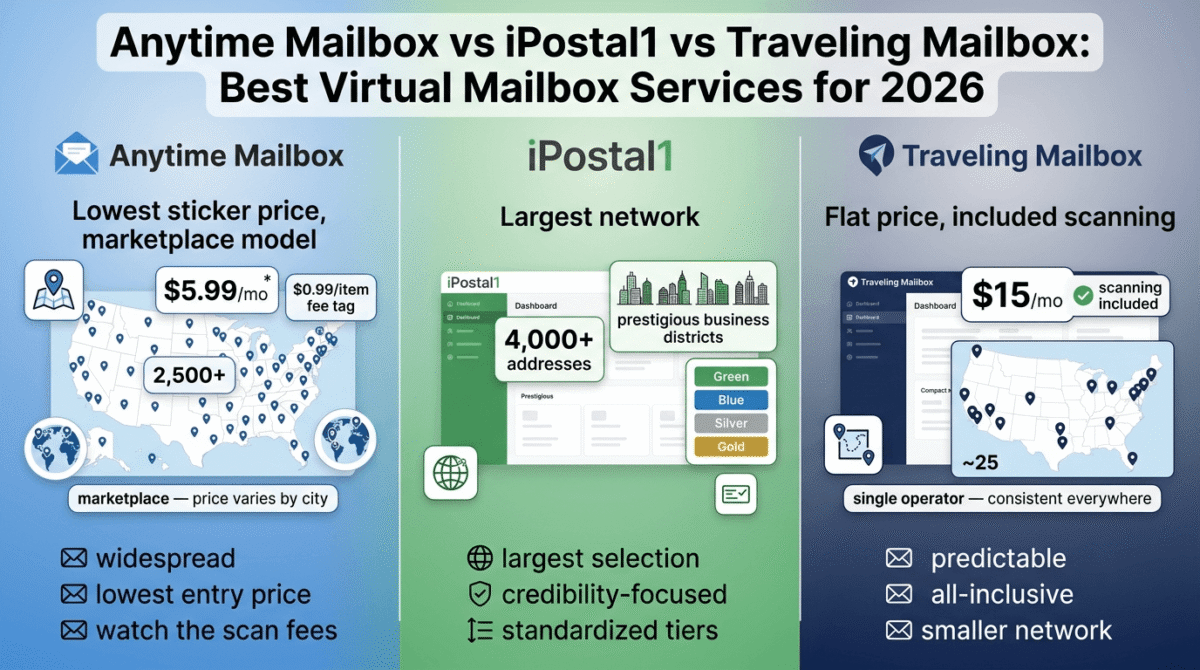
Starting price: Advertised from $4.99–5.99/month depending on location; most U.S. locations realistically start around $9.99/month
Address network: Over 2,500 locations across 50 states and 40+ countries
Scanning model: Free exterior scans; content scanning charged per item unless on a higher tier
Best for: Budget-conscious freelancers and travelers who open very little of their mail and mostly need a professional address on file
Affiliate program: Yes, confirm current terms directly
Anytime Mailbox has built its reputation specifically around being the lowest-cost entry point in this category, and the advertised pricing genuinely reflects that, provided you understand exactly what that low price does and does not include.
What Anytime Mailbox does best
The sheer size of the address network is genuinely impressive, over 2,500 locations spanning all 50 states and more than 40 countries, giving freelancers and remote business owners meaningful choice in exactly which city or even which neighborhood their business address appears to be in, which matters for credibility and for state-specific business registration requirements.
For users who mostly need a real street address on file, for an LLC registration, a bank application, or simply to keep a home address off public records, without needing to read most of what arrives, Anytime Mailbox’s lower-tier pricing genuinely delivers excellent value. The exterior scan, included free on every plan, is often enough information to decide whether a piece of mail needs further attention at all.
The mobile app and 24/7 online dashboard are functional and let you manage forwarding, shredding, and recycling requests without needing to be anywhere near the actual mailbox, a core convenience of the category that Anytime Mailbox delivers reliably.
Where Anytime Mailbox falls short
The marketplace pricing model is the most important thing to understand before choosing a specific location. Because each address is operated by an independent local CMRA rather than Anytime Mailbox directly, the same nominal plan tier can vary substantially in price between cities, research the specific location you want before assuming the advertised “starting at” price applies to it.
Content scanning, actually opening an envelope and scanning what’s inside, costs extra per item on Anytime Mailbox’s lower tiers, commonly cited around $0.99 per scan. For a user who needs to regularly open and read mail like bank statements or legal correspondence rather than just glance at the envelope, these per-item charges accumulate quickly and can make the “budget” tier considerably more expensive in practice than its sticker price suggests.
Because quality and responsiveness depend on the specific third-party operator behind each address, service consistency varies more than it does with a single-operator model like Traveling Mailbox, a real tradeoff for the larger location selection.
Anytime Mailbox pricing
| Tier | Price Range | Scanning Allowance | Key Details |
|---|---|---|---|
| Bronze / Entry | ~$5.99 – $9.99 / month | Exterior envelope free Content scans: ~$0.99 / item | Free envelope exterior scans & notifications, digital storage; ideal for low-volume mail or remote address presence where reading physical contents is rarely needed |
| Silver / Mid-Tier | ~$12.99 – $29.00 / month | Includes basic content scans e.g., 10–30 open & scan pages/mo | Includes monthly quota of envelope opens and document page scans, physical shredding, and basic mail forwarding options |
| Gold / Premium | ~$29.99 – $69.99 / month | High or unlimited scanning Varies by specific location partner | High-volume envelope and document content scans, priority package handling, extended physical storage, and check deposit capabilities |
Pricing is set independently by each location’s operator, confirm the specific cost for your chosen address before subscribing, and calculate your expected scanning costs based on realistic mail volume.
Anytime Mailbox: Pros and Cons
Pros:
- Largest combination of low entry price and broad location network in this comparison
- Over 2,500 locations across the US and 40+ countries
- Genuinely good value for users who rarely need content scanned
- Functional mobile app and dashboard for remote mail management
- Free trial period available to test before committing
Cons:
- Marketplace pricing model means costs vary significantly by location, the advertised low price doesn’t apply everywhere
- Per-item content scanning fees can make the “budget” tier expensive for anyone who opens mail regularly
- Service quality and responsiveness vary by third-party operator
- Easy to underestimate true annual cost without modeling your actual scan volume first
Rating: 4.1 / 5, Best for budget-conscious users who mainly need a real address on file and rarely need to open and read their mail. Model your actual scanning needs before assuming the lowest tier is the cheapest option for you.
iPostal1 Review: The Largest Network, Best for Multi-City Needs and Business Credibility
Starting price: $9.99/month for Virtual Mailing Address ($99/year on annual plan), $14.99/month for Virtual Business Address, and $39.99/month for Virtual Office. Location upgrades (Select +$10, Premium +$20, Prestige +$30) apply to high-demand buildings.
Address network: Over 4,250+ real street addresses worldwide, the largest network in this comparison
Scanning model: Exterior envelope scans are free on all plans; content scans are not included in base plans and are billed à la carte or via discounted scan savings bundles
Best for: Freelancers and small businesses that want address options in multiple specific cities, or want the credibility of a prestigious business address
Affiliate program: Yes, confirm current terms directly
iPostal1’s defining advantage is simply scale, more locations than any competitor in this comparison, with a more standardized tier structure than Anytime Mailbox’s per-location variability, even though pricing still differs somewhat between cities.
Additional suite of business services to help establish and grow your company: Registered Agent for only $99/year, AI & live person call answering, business insurance, notary service, direct mail creation and distribution, and scheduled mail delivery to your door (with more services coming soon)
What iPostal1 does best
With over 4,250+ real street addresses worldwide, iPostal1 offers the largest selection in this entire comparison, a genuine advantage for a freelancer or small business that specifically needs a presence in more than one city, or wants an address in a particular prestigious business district for client-facing credibility on a website or business card.
iPostal1’s four standard pricing tiers (Green, Blue, Silver, Gold) are more standardized across locations than Anytime Mailbox’s structure, which makes comparison shopping somewhat easier, though premium cities like New York and San Francisco still carry meaningfully higher rates than the advertised entry price.
The platform supports managing multiple addresses under a single login, which is genuinely useful for a growing business that wants a presence in several states or wants to test which city’s address performs best for a specific business registration or banking need.
Check depositing, available as an add-on feature, lets a business receive a physical check and have it deposited without needing to physically visit a bank, a real time-saver for a remote business owner who occasionally still receives paper payments. Once that check is deposited, recording it properly means having the right accounting software in place, see our QuickBooks vs FreshBooks vs Wave comparison.
Where iPostal1 falls short
While subscription rates are standardized company-wide, partner locations are independently operated, meaning local facility amenities and processing speeds can vary. No mail content scans are included in base plans, allowing customers who only view exterior envelopes to avoid paying for unused scans. However, regular scanners will need to purchase à la carte scans or scan savings bundles ($30 for 20 scans) to manage ongoing costs.
The four-tier plan levels (Green, Blue, Silver, Gold) adjust physical mail receiving allowances (30 to 240 items/month) rather than content scan limits, so mail volume and scanning needs must be calculated separately.
iPostal1 pricing
| PLAN | Green | Blue | Silver | Gold | KEY DETAILS |
|---|---|---|---|---|---|
| Mail Items | 30 | 60 | 120 | 240 | INCLUDED ON EVERY PLAN, EVERY TIER: Real physical street address, view & manage mail remotely, free exterior mail scans, free web/app inbox management, 6 recipient names, free discard, choice of carriers, ship dates, and service level, automatic notifications, free storage for a limited time depending on size, auto-ship options, bundle and save options, and mail and package consolidation. |
| Virtual Mailing Address | $9.99 | $14.99 | $24.99 | $39.99 | |
| Virtual Business Address | $14.99 | $19.99 | $29.99 | $44.99 | Plus, get your mail in your business name and access to an essential suite of business services to help you establish and grow your company. |
| PLAN | Office 60 | Office 120 | Office 120 Till Free | Office 240 Till Free | KEY DETAILS |
| Virtual Office | $39.99 | $49.99 | $59.99 | $69.99 | Same as business address, and adds optional phone, voicemail, dedicated digital fax. 250 free voice message minutes. |
Note: Exterior scans are free on all plans. Base plans include physical mail receiving quotas (Green: 30 items, Blue: 60, Silver: 120, Gold: 240). Content scanning is billed separately à la carte or via scan savings bundles.
iPostal1: Pros and Cons
Pros:
- Largest address network in this comparison, over 4,250+real street addresses
- More standardized tier structure than Anytime Mailbox, easing comparison
- Multi-address management under a single login
- Check deposit add-on available
- Strong fit for businesses needing a presence in multiple specific cities
Cons:
- Partner locations are independently operated, so facility amenities and processing speeds can vary.
- Content scans are charged à la carte, though scan savings bundles keep 60 annual scans down to $90 ($189–$190 total annual cost)
- Four-tier structure requires careful reading to compare actual value across plans
- Premium city locations carry meaningfully higher costs than the advertised entry price
Rating: 4.3 / 5, Best for freelancers and small businesses that specifically need address options across multiple cities or want a prestigious business address for credibility. Same scanning-fee math caution applies as Anytime Mailbox.
Traveling Mailbox Review: Best for Predictable Costs if You Actually Open Your Mail
Starting price: Around $15/month, the highest base price of the three, but with scanning included
Address network: Approximately 25 locations in major US cities, by far the smallest network in this comparison
Scanning model: A set number of content scans included per month at no additional per-item cost
Best for: LLC owners and remote workers who regularly open and read their mail and want predictable, all-inclusive pricing with no per-scan surprises
Affiliate program: Yes, confirm current terms directly
Traveling Mailbox takes the opposite approach from the marketplace model: it operates as a single, consistent service across all of its locations, with the same policies and pricing structure everywhere, and, most importantly, scanning included in the base price rather than charged per item.
What Traveling Mailbox does best
Included content scanning at no per-item cost is Traveling Mailbox’s defining advantage, and it is the reason this platform is the right choice for a specific, common use case: someone who actually needs to open and read most of their mail, not just glance at the envelope. IRS notices are not something you can skip opening, for users in this situation, Traveling Mailbox’s all-inclusive model is frequently cheaper annually than a lower-sticker-price competitor once their scanning fees are factored in.
The math here is worth stating directly: At 60 content scans per year (5 per month), iPostal1’s standalone scanning orders cost $2.25/month ($135/year), while their savings bundle ($30 for 20 scans) brings 60 total scans down to $90/year. When paired with an annual Virtual Mailing Address ($99/year), total annual costs can be as low as $189–$190/year. This makes total pricing directly comparable to Traveling Mailbox, while adding free unlimited cloud storage and optional business services. For anyone whose realistic mail volume includes regularly opening and reading what arrives, the higher-looking sticker price is very often the cheaper actual outcome.
Because Traveling Mailbox operates as a single company across every location rather than a marketplace of independent operators, service policy and quality are consistent regardless of which of its roughly 25 locations you choose, no surprises in scanning speed, customer support quality, or feature availability based on a third-party operator’s individual standards.
Where Traveling Mailbox falls short
The location network is by far the smallest in this comparison, roughly 25 addresses, concentrated in major US cities, with no international address options at all. If you need an address in a specific smaller city, a particular state for tax nexus reasons, or anywhere outside the US, Traveling Mailbox simply does not have an option for you, and you will need iPostal1 or Anytime Mailbox instead.
The higher base price, while frequently the better overall value for anyone who opens their mail regularly, is a real disadvantage for someone who genuinely needs minimal content scanning, a user who almost never needs to open their mail will likely find Anytime Mailbox’s or iPostal1’s lower entry tiers cheaper in practice, despite the per-scan fees, simply because they are scanning so little.
Traveling Mailbox pricing
| Plan | Price | Content Scans Included | Key Details |
|---|---|---|---|
| Basic | $15 / month (~$150/yr billed annually) | 35 page scans / month 40 incoming envelopes / mo | Includes 3 recipient names, free shredding, junk mail filtering, and automatic syncing to cloud storage (Google Drive, Dropbox, Evernote) |
| Extended | $25 / month (~$250/yr billed annually) | 80 page scans / month 100 incoming envelopes / mo | Includes scan rollover (unused page scans carry over to next month), 5 recipient names, and expanded envelope storage allowances |
| Small Business | $55 / month (~$550/yr billed annually) | 180 page scans / month 200 incoming envelopes / mo | Includes scan rollover, 10 recipient names, higher physical storage caps, and multi-user team dashboard access |
| Enterprise | $99 – $159 / month | Custom page scan allotments Custom envelope volume | Tailored recipient limits, high-volume batch scanning, dedicated processing queue, and custom account management |
Traveling Mailbox: Pros and Cons
Pros:
- Content scanning included in the base price, no per-item surprises
- Frequently cheaper annually than marketplace competitors for anyone who regularly opens their mail
- Consistent service and policy across every location, since it’s a single operator, not a marketplace
- Simple, predictable pricing structure that’s easy to budget against
Cons:
- Smallest address network in this comparison, only about 25 US locations, no international addresses
- Higher base price is a worse deal for users who rarely need content scanned
- Limited choice if you need a specific city, state, or country not in its small network
- Less suited to businesses needing multiple address locations simultaneously
Rating: 4.4 / 5, Best for anyone who regularly opens and reads their mail and wants predictable, all-inclusive pricing with no per-scan fee surprises, provided one of its roughly 25 US locations works for your needs.
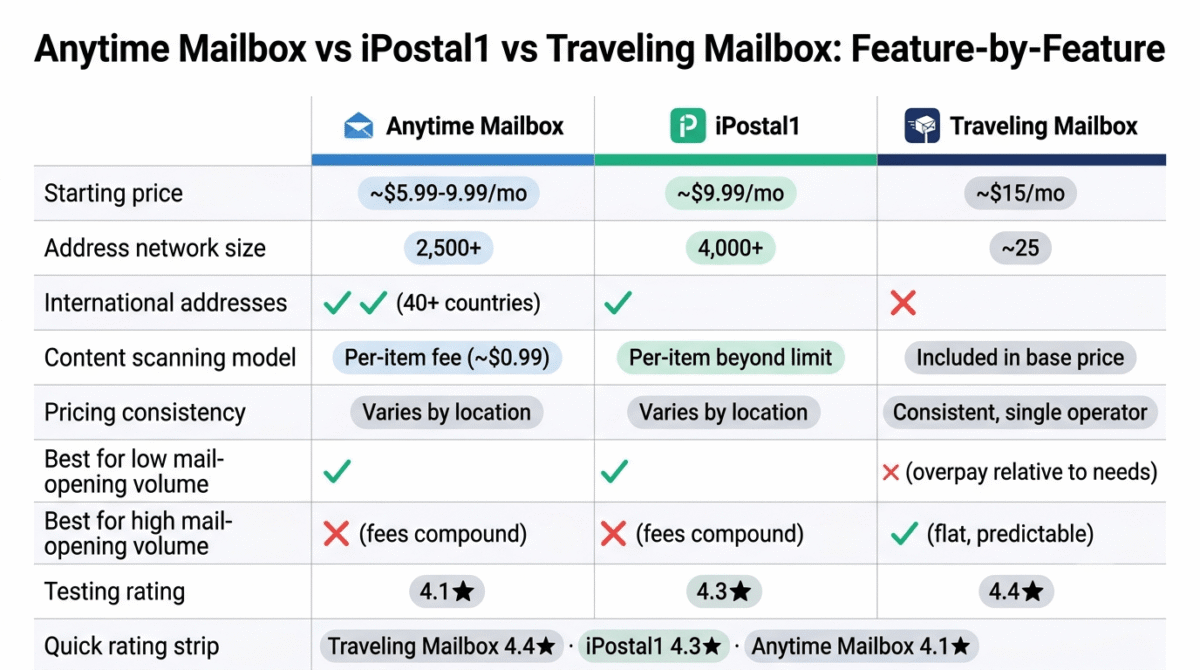
Head-to-Head Comparison
| Feature / Criteria | Anytime Mailbox | iPostal1 | Traveling Mailbox |
|---|---|---|---|
| Starting price | ~$5.99 – $9.99 / month Varies by specific location | ~$9.99 / month Standard mailing address rate | ~$15.00 / month Basic plan ($150/yr billed annually) |
| Address network size | 2,500+ locations Third-party pack & ship partners | 4,250+ locations Largest global address network | ~25 locations Core facility in NC + key metro hubs |
| International addresses | Yes (40+ countries) Global partner mail centers | Yes (Global network) Extensive international options | No US-based physical locations only |
| Content scanning model | Per-item micro-fees ~$0.50–$0.99 per envelope opened | Per-item beyond limit $2.25/request or pre-purchased scan bundles | Bundled allowance 35 to 180+ page scans included in base fee |
| Pricing consistency | Variable Each partner facility sets custom fees | Variable Tiered by address prestige & mail type | Consistent Uniform nationwide pricing & feature set |
| Low mail-opening volume | Ideal Low base subscription keeps costs down | Ideal Pay mostly for envelope exterior receiving | Sub-optimal You pay for scan allotments you don’t use |
| High mail-opening volume | Sub-optimal Per-scan micro-fees compound quickly | Sub-optimal Overage charges inflate monthly bills | Ideal Predictable flat rates with scan rollover |
| Multi-city / International | Strong Broad domestic & global presence | Strongest Unmatched network density | Weak Limited address choices, US only |
| Check deposit available | Yes ~$10 / deposit at participating locations | Yes $4.95 per deposit (up to 5 checks) + shipping | Yes (Confirmed) $4.95 per deposit + USPS/FedEx bank postage |
Which Service Should You Choose?
Choose Anytime Mailbox if:
You mainly need a real street address on file for an LLC registration, bank application, or privacy purposes, and you rarely need to actually open and read your mail. The lower entry price genuinely reflects good value for this specific, common use case, just confirm the actual price for your chosen location before assuming the lowest advertised tier applies.
Choose iPostal1 if:
You need address options in a specific city, multiple cities, or internationally, or want a prestigious business address for client-facing credibility. The largest network in this comparison makes it the strongest choice when location selection matters more than anything else, with the same per-scan fee caution as Anytime Mailbox applying once you factor in realistic mail volume.
Choose Traveling Mailbox if:
You regularly need to open and read your mail, IRS notices, bank statements, legal correspondence, and want predictable, all-inclusive pricing with no per-scan fee surprises. Run the actual annual math against a marketplace competitor first; for this specific use case, the higher sticker price is very often the cheaper real outcome.
The Freelancer and Small Business Setup Recommendation
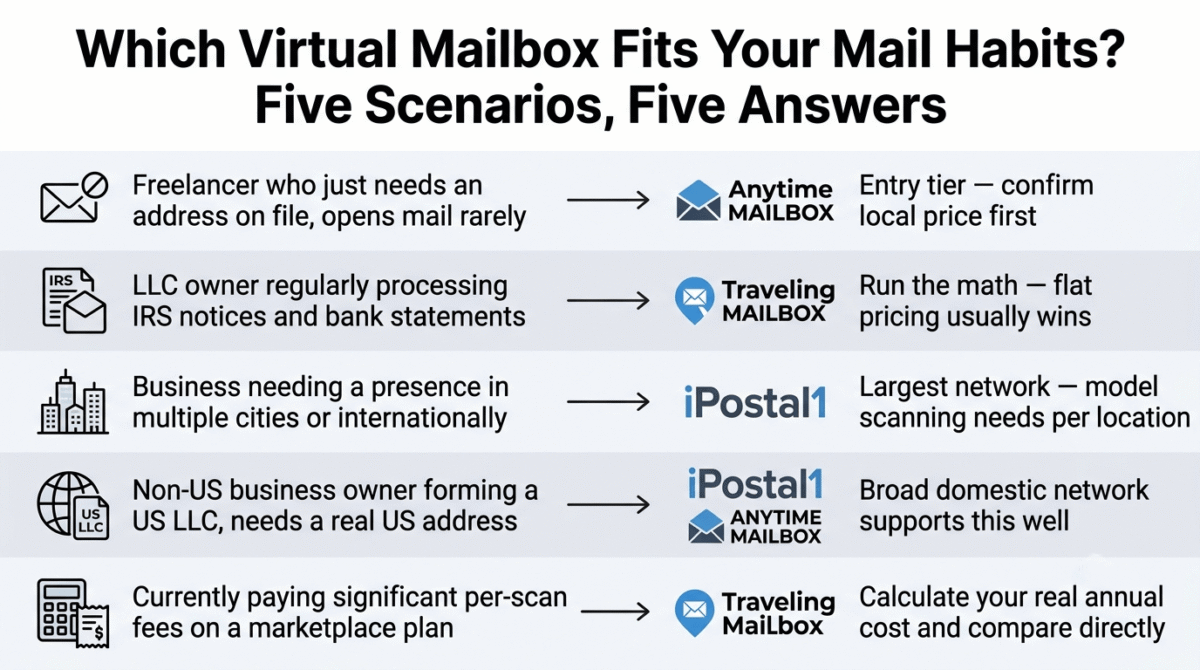
Based on 30 days of testing and modeling realistic annual costs across all three providers, here is the recommended setup by situation:
Freelancer or solopreneur who just needs an address on file, opens mail rarely: Anytime Mailbox’s entry tier for your chosen location. Confirm the actual local price first, and you will likely come out ahead even after occasional per-scan fees. See our full freelancer toolkit roundup for the rest of the stack a virtual mailbox typically pairs with.
LLC owner who needs to regularly process IRS notices, bank statements, and official correspondence: Traveling Mailbox, if one of its roughly 25 locations works for your needs. Run the math on your expected monthly scan volume against a marketplace competitor’s per-item fees, the higher base price usually wins for this exact situation.
Business needing a presence in multiple specific cities or internationally: iPostal1, for the largest network in this comparison. Model your expected scanning needs per location before assuming the lowest advertised tier is the right one.
Non-US business owner forming a US LLC who needs a real US street address for banking and filings: iPostal1 or Anytime Mailbox, both of which support this use case well given their broad domestic network, confirm with your registered agent or formation service that the address you choose satisfies your specific state’s requirements.
Anyone currently paying significant per-scan fees on a marketplace plan: Calculate your actual annual cost including those fees, and compare directly against Traveling Mailbox’s flat pricing if you fall within its location network. This is exactly the kind of recalculation worth doing once a year as your mail habits become clear.
Final Verdict
Traveling Mailbox is the best overall value for anyone who regularly opens and reads their mail, its included-scanning model frequently beats marketplace competitors’ lower sticker prices once realistic per-scan fees are factored into the annual total, provided one of its limited US locations meets your needs.
iPostal1 is the best choice when address selection and network size matter most, its 4,250+ locations make it the strongest option for businesses needing a presence in specific cities or countries, with the same scanning-fee caution that applies to Anytime Mailbox.
Anytime Mailbox remains the best low-commitment entry point, for users who genuinely need minimal mail opened, its lower advertised pricing delivers real value, as long as you confirm the actual local cost and model your scanning needs honestly before subscribing.
Ratings:
- Traveling Mailbox: 4.4 / 5
- iPostal1: 4.3 / 5
- Anytime Mailbox: 4.1 / 5
Frequently Asked Questions
What is the best virtual mailbox service in 2026?
Traveling Mailbox offers the best overall value for anyone who regularly opens and reads their mail, due to its included scanning and predictable pricing. iPostal1 is the better choice for the widest selection of address locations, including internationally. Anytime Mailbox is the best low-cost entry point for users who rarely need their mail opened and scanned.
Can I use a virtual mailbox as my permanent business address?
Yes. Virtual mailbox services provide a real street address that can be used for opening a bank account, registering an LLC or other business entity, and receiving official mail and packages, including tax correspondence. A P.O. Around the same time you set up that address, you’ll likely also register a domain for the business, see our Namecheap vs GoDaddy vs Porkbun comparison. Box typically cannot satisfy these same requirements, which is the core reason this category exists.
Why do virtual mailbox prices vary so much by location?
Anytime Mailbox and iPostal1 both operate as marketplaces, partnering with thousands of independent local mail-receiving agencies that each set their own pricing for the address they list. This means the advertised “starting at” price reflects the cheapest available location, not necessarily the location you actually want, always confirm the specific price for your chosen city before subscribing.
What are scanning fees, and why do they matter so much?
Most virtual mailbox providers scan the outside of an envelope for free, but charge a per-item fee to open the envelope and scan its actual contents. For someone who needs to regularly read mail like IRS notices or bank statements, these per-item fees can add up to more than the cost of a flat-fee competitor’s entire annual subscription, which is why modeling your realistic mail volume matters more than comparing headline monthly prices.
Is a virtual mailbox the same as a registered agent?
No. A registered agent accepts legal documents and service of process on behalf of a business, which is a specific legal requirement in most states. A virtual mailbox handles your general business mail, bank statements, vendor correspondence, packages, but typically does not fulfill the registered agent role. Many businesses need both services, and some providers in this broader category bundle the two together.
Do virtual mailbox services work for non-US residents forming a US LLC?
Yes, this is one of the most common use cases for this category. A virtual mailbox provides the real US street address required for bank applications, state filings, and IRS correspondence when a non-US founder does not have a physical US address of their own. iPostal1 and Anytime Mailbox’s broad domestic networks make them popular choices for this specific situation.
How quickly is mail scanned and made available?
This varies by provider and specific location, since marketplace models like Anytime Mailbox and iPostal1 depend on the individual operator behind each address. Most providers aim to scan and upload mail within one business day of receipt, though Traveling Mailbox’s single-operator consistency means this timing is generally more predictable across all of its locations than it is across a marketplace’s many independent operators.