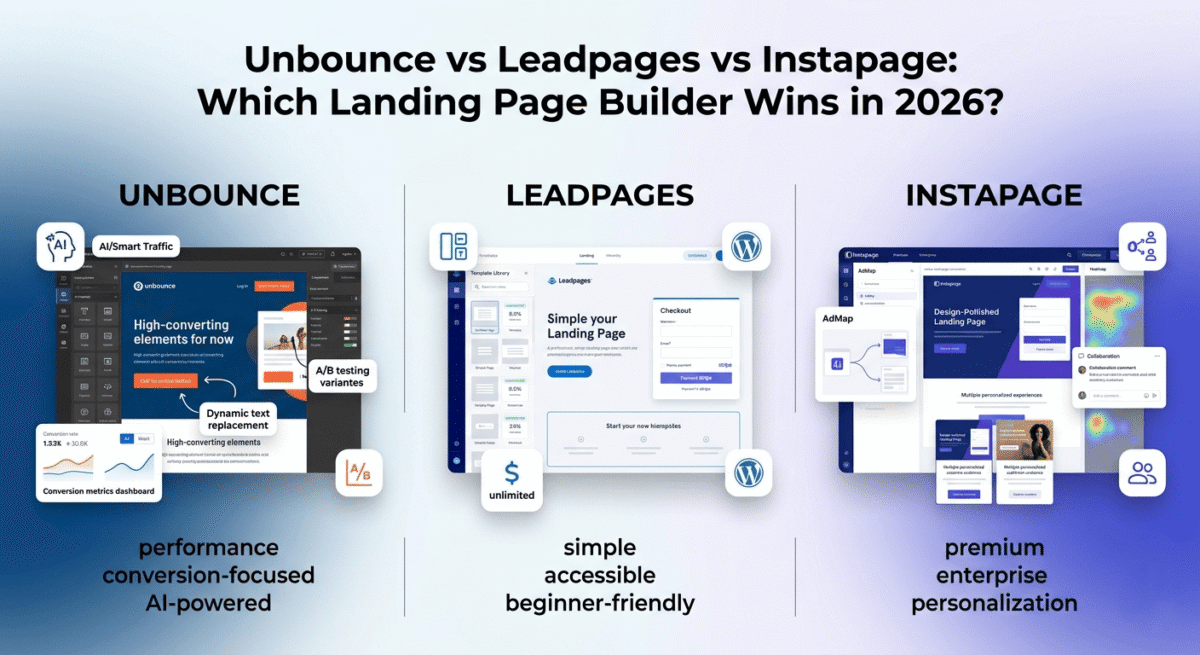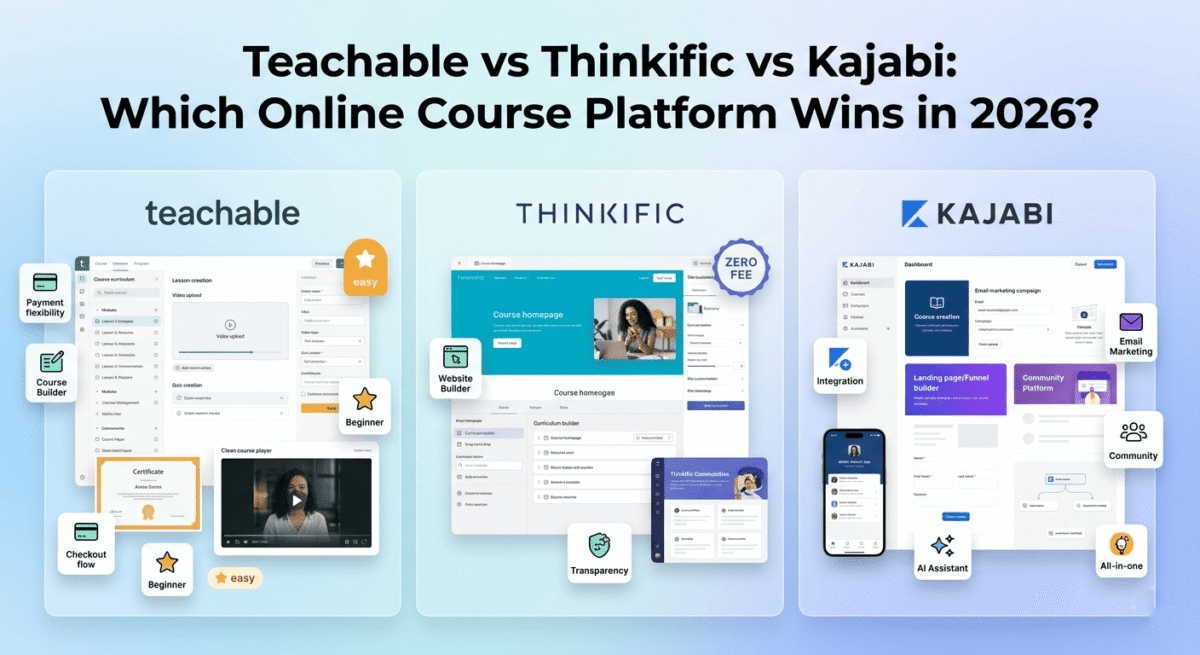
A course is something a student finishes. A community is something a member stays in. That distinction is the entire reason this software category exists separately from the course-hosting platforms covered elsewhere on this site,Teachable, Thinkific, and Kajabi are built around the assumption that a learner moves through structured content in a sequence and eventually completes it. A community platform is built around the opposite assumption: the value comes from ongoing discussion, peer connection, and ongoing access, not a finish line. For a blogger or creator whose business model depends on recurring monthly revenue rather than one-time course sales, that distinction has real financial consequences. A community platform is one piece of that recurring-revenue business, see our full content creator toolkit roundup for the rest of the stack it typically pairs with.
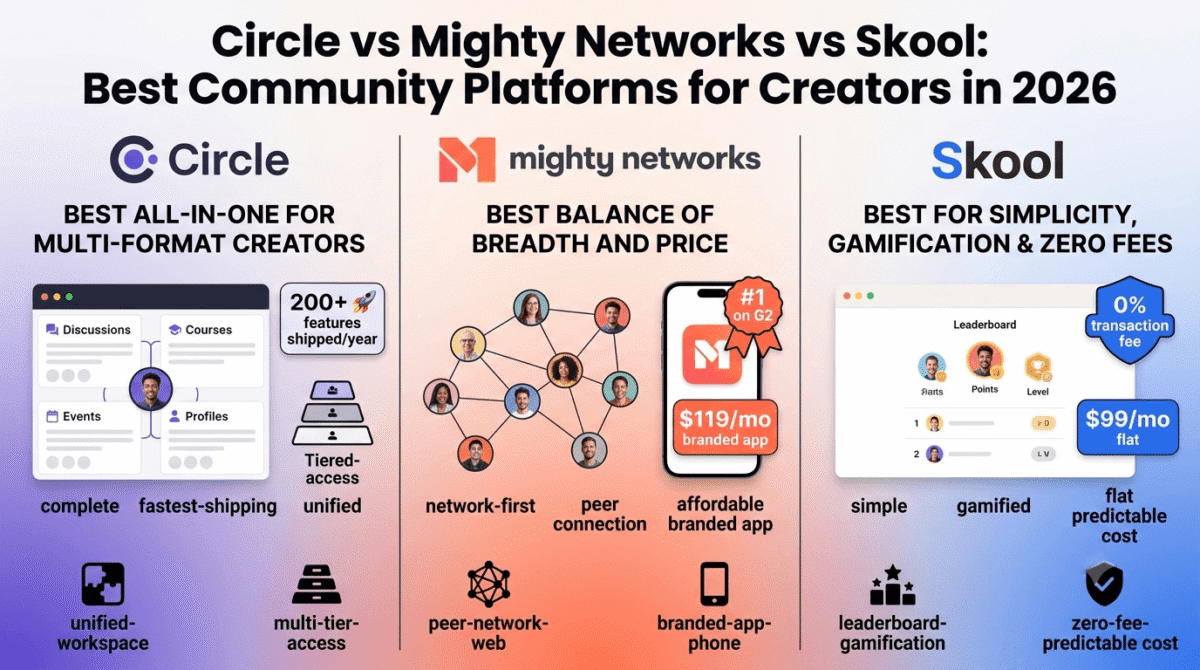
In 2026, three platforms dominate this category, and they have made genuinely different bets about how to make money from it. Circle bets on being the most complete, fastest-shipping platform, charging a percentage of your membership revenue on top of its subscription. Mighty Networks bets on a similar all-in-one breadth at a somewhat lower entry price, with its own transaction fee. Skool bets on radical simplicity and gamification, with a single flat monthly fee and zero transaction fees at all. I tested all three (Circle vs Mighty Networks vs Skool) for 30 days, running a real paid community. Here is the honest comparison, including the fee math that determines which platform is actually cheapest at your specific revenue level.
Table of Contents
How We Tested These Platforms
Every platform was evaluated against five criteria:
- Real cost at different revenue levels,not just the subscription price, but what the platform actually costs once transaction fees are applied to genuine monthly membership revenue
- Engagement and retention design,does the platform’s structure actively encourage members to return, or does it rely entirely on the creator’s own content cadence
- Course and content delivery quality,how well does each platform handle structured learning content alongside open community discussion
- Branding and white-label options,can members experience your community as your own branded space, or does it look like a generic platform with your logo attached
- Mobile experience,since most community engagement now happens on a phone, how good are the dedicated mobile apps
Why Community Platforms Are a Different Business Model Than Course Platforms
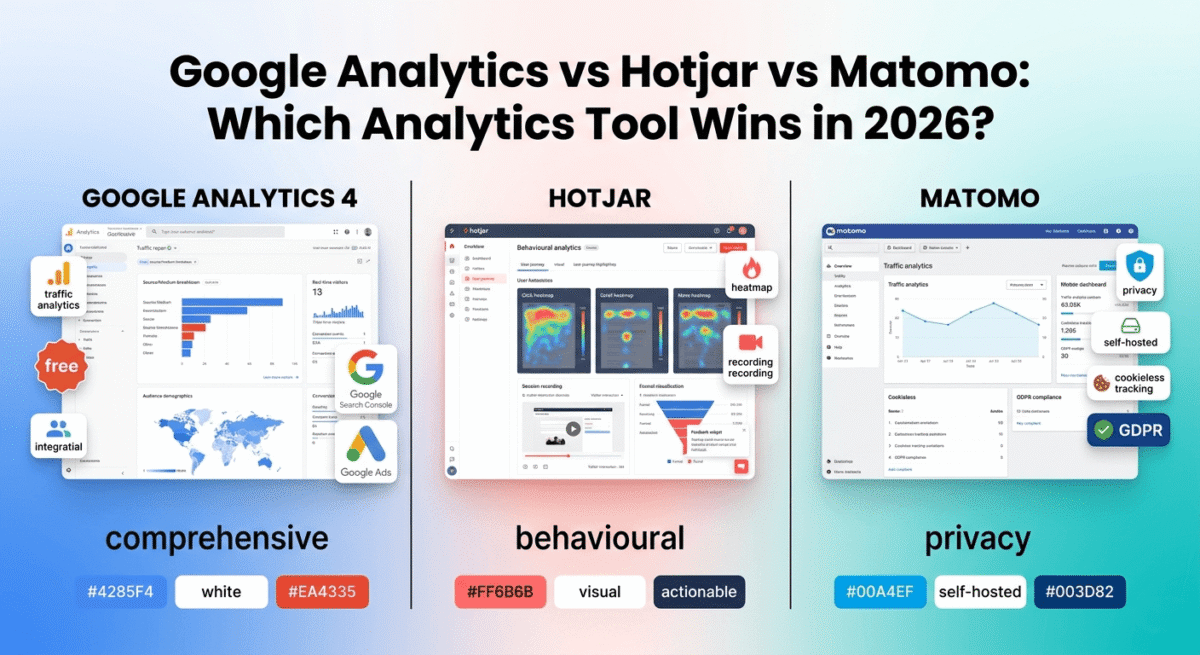
It’s worth stating this distinction plainly before going platform by platform, because it changes how you should think about your own pricing and member expectations. A course platform like Teachable sells access to specific content,a student pays once (or in installments), works through the material, and the relationship can reasonably end once they finish. A community platform sells ongoing access to people and conversation,the content matters, but the actual product being sold is continued belonging to a group, which is why retention, not completion rate, is the metric that determines whether a community business survives. If your community sits alongside a blog or marketing site, pairing that retention data with website analytics completes the picture, see our Google Analytics vs Hotjar vs Matomo comparison.
This also changes the revenue math. A course is typically a one-time or limited-installment payment. A community is, in nearly every successful case, a recurring monthly or annual subscription,which means the platform’s fee structure compounds every single month for as long as a member stays, in a way a one-time course sale’s platform fee does not. This is exactly why the fee comparison in this post matters more than it would for a simple course-hosting decision.
Circle Review: Best All-in-One Platform With the Fastest Feature Development
Free plan: No,14-day free trial
Starting paid price: Professional plan from $89/month, with a 2–4% transaction fee on membership revenue depending on the specific plan and current terms
Best plan for most paid communities: Professional, unless you specifically need a fully branded mobile app, which requires the Pro+ tier at $399/month
Platforms: Web, iOS, Android (generic app on lower tiers, white-label on Pro+)
Affiliate program: Yes,Circle affiliate program
Circle has built its reputation specifically on product velocity and breadth,independent comparisons consistently note that Circle ships more user-requested features per year than its direct competitors, and the platform’s design reflects an explicit goal of keeping discussions, courses, live events, and member profiles unified in one space rather than forcing members to bounce between separate tools.
What Circle does best
The unified experience across discussions, courses, live events, and member profiles is Circle’s clearest structural advantage. Rather than treating community and course content as separate products bolted together, Circle keeps everything inside the same branded space,a member browsing a discussion thread, then moving into a course module, then checking the events calendar, never leaves what feels like one cohesive environment.
Independent reporting cites real creators building substantial businesses on Circle specifically because of this breadth,one well-known productivity creator’s team described using Circle to support live cohorts, self-paced courses, virtual summits, a subscription membership, and an in-person event, all from the same platform, generating several million dollars in revenue over two years. That kind of multi-format flexibility is a genuine differentiator for a creator whose business has outgrown a single, simple membership tier.
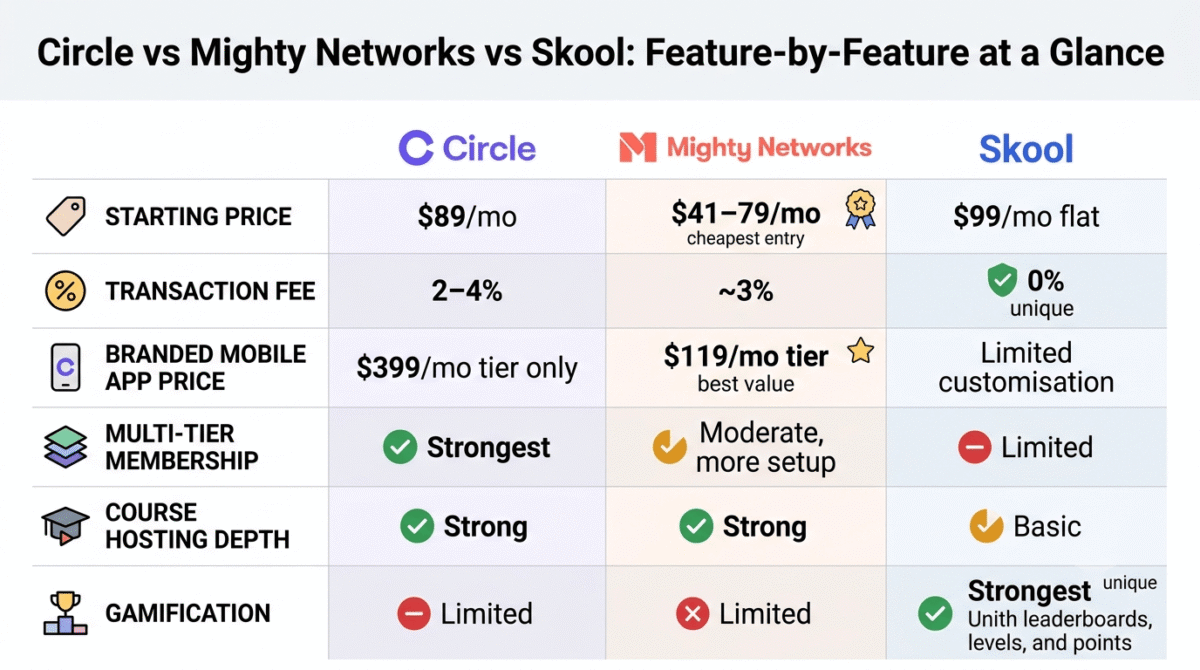
Multi-tier membership support is the strongest of the three platforms,Circle’s tiered spaces and access control let you offer a community-only tier, a community-plus-courses tier, and a premium tier with live calls, all managed from one dashboard with granular control over who can see what.
Circle’s product development pace, cited across multiple independent reviews as launching over 200 user-requested features in a recent year, suggests the platform is unlikely to feel stagnant or neglected relative to slower-moving competitors,a meaningful consideration for a long-term platform decision, since migrating a paid community later is genuinely disruptive to retention.
Where Circle falls short
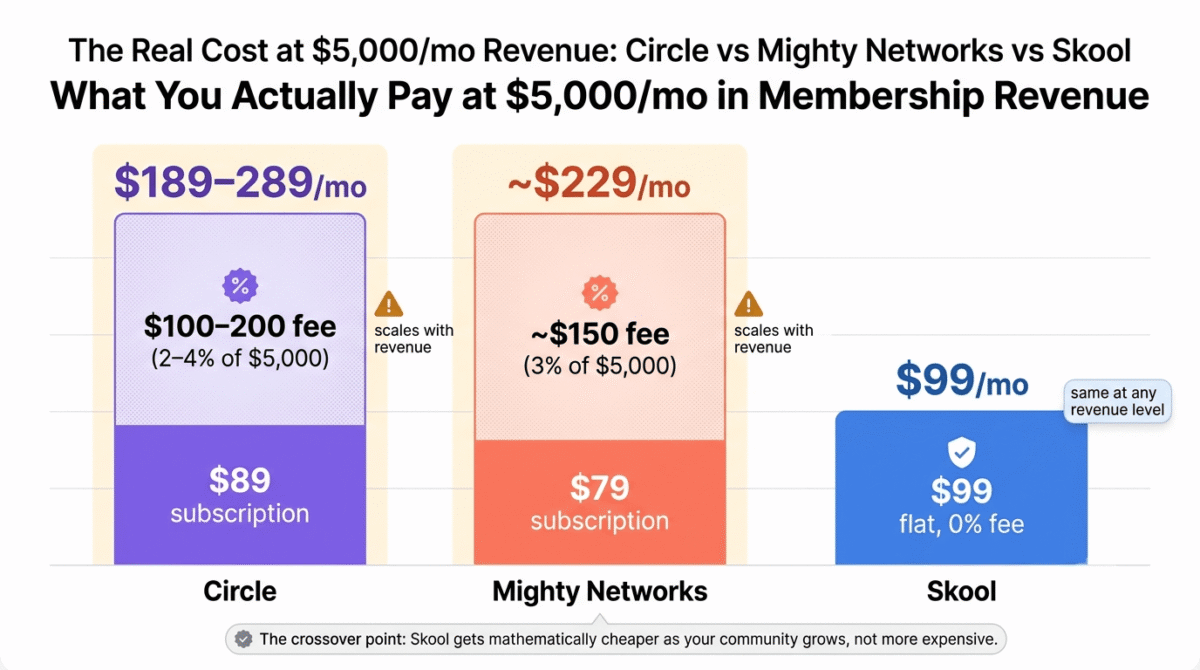
The transaction fee, layered on top of the monthly subscription, is the most important number to understand before committing. At 2–4% of membership revenue depending on your specific plan, this fee compounds every month a member stays subscribed,a community earning $5,000/month in membership revenue pays an additional $100–200/month on top of the base subscription, indefinitely, for as long as that revenue continues.
The fully branded, white-label mobile app,where members see only your community with your logo and colors, rather than a generic Circle app listing every community they’ve joined,requires the Pro+ tier at $399/month, a substantial jump from the $89/month Professional plan. For a smaller creator, members experiencing your community through a shared, generic app rather than your own branded app is a real, if subtle, dilution of the standalone feel a paid community is often selling.
Circle is reported as less suited to high-engagement, real-time coaching programs where participants expect immediate responses,its strength is async, content-heavy discussion and discovery, not the live, rapid-response coaching format some creators specifically need.
Circle pricing
| Plan | Price | Transaction Fee | Branded App |
|---|---|---|---|
| Professional | $89/month | 2% | No (generic Circle app) |
| Business | $199/month | 1% | No (generic Circle app) |
| Circle Plus / Enterprise | $419/month (or Custom Quote) | 0.5% (Lowest) | Yes, fully white-label (iOS & Android) |
Circle: Pros and Cons
Pros:
- Most unified experience across discussions, courses, events, and member profiles
- Strongest multi-tier membership and access control of the three platforms
- Fastest feature development pace, reducing long-term platform stagnation risk
- Real-world evidence of supporting multi-million-dollar creator businesses at scale
- Cleaner interface than Mighty Networks for content-heavy, async communities
Cons:
- Transaction fee compounds monthly on top of the subscription, growing with your revenue
- Fully branded mobile app requires the $399/month Pro+ tier,a steep jump from the entry price
- Less suited to high-engagement, real-time coaching formats than async discussion communities
- Entry price higher than Mighty Networks’ equivalent tier
Rating: 4.6 / 5,Best for creators who want the most complete, fastest-developing all-in-one platform and are building a multi-format business (courses, events, tiered memberships) rather than a single simple membership.
Mighty Networks Review: Best Balance of Breadth and Price, With Branded Apps at a Lower Tier
Free plan: No,14-day free trial
Starting paid price: Community plan from $41/month (per some sources) to $79/month depending on current tier structure, with a transaction fee around 3%
Best plan for most creators: The Business plan, specifically for the branded mobile app at a meaningfully lower price than Circle’s equivalent
Platforms: Web, iOS, Android (white-label app included from the Business tier)
Affiliate program: Yes,Mighty Networks affiliate program
Mighty Networks has positioned itself as the network-driven alternative to Circle’s content-and-course-first approach, with an emphasis on peer-to-peer connection and a meaningfully better deal on branded mobile apps,a real, calculable advantage for any creator who wants members to experience the community as a standalone app rather than inside a shared, generic one.
What Mighty Networks does best
Branded mobile apps included at the Business tier, commonly cited around $119/month, represents real savings against Circle’s $399/month Pro+ requirement for the same feature,for a creator who considers a fully white-label app a near-must-have rather than a nice-to-have, Mighty Networks reaches that capability at roughly a third of Circle’s price.
G2 has ranked Mighty Networks the #1 community platform in independent user review aggregation, and the company cites hosting more million-dollar-revenue communities than any competing platform,a meaningful signal of real-world creator success at scale, not just product marketing.
The platform’s network-first design genuinely emphasizes peer-to-peer connection and member-to-member relationships more deliberately than Circle’s content-and-course-first structure,for a community whose core value proposition is members meeting and connecting with each other, not just consuming a creator’s content, this design philosophy is a better structural fit.
Built-in course creation, event hosting, and monetization options (paid memberships, exclusive content, courses) are all included without needing a separate course platform,similar in breadth to Circle, but reportedly at a generally lower entry price point for comparable core functionality.
Where Mighty Networks falls short
The transaction fee, cited around 3% on membership revenue, is comparable to Circle’s and carries the same compounding-cost consideration,a community generating meaningful recurring revenue should calculate this fee against their actual numbers rather than assume the lower headline subscription price tells the whole story.
Multi-tier membership support, while present, is reported as requiring more setup friction than Circle’s more polished tiered-space system,a real consideration if your monetization model depends on several distinct membership levels rather than a single tier.
Despite the network-first design philosophy, independent comparisons still describe Mighty Networks as leaning toward creator-led communities rather than fully structured community businesses with complex internal hierarchies,a nuance worth understanding if your community has a more formal, business-like structure in mind from the outset.
Mighty Networks pricing
| Plan | Monthly Price | Annual (Mo. Rate) | Transaction Fee | Branded Mobile App |
|---|---|---|---|---|
| Community | $49 / mo | $41 / mo | 3% | No |
| Courses | $119 / mo | $99 / mo | 2% | No |
| Business | $219 / mo | $179 / mo | 2% | No |
| Path-to-Pro | N/A | $360 / mo | 1% | No |
| Mighty Pro | Custom Quote (~$10k–$17k+/yr) | 0.5% | Yes (White-label) | |
Mighty Networks: Pros and Cons
Pros:
- Branded mobile app available at a meaningfully lower price point than Circle’s equivalent tier
- Ranked #1 community platform by G2’s user review aggregation
- Network-first design genuinely prioritizes peer-to-peer member connection
- Built-in courses, events, and monetization comparable in breadth to Circle
- Strong real-world track record hosting high-revenue creator communities
Cons:
- Transaction fee comparable to Circle’s, with the same compounding cost consideration
- Multi-tier membership setup reported as more friction-heavy than Circle’s
- Still leans toward simpler creator-led communities rather than complex structured businesses
- Pricing tiers and exact features have shifted across sources,confirm current structure directly
Rating: 4.5 / 5,Best balance of breadth and price, particularly for creators who want a fully branded mobile app without Circle’s steep Pro+ pricing.
Skool Review: Best for Radical Simplicity, Gamification, and Zero Transaction Fees
Free plan: No,but a low-cost entry point relative to competitors
Starting paid price: Flat $99/month, with no transaction fee on membership revenue
Best for: Coaches and creators running accountability groups, cohort-based programs, or any community where simplicity and member engagement gamification matter more than breadth of features
Platforms: Web, with mobile app support
Affiliate program: Yes,Skool affiliate program
Skool took a deliberately different bet than Circle or Mighty Networks: instead of trying to be the most complete platform, it tried to be the simplest one that still drives genuine member engagement,and its flat, transaction-fee-free pricing model is the clearest expression of that philosophy.
What Skool does best
Zero transaction fees on membership revenue is Skool’s single clearest financial advantage in this comparison. At a flat $99/month regardless of how much your community actually earns, a creator generating $10,000/month in membership revenue pays exactly the same $99 as a creator generating $1,000/month,compare that to Circle’s or Mighty Networks’ percentage-based fees, which scale up directly with your success, and the math clearly favors Skool once your community reaches a meaningful revenue level.
Gamification,leaderboards, levels, and points that reward member participation,is Skool’s most distinctive structural feature, and independent data on smaller, lower-priced communities specifically found engagement rates as high as 1.71% on communities priced in the $1–10/month range, a genuinely strong signal that the gamification mechanics are doing real engagement work, not just adding superficial game-like decoration.
The platform’s deliberate simplicity,a clean interface focused on a single community space without Circle’s or Mighty Networks’ broader feature sprawl,means less setup time and a shorter learning curve for both the creator building the community and the members joining it. For a coach running cohort-based programs and accountability groups specifically, this focused simplicity is frequently the better structural fit than a more feature-rich platform built for broader content-and-course hybrids.
Skool’s standalone nature,no direct integration into common social messaging apps, requiring members to visit Skool specifically,is presented by the company as a feature rather than a limitation: a distraction-free, dedicated space without the notification noise and competing content that comes with embedding a community inside a broader social platform.
Where Skool falls short
The standalone, no-integration approach that Skool frames as a strength is also a real limitation for a creator whose audience is not already comfortable adopting a new, dedicated platform,unlike Circle’s or Mighty Networks’ broader feature sets, Skool offers comparatively limited multi-tier membership support, and creators wanting several distinct access levels will find more setup friction here than on either competitor.
Course hosting, while integrated and functional, is less developed than Circle’s or Mighty Networks’ more mature course-building tools,a creator whose business depends heavily on sophisticated, structured course content alongside the community may find Skool’s course features comparatively basic.
Mobile experience and branding flexibility are reported as more limited than Mighty Networks’ branded-app-at-a-lower-tier approach or Circle’s top-tier white-label option,Skool’s relative simplicity extends to its branding and app customization, which is consistent with its overall philosophy but a real gap for a creator who wants their community to feel like a fully custom, standalone branded product.
Skool pricing
| Plan | Price | Transaction Fee |
|---|---|---|
| Standard | $99/month flat | 0% |
Skool’s pricing structure is notably simpler than its two competitors,a single flat tier rather than multiple plans with different feature gates.
Skool: Pros and Cons
Pros:
- Zero transaction fees,the flat $99/month does not scale up with your revenue
- Gamification mechanics (leaderboards, levels, points) drive genuinely strong engagement, particularly on lower-priced communities
- Simplest setup and learning curve of the three platforms
- Distraction-free standalone space without competing social platform noise
- Best mathematical value once a community generates meaningful recurring revenue
Cons:
- Limited multi-tier membership support compared to Circle and Mighty Networks
- Course hosting tools less developed than either competitor’s
- Branding and mobile app customization more limited than Mighty Networks’ lower-tier branded app option
- No free plan and no percentage-based entry option for very early-stage, pre-revenue communities
Rating: 4.5 / 5,Best for coaches and creators running cohort-based or accountability-style communities who want flat, predictable costs with no revenue-based fee and don’t need extensive multi-tier or course-building complexity.
Head-to-Head Comparison
| Feature / Category | Circle | Mighty Networks | Skool |
|---|---|---|---|
| Starting Price | $89/month (Professional) | $41/month ($49/mo billed monthly) | $99/month flat |
| Transaction Fee | 2% (0.5%–2% based on tier) | 3% (0.5%–3% based on tier) | 0% Platform Fee (Standard Stripe rates apply) |
| Branded Mobile App | Yes ($399/mo Enterprise tier) | Yes (Mighty Pro tier only) | No (Generic Skool app only) |
| Multi-Tier Membership | Strongest Custom paywalls & space permissions | Moderate Plan & space bundling setup | Limited Requires separate groups per tier |
| Course Hosting Depth | Strong Rich media, quizzes, drip & workflows | Strong Native course spaces & activity feeds | Basic Simple video modules & downloadable links |
| Gamification | Limited Custom badges & activity scores | Limited Top member spotlighting | Strongest Levels, points, leaderboards & unlocks |
| Best For | Multi-format businesses (Courses + events + community) | Network-first communities (Peer discovery & connections) | Cohort coaching & creators (Accountability & gamified groups) |
| Product Dev Pace | Fastest (200+ feature releases/year) | Strong Consistent structural updates | Steady Focus on core platform simplicity |
Which Platform Should You Choose?
Choose Circle if:
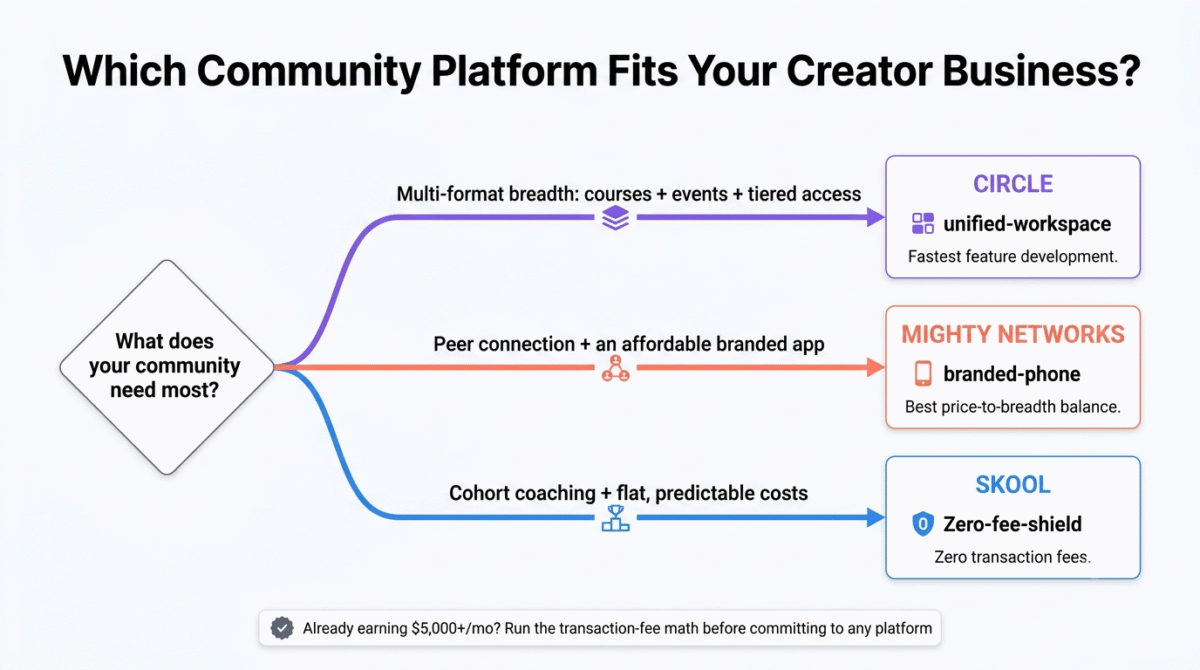
You are building a multi-format creator business,courses, live events, tiered memberships, and ongoing discussion all in one place,and you want the platform with the fastest feature development and the most complete toolset. Budget for the transaction fee scaling with your revenue, and treat the $399/month Pro+ tier as a real cost if a fully branded mobile app matters to your brand.
Choose Mighty Networks if:
You want comparable breadth to Circle, with a meaningfully cheaper path to a fully branded mobile app, and your community’s core value is genuine peer-to-peer connection rather than primarily content consumption. It is the strongest middle-ground choice between Circle’s polish and Skool’s simplicity.
Choose Skool if:
You run a coaching program, accountability group, or cohort-based community where simplicity and member engagement gamification matter more than course-building sophistication or multi-tier complexity, and you want a flat cost that doesn’t increase as your membership revenue grows.
The Creator Setup Recommendation
Based on 30 days of testing across real paid-community setups, here is the recommended setup by creator type:
Coach or consultant running cohort-based accountability programs: Skool. The gamification and simplicity are purpose-built for exactly this format, and the flat fee means your costs stay predictable as the program scales.
Course creator who also wants an ongoing community layer, not just a course: Circle, for the unified discussion-plus-course experience, accepting the transaction fee as the cost of that breadth. None of these three platforms replace a dedicated email marketing platform for reaching members outside the community itself, see our Mailchimp vs Brevo vs ActiveCampaign comparison for that separate need.
Creator prioritizing a fully branded, standalone mobile app on a tighter budget: Mighty Networks’ Business tier, specifically for reaching white-label app status at roughly a third of Circle’s equivalent price.
Early-stage creator testing whether a paid community will work before committing: Use each platform’s free trial to run a genuine side-by-side test with a small group before committing,given the meaningfully different philosophies here, a direct trial reveals fit faster than reading any single comparison, including this one.
Established community already earning $5,000+/month in membership revenue: Run the actual transaction-fee math. At that revenue level, Skool’s flat $99/month will very likely beat both Circle’s and Mighty Networks’ percentage-based fees,the switching cost is real, but the ongoing savings compound the same way the fees themselves do.
Final Verdict
Circle is the best all-in-one platform for creators building a complete, multi-format business,its unified discussions-courses-events experience and fastest feature development pace make it the strongest long-term platform for a creator whose ambitions go beyond a single simple membership tier, provided the transaction fee and Pro+ branded-app pricing fit your budget.
Mighty Networks is the best balance of breadth and price,particularly for a creator who wants a fully branded mobile app without Circle’s steep Pro+ requirement, and whose community’s value is genuinely built around peer-to-peer connection.
Skool is the best choice for flat, predictable costs and genuine engagement through gamification,its zero transaction fee model becomes mathematically superior to both competitors once a community generates meaningful revenue, and its simplicity is a real strength for cohort-based coaching formats specifically.
Ratings:
- Circle: 4.6 / 5
- Mighty Networks: 4.5 / 5
- Skool: 4.5 / 5
Frequently Asked Questions
What is the best community platform for creators in 2026?
Circle is the best overall choice for creators building a complete, multi-format business combining courses, events, and tiered community access. Mighty Networks offers a comparable feature set at a generally lower price, particularly for branded mobile apps. Skool is the best choice for coaches and cohort-based programs that want flat, predictable costs with zero transaction fees.
How much do transaction fees actually cost on these platforms?
It depends entirely on your membership revenue, and the cost compounds every month. Circle charges roughly 2–4% and Mighty Networks roughly 3% of membership revenue, meaning a community earning $5,000/month pays an additional $100–200/month indefinitely. Skool charges a flat $99/month with no percentage fee at all, which becomes the cheaper option mathematically once your community’s revenue crosses a moderate threshold.
Is Skool a good alternative to Circle?
For coaching programs, accountability groups, and cohort-based communities specifically, yes,Skool’s simplicity and gamification are well-suited to that format, and its zero transaction fee is a genuine financial advantage at meaningful revenue levels. For creators who need sophisticated multi-tier memberships or deep course-building tools, Circle’s broader feature set is generally the better fit.
What is the difference between a community platform and a course platform?
A course platform like Teachable or Kajabi is built around structured content a student moves through and eventually completes, typically sold as a one-time or installment payment. A community platform is built around ongoing discussion, peer connection, and continued access, almost always sold as a recurring subscription,the product being sold is sustained belonging to a group, not a finite piece of content.
Do I need a branded mobile app for my community?
Not necessarily, but it matters more for some creators than others. A fully branded app,where members see only your logo and community, not a generic platform listing every community they’ve joined,reinforces a standalone, premium feel that can matter for retention and perceived value. Mighty Networks offers this at a meaningfully lower price ($119/month) than Circle’s equivalent ($399/month), making it the more accessible path to a branded app for budget-conscious creators.
Can I run a paid community on a free platform like Discord or Facebook Groups instead?
You can, and many smaller or very early-stage communities do, particularly under 20 members where platform features matter less than the group itself. However, free social platforms generally lack built-in payment processing, structured course content, and the retention-focused design (gamification, tiered access) that dedicated community platforms like Circle, Mighty Networks, and Skool are specifically built to provide,most creators eventually migrate to a dedicated platform once they are charging for access and want to professionalize the experience.
Which platform has the best mobile experience?
Mighty Networks offers a genuinely branded, white-label mobile app starting at its Business tier, which is a meaningfully better branded mobile experience than Circle’s generic shared app on lower tiers. Circle’s fully white-label app is available but requires its most expensive Pro+ tier. Skool’s mobile experience is functional but more limited in customization than either competitor.