If you are comparing Zoho Inventory vs inFlow vs Cin7, you have probably outgrown a spreadsheet. Stock counts drift, a best-seller sells out while the website still shows it in stock, and purchase orders live in someone’s inbox. Inventory management software tracks stock across locations, syncs with your sales channels, and tells you when to reorder. To evaluate how inventory tracking fits into your operational ecosystem, read our complete small business software stack guide.
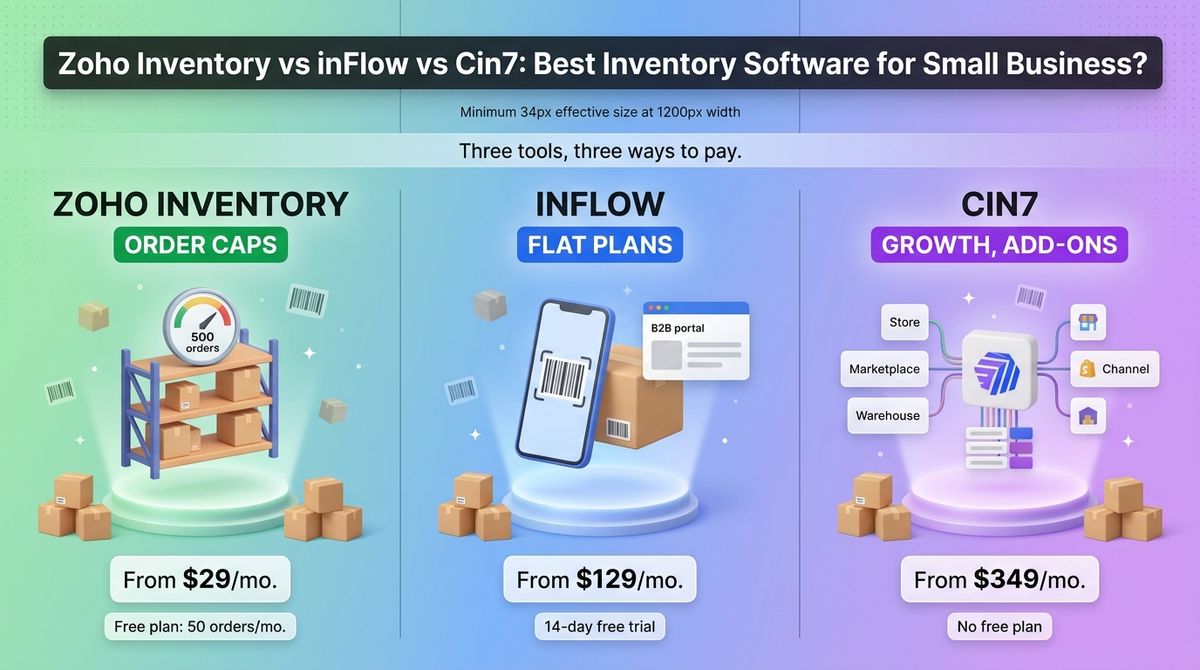
The three tools charge in very different ways. Zoho Inventory sells plans by monthly order volume starting at $29, inFlow sells flat plans with user and order caps starting at $129, and Cin7 starts at $349 plus add-ons and onboarding. A 10-user business can pay about $1,400 a year on one and more than $7,000 on the others.
I reviewed Zoho Inventory vs inFlow vs Cin7 over 30 days, using each vendor’s free trial or demo, loading the same 300 products, connecting a Shopify store, and running purchase orders, sales orders, and barcode counts on each. Here is the honest comparison, including one pricing catch: older reviews quote Zoho and inFlow plans and prices that no longer exist.
Table of Contents
How We Tested
Every tool was scored on the same five criteria.
- Stock tracking and ordering. Purchase orders, sales orders, reorder points, and multiple locations.
- Sales channel integrations. Shopify, marketplaces, accounting, and shipping connections.
- Barcode and mobile workflows. Scanning, counting, and receiving from a phone or handheld device.
- Pricing and limits. Order caps, user limits, add-ons, and onboarding costs.
- Cost for a small team. Yearly cost for 5 users and 500 orders a month, and for 10 users and 1,000 orders a month.
Zoho Inventory Review: Cheapest by Far, With Order-Based Limits
- Free plan: Yes, 50 orders per month and 1 user
- Starting price: Standard at $29 per month billed annually ($39 monthly)
- Best plan for most users: Standard for up to 500 orders a month, Premium once you need serial or batch tracking
- Platforms: Web, iOS app, Android app
- Affiliate program: Reported through Zoho’s affiliate program, rate unconfirmed
Zoho Inventory is Zoho’s inventory and order management app. It tracks stock across locations, manages sales and purchase orders, handles composite items, dropshipping, and backorders, and connects to stores and marketplaces such as Shopify and Amazon. It prices by organization, not by seat, and caps monthly orders by plan.
What Zoho Inventory does best
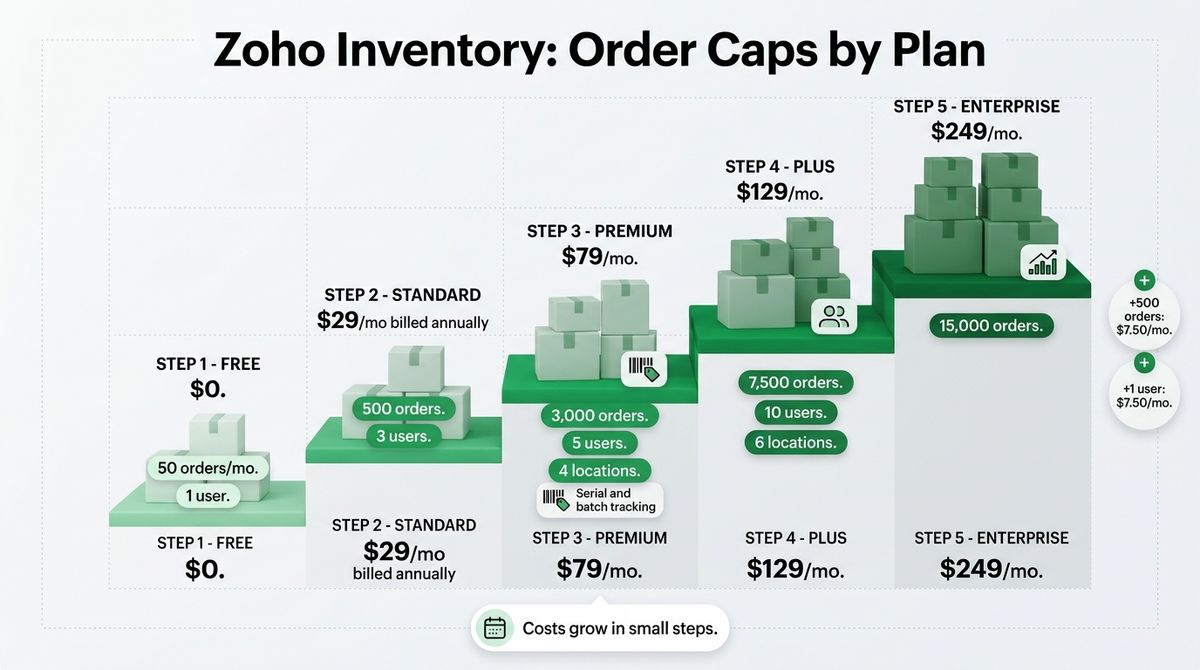
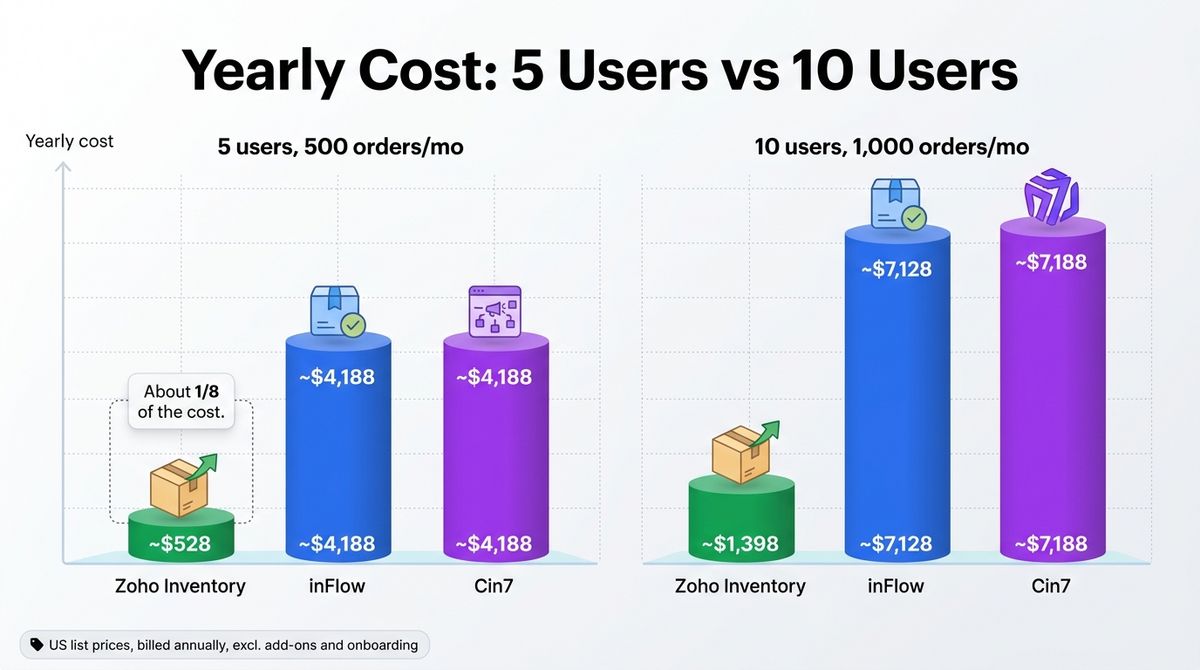
Price is the headline. Standard at $29 per month includes 3 users, 2 locations, and 500 orders, and a free plan covers 50 orders a month for one user. For a team of five on 500 orders a month, the yearly cost is about $528, against about $4,188 on inFlow or Cin7.
Premium at $79 is where Zoho becomes a fuller operations tool. It adds serial and batch tracking, barcode generation, stock counting, a vendor portal, and automation, with 3,000 orders and 4 locations. It also fits the wider Zoho suite, so Zoho Books and Zoho CRM connect without a third-party tool.
Where Zoho Inventory falls short
Order caps are the main limit. Standard stops at 500 orders a month and Premium at 3,000, and extra orders are sold in 500-order add-ons at $7.50 per month when billed annually. Users beyond the included count also cost $7.50 each, so costs grow in small steps.
Plan names and prices have shifted. Older reviews list Standard, Professional, Premium, and Enterprise at $39, $99, $159, and $299, but those are monthly-billing prices, and the current names are Standard, Premium, Plus, and Enterprise at $29, $79, $129, and $249 billed annually. Serial and batch tracking now start at Premium, and reviewers say connecting accounting software outside Zoho Books takes more work. Businesses comparing financial tools can also review our comparison of top small business accounting software options.
Zoho Inventory pricing
| Plan | Price | What you get |
|---|---|---|
| Free | $0 | 50 orders per month, 1 user |
| Standard | $29 per month billed annually ($39 monthly) | 500 orders, 3 users, 2 locations, composite items, dropshipping, backorders, customer portal |
| Premium | $79 per month billed annually ($99 monthly) | 3,000 orders, 5 users, 4 locations, serial and batch tracking, barcode generation, vendor portal, automation |
| Plus | $129 per month billed annually ($159 monthly) | 7,500 orders, 10 users, 6 locations |
| Enterprise | $249 per month billed annually ($299 monthly) | 15,000 orders, Zoho Analytics |
Zoho Inventory: Pros and Cons
Pros:
- Lowest price of the three, with a permanent free plan
- Pricing by organization, not by seat
- Serial and batch tracking from $79
- Composite items, dropshipping, and backorders on Standard
- Fits the Zoho suite, with iOS and Android apps
Cons:
- Hard order caps on every plan
- Extra orders and users are sold as $7.50 add-ons
- Plan names and prices have changed
- Accounting integrations outside Zoho Books take work
- Premium needed for serial tracking
Rating: 4.6 / 5, the best value for most small businesses.
inFlow Review: Easy to Learn, Pricier Than It Looks
- Free plan: No, 14-day free trial with all features
- Starting price: Entrepreneur at $129 per month billed annually ($161 monthly)
- Best plan for most users: Small Business at $349 per month once you pass 100 orders a month
- Platforms: Web, Windows, iOS app, Android app
- Affiliate program: Yes, 20% recurring through the inFlow Partner Program
inFlow is a cloud inventory system aimed at small product businesses. It handles purchase orders, sales orders, barcode scanning, reorder points, and a B2B customer portal, with apps for Windows, iOS, and Android. It sells flat plans by team size and sales-order allowance.
What inFlow does best
inFlow is easy to learn and works well for wholesale and B2B. The interface is simple, setup is quick, and the mobile app lets you scan barcodes to receive, pick, and count stock without extra hardware. A B2B customer portal lets wholesale buyers place orders themselves. Wholesale suppliers looking to re-engage past customers can also explore the best email marketing tools for small business growth.
Mid-Size at $699 per month includes unlimited sales orders, and a Windows desktop app gives long-time users keyboard shortcuts, bulk pricing tools, and customizable reports. The free 14-day trial includes all features, so you can test the full system before paying.
Where inFlow falls short
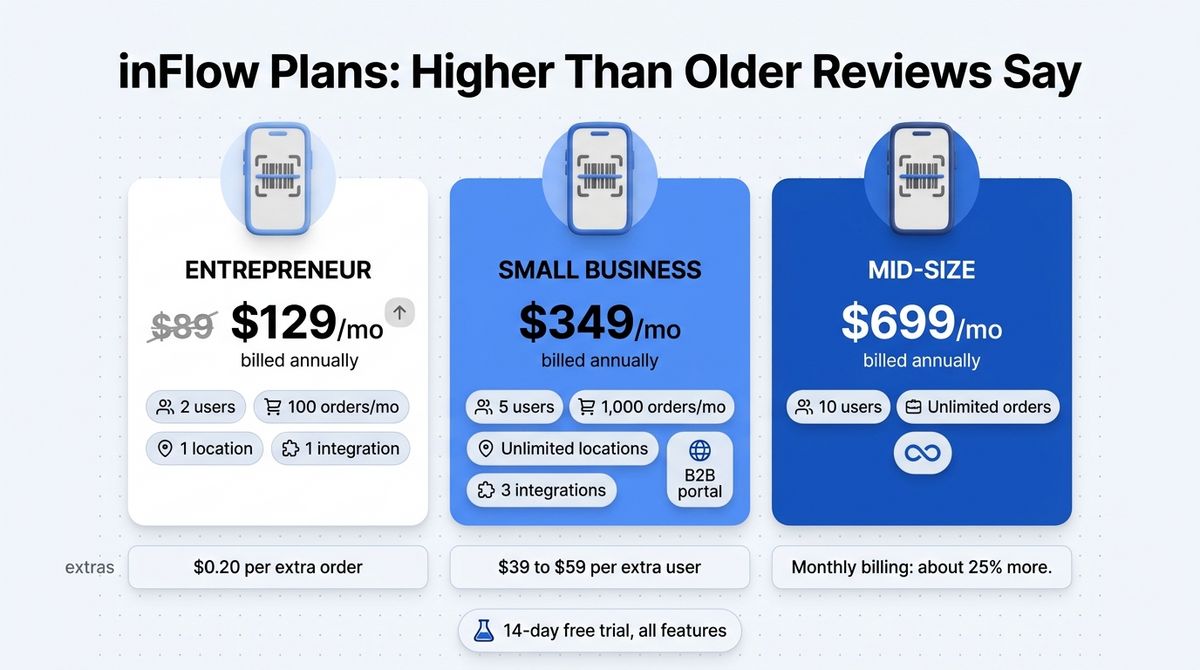
Prices are higher than older reviews suggest. Entrepreneur costs $129 per month billed annually, up from the $89 many reviews still list, and it includes only 2 users, 1 location, and 100 sales orders a month. Extra orders cost $0.20 each, and extra users cost $59, $49, or $39 per month depending on the plan.
Caps and add-ons add up. Small Business at $349 covers 1,000 orders and 5 users, and a 10-user team on 1,000 orders a month costs about $7,128 a year once extra seats are added. Manufacturing and API access are separate add-ons, and monthly billing costs about 25% more than annual.
inFlow pricing
| Plan | Price | What you get |
|---|---|---|
| Free trial | $0 for 14 days | All features unlocked |
| Entrepreneur | $129 per month billed annually ($161 monthly) | 2 users, 100 sales orders per month, 1 location, 1 integration |
| Small Business | $349 per month billed annually ($436 monthly) | 5 users, 1,000 sales orders per month, unlimited locations, 3 integrations |
| Mid-Size | $699 per month billed annually ($874 monthly) | 10 users, unlimited sales orders |
| Extras | $39 to $59 per extra user per month, $0.20 per extra order | Manufacturing and API access cost extra |
inFlow: Pros and Cons
Pros:
- Easy to learn, with quick setup
- B2B customer portal for wholesale buyers
- Mobile barcode scanning on iOS and Android
- Windows desktop app
- Unlimited sales orders on Mid-Size
Cons:
- Entrepreneur is capped at 2 users and 100 orders a month
- Prices have risen from the older $89 entry plan
- Extra users and orders cost more
- Manufacturing and API are paid add-ons
- Monthly billing costs about 25% more
Rating: 4.3 / 5, easy to use, but pricey for small teams.
Cin7 Core Review: Built for Growth, Priced Like It
- Free plan: No free plan, and no free trial listed
- Starting price: Standard at $349 per month
- Best plan for most users: Pro at $599 per month for manufacturing and multichannel
- Platforms: Web, Cin7 Core WMS app for iOS and Android
- Affiliate program: Customer referral program paying $1,000 per referred company; no affiliate program confirmed
Cin7 Core, formerly DEAR Inventory, is a cloud inventory and light warehouse system for growing product businesses. It combines purchasing, sales orders, manufacturing, and multichannel selling, and it sits beside Cin7 Omni, a quote-priced product for larger multichannel operations.
What Cin7 does best
Cin7 handles complexity the other two do not. Pro adds material requirements planning for manufacturing, Advanced adds advanced warehouse management, and every plan includes unlimited inventory locations. Cin7’s own referral page cites 700+ ecosystem apps, so multichannel brands and manufacturers get the widest connection list here.
Order limits are generous at higher tiers. Standard covers 6,000 sales orders a year, Pro 24,000, and Advanced 120,000, and the Cin7 Core WMS app for iOS and Android supports scanning, picking, and receiving. One implementation partner notes that paying annually earns one month free.
Where Cin7 falls short
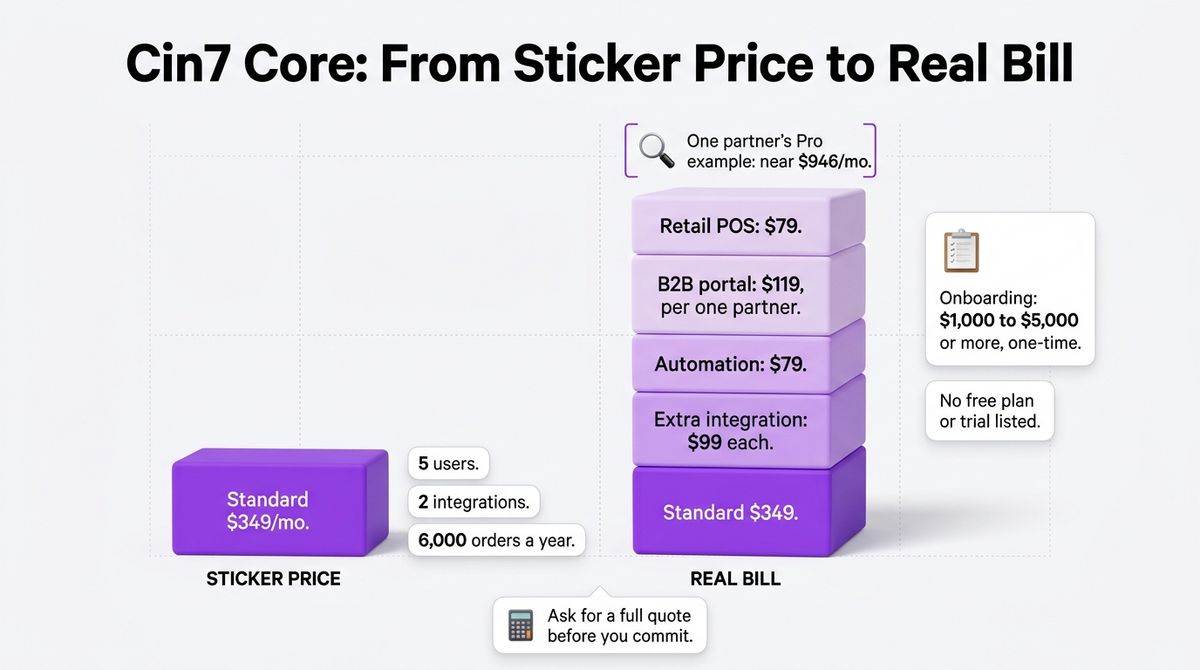
Cost is the barrier. Standard is $349 per month for 5 users and 2 integrations; extra integrations cost $99 per month each, and extra users cost $99 per group of three. Add-ons such as automation at $79, a B2B portal at $119, and retail POS at $79 raise the bill, and one partner’s example puts a Pro setup with several add-ons near $946 per month.
Onboarding is a second cost. Third-party estimates put implementation at $1,000 to $5,000 or more, and Cin7 lists no free trial. Advanced is listed at $1,199 on recent pages, although some sources still show $999, and some Shopify merchants say subscriptions rise over time.
Cin7 pricing
| Plan | Price | What you get |
|---|---|---|
| Standard | $349 per month | 5 users, 2 integrations, 6,000 sales orders per year, unlimited locations |
| Pro | $599 per month | 10 users, 4 integrations, 24,000 orders per year, material requirements planning |
| Advanced | $1,199 per month on recent pages ($999 on older ones) | 15 users, 6 integrations, 120,000 orders per year, advanced warehouse management |
| Omni | Custom quote | 8 users, 5 integrations, flexible order volume |
| Add-ons | $79 to $149 per month for automation, POS, and manufacturing; $99 per extra integration | One implementation partner also lists a B2B portal at $119 per month |
Cin7: Pros and Cons
Pros:
- Handles manufacturing, multichannel, and warehouse needs
- Unlimited inventory locations on every plan
- 700+ ecosystem apps
- 6,000 to 120,000 orders per year by plan
- WMS mobile app for iOS and Android
Cons:
- Starts at $349 per month
- Add-ons, integrations, and extra users raise the cost
- Onboarding reported at $1,000 to $5,000 or more
- No free plan or trial listed
- Advanced price differs between sources
Rating: 4.1 / 5, powerful for growing multichannel businesses, expensive for small ones.
Zoho Inventory vs inFlow vs Cin7: Head-to-Head Comparison
| Feature | Zoho Inventory | inFlow | Cin7 Core |
|---|---|---|---|
| Free plan | 50 orders per month, 1 user | No, 14-day free trial | None listed |
| Entry price, billed annually | $29 per month | $129 per month | $349 per month |
| Month-to-month price | $39 per month | $161 per month | $349 per month (annual billing earns one month free) |
| Pricing model | By organization, with order caps | Flat plans with user and order caps | Flat plans with user and order caps |
| Orders at entry plan | 500 per month | 100 per month | 6,000 per year (about 500 per month) |
| Users at entry plan | 3 | 2 | 5 |
| Locations at entry plan | 2 | 1 | Unlimited |
| Yearly cost, 5 users and 500 orders a month | About $528 | About $4,188 | About $4,188 |
| Yearly cost, 10 users and 1,000 orders a month | About $1,398 | About $7,128 | About $7,188 |
| Manufacturing | Composite items | BOM and work orders as an add-on | Material requirements planning on Pro |
| Apps | Web, iOS, Android | Web, Windows, iOS, Android | Web, Cin7 Core WMS for iOS and Android |
| Affiliate program | Reported, rate unconfirmed | Yes, 20% recurring | Customer referral, $1,000 per company |
| Best for | Most small businesses | B2B and wholesale teams that want simplicity | Growing multichannel and manufacturing businesses |
| Rating | 4.6 / 5 | 4.3 / 5 | 4.1 / 5 |
Yearly costs use US list prices billed annually, add extra users at each vendor’s listed rate, and exclude taxes, add-ons, integrations, and Cin7 onboarding. Zoho’s Standard plan covers exactly 500 orders a month, so growth means a plan change or order add-ons.
Which Should You Choose?
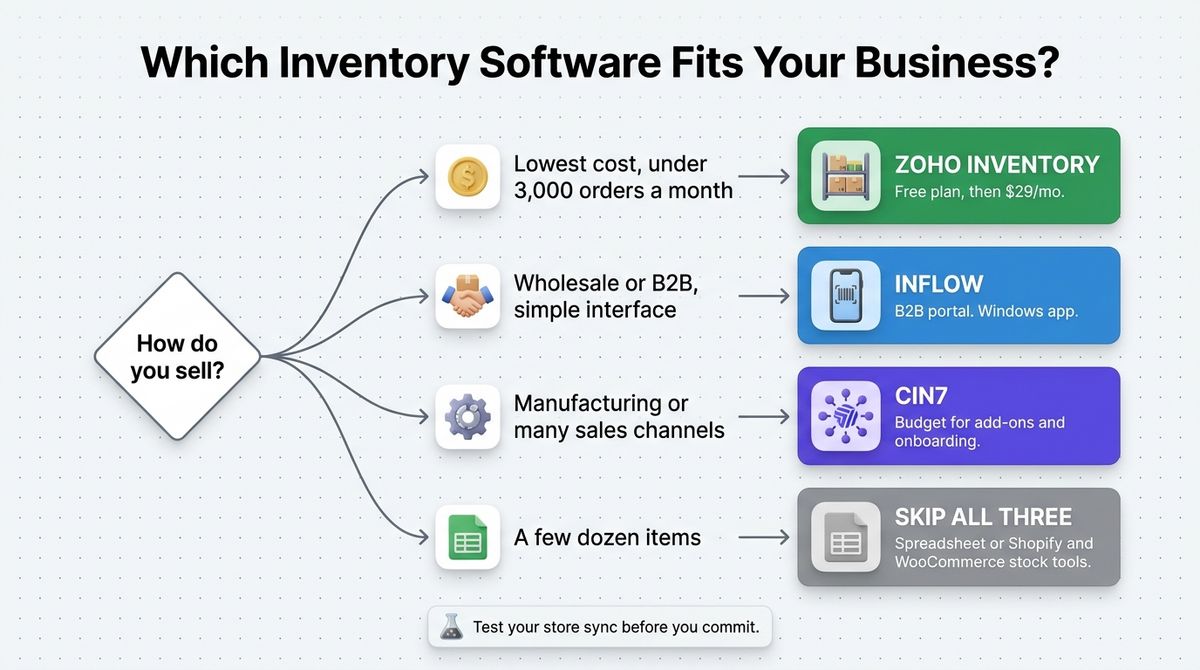
- Choose Zoho Inventory if you want the lowest cost, run under 3,000 orders a month, and may already use Zoho Books or Zoho CRM.
- Choose inFlow if you sell wholesale or B2B, want a simple interface and a Windows app, and your volume fits the order caps.
- Choose Cin7 if you manufacture or sell across many channels, have outgrown simpler tools, and can budget for add-ons and onboarding.
- Skip all three if you sell a few dozen items. A spreadsheet with a reorder column, or the stock tracking built into Shopify or WooCommerce, costs nothing and is enough for small catalogs.
One developer note applies to every tool here. As a WordPress developer, I would check how the inventory tool syncs with WooCommerce before you commit. Look for a maintained integration or a documented API, test stock updates on a staging site, and keep one system as the source of truth so you never oversell.
Our Recommendations
- Solo seller or side business under 50 orders a month: Zoho Inventory Free.
- Small team of 3 to 5 with up to 500 orders a month: Zoho Inventory Standard at $29, plus $7.50 per extra user.
- Wholesaler or distributor with B2B buyers: inFlow Small Business at $349, which includes the customer portal.
- Manufacturer or multichannel brand growing past 2,000 orders a month: Cin7 Pro at $599.
- WooCommerce or Shopify store owner: Zoho Inventory Standard first, with the sync tested during the trial.
Final Verdict
In the Zoho Inventory vs inFlow vs Cin7 comparison, Zoho Inventory is the best pick for most small businesses. It costs a fraction of the others, has a free plan, and adds serial tracking from $79. InFlow is a good fit for wholesale teams that want simplicity, and Cin7 suits growing multichannel and manufacturing businesses with the budget for it.
- Zoho Inventory: 4.6 / 5
- inFlow: 4.3 / 5
- Cin7 Core: 4.1 / 5
Check each vendor’s live pricing page before you buy. All prices above were checked in October 2026.
Frequently Asked Questions
Which is better, Zoho Inventory, inFlow, or Cin7?
Zoho Inventory suits most small businesses because it costs $29 per month and has a free plan. inFlow suits wholesale and B2B teams that want a simple interface and a Windows app. Cin7 suits growing manufacturers and multichannel brands that can afford $349 or more per month plus add-ons and onboarding.
How much does Zoho Inventory cost?
Zoho Inventory has a free plan with 50 orders a month. Paid plans billed annually are Standard at $29, Premium at $79, Plus at $129, and Enterprise at $249 per organization per month. Monthly billing costs $39, $99, $159, and $299. Older reviews that name a Professional plan are using outdated plan names.
How much does inFlow cost?
inFlow Entrepreneur costs $129 per month billed annually or $161 monthly, with 2 users and 100 sales orders a month. Small Business costs $349 annually or $436 monthly with 5 users and 1,000 orders. Mid-Size costs $699 annually or $874 monthly with 10 users and unlimited orders. A 14-day free trial is available.
How much does Cin7 cost?
Cin7 Core Standard costs $349 per month for 5 users and 6,000 sales orders a year. Pro costs $599 for 10 users and 24,000 orders, and Advanced costs $1,199 for 15 users and 120,000 orders, though some sources still list $999. Omni is quote-based. Add-ons, extra users, and onboarding cost more.
Is there a free inventory management software?
Zoho Inventory has the only permanent free plan of the three, covering 50 orders a month and 1 user. inFlow offers a 14-day free trial, and Cin7 lists no free plan or trial. For very small catalogs, a spreadsheet or the inventory tools built into Shopify or WooCommerce can be enough.
Which tool connects to Shopify and WooCommerce?
All three list Shopify integrations, and Zoho Inventory and Cin7 also support WooCommerce and major marketplaces. Integration limits matter: inFlow includes 1 integration on Entrepreneur and 3 on Small Business, while Cin7 includes 2, 4, or 6 by plan and charges $99 per month for each extra one. Test your store on a trial or demo first.
Do these tools support barcode scanning?
Yes. inFlow scans barcodes with a phone camera in its iOS and Android apps, and its Stockroom add-on supports scan-in and scan-out workflows. Cin7 Core WMS is a separate mobile app for picking and receiving with a phone camera or handheld scanner. Zoho Inventory generates barcodes from Premium and includes mobile apps with scanning.
What is the cheapest way to start with inventory software?
Start on Zoho Inventory’s free plan if you handle under 50 orders a month, then move to Standard at $29. For a team of five at 500 orders a month, Zoho costs about $528 a year, compared with about $4,188 for inFlow Small Business or Cin7 Standard. Move up only when order caps or missing features hurt.