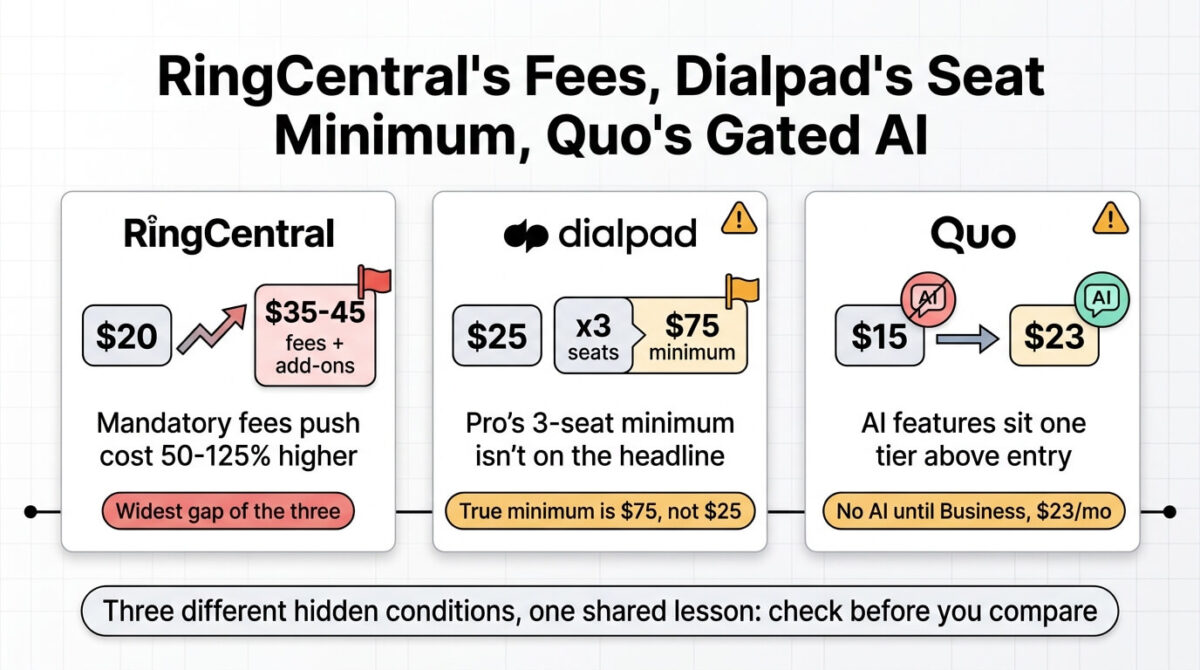
A business phone system’s advertised per-seat price rarely survives contact with the checkout page. RingCentral vs Dialpad vs Quo all list a clean starting number, and all three attach a condition to that number that changes the total monthly bill for a meaningful share of buyers.
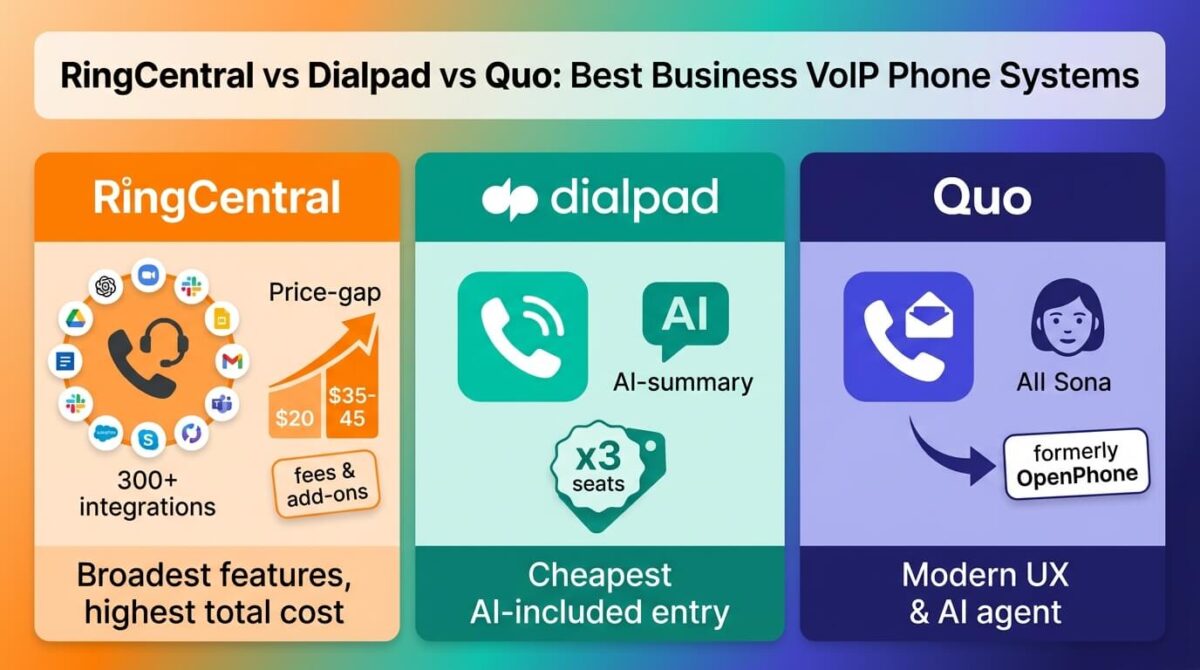
One quick note before comparing: Quo is the current name for OpenPhone, which rebranded in late 2025 alongside new funding and an AI voice agent called Sona. Same product, same login, new name; useful to know since plenty of pricing pages and reviews still reference the old one.
I tested RingCentral vs Dialpad vs Quo for 30 days, setting up a business number on each and pricing out what a solo operator and a small team would pay in practice once the fine print was factored in. Here is the honest comparison, including a seat minimum on one platform that triples the total cost of its mid-tier plan.
Table of Contents
How We Tested
Five criteria shaped the testing:
- Advertised versus total cost: what the plan page lists versus what a checkout charges in practice
- Seat minimums and scaling, whether a solo user can access every tier, or gets forced into buying seats they don’t need
- AI feature placement, which tier includes call summaries and transcription
- Setup and call quality, how quickly a working business number was ready, and how calls sounded
- Fee transparency, regulatory charges, add-ons, and overages not listed on the main pricing page
RingCentral Review: The Broadest Feature Set, With the Widest Gap to Total Cost
Free plan: No, 14-day trial covering up to 20 phone lines
Starting price: $20/user/month (Core, billed annually)
Best plan for most users: Advanced, $25/user/month, CRM integrations and call recording
Platforms: Web, iOS, Android, desktop apps
Affiliate program: Yes, RingCentral affiliate program
RingCentral packages voice, SMS, video, and team chat into one platform, with the broadest enterprise feature set of the three systems tested.
What RingCentral does best
RingCentral’s integration depth is its clearest strength: 300-plus CRM and productivity integrations, advanced call monitoring with whisper and barge features, and a full webinar product all sit inside the same ecosystem. For a growing team that wants video conferencing, dedicated webinar software, team chat, and phone service under one vendor rather than three, that consolidation has value.
Ultra’s unlimited storage and 200-person video capacity also give RingCentral more headroom for a larger organization than either Dialpad or Quo currently offers at a comparable tier.
Where RingCentral falls short
Mandatory regulatory fees and common add-ons push the total monthly cost 50% to 125% higher than the advertised per-seat rate, according to independent cost breakdowns of the platform. Core’s entry tier is also tightly capped: 25 SMS messages and 100 toll-free minutes per user monthly, limits a moderately active small business clears within the first few weeks.
The gap between monthly and annual billing is steep too, $30 versus $20 on Core alone, making the annual commitment close to mandatory for the advertised price to apply at all.
RingCentral pricing
| Plan | Price | SMS/Toll-Free Limits | Notable Feature |
|---|---|---|---|
| Core | $20/user/month (annual) | 25 SMS, 100 toll-free min | Unlimited US/Canada calling |
| Advanced | $25/user/month (annual) | 100 SMS, 1,000 toll-free min | CRM integrations, call recording |
| Ultra | $35/user/month (annual) | 200 SMS, 10,000 toll-free min | Webinar, unlimited storage |
| Customer Engagement Bundle | Custom | Custom | Contact center features |
RingCentral: Pros and Cons
Pros:
- Broadest third-party integration ecosystem of the three
- Webinar and video capacity suited to larger teams
- Advanced call monitoring features (whisper, barge)
- Most complete all-in-one unified communications package
Cons:
- Mandatory fees and add-ons push total cost well above the advertised rate
- Core tier’s SMS and toll-free limits are restrictive for active small businesses
- Steepest monthly-to-annual pricing gap of the three
- Most complex pricing structure to fully understand upfront
Rating: 4.0 / 5, the most complete feature set of the three, with the largest gap between advertised and total monthly cost.
Dialpad Review: The Cheapest True Entry Point, With a Hidden Seat Minimum on Pro
Free plan: No, 14-day free trial
Starting price: $15/user/month (Standard, billed annually), no seat minimum
Best plan for most users: Standard, since Pro requires a 3-seat minimum regardless of team size
Platforms: Web, iOS, Android, desktop apps
Affiliate program: Yes, Dialpad affiliate program
Dialpad Connect, its business phone product, includes AI call summaries on every plan, including the cheapest tier, a feature both competitors gate behind a higher plan.
What Dialpad does best
AI call transcription and summaries come included on Standard at $15/user/month, no upgrade required, a meaningful advantage over Quo, which reserves that feature for its $23/user Business tier. For a solo operator or very small team pairing phone automation with AI calendar and scheduling assistants, Dialpad’s entry price with AI included beats both competitors on pure value.
Standard also has no seat minimum, letting a single-person business access the full plan without being forced into buying capacity it doesn’t need.
Where Dialpad falls short
Pro, the $25/user/month tier, carries a 3-seat minimum that isn’t obvious from the headline price. A solo user or two-person team wanting Pro’s extended integrations and multi-office management can’t simply pay $25 or $50; the true minimum is $75/month on annual billing, or $105/month paid monthly, regardless of headcount.
Dialpad is also four separate products, not one: Connect for phone service, Sell for outbound sales dialing starting at $39/user, and Support for customer service starting at $80/user. Comparing Dialpad’s $15 headline against RingCentral’s or Quo’s all-in-one pricing without accounting for whether your team also requires separate live chat software or multi-channel support can understate the total cost for a team needing more than basic calling.
Dialpad pricing
| Plan | Price | Seat Minimum | Notable Feature |
|---|---|---|---|
| Standard | $15/user/month (annual) | 1 | AI call summaries included, unlimited domestic calling |
| Pro | $25/user/month (annual) | 3 (effectively $75/month minimum) | Extended integrations, multi-office management |
| Enterprise | Custom | 100 users | SSO, 99.9% uptime SLA |
Dialpad: Pros and Cons
Pros:
- AI call summaries included even on the cheapest Standard tier
- No seat minimum on Standard, true single-user pricing
- Lowest true entry cost of the three systems tested
- Unlimited domestic calling included from the entry tier
Cons:
- Pro’s 3-seat minimum triples the total cost for a solo or two-person team
- Four separate products priced independently, easy to underestimate total cost
- Enterprise tier requires a 100-user minimum, unusual compared to competitors
- Support product’s per-minute charges add cost beyond the seat license for service teams
Rating: 4.1 / 5, the best per-seat value with AI included from the start, undercut by a Pro-tier seat minimum that isn’t obvious at first glance.
Quo Review: The Most Modern Interface, With AI Behind a Higher Tier
Free plan: No, 7-day free trial
Starting price: $15/user/month (Starter, billed annually)
Best plan for most users: Business, $23/user/month, includes Sona AI call summaries
Platforms: Web, iOS, Android
Affiliate program: Yes, Quo (formerly OpenPhone) affiliate program
Quo, formerly OpenPhone, rebranded in late 2025 alongside a $105 million funding round and the launch of Sona, an AI voice agent that can answer and route calls around the clock.
What Quo does best
The interface and setup process tested as the cleanest and fastest of the three, with a shared team inbox model that keeps call, text, and voicemail history visible across a small team without extra configuration. Sona, available on Business and above, can answer calls, qualify leads, and route them automatically, a more developed AI phone agent than either competitor currently offers.
Native integrations with leading CRM software options like HubSpot and Salesforce and Zapier cover the tools a small business is most likely to already use, without RingCentral’s broader but more complex integration marketplace.
Where Quo falls short
AI call summaries and Sona both require the $23/user Business tier; Starter at $15 doesn’t include them, unlike Dialpad, which bundles AI summaries into its cheapest plan at the same price point. A solo user wanting AI features pays more on Quo than on Dialpad for comparable functionality.
The 2025 rebrand has also created meaningful search confusion: many existing comparison articles, tutorials, and even some third-party integration listings still reference OpenPhone, and pricing information under the old name isn’t always current.
Quo pricing
| Plan | Price | AI Features | Notable Feature |
|---|---|---|---|
| Starter | $15/user/month (annual) | No | Shared number, basic inbox |
| Business | $23/user/month (annual) | Sona AI summaries, call routing | HubSpot/Salesforce integration |
| Scale | $35/user/month (annual) | Full Sona AI agent | Advanced analytics, priority support |
Quo: Pros and Cons
Pros:
- Cleanest, fastest setup process of the three systems tested
- Sona AI voice agent is more developed than competitors’ AI call handling
- Shared team inbox keeps communication history visible without extra setup
- Strong native integrations with HubSpot, Salesforce, and Zapier
Cons:
- AI call summaries require the $23 Business tier, not included at Starter
- Rebrand has created search and documentation confusion under the old OpenPhone name
- Smaller third-party integration ecosystem than RingCentral’s
- Newer funding and rebrand add a small measure of the same uncertainty seen elsewhere in fast-changing software categories
Rating: 4.2 / 5, the most modern interface and AI features of the three, provided the Business tier is budgeted in for any AI functionality.
Head-to-Head Comparison
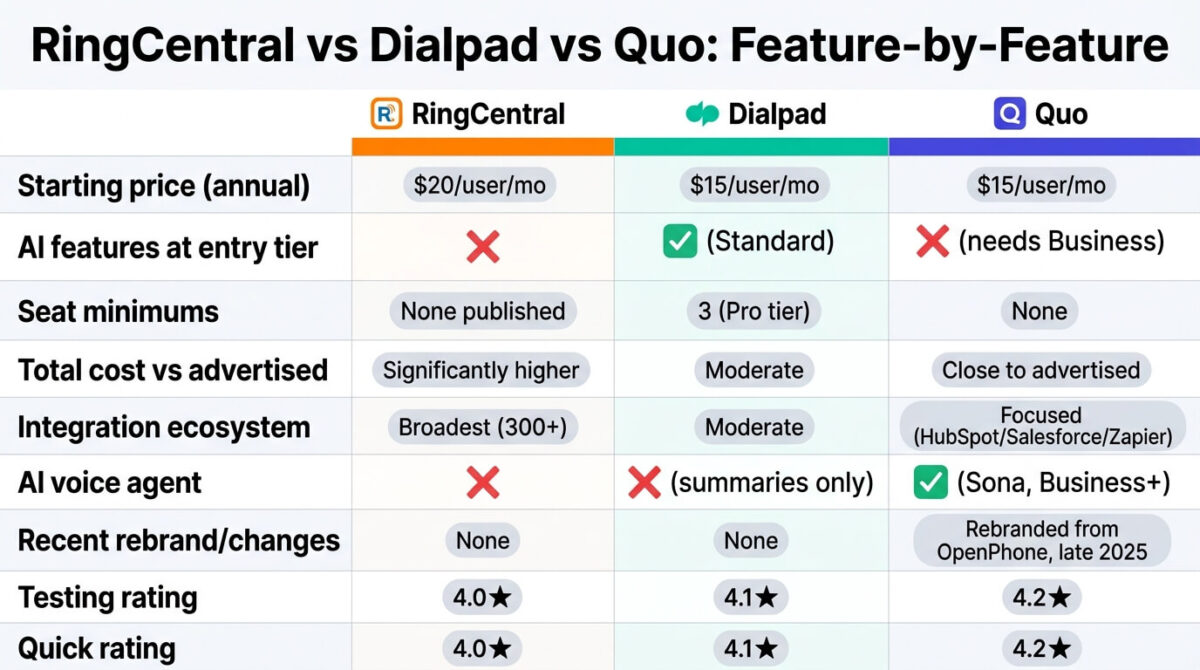
| Feature | RingCentral | Dialpad | Quo |
|---|---|---|---|
| Starting price (annual) | $20/user/month | $15/user/month | $15/user/month |
| AI features included at entry tier | No | Yes (Standard) | No (requires Business) |
| Seat minimums | None published | 3 (Pro tier) | None |
| Total cost vs advertised | Significantly higher (fees/add-ons) | Moderate, if avoiding Pro | Close to advertised |
| Integration ecosystem | Broadest (300+) | Moderate | Focused (HubSpot, Salesforce, Zapier) |
| Best suited for | Larger teams wanting all-in-one UCaaS | Solo/small teams wanting AI at low cost | Small teams wanting modern UX and AI routing |
Which Should You Choose?
Choose RingCentral if video conferencing, webinars, and deep CRM integration all need to live under one platform, and the total cost after fees fits the budget.
Choose Dialpad if AI call summaries at the lowest possible entry price matter most, and Pro’s 3-seat minimum either doesn’t apply or is budgeted for from the start.
Choose Quo if a modern, clean interface and an AI voice agent that can independently handle calls matter more than the cheapest possible AI-inclusive tier.
Our Recommendations
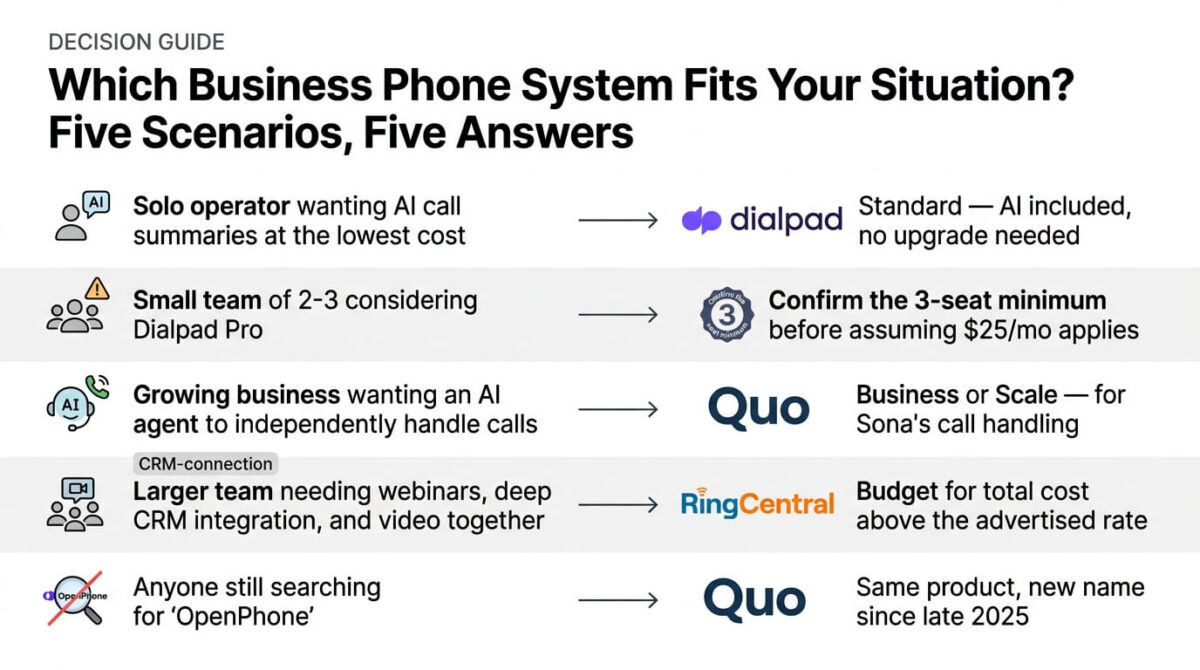
Based on 30 days of testing across setup, calling, and AI feature workflows, here is the recommended setup by situation:
Solo operator wanting AI call summaries at the lowest cost: Dialpad Standard, since AI features are included without needing to reach for a higher tier.
Small team of 2-3 people considering Dialpad Pro: Confirm the 3-seat minimum works for the planned headcount before assuming the $25/month headline applies.
Growing business wanting an AI agent to independently handle incoming calls: Quo Business or Scale, for Sona’s call answering and routing capability.
Larger team needing webinars, deep CRM integration, and video conferencing together: RingCentral, budgeting for the total cost to run meaningfully above the advertised per-seat rate.
Anyone still searching for “OpenPhone”: That product is Quo now; confirm current pricing directly rather than trusting an older review still using the previous name.
Final Verdict
RingCentral, Dialpad, and Quo all solve the same core problem, but each one attaches a different condition to its advertised price that changes which one costs the least for a given team.
- Quo, 4.2 / 5, the most modern interface and AI agent capability, once the Business tier is budgeted in
- Dialpad, 4.1 / 5, the best AI-inclusive value at the entry tier, with a seat-minimum trap on Pro
- RingCentral, 4.0 / 5, the most complete feature set, with the widest gap between advertised and total cost
Before comparing headline prices across these three, check what each platform doesn’t put on the pricing page: RingCentral’s mandatory fees, Dialpad’s Pro-tier seat minimum, and Quo’s AI features sitting one tier up from the entry price.
Frequently Asked Questions
Is OpenPhone the same company as Quo?
Yes. OpenPhone rebranded to Quo in late 2025 alongside a $105 million funding round and the launch of Sona, an AI voice agent. The product, login, and existing accounts carried over unchanged; only the name and some positioning changed.
Does Dialpad really have a seat minimum on its Pro plan?
Yes. Pro requires a minimum of 3 seats regardless of team size, making the true minimum monthly cost $75 on annual billing rather than $25 for a solo user. Standard, the entry tier, has no such minimum.
Why does RingCentral cost more than the advertised price?
Independent cost analyses report mandatory regulatory fees and common add-ons pushing RingCentral’s total monthly cost 50% to 125% above the listed per-seat rate, depending on which features and compliance requirements apply to a given business.
Which of these three includes AI call summaries at the cheapest tier?
Dialpad, exclusively. Standard, at $15/user/month, includes AI transcription and call summaries with no upgrade required. Quo requires its $23/user Business tier for the same capability, and RingCentral’s AI features are similarly tiered above its entry plan.
Is Quo a safe long-term choice after its rebrand?
The rebrand came with a $105 million funding round rather than financial distress, which is a different signal than some other recent software rebrands. Existing accounts and pricing were unaffected by the name change itself.
Which system is cheapest for a solo operator?
Dialpad Standard and Quo Starter both start at $15/user/month on annual billing. Dialpad includes AI call summaries at that price, while Quo requires upgrading to Business at $23/month for the same feature, making Dialpad the better value if AI summaries are a priority.
Does RingCentral’s Core plan work for an active small business?
It can, but its 25 SMS messages and 100 toll-free minutes per user monthly are tight limits that an actively communicating small business often exceeds within the first month, pushing a realistic upgrade to Advanced sooner than the headline price suggests.
Which platform has the most developed AI phone agent?
Quo, through Sona, can answer calls, qualify leads, and route them without human intervention. Dialpad’s AI focuses more on transcription and call summaries than independent call handling, and RingCentral’s AI capabilities are comparatively less developed in this specific area.