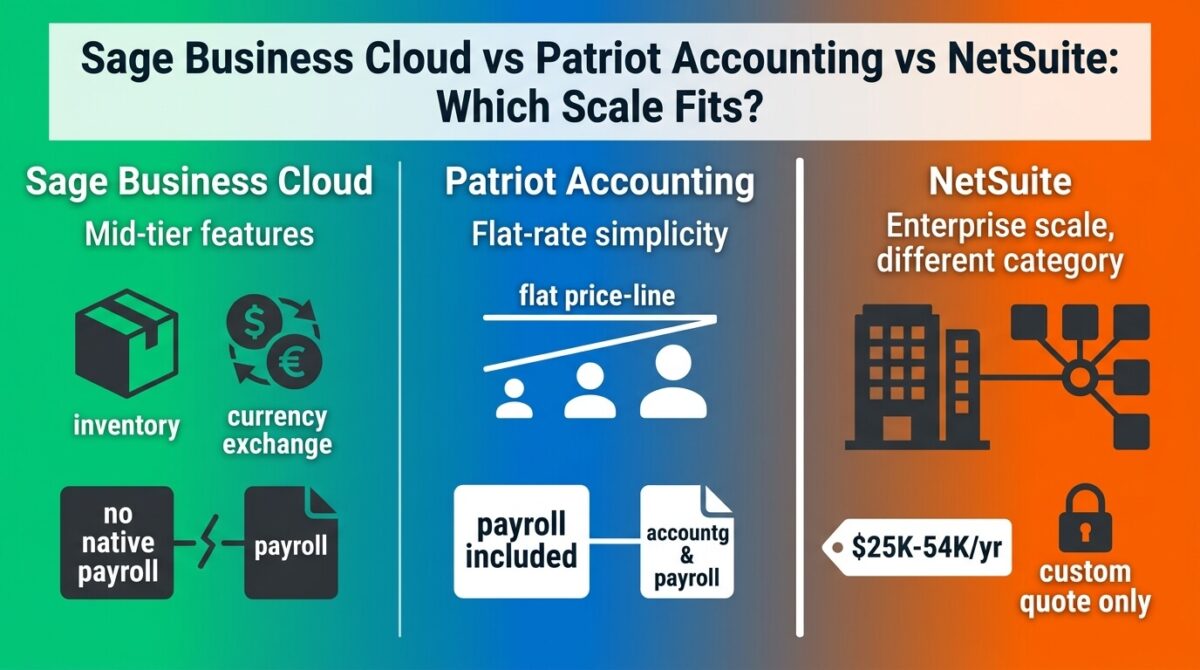
Choosing between Sage Business Cloud vs Patriot Accounting vs NetSuite is a common dilemma, similar to how founders evaluate options like QuickBooks Vs Xero Vs Zoho Books when setting up their initial financial stack. Sage and Patriot are both accounting software built for small businesses, priced monthly, and set up in an afternoon. NetSuite is enterprise resource planning software, custom-quoted, and typically implemented over months with a five-figure setup cost before the first monthly bill even arrives, often accompanying administrative workflows that also require tools like SignEasy Vs Signaturely Vs Zoho Sign for client onboarding.
That’s not a knock on NetSuite. It’s built for a distinctly different job, managing inventory, multiple subsidiaries, and complex financial operations at a scale where standard accounting tools stop being viable, much like how growing modern enterprises integrate Pika Vs HeyGen Vs Synthesia to scale their marketing operations. The mistake is comparing the three as if they’re competing for the same customer.
I tested Sage Business Cloud vs Patriot Accounting vs NetSuite by setting up working accounts on Sage and Patriot, documenting every step of the interface just as I would when reviewing software demos using Snagit Vs ShareX Vs Vidyard. Here is the honest comparison, including what a small business would pay in practice to get NetSuite running versus a full year of either of the other two.
Table of Contents
How We Tested
Five criteria shaped the testing:
- Total first-year cost, software plus setup, not just the advertised monthly rate
- User pricing model, flat rate, per-user, or fully custom licensing
- Setup and implementation time, from signup to a usable, running system
- Feature ceiling, what each platform can and can’t handle as a business grows
- Appropriate scale, what size and complexity of business each tool is built for
Sage Business Cloud Accounting Review: Solid Mid-Tier Features, No Built-In Payroll
Free plan: No, free trial only
Starting price: $20/month (Accounting Start), 1 user
Best plan for most users: Accounting Plus, $50/month, inventory and project tracking
Platforms: Web, iOS, Android
Affiliate program: Yes, Sage partner program
Sage Business Cloud Accounting sits in familiar small-business accounting territory, with a three-tier structure that reaches inventory tracking and multi-currency support earlier in its lineup than several competitors.
What Sage Business Cloud does best
Inventory tracking and project costing arrive at Plus, $50/month, a lower price point than several comparable competitors charge for similar functionality. Multi-currency support at Standard, $40/month, also serves any small business with international customers or suppliers without needing to reach for a top-tier plan.
The interface tested as clean and reasonably quick to learn, with automatic bank reconciliation working reliably across the connections tested during setup.
Where Sage Business Cloud falls short
Payroll isn’t built into Sage Business Cloud Accounting at all; it requires a separate, third-party payroll integration rather than a native add-on the way Patriot bundles its own payroll product. That’s an extra vendor relationship and integration step neither Patriot nor a full NetSuite deployment requires in the same way.
Pricing per user isn’t as generous as Patriot’s flat-rate model: Standard and Plus support multiple users, but the cost structure scales less predictably than Patriot’s same-price-regardless-of-headcount approach.
Sage Business Cloud pricing
| Plan | Price | Users | Notable Feature |
|---|---|---|---|
| Accounting Start | $20/month | 1 | Invoicing, expense tracking, bank reconciliation |
| Accounting Standard | $40/month | Multiple | Quotes, purchase invoices, multi-currency |
| Accounting Plus | $50/month | Multiple | Inventory management, project tracking |
Sage Business Cloud: Pros and Cons
Pros:
- Inventory tracking available at a lower price point than several competitors
- Multi-currency support included at the middle tier
- Clean interface with reliable bank reconciliation
- Reasonable pricing spread across three clearly differentiated tiers
Cons:
- No built-in payroll, requiring a separate third-party integration
- Multi-user pricing less predictable than Patriot’s flat-rate structure
- Smaller third-party integration ecosystem than QuickBooks or Xero
- No permanent free plan
Rating: 4.0 / 5, solid mid-tier accounting software with earlier inventory access than many competitors, held back by the lack of native payroll.
Patriot Accounting Review: Flat-Rate Pricing That Doesn’t Punish Growing Teams
Free plan: No, 30-day free trial only
Starting price: $20/month (Basic), flat rate regardless of user count
Best plan for most users: Premium, $30/month, unlimited users and full feature set
Platforms: Web
Affiliate program: Yes, Patriot Software affiliate program
Patriot Accounting charges the same flat monthly rate no matter how many people use the account, a structural difference from nearly every competitor in this category that prices by seat or user tier.
What Patriot Accounting does best
Flat-rate pricing means a 10-person team pays exactly what a solo user pays, $20 or $30 a month depending on tier, a clear structural advantage over per-user models that punish adding team members. Native integration with Patriot’s own payroll product, starting around $17/month plus a per-worker fee, keeps both accounting and payroll under one vendor relationship rather than requiring a separate integration.
The interface tested as the most approachable of the three for someone without prior bookkeeping software experience, with a straightforward chart of accounts and minimal setup friction.
Where Patriot Accounting falls short
Feature depth caps out lower than Sage’s Plus tier or anything NetSuite offers: there’s no inventory management at either Patriot tier, a meaningful limitation for any business that sells physical products and needs to track stock levels inside its accounting software.
The two-tier structure, while simple, also means less room to grow into more advanced functionality without eventually outgrowing the platform entirely and migrating elsewhere, unlike Sage’s three-tier ladder or NetSuite’s modular add-on approach.
Patriot Accounting pricing
| Plan | Price | Users | Notable Feature |
|---|---|---|---|
| Basic | $20/month | Unlimited (flat rate) | Invoicing, expense tracking, bank imports |
| Premium | $30/month | Unlimited (flat rate) | Reconciliation, estimates, custom invoice templates |
Patriot Accounting: Pros and Cons
Pros:
- Flat-rate pricing regardless of user count, unmatched by either competitor
- Native payroll integration under the same vendor
- Most approachable interface of the three for accounting software beginners
- Lowest total cost of the three for a small team needing basic bookkeeping
Cons:
- No inventory management at either tier
- Two-tier structure offers less room to grow into advanced features
- Smaller feature ceiling than Sage’s Plus tier
- No mobile app, web-only access
Rating: 4.1 / 5, the best value of the three for a small team on a flat budget, limited by a feature ceiling that arrives sooner than Sage’s.
NetSuite Review: Enterprise Power, at a Scale Neither Competitor Approaches
Free plan: No, no self-serve pricing at all
Starting price: Custom quote only, typically $999-1,500/month base platform plus $99-199/user/month
Best plan for most users: Not applicable, NetSuite requires a sales consultation to determine fit
Platforms: Web
Affiliate program: Yes, NetSuite Solution Provider partner program
NetSuite is full enterprise resource planning software, not accounting software with extra features, and comparing its price to Sage’s or Patriot’s monthly rate misses what it’s built to do.
What NetSuite does best
Multi-subsidiary consolidation, deep inventory and warehouse management, and financial operations at a scale where spreadsheet-adjacent tools like Sage or Patriot stop being viable are where NetSuite earns its cost most clearly. For a business running multiple legal entities, complex manufacturing, or global operations, that depth of functionality doesn’t exist in either competitor at any price.
CRM comes included in the base platform without an extra module fee, a rare inclusion compared to how aggressively NetSuite otherwise charges for add-on modules like advanced financials, warehouse management, or SuiteCommerce.
Where NetSuite falls short
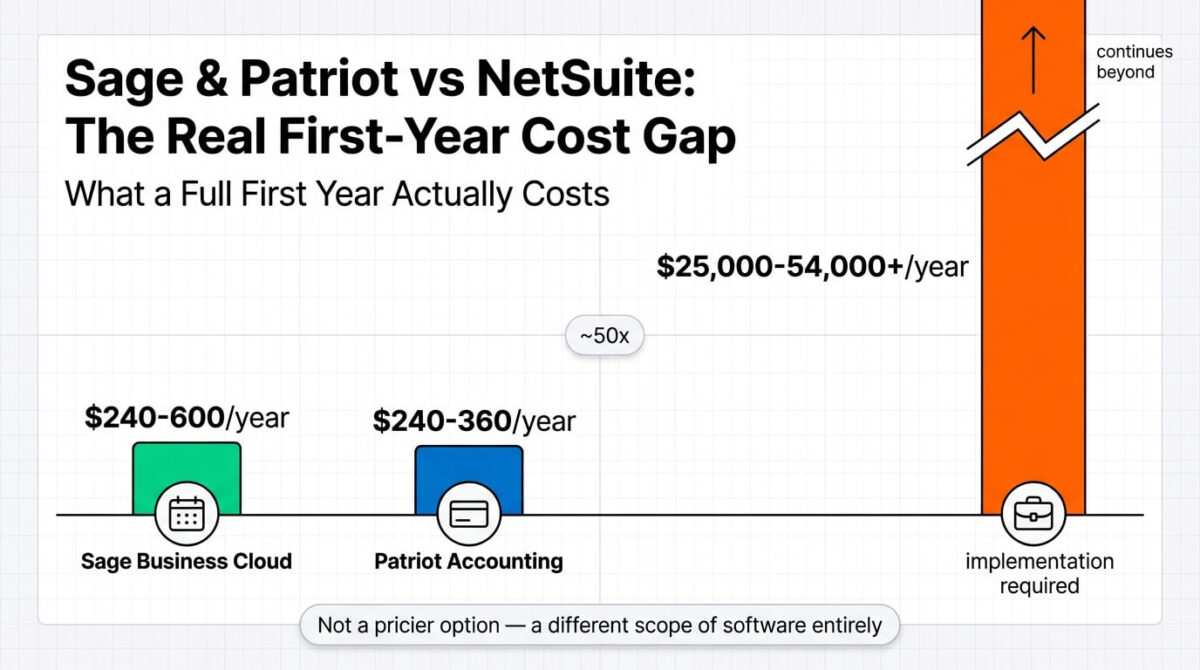
Implementation alone typically runs $25,000 to $50,000 for even a small deployment, before the first monthly subscription payment, and annual costs for a 5-15 user small business commonly land between $25,000 and $54,000 total. That’s often more than 50 times what a full year of Sage Plus or Patriot Premium would cost for a business that doesn’t need NetSuite’s specific enterprise capabilities.
There’s no self-serve signup, no published pricing, and no path to trying the platform without entering a sales process. For the vast majority of businesses comparing accounting software at Sage’s or Patriot’s price point, NetSuite isn’t a pricier option, it’s a different category of software entirely.
NetSuite pricing
| Component | Typical Cost | Notes |
|---|---|---|
| Base platform license | $999–$1,500/month | Core financials & general ledger tenant |
| User licenses | $99–$199/user/month | Per named user (full vs self-service seats) |
| Implementation (one-time) | $25,000–$50,000+ | Small business baseline deployment (SI / Partner) |
| Add-on modules | $500–$5,000+/month each | Advanced Inventory, WMS, CRM, SuiteCommerce |
NetSuite: Pros and Cons
Pros:
- Enterprise-grade functionality neither competitor attempts to match
- Multi-subsidiary and multi-entity consolidation built in
- CRM included in the base platform at no extra module cost
- Scales to complexity Sage and Patriot were never designed to handle
Cons:
- No self-serve pricing, requiring a full sales process before knowing the cost
- Implementation alone typically exceeds a full year of Sage’s or Patriot’s total cost
- Wildly inappropriate for the small-business scale either competitor targets
- Annual contracts required, with limited flexibility to downgrade
Rating: 3.7 / 5, powerful software for the business it’s built for, and the wrong comparison entirely for anyone choosing between Sage and Patriot.
Head-to-Head Comparison
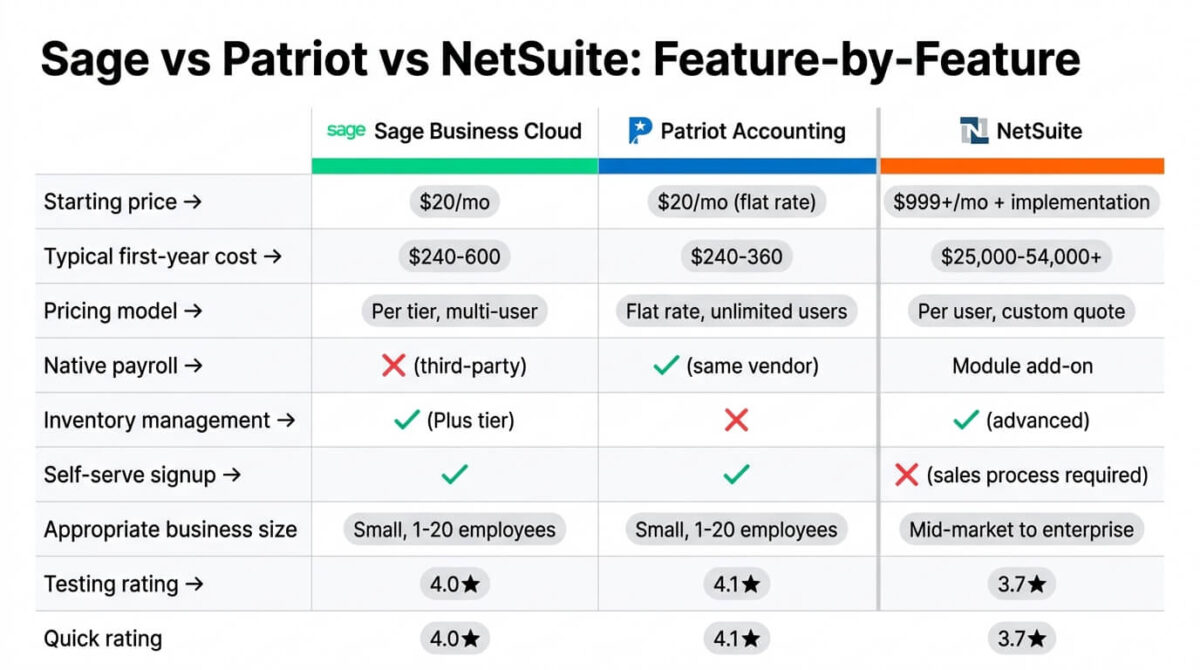
| Feature | Sage Business Cloud | Patriot Accounting | NetSuite |
|---|---|---|---|
| Starting price | $20/month | $20/month (flat rate) | $999+/month plus implementation |
| Typical first-year cost | $240–$600 | $240–$360 | $25,000–$54,000+ |
| Pricing model | Per tier, multi-user | Flat rate, unlimited users | Per user, custom quote |
| Native payroll | No (third-party) | Yes (same vendor) | Available as module |
| Inventory management | Yes (Plus tier) | No | Yes (advanced) |
| Self-serve signup | Yes | Yes | No |
| Appropriate business size | Small business, 1–20 employees | Small business, 1–20 employees | Mid-market to enterprise |
Which Should You Choose?
Choose Sage Business Cloud if inventory tracking or multi-currency support matters, and a slightly higher price than Patriot is acceptable for that added capability.
Choose Patriot Accounting if the team is small, the budget is flat, and integrated payroll under one vendor matters more than inventory tracking or extensive feature depth.
Choose NetSuite only if the business has clearly outgrown small-business accounting software: multiple subsidiaries, complex inventory or manufacturing operations, or a scale where a five-figure implementation cost is a reasonable fraction of overall operations, not the majority of the software budget.
Our Recommendations
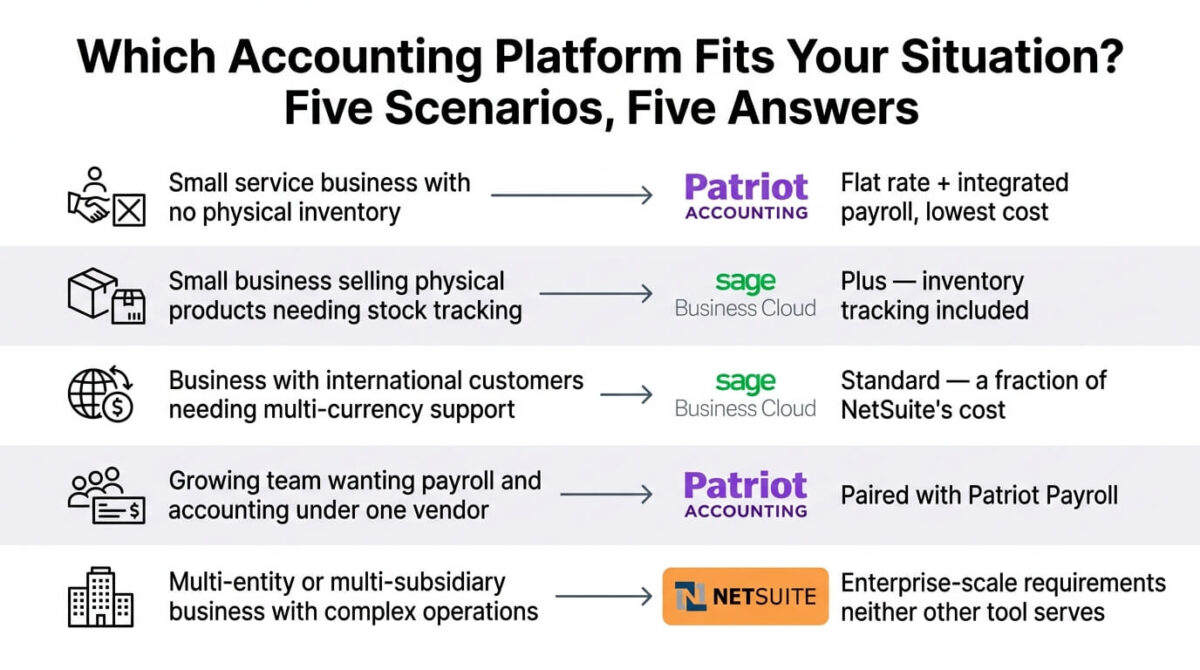
Based on testing setup, feature depth, and total cost across all three, here is the recommended setup by situation:
Small service business with no physical inventory: Patriot Accounting, for the flat-rate pricing and integrated payroll at the lowest total cost.
Small business selling physical products needing stock tracking: Sage Business Cloud Plus, for inventory management neither Patriot nor a reasonable budget would extend to NetSuite for.
Business with international customers needing multi-currency support: Sage Business Cloud Standard, at a fraction of what NetSuite would cost for the same basic capability.
Growing team wanting payroll and accounting under one vendor: Patriot Accounting paired with Patriot Payroll, both from the same company with native integration.
Multi-entity or multi-subsidiary business with complex operations: NetSuite, where the implementation cost and monthly price reflect enterprise-scale requirements neither Sage nor Patriot was built to serve.
Final Verdict
Sage Business Cloud and Patriot Accounting compete directly with each other for the same small-business customer. NetSuite competes with neither; it serves a business that has already outgrown what either one offers.
- Patriot Accounting, 4.1 / 5, the best value for a small team on a flat budget
- Sage Business Cloud, 4.0 / 5, the stronger choice once inventory or multi-currency support is needed
- NetSuite, 3.7 / 5, capable enterprise software, and the wrong tool for anyone comparing prices against Sage or Patriot
If a five-figure implementation cost sounds unreasonable for accounting software, that reaction is the correct signal that NetSuite isn’t built for a business at Sage’s or Patriot’s scale. The choice between those two comes down to whether inventory tracking justifies $10-30 more per month than Patriot charges.
Frequently Asked Questions
Is NetSuite really that much more expensive than Sage or Patriot?
Yes, by a wide margin. A small business typically pays $240-600 total for a full year of Sage or Patriot, while a small NetSuite deployment commonly costs $25,000-54,000 in the first year once implementation is included, often 50 times more for a fundamentally different scope of software.
Does Patriot Accounting really charge the same price no matter how many users I add?
Yes. Both Basic ($20/month) and Premium ($30/month) are flat-rate plans that don’t increase with additional users, a structural difference from Sage’s per-tier model and from nearly every per-seat accounting platform in this category.
Does Sage Business Cloud include payroll?
No. Payroll requires a separate third-party integration rather than a native Sage product, unlike Patriot, which offers its own payroll software that integrates directly with Patriot Accounting under the same vendor relationship.
When does a small business need NetSuite instead of Sage or Patriot?
Once operations involve multiple legal entities or subsidiaries, complex manufacturing or warehouse management, or financial consolidation across several business units, needs that clearly exceed what spreadsheet-adjacent small business accounting software like Sage or Patriot was designed to handle.
Can I try NetSuite before committing to a contract?
Not through a self-serve trial the way Sage and Patriot both offer. NetSuite requires a sales consultation to scope the deployment and receive a quote, with no published pricing available to browse independently beforehand.
Which of these three has inventory management?
Sage Business Cloud’s Plus tier includes inventory tracking at $50/month. Patriot Accounting doesn’t offer inventory management at either tier. NetSuite includes advanced inventory and warehouse management as part of its broader enterprise feature set.
Is Patriot Accounting missing features that Sage or NetSuite include?
Yes, most notably inventory management, which neither Patriot tier offers. For a business that doesn’t sell physical products needing stock tracking, this gap doesn’t matter; for one that does, Sage Business Cloud or a different tool entirely would be a better fit.
Why would anyone compare NetSuite to Sage or Patriot at all?
Usually because a growing business is trying to determine when it’s outgrown small-business accounting software. The honest answer for most businesses still comparing Sage and Patriot’s monthly price is that NetSuite’s scale and cost aren’t yet relevant, and revisiting the comparison makes more sense once multi-entity or complex inventory needs appear in practice.