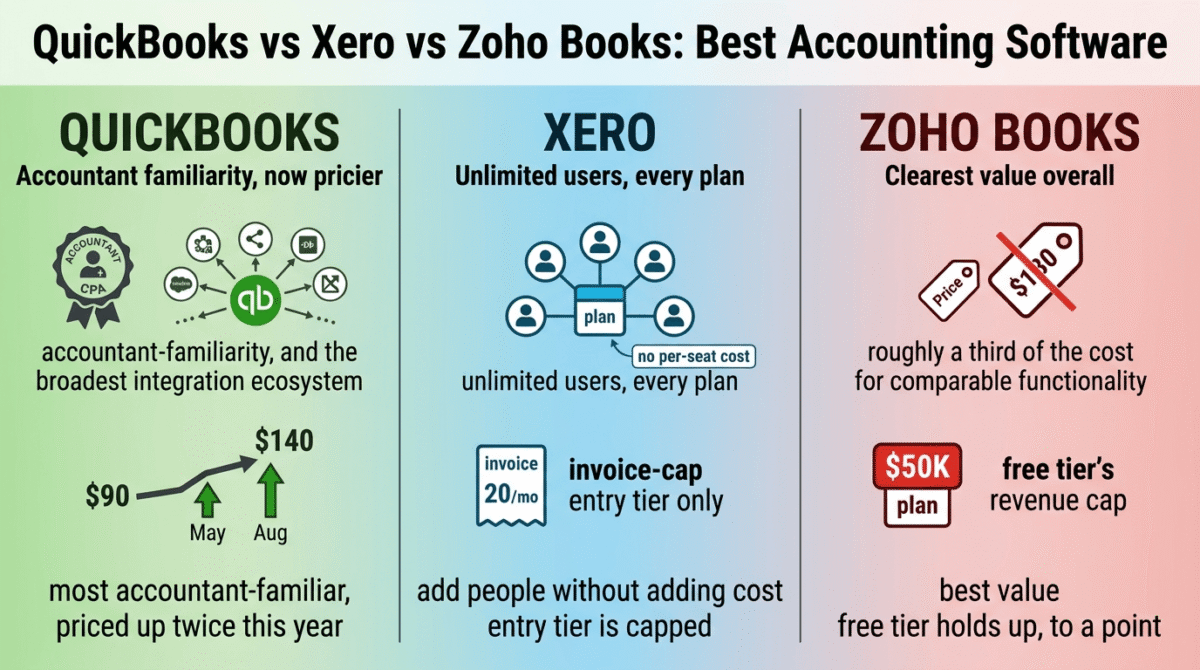
QuickBooks vs Xero vs Zoho Books is the shortlist almost every small business ends up comparing, and this year the comparison changed more than usual. QuickBooks Online raised prices twice in 2026, once in May and again in August, and the gap between it and its two competitors is wider now than it’s been in years.
Xero and Zoho Books both take a different approach to what QuickBooks charges the most for: user access. Xero includes unlimited users on every plan. Zoho Books caps users per tier but at a noticeably lower price than QuickBooks charges for a comparable seat count.
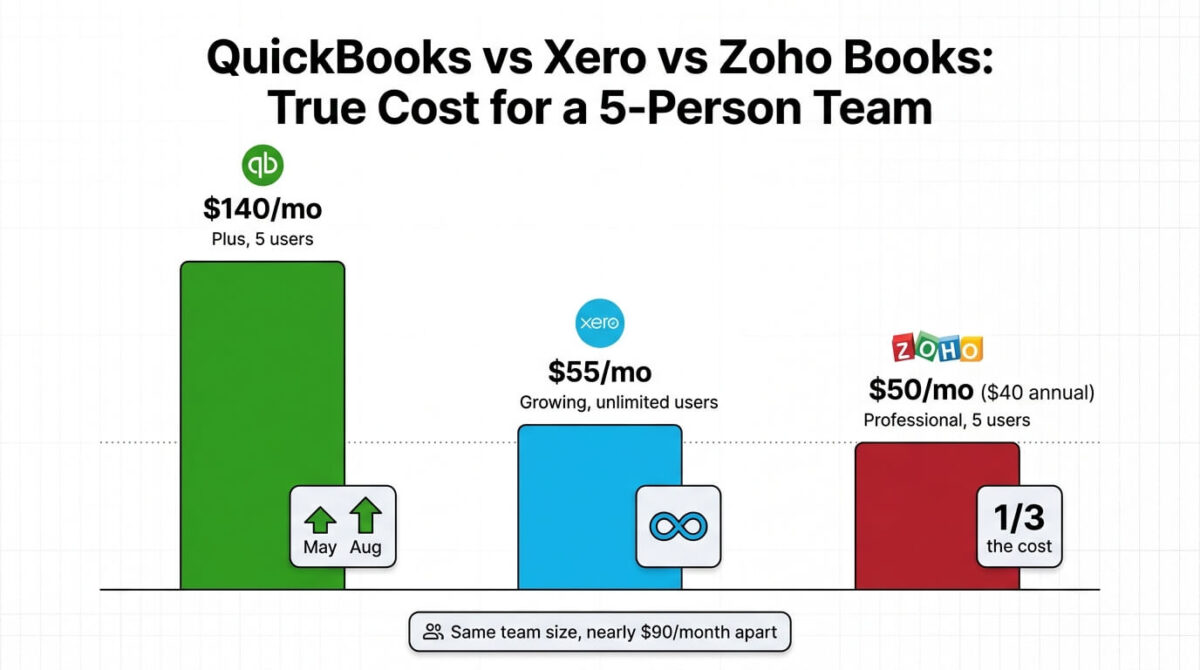
I tested QuickBooks vs Xero vs Zoho Books for 30 days, running the same set of invoices, bank reconciliations, and reports through all three and pricing out what a 5-person team would pay on each in practice. Here is the honest comparison, including how much more QuickBooks costs today than it did at the start of this year.
Table of Contents
How We Tested
Five criteria shaped the testing:
- Cost at a realistic team size, pricing for a 5-person team, not just the cheapest solo tier
- User pricing model, whether cost scales per seat, is capped per tier, or is unlimited
- Feature parity at comparable price points, what a similar feature set costs across all three
- Accountant and bookkeeper familiarity, how easily an outside accountant can work inside each platform
- Recent pricing changes, any increases or restructures in the past 12 months that affect the true cost
QuickBooks Online Review: The Familiar Default, Now Meaningfully More Expensive
Free plan: Yes, 1 user, 2 invoices/month
Starting price: $20/month (Solopreneur), 1 user
Best plan for most users: Plus, $140/month, 5 users, inventory and project tracking
Platforms: Web, iOS, Android, QuickBooks Desktop (separate product)
Affiliate program: Yes, up to $100 per referral via the QuickBooks affiliate program
QuickBooks Online remains the accounting software most bookkeepers and accountants already know, which matters more than a feature checklist for anyone planning to hand off books to an outside professional.
What QuickBooks does best
Accountant familiarity is QuickBooks’ clearest advantage: more bookkeepers, CPAs, and tax preparers are trained on QuickBooks than on Xero or Zoho Books combined, which can mean lower onboarding friction when hiring outside help. The integration ecosystem is also the broadest of the three, with more third-party apps built specifically for QuickBooks than for either competitor.
Plus and Advanced both offer developed inventory tracking, project profitability reporting (which can often replace the need for separate project management software), and 1099 contractor management, covering more specialized small-business needs directly than Zoho Books’ equivalent tiers.
Where QuickBooks falls short
QuickBooks Online raised prices twice in 2026. The first increase, effective May 1, ran 13% to 70% across tiers and was described internally as the largest in the product’s history, affecting roughly 3 million Plus subscribers alone. A second increase followed in August, pushing Essentials, Plus, and Advanced up further, $10 to $65 more per month depending on tier. Combined, a business on Plus paid roughly $90/month at the start of 2026 and pays $140/month now.
User limits are also stricter than either competitor’s: Essentials includes only 3 users at $85/month, and Plus caps at 5 users for $140/month, both far short of Xero’s unlimited-user model at a lower price. Payroll and payment processing are billed entirely separately a common reason growing businesses evaluate dedicated HR and payroll software and can more than double the total monthly cost for a business running both through QuickBooks.
QuickBooks pricing
| Plan | Price | Users | Notable Feature |
|---|---|---|---|
| Free | $0 | 1 | 2 invoices/month, very limited |
| Solopreneur | $20/month | 1 | Mileage tracking, receipt capture |
| Simple Start | $38/month | 1 | Basic invoicing, expense tracking |
| Essentials | $85/month | 3 | Bill management, time tracking |
| Plus | $140/month | 5 | Inventory, project profitability |
| Advanced | $340/month | 25 | Custom permissions, batch transactions |
QuickBooks: Pros and Cons
Pros:
- Widest accountant and bookkeeper familiarity of the three
- Largest third-party integration ecosystem
- Developed inventory and project profitability tools at Plus and above
- 1099 contractor management included from Plus
Cons:
- Two price increases in 2026 alone, one described as the largest in the product’s history
- Strictest user limits of the three at comparable price points
- Payroll and payment processing billed separately, often doubling the effective cost
- Essentials’ 3-user cap at $85/month compares poorly to Xero’s unlimited users at $55/month
Rating: 3.9 / 5, the most accountant-familiar option, now priced meaningfully higher than either competitor after two increases in a single year.
Xero Review: Unlimited Users on Every Plan, With Tighter Caps at the Entry Tier
Free plan: No, 30-day free trial only
Starting price: $25/month (Early), 20 invoices and 5 bills/month
Best plan for most users: Growing, $55/month, unlimited invoices, bills, and users
Platforms: Web, iOS, Android
Affiliate program: Yes, up to $55 per referral plus $10 per trial signup
Xero’s core structural difference from both competitors is that every plan, including the cheapest, includes unlimited users at no additional per-seat cost.
What Xero does best
Unlimited users on every tier is a clear structural advantage for any growing team: a 10-person team on Growing pays the same $55/month as a solo user, a cost structure neither QuickBooks nor Zoho Books matches.Multi-currency support, strong from Established upward, and a large marketplace of over 1,000 integrations (including popular email marketing tools) make Xero a natural fit for businesses with any international dimension.
Hubdoc, Xero’s included receipt-capture and document tool, comes bundled at no extra cost across plans, covering ground that costs extra as a QuickBooks add-on.
Where Xero falls short
Early, the entry tier, caps at 20 invoices and 5 bills per month, restrictive enough that many small businesses outgrow it within the first few months and need to move to Growing regardless of user count. That cap makes the effective entry price for unrestricted use $55/month, not the advertised $25.
Xero also has no permanent free plan, unlike Zoho Books, and its accountant and bookkeeper familiarity, while solid particularly outside the US, trails QuickBooks’ dominance in American small-business accounting specifically.
Xero pricing
| Plan | Price | Invoices/Bills | Users | Notable Feature |
|---|---|---|---|---|
| Early | $25/month | 20 invoices, 5 bills/month | Unlimited | Basic reporting, online payments |
| Growing | $55/month | Unlimited | Unlimited | Task automation, performance dashboards |
| Established | $90/month | Unlimited | Unlimited | Multi-currency, project tracking, advanced analytics |
Xero: Pros and Cons
Pros:
- Unlimited users on every plan, a clear structural advantage over per-seat competitors
- Hubdoc receipt capture included, an added cost on QuickBooks
- Large integration marketplace, over 1,000 apps
- Strong multi-currency support from Established upward
Cons:
- Early tier’s 20-invoice/5-bill cap makes it impractical for most active small businesses
- No permanent free plan
- Less accountant familiarity in the US specifically than QuickBooks
- Effective entry price for unrestricted use is $55/month, not the advertised $25
Rating: 4.2 / 5, unlimited users at every tier is a measurable structural win, undercut somewhat by how quickly the entry plan’s invoice cap forces an upgrade.
Zoho Books Review: The Clearest Value, With a Familiarity Tradeoff
Free plan: Yes, businesses under $50,000/year revenue, 1 user, 1,000 invoices/year
Starting price: $20/month (Standard), $15/month billed annually, 3 users
Best plan for most users: Professional, $50/month ($40 annual), 5 users, inventory and purchase orders
Platforms: Web, iOS, Android
Affiliate program: Yes, up to 15% recurring commission via the Zoho affiliate program
Zoho Books consistently delivers comparable functionality to QuickBooks at a noticeably lower price, particularly once inventory and multi-user access enter the comparison.
What Zoho Books does best
Professional, at $40/month billed annually, includes inventory tracking, purchase orders, and 5 users, functionality that costs $140/month on QuickBooks Plus for the same user count. Over a year, that’s roughly $480 versus $1,680, a difference of about $1,200 for comparable core functionality.
The free plan is also unusually capable for a free tier in this category: full invoicing, bank reconciliation, and expense tracking for any business under $50,000 in annual revenue, a starting point that holds up rather than a stripped-down trial.
Where Zoho Books falls short
Fewer accountants and bookkeepers are trained on Zoho Books specifically than on QuickBooks, which can add friction when handing books to an outside professional who’s more comfortable in a more widely used platform. The free plan’s $50,000 revenue cap also means a growing business ages out of it faster than expected, requiring a move to Standard once that threshold is crossed.
Zoho Books’ deepest ecosystem value shows up most clearly for businesses already using other Zoho products, such as their flagship Zoho CRM; for a business with no other Zoho tools in place, some of that integration advantage doesn’t apply.
Zoho Books pricing
| Plan | Price | Users | Notable Feature |
|---|---|---|---|
| Free | $0 | 1 | Under $50K revenue, 1,000 invoices/year |
| Standard | $20/month ($15 annual) | 3 | Bank feeds, sales tax, 1099 e-file |
| Professional | $50/month ($40 annual) | 5 | Inventory, purchase orders |
| Premium | $70/month ($60 annual) | 10 | Multi-currency, budgeting |
| Elite | $150/month | 10 | Advanced inventory, warehouses |
| Ultimate | $275/month | 15 | Advanced analytics, 50+ visualizations |
Zoho Books: Pros and Cons
Pros:
- Comparable functionality to QuickBooks Plus at roughly a third of the price at Professional
- Free tier holds up for qualifying businesses, not just a stripped trial
- Deep integration with other Zoho apps for businesses already in that ecosystem
- Most granular tier structure, six plans total, for matching cost to specific need
Cons:
- Less accountant and bookkeeper familiarity than QuickBooks
- Free plan’s $50,000 revenue cap means faster graduation than expected for growing businesses
- Ecosystem advantages apply less to businesses not already using other Zoho products
- Still caps users per tier, unlike Xero’s unlimited model
Rating: 4.3 / 5, the clearest value of the three, with an accountant-familiarity tradeoff to weigh against the savings.
Head-to-Head Comparison
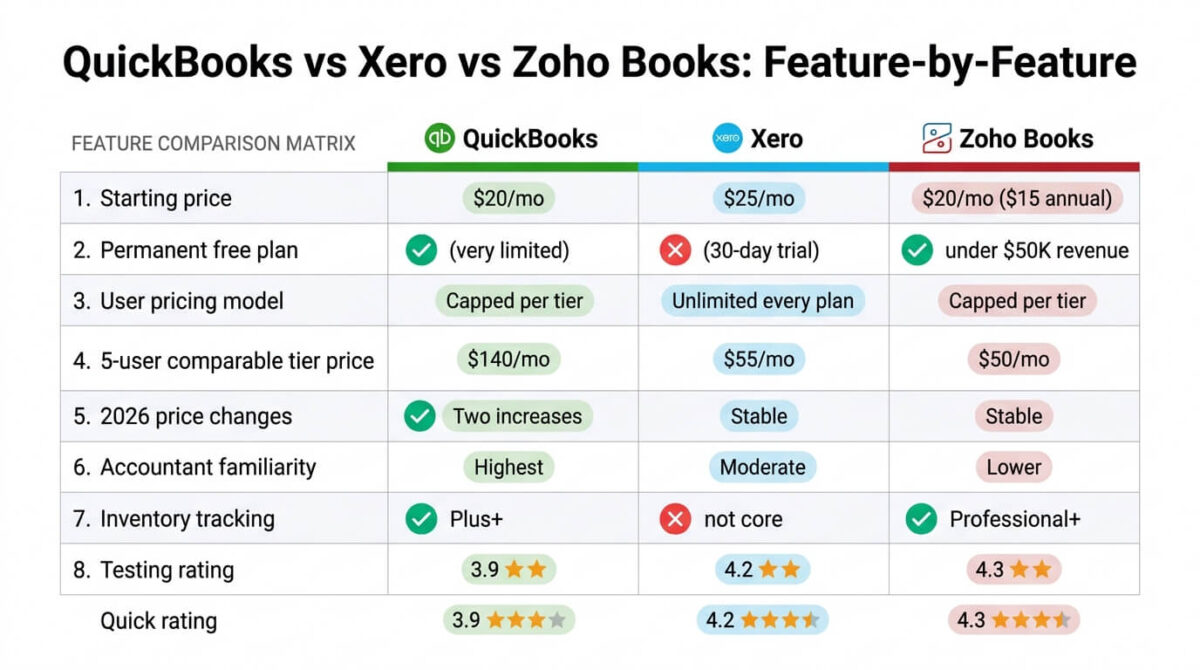
| Feature | QuickBooks | Xero | Zoho Books |
|---|---|---|---|
| Starting price | $20/month | $25/month | $20/month ($15 annual) |
| Permanent free plan | Yes (very limited) | No | Yes (under $50K revenue) |
| User pricing model | Capped per tier | Unlimited on every plan | Capped per tier |
| 5-user comparable tier | Plus, $140/month | Growing, $55/month | Professional, $50/month |
| 2026 price changes | Two increases (May, August) | Stable | Stable |
| Accountant familiarity | Highest | Moderate | Lower |
| Best suited for | Businesses needing maximum accountant compatibility | Growing teams wanting unlimited users | Cost-conscious businesses matching tier to need |
Which Should You Choose?
Choose QuickBooks if working with an outside accountant or bookkeeper who specifically uses it is a priority, and the higher cost after 2026’s increases fits the budget.
Choose Xero if a growing team needs more than a couple of users without per-seat cost scaling, and the Early tier’s invoice cap won’t be a practical constraint.
Choose Zoho Books if the priority is matching cost closely to specific need, and either the business qualifies for the free tier or the savings at Professional against QuickBooks Plus outweigh the smaller accountant pool.
Our Recommendations
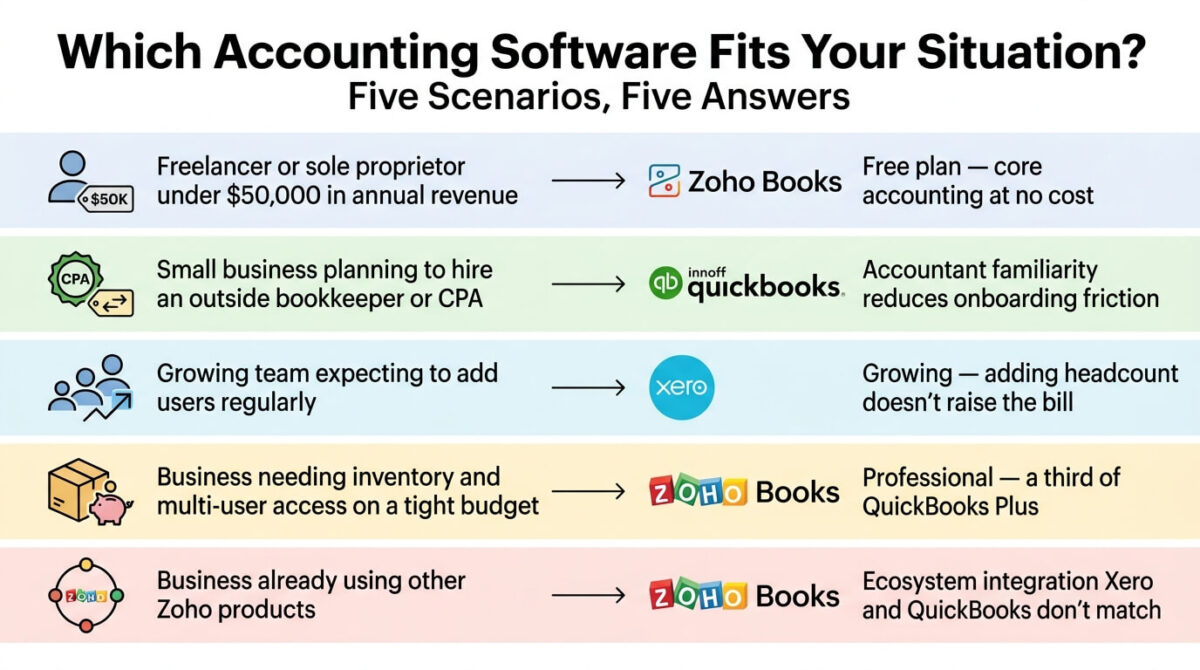
Based on 30 days of testing across invoicing, reconciliation, and reporting workflows, here is the recommended setup by situation:
Freelancer or sole proprietor under $50,000 in annual revenue: Zoho Books’ free plan, for core accounting that holds up at no cost.
Small business planning to hire an outside bookkeeper or CPA: QuickBooks, since accountant familiarity reduces onboarding friction more than the price difference typically justifies avoiding.
Growing team expecting to add users regularly: Xero Growing, where unlimited users mean adding headcount doesn’t increase the accounting software bill.
Business needing inventory and multi-user access on a tight budget: Zoho Books Professional, for roughly a third of what QuickBooks Plus charges for comparable functionality.
Business already using other Zoho products: Zoho Books, for the ecosystem integration that doesn’t apply the same way to Xero or QuickBooks.
Final Verdict
QuickBooks, Xero, and Zoho Books solve the same core problem, but 2026’s pricing changes have widened the practical gap between them more than in past years.
- Zoho Books, 4.3 / 5, the clearest value, with an accountant-familiarity tradeoff to weigh
- Xero, 4.2 / 5, unlimited users on every plan is a measurable structural advantage for growing teams
- QuickBooks, 3.9 / 5, the most accountant-familiar option, now priced well above where it stood at the start of 2026
For a business with no strong accountant preference, Zoho Books or Xero both offer more predictable, often lower, total cost than QuickBooks after this year’s increases. QuickBooks still earns its higher price primarily through the accountant and bookkeeper familiarity that comes with being the category’s long-standing default.
Frequently Asked Questions
How much did QuickBooks Online prices increase in 2026?
QuickBooks raised prices twice: once on May 1 (13% to 70% across tiers, described as the largest increase in the product’s history) and again on August 1 (a further $10 to $65 per month on Essentials, Plus, and Advanced). Combined, Plus rose from roughly $90 to $140 per month across the year.
Does Xero really include unlimited users on every plan?
Yes, including the cheapest Early tier at $25/month. This differs from QuickBooks and Zoho Books, both of which cap the number of users included at each price point and require moving to a higher tier for more seats.
Is Zoho Books’ free plan usable for an active business?
For a business under $50,000 in annual revenue, yes. It includes full invoicing, bank reconciliation, and expense tracking rather than a stripped-down trial, though the business needs to move to a paid tier once it exceeds that revenue threshold.
Which accounting software do most accountants and bookkeepers use?
QuickBooks, by a wide margin in the US specifically. This matters most for businesses planning to work with outside accounting help, since onboarding friction is lower when the professional already knows the platform.
Is Xero’s Early plan enough for a small business?
Often not for long. The 20-invoice and 5-bill monthly cap is restrictive enough that many active small businesses outgrow it within a few months, making Growing at $55/month the more realistic starting point for ongoing use.
How much cheaper is Zoho Books than QuickBooks for comparable features?
At the 5-user, inventory-inclusive tier, Zoho Books Professional runs about $40/month billed annually compared to QuickBooks Plus at $140/month, a difference of roughly $1,200 per year for similar core functionality.
Does QuickBooks include payroll in its listed prices?
No. Payroll and payment processing are both billed separately from the core subscription price, and combined can substantially increase the total monthly cost beyond the plan price alone.
Which tool is best for a business with international operations?
Xero, generally, given its strong multi-currency support from Established upward and its larger footprint outside the US specifically. Zoho Books offers multi-currency at Premium, and QuickBooks’ international features are less developed than either competitor’s.