A podcast host does one job that sounds simple and is actually the entire foundation of the show: it stores your audio files, generates the RSS feed that every podcast app reads, and distributes that feed to Spotify, Apple Podcasts, and everywhere else listeners find your show. Get this layer wrong, pick a host with a confusing pricing model, weak analytics, or a free tier that deletes your back catalog, and every other investment in recording and editing equipment is built on an unstable foundation.
This is a narrower, more specific decision than the general “tools for podcasters” question, and it deserves its own dedicated comparison separate from recording and editing software. I tested Buzzsprout vs Captivate vs Transistor for 30 days, publishing real episodes and tracking how each platform’s pricing model actually behaves as a show grows. Here is the honest comparison.
Table of Contents
How We Tested These Platforms
Every platform was evaluated against five criteria:
- Pricing model clarity, is the cost based on hours uploaded, downloads per month, or something else, and how predictable is that cost as a show grows
- Distribution and submission, how much of the directory submission process (Spotify, Apple Podcasts, and others) does the platform handle for you
- Analytics quality, are the download numbers IAB-certified and trustworthy enough to show a potential sponsor
- Website and embed quality, does the platform provide a usable show website, or just a feed
- Growth and monetization features, what tools exist for actually building an audience and earning from the show, not just hosting it
Why the Pricing Model Matters More Than the Sticker Price in This Category
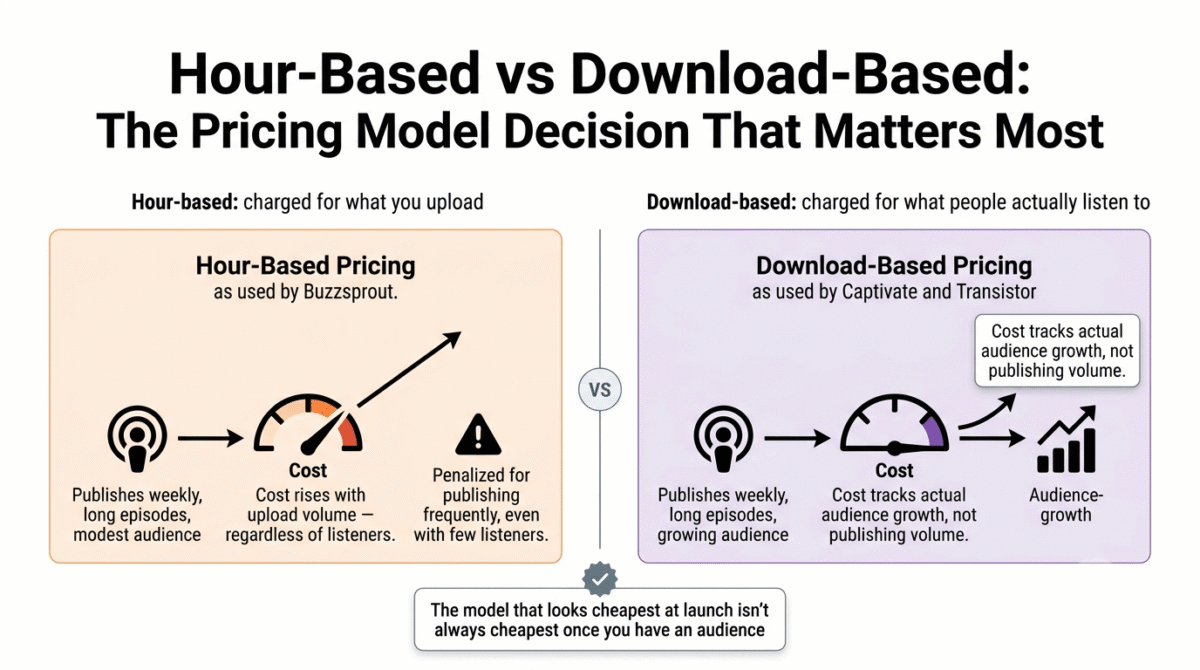
It is easy to compare three podcast hosts on their advertised monthly price and miss the detail that actually determines your long-term cost: hosting platforms in this category charge in fundamentally different ways, and the model that looks cheapest at launch is not always the cheapest once your show has an audience.
Some platforms charge based on hours of audio uploaded per month, a model that penalizes podcasters who publish frequently or run longer episodes, regardless of how many people are actually listening. Others charge based on downloads per month, a model that scales with your actual audience size and listener engagement, which can become more expensive specifically because your show is succeeding. Understanding which model a platform uses, and which one fits your publishing habits and growth trajectory, matters more than the headline number on the pricing page.
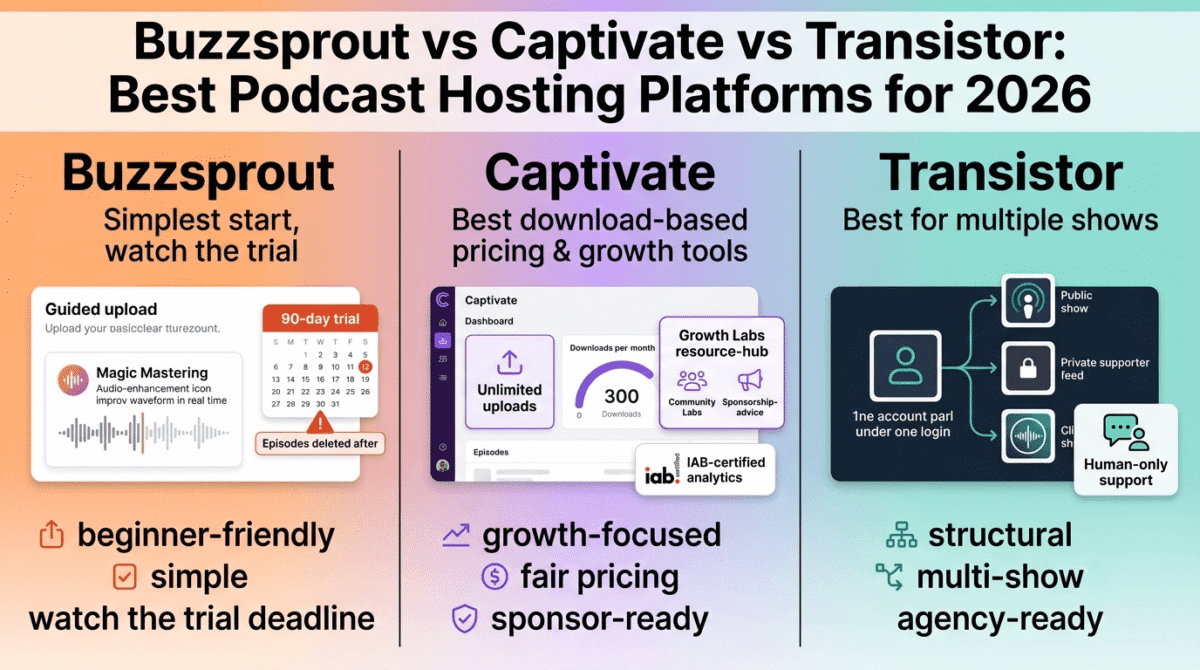
Buzzsprout Review: Best for First-Time Podcasters Who Want Simplicity Above All Else
Free plan: Yes, 90-day trial, 2 hours of audio per month, deleted after the 90-day period
Starting paid price: Around $19/month for 3 hours of upload per month
Best plan for most beginners: The entry paid tier, once you are ready to commit beyond the 90-day trial
Platforms: Web
Affiliate program: Yes, Buzzsprout affiliate program, including a reported $20 Amazon gift card incentive for new paid subscribers
Buzzsprout has built its reputation specifically around being the easiest entry point into podcast hosting, a clean onboarding flow, sensible defaults, and enough automation to make publishing a first episode feel approachable rather than technical.
What Buzzsprout does best
The onboarding experience is the simplest and most beginner-friendly of the three platforms tested. A first-time podcaster can go from signing up to having a published, distributed episode in a single sitting, with Buzzsprout’s interface explaining each step rather than assuming prior podcasting knowledge.
Buzzsprout’s Magic Mastering audio processing automatically improves sound quality on uploaded episodes, a genuinely useful feature for podcasters recording with basic equipment who want a more polished final result without learning audio engineering.
The Cohost AI automation suite, available for an additional fee, handles transcription, show notes generation, chapter markers, and promotional clip creation, consolidating several tasks that would otherwise require separate tools into the hosting platform itself.
Distribution to major podcast directories is handled cleanly, with Buzzsprout submitting your show to Spotify, Apple Podcasts, and other major platforms with minimal manual work on your part, and the analytics dashboard presents download data in a format that is easy to read without a learning curve.
Where Buzzsprout falls short
The free plan is explicitly a 90-day trial, not an ongoing free tier, after 90 days, uploaded audio is deleted entirely. This is a meaningfully more aggressive limitation than a permanent free tier with restricted features, and podcasters who treat the free plan as a long-term home for their show risk losing their episodes outright.
Pricing is tied to hours uploaded per month, which means a podcaster who publishes frequently or runs longer episodes will need a higher tier regardless of how many people are actually listening, a structural disadvantage compared to download-based pricing for a high-output, lower-audience show.
Buzzsprout is strictly an audio host, uploading a video file results in the video being stripped to audio only, which is a real limitation for any podcaster planning to publish video episodes to YouTube or Spotify’s video podcast format as part of their distribution strategy.
Buzzsprout also limits hosting to one podcast per account on its standard plans, unlike Captivate and Transistor, which both support unlimited shows under a single account, a relevant constraint for anyone planning to launch a second show or a bonus/members-only feed alongside their main podcast.
Buzzsprout pricing
| Plan | Price | Upload allowance | Key features |
|---|---|---|---|
| Free trial | $0 / month | 2 hours / month Deleted after 90 days | Full feature trial, RSS feed generation, embeddable player, basic listener stats |
| Paid tiers | $19 / $39 / $79 / month | 3 / 6 / 12 hours / month Additional hours: $2–$4/hr | Indefinite episode hosting, RSS distribution to Apple/Spotify, IAB-certified analytics, optional Magic Mastering add-on |
Cohost AI features are billed as an add-on beyond the base hosting plan, confirm current add-on pricing directly.
Buzzsprout: Pros and Cons
Pros:
- Simplest, most beginner-friendly onboarding of the three platforms
- Magic Mastering improves audio quality automatically
- Cohost AI consolidates transcription, show notes, and clips into one platform
- Clean directory distribution and easy-to-read analytics
- Strong fit for a first-time podcaster’s very first show
Cons:
- Free plan is a 90-day trial only, with episodes deleted afterward, not an ongoing free tier
- Hour-based pricing penalizes frequent publishers regardless of audience size
- Strictly audio-only, video uploads are stripped to audio automatically
- Limited to one podcast per account on standard plans
- Less suited to podcasters planning multiple shows or a video component
Rating: 4.4 / 5, Best for a first-time podcaster who wants the simplest possible path from recording to a published, distributed episode. Reassess once you are publishing frequently or planning a second show.
Captivate Review: Best for Growth-Focused Podcasters Who Want Marketing Tools Built In
Free plan: No ongoing free plan; free trial available
Starting paid price: Around $19/month, with download-based pricing and unlimited uploads included at every tier
Best plan for most growing shows: The entry tier, since unlimited podcasts and storage are included even at the base price
Platforms: Web
Affiliate program: Yes, Captivate affiliate program
Captivate positions itself explicitly around growth rather than simple hosting, built-in calls-to-action, audience-building tools, and a genuine community resource (Growth Labs) reflect a platform designed for podcasters who see their show as a long-term audience-building project, not just an audio file that needs somewhere to live.
What Captivate does best
Download-based pricing with unlimited uploads included is Captivate’s most distinctive structural advantage. Rather than capping how many hours you can upload per month, Captivate charges based on monthly downloads, which means a podcaster who publishes frequently or runs long episodes is not penalized for output, only for actual listener volume, a meaningfully different incentive structure than Buzzsprout’s hour-based model.
Unlimited podcasts and team logins are included on every Captivate plan, not gated behind a higher tier, a real advantage for anyone running multiple shows, a network, or a team with several collaborators needing dashboard access.
Growth Labs, Captivate’s built-in resource for marketing advice, sponsor acquisition, and audience growth strategy, plus an active community of other podcasters, is a feature unmatched by either competitor in this comparison, most hosting platforms treat growth as the podcaster’s problem to solve elsewhere, while Captivate builds at least some of that support directly into the platform.
IAB-certified analytics give Captivate’s download numbers real credibility when approaching potential sponsors, who increasingly expect industry-standard measurement rather than a platform’s own internal counting methodology.
Captivate’s website builder and dashboard are frequently described as more thoughtfully designed than competitors at a similar price point, with batch uploading and smart scheduling defaults that reduce the manual repetition of publishing on a regular cadence.
Where Captivate falls short
There is no ongoing free plan, only a free trial, which means Captivate is a less forgiving option for someone who wants to test podcasting as a hobby for an extended period before committing to a paid subscription.
Download-based pricing, while fairer for frequent publishers, means a Captivate podcaster’s costs increase specifically as their show succeeds and gains listeners, a structural tradeoff worth understanding clearly, since the pricing model that protects you at launch becomes the one that costs more once you have built a real audience.
Captivate’s broader feature set, while valuable, adds some complexity relative to Buzzsprout’s more streamlined, beginner-first interface, a brand-new podcaster with no prior experience may find Buzzsprout’s narrower focus easier to start with.
Captivate pricing
| Plan | Price | Downloads included | Key features |
|---|---|---|---|
| Personal (Tier 1) | ~$19 / month (billed annually) | 30,000 / month Pooled across all shows | Unlimited storage & shows, IAB v2 certified analytics, Captivate Growth Labs, AMIE dynamic ad insertion, customizable website builder, unlimited team members |
| Professional (Tier 2) | ~$49 / month (billed annually) | 150,000 / month Pooled across all shows | All Personal features included, higher download bandwidth ceiling, network client management & sponsor attribution reporting |
| Business (Tier 3) | ~$99 / month (billed annually) | 300,000 / month Pooled across all shows | Full feature suite for enterprise networks & agencies, high-volume server bandwidth, priority 24/7 support & dedicated account guidance |
Captivate: Pros and Cons
Pros:
- Download-based pricing with unlimited uploads, no penalty for frequent publishing
- Unlimited podcasts and team logins on every plan
- Growth Labs marketing resource and community, unmatched by competitors
- IAB-certified analytics for sponsor credibility
- Thoughtfully designed website builder and dashboard
Cons:
- No ongoing free plan, only a trial
- Costs increase specifically as your show’s download numbers grow
- More complex feature set than Buzzsprout for an absolute beginner
- Better suited to podcasters already thinking about growth and monetization than casual hobbyists
Rating: 4.6 / 5, Best for podcasters serious about growth, sponsorship, and running their show as a long-term project, with pricing and tools built around audience-building rather than simple file storage.
Transistor Review: Best for Networks, Agencies, and Anyone Running Multiple Shows
Free plan: No ongoing free plan; free trial available
Starting paid price: $19/month, scaling to $49 and $99 per month
Best plan for most multi-show operations: Depends on download volume across all shows combined, Transistor’s unlimited-podcasts structure makes the entry tier viable for several small shows at once
Platforms: Web
Affiliate program: Yes, Transistor affiliate program
Transistor has built a specific reputation as the podcast host of choice for organizations running more than one show, businesses, agencies, and networks including notable names like IBM and an NHL team are cited as Transistor customers, reflecting its positioning toward professional and organizational use rather than purely individual creators.
What Transistor does best
Unlimited public or private podcasts under one account is Transistor’s defining structural feature. Where Buzzsprout limits standard accounts to one show, Transistor lets you host as many shows as you want, public, private, or a mix, from a single dashboard, which is the clear right answer for an agency managing client shows or a business running both a public marketing podcast and an internal, private communications feed.
Human-only chat support is a differentiator worth taking seriously in a category where support quality varies significantly between platforms, Transistor’s commitment to human support rather than AI-first or ticket-queue-only assistance matters when something breaks close to a publishing deadline.
Built-in AI transcription, priced affordably per hour, is integrated directly into the platform rather than requiring a separate tool, and Transistor’s direct integration with platforms like Bluesky reflects ongoing investment in connecting the podcast’s web presence to where audience conversation is actually happening. If you want more control over transcription quality than Transistor’s built-in per-hour pricing, see our Descript vs Otter.ai vs Riverside comparison of dedicated AI transcription tools.
Private podcast support, the ability to run a members-only or supporter-only feed alongside a public show, gives Transistor users a built-in path to a premium or bonus-content monetization model without needing a separate platform for that gated content.
The ability to integrate a Transistor podcast’s web page with email marketing services connects podcast distribution to the broader audience-building workflow most bloggers and creators already run for their other content. See our Mailchimp vs ConvertKit vs Brevo comparison if you haven’t picked the email marketing service to connect that podcast page to.
Where Transistor falls short
There is no ongoing free plan, similar to Captivate, which means new podcasters need to commit to a paid trial-to-subscription path rather than testing the format indefinitely at no cost.
Transistor’s core strength, supporting unlimited shows under one account, is a feature most solo, single-show podcasters will never fully use, meaning the pricing structure is implicitly built around a use case (multiple shows, team or agency management) that does not match the majority of individual creators’ actual needs.
The platform’s marketing and audience-growth tooling, while solid, does not match Captivate’s dedicated Growth Labs resource and community, Transistor’s strengths are organizational and structural (multiple shows, team access, private feeds) rather than growth-strategy-focused in the way Captivate explicitly positions itself.
Transistor pricing
| Plan | Price | Key features |
|---|---|---|
| Starter | $19 / month (billed annually) | Unlimited podcasts & team members, 20,000 monthly downloads, 50 private subscribers, built-in podcast website, analytics & RSS distribution |
| Professional | $49 / month (billed annually) | 100,000 monthly downloads, 500 private subscribers, dynamic ad insertion (pre/mid/post-roll), dynamic show notes, auto-posting to YouTube |
| Business | $99 / month (billed annually) | 250,000 monthly downloads, 3,000 private subscribers, custom web player branding removal, dedicated network support |
Transistor: Pros and Cons
Pros:
- Unlimited public or private podcasts under a single account
- Human-only chat support, a real differentiator in a support-quality-variable category
- Built-in, affordably priced AI transcription
- Private podcast support for members-only or supporter feeds
- Strong fit for agencies, networks, and businesses running multiple shows
Cons:
- No ongoing free plan, only a trial
- Multi-show flexibility is underused value for the majority of solo, single-show podcasters
- Less dedicated growth and marketing tooling than Captivate
- Pricing structure implicitly assumes a use case many individual creators do not have
Rating: 4.5 / 5, Best for agencies, networks, and businesses running multiple podcasts or needing private show support. Overkill for a solo podcaster with a single show and no plans to expand.
A Word on “Free” Hosting Options Worth Knowing About
Before the head-to-head comparison, it is worth flagging a detail relevant to anyone tempted by genuinely free hosting alternatives outside this comparison’s three main platforms: Spotify for Creators offers free podcast hosting with unlimited uploads and built-in monetization, with eligibility thresholds that became more accessible after a January 2026 Partner Program update. The catch is that Spotify takes a reported 50% cut of ad revenue generated through the platform, plus processing fees, a meaningful cost hidden behind the word “free,” and exactly the kind of detail worth understanding clearly before choosing a host based on price alone.
Head-to-Head Comparison
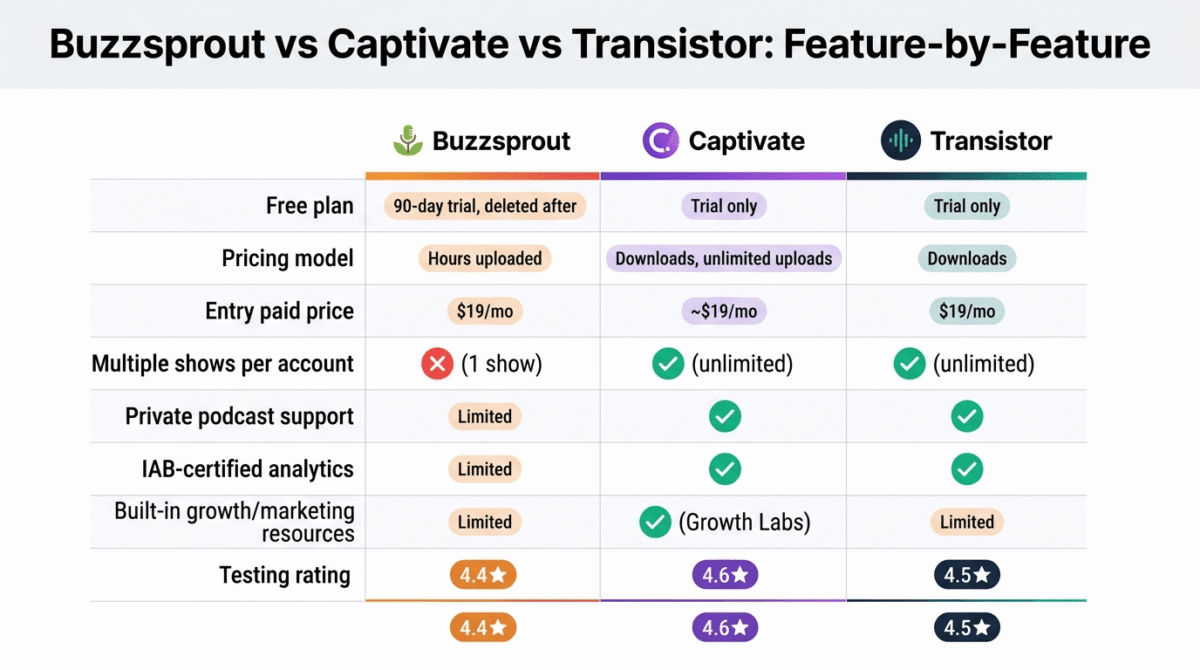
| Feature / Criteria | Buzzsprout | Captivate | Transistor |
|---|---|---|---|
| Free plan | 90-Day Free Trial Files purged after 90 days | 7-Day Free Trial Full feature access during trial | 14-Day Free Trial Full feature access during trial |
| Pricing model | Hours uploaded / month Unlimited downloads included | Downloads / month Unlimited uploads & shows | Downloads / month Unlimited uploads & shows |
| Entry paid price | $19 / month Includes 6 hours upload/month | ~$19 / month $17/mo billed annually (30k downloads) | $19 / month Starter plan (20k downloads) |
| Multiple shows per account | Multi-Podcast tier required Standard plans cover 1 show | Yes, unlimited Pooled download traffic across shows | Yes, unlimited Pooled download traffic across shows |
| Private podcast support | Limited Basic subscriber options | Yes Subscriber management & private RSS | Yes Subscriber caps per tier (50 / 500 / 3,000) |
| IAB-certified analytics | Yes IAB v2.2 certified across all paid plans | Yes IAB v2 certified with link attribution | Yes IAB v2 certified listener tracking |
| Built-in growth / marketing resources | Standard In-depth guides, Cohost AI add-on | Yes (Growth Labs) Integrated courses, masterminds & SEO tools | Standard Built-in website builder & smart link landing pages |
| Video support | Audio + Video tier Apple Podcasts video feed distribution | Limited Primary focus on audio RSS feeds | Limited Auto-posting audio episodes to YouTube |
| Support quality | Standard email support Extensive self-serve help library | Standard live chat & email Support from active podcasters | Human-only chat & email Direct access to founders & support team |
| Best for | First-time solo creators seeking simplicity and quick setup | Growth-focused creators, multi-show networks, and independent podcasters | Agencies, enterprise brands, and creators managing multiple podcasts |
Which Platform Should You Choose?
Choose Buzzsprout if:
This is your first podcast, you want the simplest possible path from recording to a published episode, and you are running a single show without immediate plans to add a second. The 90-day free trial is a genuine, no-risk way to test whether podcasting is something you want to commit to.
Choose Captivate if:
You are thinking about your podcast as a long-term audience-building project from day one, you publish frequently or run longer episodes, and you want growth and sponsorship support built into the same platform that hosts your files. The download-based pricing with unlimited uploads is the right model for an ambitious, growing show.
Choose Transistor if:
You are running, or planning to run, more than one podcast, a public show plus a private supporter feed, multiple client shows for an agency, or several shows under one brand. The unlimited-shows structure and human support make it the clear right tool for this specific, less common but real use case.
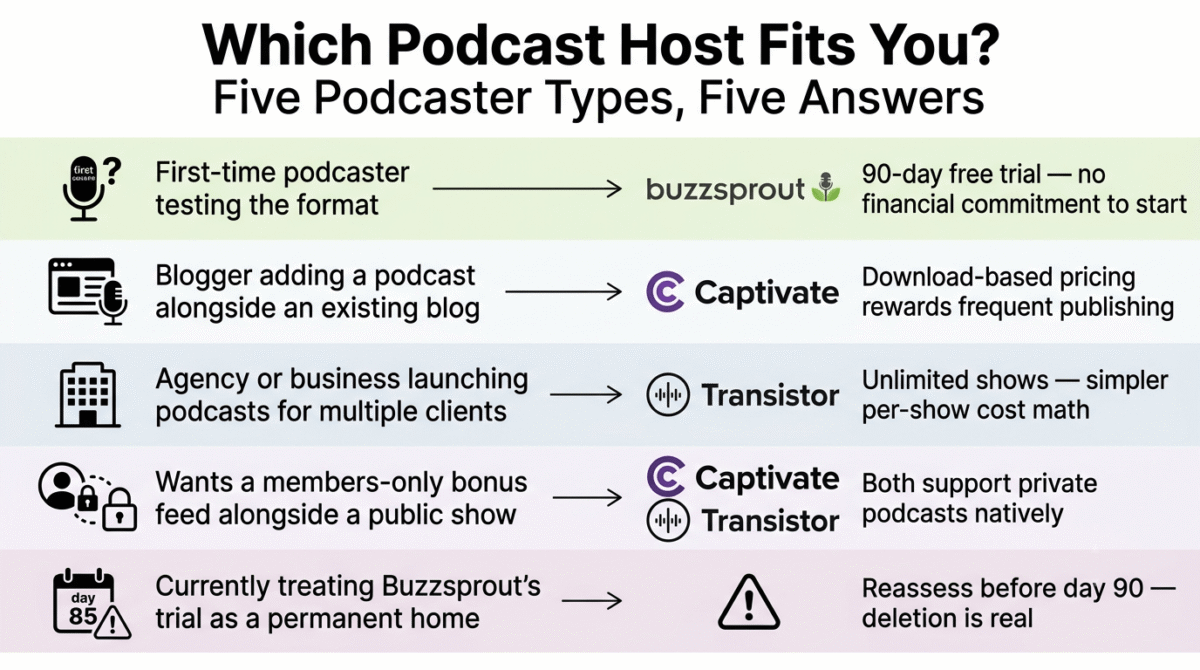
The Podcaster Setup Recommendation
Based on 30 days of testing across real episode publishing and directory distribution, here is the recommended setup by podcaster type:
First-time podcaster testing the format: Buzzsprout’s 90-day free trial. There is no financial commitment required to find out whether you will stick with podcasting, though be aware your episodes are deleted if you do not upgrade before the trial ends.
Blogger adding a podcast as a content format alongside an existing blog: Captivate, for the growth tools and download-based pricing that rewards building an actual audience rather than penalizing frequent publishing, which most active bloggers will want to do. Promoting each new episode consistently matters just as much as hosting it well, see our Buffer vs Publer vs Sprout Social comparison of social media scheduling tools for that side of the workflow.
Agency or business launching podcasts for multiple clients or departments: Transistor, specifically for the unlimited-shows structure that makes per-show cost calculations dramatically simpler than juggling separate accounts across platforms.
Podcaster wanting a members-only bonus feed alongside a public show: Captivate or Transistor, both of which support private podcasts natively, Buzzsprout’s standard plans are not built for this use case.
Anyone currently treating Buzzsprout’s free trial as a permanent home for their show: Reassess before the 90-day window closes. The deletion policy is real, and losing a back catalog of published episodes is a genuinely avoidable mistake with enough advance planning.
Final Verdict
Captivate is the best overall podcast hosting platform for most growing shows in 2026, its download-based pricing rewards frequent publishing rather than penalizing it, its Growth Labs resource is unmatched by either competitor, and IAB-certified analytics give it real credibility for sponsorship conversations.
Buzzsprout remains the best entry point for a first-time podcaster, nothing in this comparison is simpler to start with, and the free trial provides a genuinely risk-free way to test the format before committing financially.
Transistor is the best choice for the specific, real use case of running multiple shows, agencies, networks, and businesses managing more than one podcast under a single account will find no better structural fit in this comparison.
Ratings:
- Captivate: 4.6 / 5
- Transistor: 4.5 / 5
- Buzzsprout: 4.4 / 5
Frequently Asked Questions
What is the best podcast hosting platform in 2026?
Captivate is the best overall choice for most growing podcasts, due to its download-based pricing, built-in growth tools, and IAB-certified analytics. Buzzsprout is the best choice for a first-time podcaster wanting the simplest possible starting experience. Transistor is the best choice specifically for agencies, networks, or anyone running multiple shows under one account.
Is Buzzsprout’s free plan actually free forever?
No. Buzzsprout’s free option is a 90-day trial, not an ongoing free tier, and uploaded audio is deleted after that period if you do not upgrade to a paid plan. Podcasters who want a genuinely free, indefinite hosting option should look outside this comparison’s three main platforms, while understanding that alternatives like Spotify for Creators carry their own tradeoffs, including a significant revenue share on monetized content.
What is the difference between hour-based and download-based pricing?
Hour-based pricing, used by Buzzsprout, charges based on how much audio you upload each month, regardless of how many people listen, this can become limiting for podcasters who publish frequently or run long episodes. Download-based pricing, used by Captivate and Transistor, charges based on how many times episodes are downloaded each month, which scales with your actual audience size rather than your publishing volume.
Can I host more than one podcast on these platforms?
Buzzsprout’s standard plans limit accounts to one podcast. Captivate and Transistor both support unlimited podcasts under a single account at every pricing tier, making either a better choice if you are running, or planning to run, more than one show.
Do these platforms submit my podcast to Spotify and Apple Podcasts for me?
Yes, all three platforms handle the bulk of directory submission, providing direct distribution links and, in many cases, one-click or largely automated submission to major platforms including Spotify and Apple Podcasts. Google’s podcast indexing generally happens automatically once your RSS feed is public, without requiring manual submission through any of these hosts.
What happens to my podcast if I switch hosting platforms later?
Switching hosts is a well-established, generally straightforward process across this category, since podcast RSS feeds are built on an open standard rather than proprietary lock-in. Most platforms, including all three compared here, provide redirect tools that preserve your existing subscriber base and episode history when migrating, though the specific steps and any associated downtime should be confirmed directly with your new host before initiating a switch.
Do I need IAB-certified analytics if I am not seeking sponsors yet?
Not immediately, but it is worth considering even for an early-stage show. IAB certification matters most when approaching potential sponsors who expect industry-standard measurement, but accurate download data is also genuinely useful for understanding your own show’s growth and audience behavior regardless of monetization plans, making it a reasonable feature to prioritize even before you are actively seeking sponsorship.