If you are serious about growing a blog through organic search traffic, you need an SEO tool. Not because SEO is complicated, but because you cannot optimise what you cannot measure.
Without an SEO tool, you are guessing which keywords to target, estimating how hard it will be to rank, and hoping your content is performing. With a good SEO tool, you know exactly which keywords drive traffic to your competitors, which pages on your site are underperforming, and which backlink opportunities would most improve your rankings.
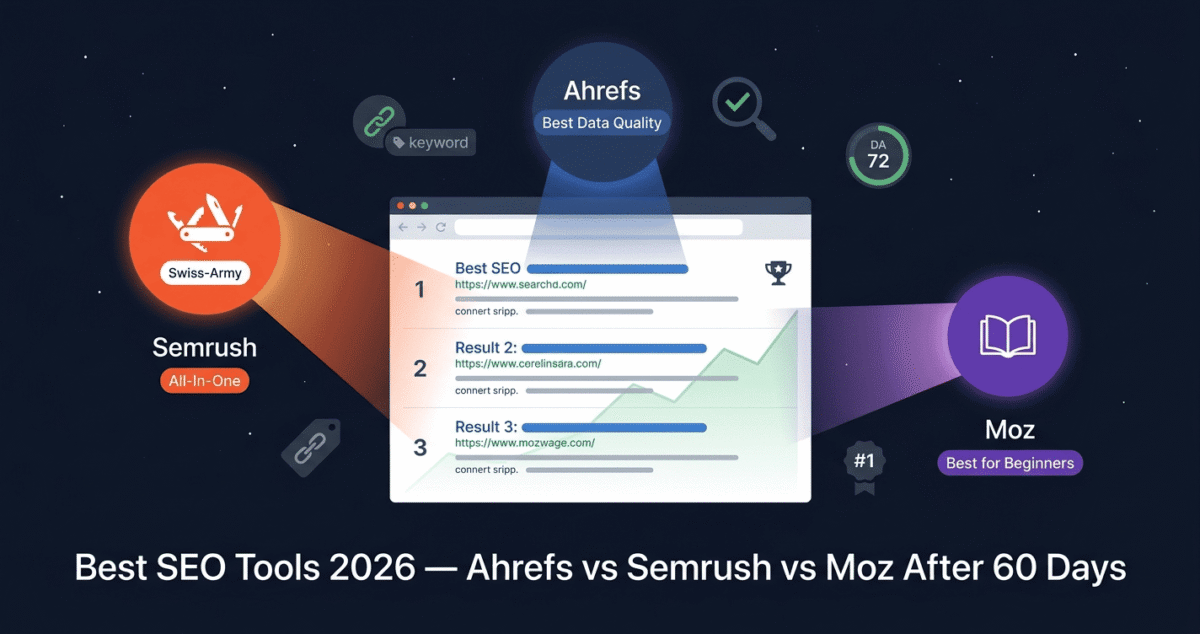
The challenge is that Ahrefs, Semrush, and Moz are all expensive, and they all claim to be the best. I tested all three for 60 days on real websites, including this blog. Here is the honest comparison of Ahrefs vs Semrush vs Moz and which one is worth your money in 2026.
Table of Contents
How We Evaluated These SEO Tools
Every platform was tested across five criteria:
– Keyword research accuracy of search volume data, keyword difficulty scores, and keyword ideas
– Backlink analysis size and freshness of the backlink database
– Site audit ability to identify and prioritise technical SEO issues
– Rank tracking accuracy and frequency of position tracking
– Value: what you get for the price, including free plan and trial options
Why SEO Tools Matter More Than Ever in 2026
Search engine optimisation has become more competitive and more data-dependent in 2026. Google’s algorithms consider hundreds of signals, content quality, page speed, backlink authority, topical relevance, user engagement, and more. AI-powered search (Google’s AI Overviews, Bing AI, Perplexity) has changed how some queries are answered, but organic search results remain the primary traffic source for most informational and commercial websites.
For bloggers specifically, SEO tools matter for three core tasks:
Keyword research: finding search terms your target audience uses, understanding how competitive they are, and identifying gaps your competitors have not covered. For example, finding high-intent commercial keywords can directly feed traffic into your high-ticket monetization blueprints, replacing low-yield display ads with high-margin returns.
Content optimisation: understanding what existing content needs to be improved, updated, or consolidated to rank better. While SEO tools pinpoint architectural and search-landscape gaps, layering this information with data from visual behavior analytic engines shows exactly how users interact with that text once they arrive.
Backlink analysis: understanding who links to your competitors and identifying opportunities to earn similar links to your own content.
Without data from a dedicated SEO tool, all three of these activities rely on guesswork. With it, they become systematic and measurable.
Semrush Review: Best All-in-One SEO Platform
Free plan: Yes, 10 queries/day, limited features
Starting price: $139.95/month (Pro, billed monthly) | $117.33/month (billed annually)
Best plan for most bloggers: Pro, $117.33/month (billed annually)
Platforms: Web
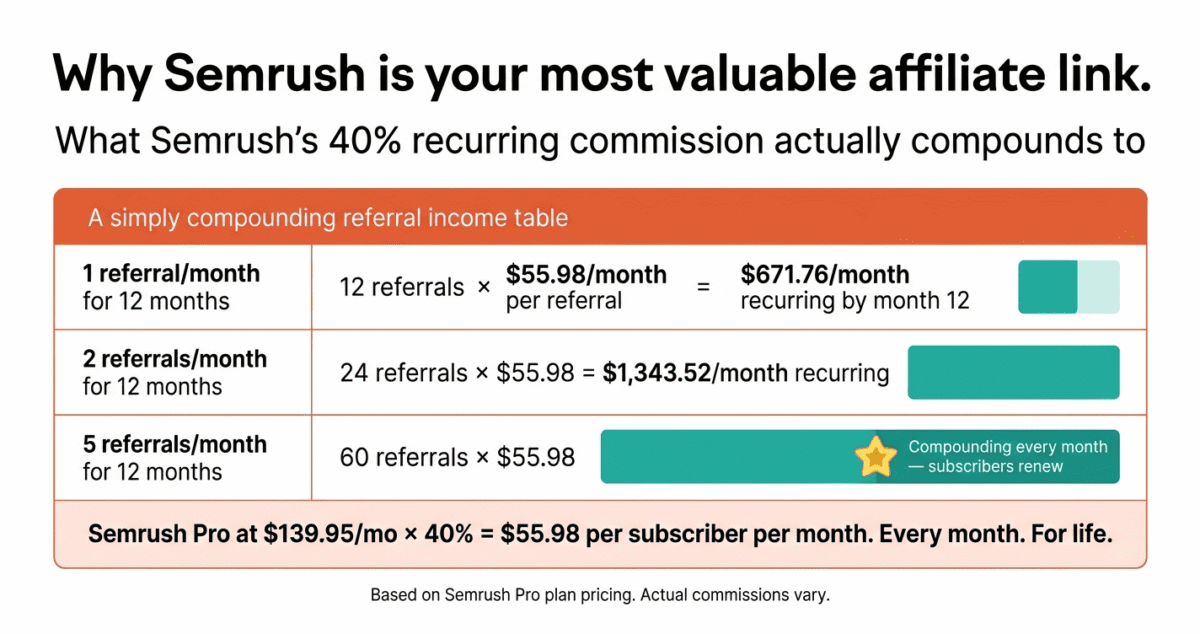
Affiliate program: Yes, 40% recurring commission for the life of the customer
Semrush is the most comprehensive SEO and digital marketing platform available in 2026. It covers keyword research, backlink analysis, site audit, rank tracking, competitor analysis, content marketing, social media management, local SEO, and paid advertising research, all in a single subscription. For bloggers and digital marketers who want one tool to handle every aspect of their online presence, Semrush is the most complete solution available.
What Semrush does best
Semrush’s keyword research database is the largest of the three tools, with over 25 billion keywords across 142 countries. The Keyword Magic Tool generates thousands of keyword variations from a single seed keyword, organised by topic cluster, question format, and search intent. Filtering by keyword difficulty, search volume, and CPC (cost per click) helps identify the most valuable ranking opportunities quickly.
The Keyword Difficulty score in Semrush is the most nuanced of the three tools; it considers not just the domain authority of ranking pages but also the topical relevance of those pages and the likelihood that a new entrant could realistically displace them. In testing, Semrush’s difficulty scores were the most accurate predictor of the actual ranking effort required.
Semrush’s competitor analysis is its most distinctive capability. The Domain Overview report shows you exactly which keywords any competitor ranks for, which pages drive the most traffic, and which backlinks contribute most to their authority. For a blogger entering a new niche, this competitive intelligence is invaluable. You can identify exactly which content your competitors produce that drives traffic and create something better.
The Content Marketing Toolkit, included in all plans, is unique to Semrush among the three tools. The SEO Content Template analyses the top ten ranking pages for your target keyword and generates recommendations for word count, semantic keywords to include, readability target, and backlink targets. The SEO Writing Assistant integrates with Google Docs and WordPress, providing real-time optimisation feedback as you write. If you want a tool built specifically around AI-assisted SEO writing rather than Semrush’s built-in assistant, our Jasper vs Surfer SEO vs MarketMuse comparison covers the dedicated content-optimization platforms. This workflow ensures your organic informational hubs perform perfectly, much like optimizing visual landing page environments for conversion efficiency.
The Site Audit tool is the most thorough of the three platforms; it checks over 130 technical SEO factors and prioritises issues by their potential impact on rankings. The audit runs automatically on a schedule and tracks improvements over time, making it genuinely useful for ongoing site maintenance rather than just a one-time diagnostic. Once technical integrity is assured, coordinating the distribution of your newly audited content through cross-platform social suite automation multiplies your visibility parameters seamlessly.
Semrush’s backlink database contains over 43 trillion backlinks, the largest of the three tools, with daily updates that reflect the current state of the web more accurately than weekly or monthly crawl cycles.
The Position Tracking tool monitors your rankings for up to 500 keywords daily (Pro plan), showing movement over time, SERP feature capture (featured snippets, image packs, local packs), and competitor ranking comparisons side by side.
Semrush’s affiliate program: the best in SEO tools
Semrush pays 40% recurring commission for the lifetime of the customer. A reader who signs up for Semrush Pro at $139.95/month earns you $55.98 every single month for as long as they remain a subscriber. Ten such referrals = $559.80/month in recurring affiliate income from this one post, compounding every month as more readers convert and existing referrals continue their subscriptions.
This is one of the most valuable affiliate programs in the software review niche.
Where Semrush falls short
Semrush is expensive. The Pro plan at $139.95/month (or $117.33/month billed annually) is a significant commitment for bloggers in the early stages. The free plan’s 10 daily queries are enough for occasional research but inadequate for regular use.
The interface is the most complex of the three tools. Semrush covers so many features that new users often feel overwhelmed by the options. The learning curve is steeper than Moz and comparable to Ahrefs. Most users only ever use a fraction of the available functionality.
Semrush’s backlink data, while the largest database, has historically included more low-quality and spam links than Ahrefs’ more curated database. For backlink analysis specifically, Ahrefs’ data quality is often considered superior despite the smaller absolute database size.
Semrush pricing
Plan | Monthly price | Annual price/month | Keywords tracked | Key features |
Pro | $139.95 | $117.33 | 500 | 5 projects, keyword research, site audit, rank tracking |
Guru | $249.95 | $208.33 | 1,500 | + Content Marketing Toolkit, historical data, multi-location |
Business | $499.95 | $416.66 | 5,000 | + API access, white label, extended limits |
Semrush: Pros and Cons
Pros:
– Largest keyword database, 25 billion keywords in 142 countries
– Most comprehensive platform, SEO, content, social, PPC in one tool
– Best competitor analysis, see exactly what drives competitor traffic
– Content Marketing Toolkit with SEO Writing Assistant for Google Docs
– Largest backlink database, 43 trillion links with daily updates
– Best affiliate program, 40% recurring lifetime commission
– Site audit checks 130+ technical SEO factors
– 14-day free trial on paid plans
Cons:
– Most expensive starting price, $117.33/month billed annually
– Most complex interface, steepest learning curve
– Free plan limited to 10 queries/day, barely useful
– Backlink data quality slightly below Ahrefs despite larger volume
– Many features most bloggers will never use
– Pro plan limits (5 projects, 500 keywords) feel restrictive at the price
Rating: 4.7 / 5 Best all-in-one SEO and digital marketing platform. The 40% recurring affiliate commission makes it the most valuable tool to recommend to your readers.
Ahrefs Review: Best SEO Tool for Backlink Analysis and Content Research
Free plan: Yes, Ahrefs Webmaster Tools (site audit and backlink data for your own site)
Starting price: $129/month (Lite, billed monthly) | $108/month (billed annually)
Best plan for most bloggers: Lite, $108/month (billed annually)
Platforms: Web
Affiliate program: Yes, Ahrefs affiliate program
Ahrefs is the SEO tool most respected by professional SEOs, particularly for backlink analysis and keyword research quality. While Semrush wins on breadth of features, Ahrefs wins on depth of data quality; its backlink index is widely considered the most accurate and actionable, and its keyword data is the most reliable for understanding actual search demand.
What Ahrefs does best
Ahrefs’ backlink database is the gold standard in the SEO industry. With over 35 trillion known backlinks and one of the fastest crawl rates of any SEO tool, Ahrefs shows you new and lost backlinks faster and more accurately than any competitor. The Link Intersect tool, showing which sites link to your competitors but not to you, is the most actionable link building feature in any SEO tool.
The Keywords Explorer is the most data-rich keyword research tool available. For every keyword, Ahrefs shows search volume, keyword difficulty, clicks (not the same as searches; many searches get answered without a click), traffic potential of the top-ranking page, and parent topic (the broader keyword the page is most likely to rank for). The clicks data is unique to Ahrefs and particularly valuable; it prevents you from targeting keywords that get many searches but few actual website visits due to featured snippets or other SERP features.
Content Explorer is Ahrefs’ most distinctive feature, a searchable database of over 15 billion web pages indexed by content performance. Search for any topic and find the most-linked, most-shared, and highest-traffic pages about that topic. This makes it the best tool for content ideation, identifying what performs well in your niche, and finding link-building targets.
Site Explorer, Ahrefs’ competitor analysis tool, shows any domain’s organic traffic, top keywords, top pages, and backlink profile. For understanding what drives a competitor’s search success, Ahrefs’ Site Explorer is the most detailed view available.
The Site Audit tool is strong and has improved significantly in recent years, it catches technical SEO issues clearly and prioritises them helpfully. It is not quite as comprehensive as Semrush’s 130-factor audit, but it covers all the issues that meaningfully affect rankings.
Ahrefs Webmaster Tools, the free tier, is one of the most valuable free SEO offerings available. It gives you site audit and backlink data for websites you verify ownership of, which means bloggers can get meaningful SEO data for their own site at zero cost. This is genuinely useful for monitoring your own site’s backlink profile and technical health without paying for a full subscription.
Where Ahrefs falls short
Ahrefs has no content marketing tools, no SEO writing assistant, no content brief generator, and no social media or PPC research. It is a pure SEO tool, and users who want content marketing features alongside SEO need either Semrush or separate tools.
The free plan is limited to your own verified sites; you cannot research competitor keywords or backlinks without a paid subscription. For competitive research, Ahrefs requires a paid plan from day one.
Ahrefs removed its trial option in 2022; there is no free trial of the paid features. You commit $108/month without a risk-free evaluation period, which is a meaningful barrier compared to Semrush’s 14-day trial.
Rank tracking updates daily on higher plans but only weekly on the Lite plan, meaning position data can be up to 7 days old. Semrush tracks rankings daily on all paid plans.
Ahrefs pricing
Plan | Monthly price | Annual price/month | Projects | Key features |
Lite | $129 | $108 | 5 | Site Explorer, Keywords Explorer, Site Audit, Rank Tracker |
Standard | $249 | $208 | 20 | + Content Explorer, 6-month history |
Advanced | $449 | $374 | 50 | + Looker Studio integration, 2-year history |
Enterprise | $1,499 | Custom | Unlimited | + API, SSO, custom limits |
Ahrefs: Pros and Cons
Pros:
– Best backlink database quality, most accurate and actionable link data
– Best keyword data depth, clicks data unique to Ahrefs
– Content Explorer for topic and link building research
– Ahrefs Webmaster Tools free, site audit and backlinks for your own site
– Most trusted by professional SEOs for data accuracy
– Clean, intuitive interface, easier to navigate than Semrush
– Link Intersect for identifying competitor link building opportunities
Cons:
– No free trial of paid features, $108/month commitment without evaluation
– No content marketing tools, pure SEO focus
– Rank tracking weekly on Lite plan (not daily)
– More expensive than Moz for equivalent functionality
– No social media, PPC, or content marketing research
– Standard plan required for Content Explorer, most valuable feature
Rating: 4.6 / 5 Best SEO tool for data quality and backlink analysis. The preferred tool of professional SEOs worldwide.
Moz Pro Review: Best SEO Tool for Beginners and Small Blogs
Free plan: Yes, Moz Free (limited searches), MozBar browser extension
Starting price: $99/month (Starter, billed monthly) | $79/month (billed annually)
Best plan for most bloggers: Starter, $79/month (billed annually)
Platforms: Web, Chrome extension (MozBar)
Affiliate program: Yes, Moz affiliate program
Moz is the oldest dedicated SEO tool on this list; it pioneered the concept of Domain Authority (DA) as a metric for measuring website strength, and its MozBar browser extension has been a staple of SEO practitioners for over a decade. In 2026, Moz Pro is the most affordable premium SEO tool and the most accessible for bloggers new to SEO analysis.
What Moz does best
Moz’s Domain Authority (DA) score, a 1–100 scale predicting how likely a website is to rank in search results, has become an industry-standard metric used by virtually every SEO practitioner worldwide. Despite not being a Google metric, DA correlates well with actual ranking ability and is universally used for quick website authority comparisons.
The MozBar Chrome extension is the most widely used free SEO browser extension available. It overlays DA and Page Authority (PA) scores, link metrics, and on-page SEO data directly on search results and any web page you visit, without needing to open the Moz dashboard. For quick competitive analysis while browsing, MozBar provides immediate insight at no cost.
Moz Pro’s Keyword Explorer generates solid keyword research data with a particularly useful Priority Score, a composite metric combining search volume, keyword difficulty, and organic click-through rate into a single number that helps prioritise which keywords deserve your attention first. For bloggers overwhelmed by keyword data, this simplified prioritisation is genuinely helpful.
The Link Explorer backlink tool shows your site’s backlink profile with DA scores for linking domains, useful for evaluating the quality of your existing links and identifying potentially harmful low-quality links.
Moz’s on-page optimisation tool, Page Optimisation, analyses individual pages against target keywords and provides specific recommendations for improvement. The recommendations are clear, prioritised, and actionable, particularly useful for bloggers optimising existing content that is not ranking as well as expected.
Moz Pro’s interface is the cleanest and most beginner-friendly of the three tools. New users can navigate the platform and find useful data without feeling overwhelmed by options. The learning resources, Moz Academy, Whiteboard Friday videos, and the Moz Blog are the best educational resources of any SEO tool company, making it the most supportive environment for SEO beginners.
Where Moz falls short
Moz’s data is the least comprehensive of the three tools. The keyword database is smaller than Semrush and Ahrefs, the backlink index is updated less frequently, and the site audit checks fewer technical factors. For competitive niches where every data point matters, Moz’s limitations become significant.
The Starter plan at $79/month is limited to 1 user, 3 campaigns (tracked domains), and 300 keyword rankings, restrictive for bloggers managing multiple sites or tracking more than a handful of target keywords per site.
Moz has fallen behind Semrush and Ahrefs in feature development. The Content Marketing Toolkit available in Semrush, the Content Explorer in Ahrefs, and the advanced competitor analysis features in both tools have no equivalent in Moz Pro. For serious SEO practitioners, Moz has become a supplementary tool rather than a primary platform.
Rank tracking updates weekly rather than daily on all Moz Pro plans, a limitation that both Semrush and Ahrefs address on their paid plans.
Moz pricing
Plan | Monthly price | Annual price/month | Campaigns | Keywords tracked |
Starter | $99 | $79 | 3 | 300 |
Standard | $179 | $143 | 10 | 1,500 |
Medium | $299 | $239 | 25 | 5,000 |
Large | $599 | $479 | 50 | 10,000 |
Moz: Pros and Cons
Pros:
– Most affordable starting price, $79/month billed annually
– Domain Authority, industry standard metric used by all SEO practitioners
– MozBar Chrome extension, free, widely used, immediately useful
– Most beginner-friendly interface and learning resources
– Priority Score simplifies keyword prioritisation for new users
– 30-day free trial, the longest trial of the three tools
– Page Optimisation tool for actionable on-page recommendations
Cons:
– Smallest keyword and backlink database of the three tools
– Rank tracking weekly only, not daily
– Fewest features, no content marketing or competitor gap analysis tools
– Starter plan very limited, 3 campaigns, 300 keywords
– Has fallen behind Semrush and Ahrefs in feature development
– Less accurate data in competitive niches
Rating: 4.1 / 5 Best SEO tool for beginners and small blogs. Most affordable entry point with the longest free trial, but outclassed by Semrush and Ahrefs for serious SEO work.
Head-to-Head Comparison
Semrush Pro | Ahrefs Lite | Moz Starter | |
Annual price/month | $117.33 | $108 | $79 |
Free plan | 10 queries/day | Own site only (AWT) | MozBar + limited |
Free trial | 14 days | None | 30 days |
Keyword database | 25 billion | 28 billion | ~1 billion |
Backlink database | 43 trillion | 35 trillion | Smaller |
Rank tracking | Daily | Weekly (Lite) | Weekly |
Site audit depth | 130+ factors | Strong | Moderate |
Content marketing tools | Yes (full suite) | No | No |
Competitor gap analysis | Excellent | Excellent | Limited |
Beginner friendliness | Moderate | Moderate | Best |
Affiliate commission | 40% recurring lifetime | Standard | Standard |
Best for | All-in-one marketing | Backlinks + keywords | Beginners + budget |
Which SEO Tool Should You Choose?
Choose Semrush if:
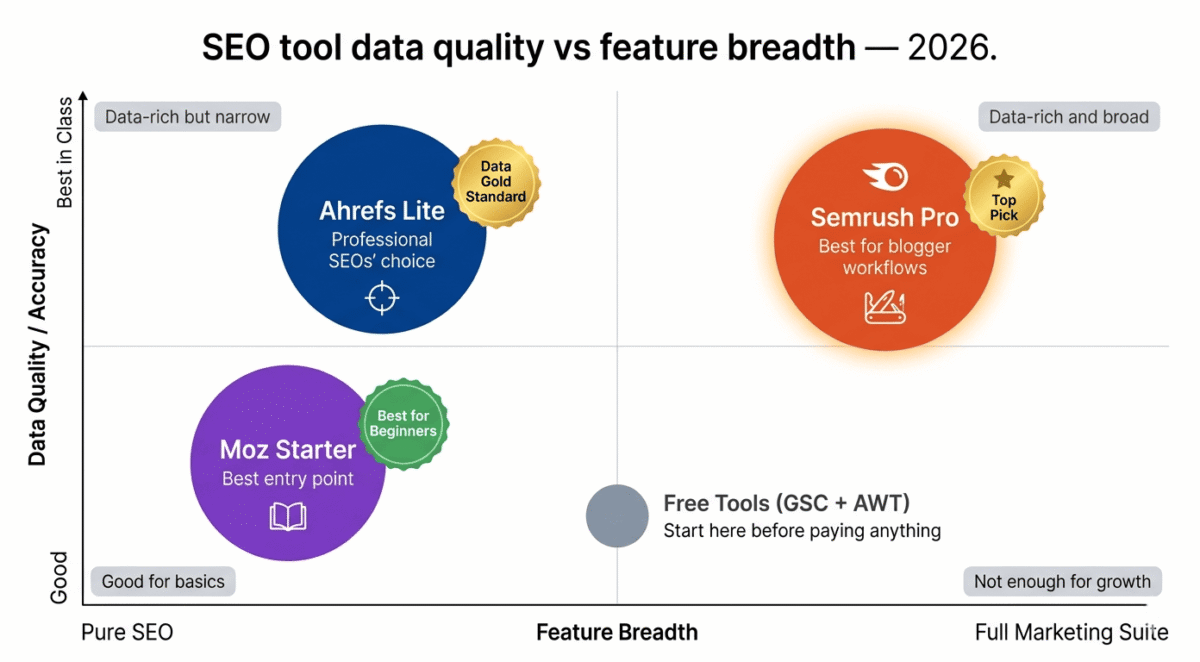
You want the most comprehensive SEO and digital marketing platform and the highest-value affiliate program to recommend to your readers. Semrush’s competitor analysis, Content Marketing Toolkit, and SEO Writing Assistant make it the most complete tool for bloggers who want to research, write, and optimise content in one ecosystem. The 40% recurring affiliate commission makes it uniquely valuable to recommend on your blog.
Choose Ahrefs if:
Backlink analysis and keyword data quality are your top priorities. Ahrefs is the preferred tool of professional SEOs for a reason; its data is the most trusted in the industry. Use Ahrefs Webmaster Tools free to monitor your own site, and upgrade to Lite when you need competitor keyword and backlink research. The lack of a free trial is a genuine drawback; be confident before committing.
Choose Moz if:
You are new to SEO tools and want the most approachable entry point with the longest free trial. The MozBar browser extension is worth installing regardless of which paid tool you choose. Moz’s Priority Score and beginner-friendly interface make it the lowest-friction starting point for bloggers who find Semrush and Ahrefs overwhelming.
Free SEO Tools Worth Using Alongside a Paid Subscription
Before spending $80–$140/month on an SEO tool, take advantage of these free tools that provide meaningful data at no cost:
Google Search Console: your most important free SEO tool. Shows exactly which queries your pages rank for, your average position, click-through rates, and indexing issues. Every blogger should set this up before spending on paid SEO tools.
Google Analytics 4 shows which pages drive traffic, how long visitors stay, and where they come from. Essential for understanding what is working.
Ahrefs Webmaster Tools: free site audit and backlink data for your own verified domains. Use this before paying for a full Ahrefs subscription.
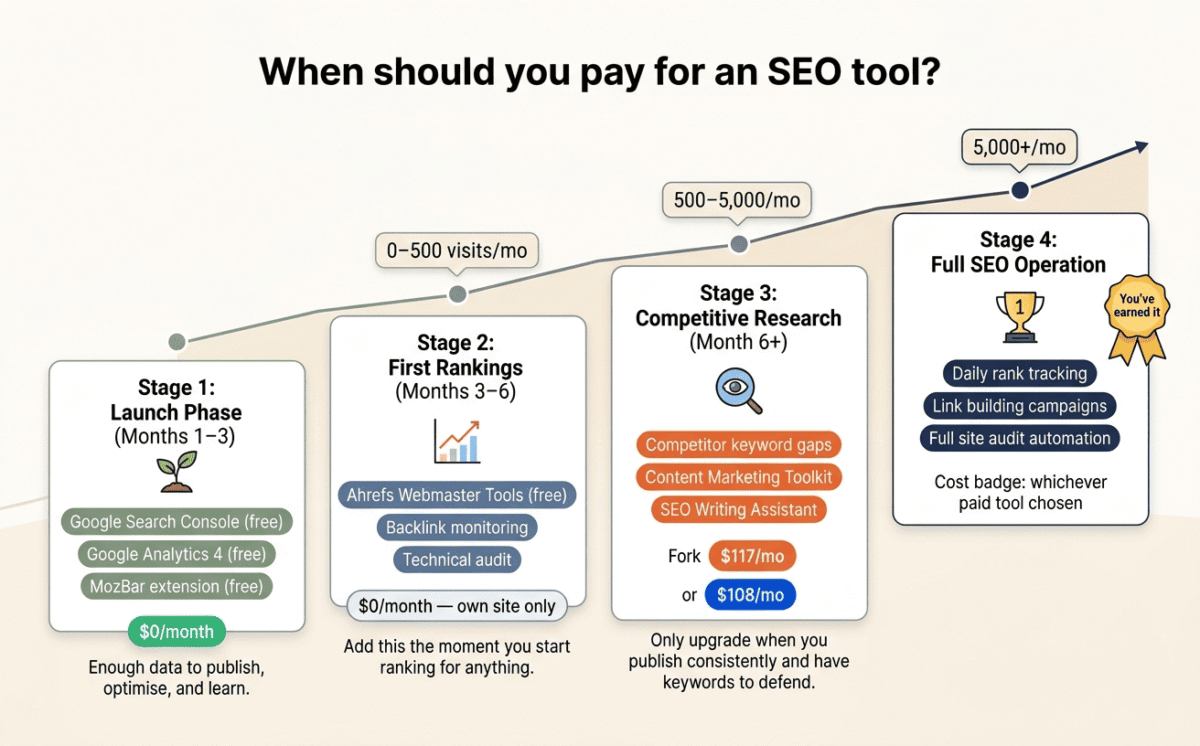
MozBar Chrome extension: free DA scores and basic SEO data overlaid on every webpage you visit. Install this regardless of which paid tool you use.
Ubersuggest: Neil Patel’s freemium SEO tool provides keyword ideas, basic difficulty scores, and limited competitor data at zero cost. A useful supplement for light keyword research. For a full keyword research deep dive comparing Ubersuggest against paid options, see our Ahrefs vs Semrush vs Ubersuggest breakdown.
For bloggers in the first 3–6 months of launching, Google Search Console plus Ahrefs Webmaster Tools provides enough free data to make meaningful content decisions. Invest in a paid SEO tool when you are publishing consistently, have some rankings to optimise, and the potential return on better keyword data justifies the monthly cost.
Final Verdict
Semrush is the best SEO tool for most bloggers and digital marketers: its comprehensive feature set, accurate keyword data, powerful competitor analysis, and content marketing tools make it the most complete platform available. The 40% recurring lifetime affiliate commission makes it the most valuable tool to recommend to your readers.
Ahrefs is the best tool for serious SEO practitioners: if data quality and backlink analysis are your top priorities, Ahrefs is the most trusted platform in the industry. The lack of a free trial is a genuine drawback.
Moz is the best starting point for complete SEO beginners: the most affordable entry price, the longest free trial, and the most accessible interface make it the lowest-risk introduction to paid SEO tools.
Ratings:
– Semrush: 4.7 / 5
– Ahrefs: 4.6 / 5
– Moz: 4.1 / 5
Frequently Asked Questions
What is the best SEO tool for bloggers in 2026?
Semrush is the best SEO tool for most bloggers, its keyword research, competitor analysis, Content Marketing Toolkit, and SEO Writing Assistant cover every aspect of a blogger’s SEO workflow in one platform. For bloggers focused primarily on backlink analysis and keyword research quality, Ahrefs is the preferred alternative among SEO professionals.
Is Semrush worth the price?
Yes, for bloggers and marketers who publish content regularly and want data-driven insights into keyword opportunities and competitor strategies. The Pro plan at $117.33/month (billed annually) is expensive, but the time saved on keyword research and content optimisation, and the traffic gained from better-targeted content, typically generate a return that exceeds the cost within a few months of consistent use.
Is Ahrefs better than Semrush?
Neither is definitively better; they excel in different areas. Ahrefs is better for backlink analysis and keyword data quality. Semrush is better for content marketing tools, competitor gap analysis, and overall platform breadth. Most SEO professionals who work with multiple websites use both. For bloggers who can afford one tool, Semrush’s content marketing features give it the edge for a blogging-specific workflow.
What is Domain Authority and why does it matter?
Domain Authority (DA) is a score from 1 to 100 developed by Moz that predicts how likely a website is to rank in search results; higher scores indicate stronger ranking potential. It is calculated based on the quality and quantity of backlinks pointing to your site. While not a Google metric, DA is widely used by SEO practitioners to assess website strength and evaluate whether a domain has enough authority to rank for competitive keywords.
Can I do SEO without paying for tools?
Yes, Google Search Console and Google Analytics 4 are both free and provide the most important data for basic SEO: which queries you rank for, your positions, click-through rates, and traffic sources. Ahrefs Webmaster Tools adds free backlink and audit data for your own site. MozBar provides free competitor DA scores in your browser. These free tools are sufficient for bloggers in the early stages. Paid tools become worth it when you need competitor keyword research, backlink gap analysis, and keyword difficulty data at scale.
What is the cheapest SEO tool that is actually useful?
Moz Starter at $79/month, billed annually, is the cheapest premium SEO tool with a 30-day free trial. For an even more affordable option, Ubersuggest offers a lifetime plan, and Mangools offers plans from $29/month; both provide keyword research and basic competitor analysis at lower price points than Semrush, Ahrefs, or Moz, though with smaller databases and fewer features.
How long does it take to see results from SEO?
Typically, 3–6 months for new websites to see meaningful organic traffic from SEO efforts and 6–12 months to rank competitively for moderate-difficulty keywords. The timeline depends on your domain authority, content quality, publishing frequency, and how competitive your target keywords are. SEO tools help accelerate this timeline by ensuring you target achievable keywords and optimise content effectively, but they do not bypass the fundamental time requirement for Google to trust and rank new content.
Do I need an SEO tool to rank on Google?
No, many bloggers rank successfully using only Google Search Console and good content instincts. But SEO tools dramatically improve efficiency: instead of guessing which keywords to target, you know exactly how many people search for a term and how hard it is to rank. Instead of wondering why a page is not ranking, you see exactly which technical issues or missing backlinks are holding it back. For bloggers treating their blog as a business rather than a hobby, the data from SEO tools typically generates a return that exceeds the monthly cost.