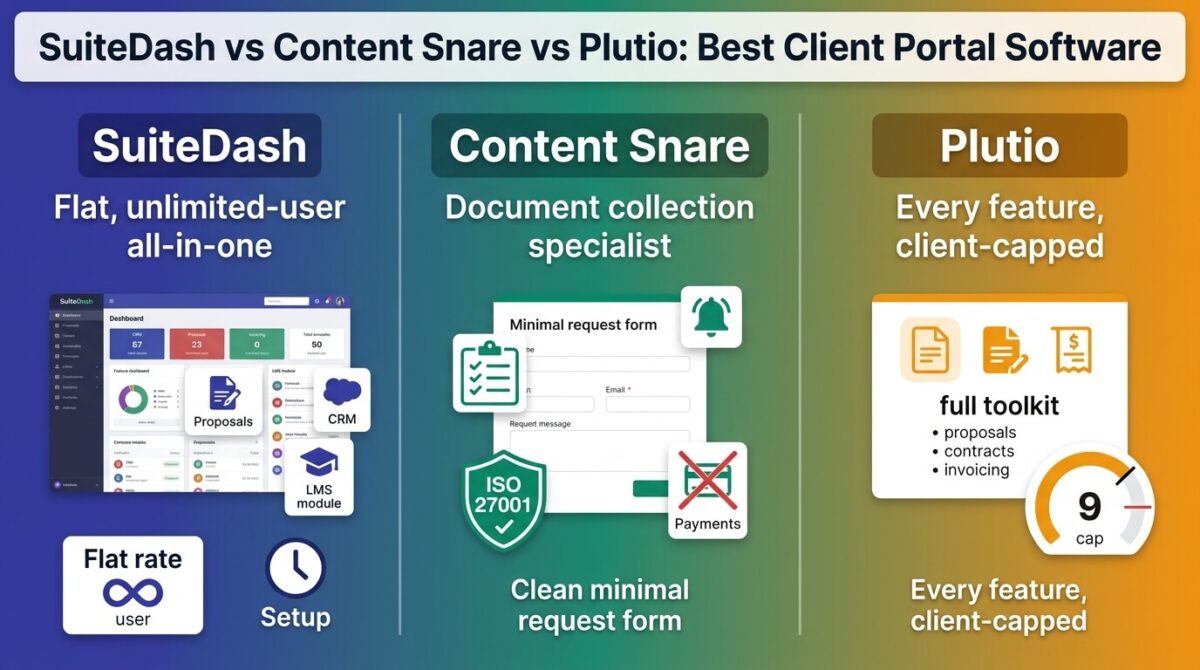
SuiteDash vs Content Snare vs Plutio get compared constantly, though one of the three is solving a narrower problem than the other two. Content Snare does one job specifically: collecting documents and information from clients through a structured, reminder-driven form. SuiteDash and Plutio both try to be the whole client-facing business platform, from proposals through invoicing through an ongoing portal.
Even between the two all-in-one options, the pricing philosophy differs enough to matter. SuiteDash charges a flat fee per workspace with features unlocking by tier. Plutio includes every feature at every tier and instead gates pricing by how many active clients are on the account, with a specific jump between tiers to know about before it happens.
I tested SuiteDash vs Content Snare vs Plutio for 30 days, setting up a client onboarding flow in each and tracking where a growing freelance or agency business would hit a wall in practice. Here is the honest comparison, including a pricing cliff on one platform that more than doubles the monthly cost the moment an 11th client is added.
Table of Contents
How We Tested
Five criteria shaped the testing:
- Scope fit, whether the tool handles document collection alone or the full client relationship
- Pricing structure, flat rate, per-user, or usage-based, and where the cost jumps between tiers
- Feature gating, whether capability is locked by tier or every tier gets the same toolset
- Setup time, how long it took to get a working client-facing flow live
- Realistic cost at growth, what the bill looks like once a business adds more clients or team members
SuiteDash Review: The Most Feature-Dense Option, With a Learning Curve to Match
Free plan: No, 14-day free trial
Starting price: $19/month (Start, billed monthly), $180/year annual
Best plan for most users: Thrive, $49/month, unlocks automation and proposal tools
Platforms: Web, custom-branded mobile app
Affiliate program: Yes, SuiteDash affiliate program
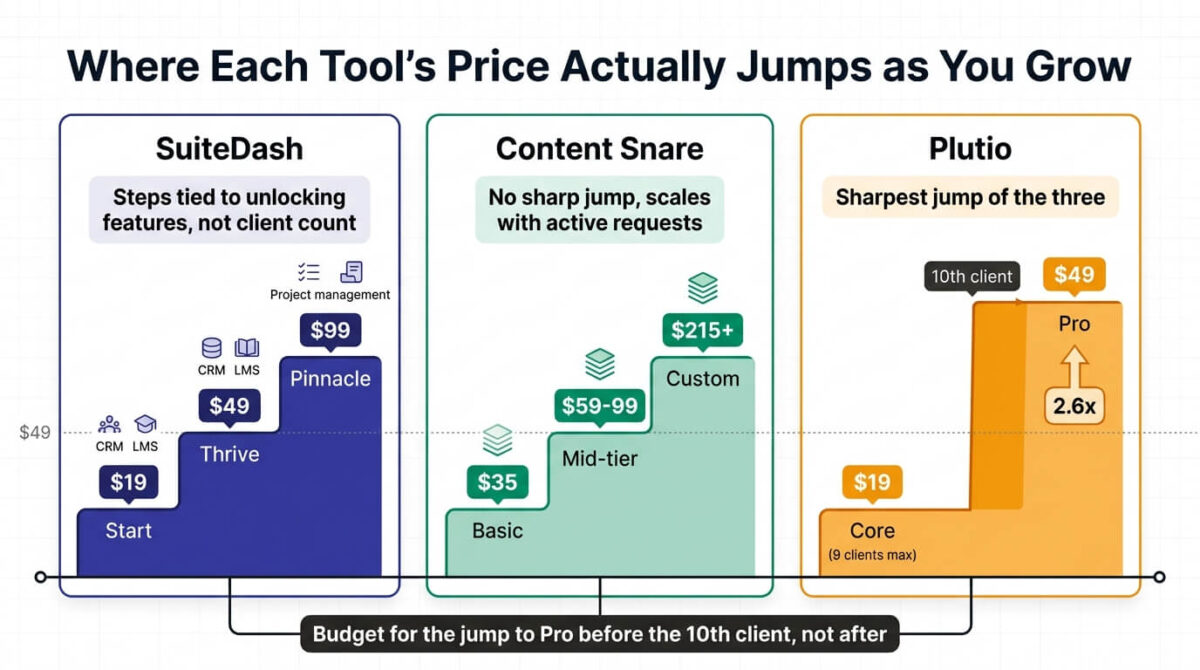
SuiteDash prices flat per workspace rather than per user, meaning unlimited staff and unlimited client portals at every tier, with storage and automation toolkits as what changes between plans.
What SuiteDash does best
Flat, unlimited-user pricing is a clear structural advantage: a five-person team pays exactly what a solo freelancer pays on the same tier, a different cost trajectory than per-seat competitors in adjacent categories. SuiteDash also publishes an openly available lifetime “Century” pricing option, $2,240 to $6,840 depending on tier, a rare transparent lifetime deal rather than one gated behind a third-party marketplace.
The feature depth at Pinnacle, the top tier, is the most comprehensive of the three tools tested: complete automation toolkits that rival dedicated no-code automation tools, 2TB of storage, and an integrated learning management system for client or team onboarding that neither competitor offers.
Where SuiteDash falls short
That feature depth comes with a meaningful setup cost in time. Multiple independent reviews describe SuiteDash’s interface as slower to load and more time-consuming to configure than either competitor, a tradeoff for the breadth of toolkits available. Growth-oriented features like drip marketing, which can supplement your dedicated cold email outreach tools, and dynamic proposals are also locked to Thrive and above, so the $19 Start tier undersells what the platform can do once fully configured.
Automation and workflow tools specifically don’t unlock until Pinnacle at $99/month, a meaningful jump for a solo operator who started on Start and grew into needing them.
SuiteDash pricing
| Plan | Price | Storage | Notable Feature |
|---|---|---|---|
| Start | $19/month ($180/year) | 100GB | Unlimited contacts, portals, staff |
| Thrive | $49/month ($480/year) | 500GB | Drip marketing, dynamic proposals |
| Pinnacle | $99/month ($960/year) | 2TB | Complete automation toolkit, LMS |
SuiteDash: Pros and Cons
Pros:
- Flat pricing with unlimited staff and portals at every tier
- Openly published lifetime pricing option, not gated to a marketplace deal
- Most feature-dense platform of the three, including a built-in LMS
- Unlimited CRM contacts included from the entry tier
Cons:
- Slower interface and longer setup time than either competitor
- Automation tools and dynamic proposals require Thrive or Pinnacle
- Entry tier undersells what the platform is capable of once configured
- Steeper overall learning curve given the breadth of included toolkits
Rating: 4.2 / 5, the most feature-complete option of the three, with a setup and learning curve that takes meaningful time to work through.
Content Snare Review: One Job, Done Narrowly and Well
Free plan: No, 14-day free trial
Starting price: $35/month (Basic, billed annually), 20 active requests, 2 users
Best plan for most users: Basic, for most solo practitioners and small firms
Platforms: Web
Affiliate program: Yes, Content Snare affiliate program
Content Snare deliberately stays narrow: it collects documents and information from clients through structured, reminder-driven requests, and doesn’t attempt payments, contracts, or an ongoing client portal.
What Content Snare does best
Pricing by active requests rather than by client count or seats is a meaningfully different model: the 20 active requests on Basic can cover a few hundred clients across a year, since completing or archiving a request frees the slot for the next one. Every plan includes unlimited clients and unlimited reminders with no per-client fee, which keeps cost predictable regardless of how many total clients pass through over time.
ISO 27001 certification and structured, timestamped, attributed submissions make it a reasonable fit specifically for accountants and professional services firms handling sensitive document collection where that kind of audit trail matters.
Where Content Snare falls short
The narrow scope is also the limitation: no payment processing, no contract signing workflow, no ongoing portal for client communication beyond the request itself. A business expecting a full client portal replacement will need to pair Content Snare with a separate tool for everything past the document collection step, such as dedicated e-signature tools for finalizing contracts.
At $35/month for 20 active requests, the entry price sits above SuiteDash’s or Plutio’s comparable entry tiers for what is a narrower slice of functionality, a fair tradeoff only if document collection is specifically the core pain point being solved.
Content Snare pricing
| Plan | Price | Active Requests | Users | Notable Feature |
|---|---|---|---|---|
| Basic | $35/month (annual) | 20 | 2 | 20GB storage, unlimited clients |
| Mid-tier | ~$59-99/month | 50-100 | 5-8 | Custom branding, more storage |
| Custom | $215+/month | 200+ | 20+ | Highest volume, full feature set |
Content Snare: Pros and Cons
Pros:
- Unlimited clients on every plan, billed by active requests instead
- ISO 27001 certified, well-suited to sensitive document collection
- Clean, narrowly focused scope that does one job without feature bloat
- Structured, attributed submissions useful for audit and compliance needs
Cons:
- No payment processing, contract signing, or ongoing client portal
- Higher entry price than either competitor for a narrower feature set
- Requires pairing with a separate tool for anything beyond document collection
- Smaller integration list than SuiteDash’s or Plutio’s broader ecosystems
Rating: 4.0 / 5, the strongest tool specifically for document collection, and a poor substitute for a full client portal replacement.
Plutio Review: Every Feature at Every Tier, With a Steep Jump at 10 Clients
Free plan: No, 14-day free trial, no credit card required
Starting price: $19/month (Core, billed monthly), $15/month annually
Best plan for most users: Pro, $49/month, once past 9 active clients
Platforms: Web, native iOS and Android apps
Affiliate program: Yes, Plutio affiliate program
Plutio includes its full feature set- proposals, contracts, project management, time tracking, invoicing, and a white-labeled portal- at every single tier, gating pricing instead by active client count and team contributors.
What Plutio does best
No feature tiers means a solo freelancer on the $19 Core plan has access to the same proposal, contract, and invoicing tools as a larger team on Max, a different model from SuiteDash’s progressive toolkit unlocking. Native mobile apps and a custom domain on every plan, including the entry tier, round out a fully stocked starting toolkit for the price.
The platform connects the full client lifecycle end to end: a signed proposal converts directly into a project, tracked hours feed invoice line items automatically, reducing the back-and-forth often required with external accounting software, and all of it sits behind one branded portal rather than requiring several connected tools.
Where Plutio falls short
Core caps at 9 active clients with no additional contributors at all. The moment an 11th client needs to be added, the only option is Pro at $49/month, a 2.6x jump with no intermediate tier to soften the transition. A freelancer growing steadily will hit this cliff abruptly rather than scaling gradually.
Contributors are also excluded entirely from Core; any plan needing even one additional team member must jump straight to Pro regardless of client count, which can force an earlier upgrade than active-client volume alone would suggest.
Plutio pricing
| Plan | Price | Active Clients | Contributors | Notable Feature |
|---|---|---|---|---|
| Core | $19/month ($15 annual) | 9 max | None | Full feature set, 100GB storage |
| Pro | $49/month ($39 annual) | Unlimited | 30 included | White-label add-on, 500GB storage |
| Max | $199/month ($159 annual) | Unlimited | Unlimited | White-label and SSO included, 2TB storage |
Plutio: Pros and Cons
Pros:
- Full feature set included at every tier, no functionality gated behind upgrades
- Cheapest true entry point among the three all-in-one style tools
- End-to-end workflow from signed proposal to paid invoice in one platform
- Native mobile apps included from the entry tier
Cons:
- 9-client cap on Core forces a 2.6x price jump to Pro with no middle tier
- No contributors at all on Core, forcing an early upgrade for any team addition
- White-label branding requires an add-on even on Pro
- Workflow automation and AI credits scale down meaningfully at the entry tier
Rating: 4.1 / 5, the most complete feature set at the lowest entry price, undercut by a sharp pricing cliff the moment client count or team size grows past Core’s limits.
Head-to-Head Comparison
| Feature | SuiteDash | Content Snare | Plutio |
|---|---|---|---|
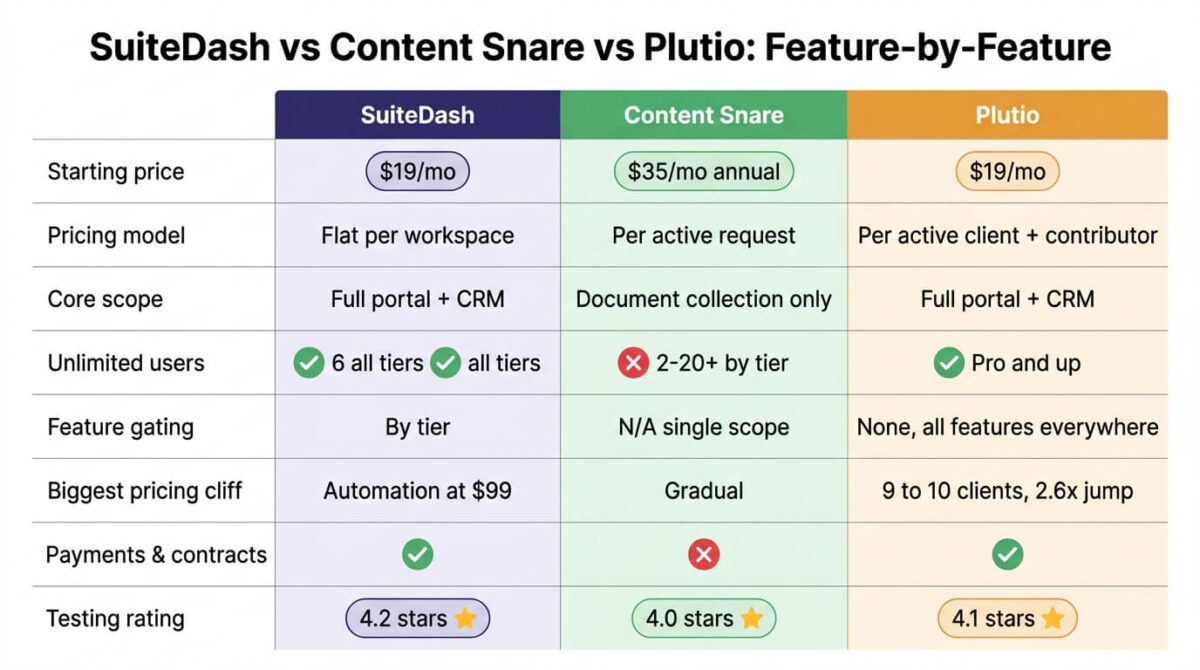
| Starting price | $19/month | $35/month (annual) | $19/month |
| Pricing model | Flat per workspace | Per active request | Per active client/contributor |
| Feature gating | By tier (progressive) | N/A (single scope) | None, same features everywhere |
| Unlimited users | Yes, all tiers | No (2-20+ by tier) | Only from Pro upward |
| Core scope | Full client portal + CRM | Document collection only | Full client portal + CRM |
| Pricing cliff | Automation at Pinnacle ($99) | Gradual, no sharp jump | 9→10 clients, 2.6x jump |
| Best suited for | Teams wanting flat unlimited-user pricing | Firms needing document collection specifically | Solo-to-small teams wanting full features cheap, until growth hits |
Which Should You Choose?
Choose SuiteDash if unlimited team members at a flat rate matters more than interface speed, and the learning curve is an acceptable tradeoff for feature depth.
Choose Content Snare if document and information collection is the core bottleneck, not a full client portal, and the active-request pricing model fits an episodic rather than ongoing client relationship.
Choose Plutio if the full feature set at the lowest entry price matters most, and the business either stays under 9 active clients or is ready to absorb the jump to Pro when it doesn’t.
Our Recommendations
Based on 30 days of testing across onboarding, document collection, and full-portal workflows, here is the recommended setup by situation:
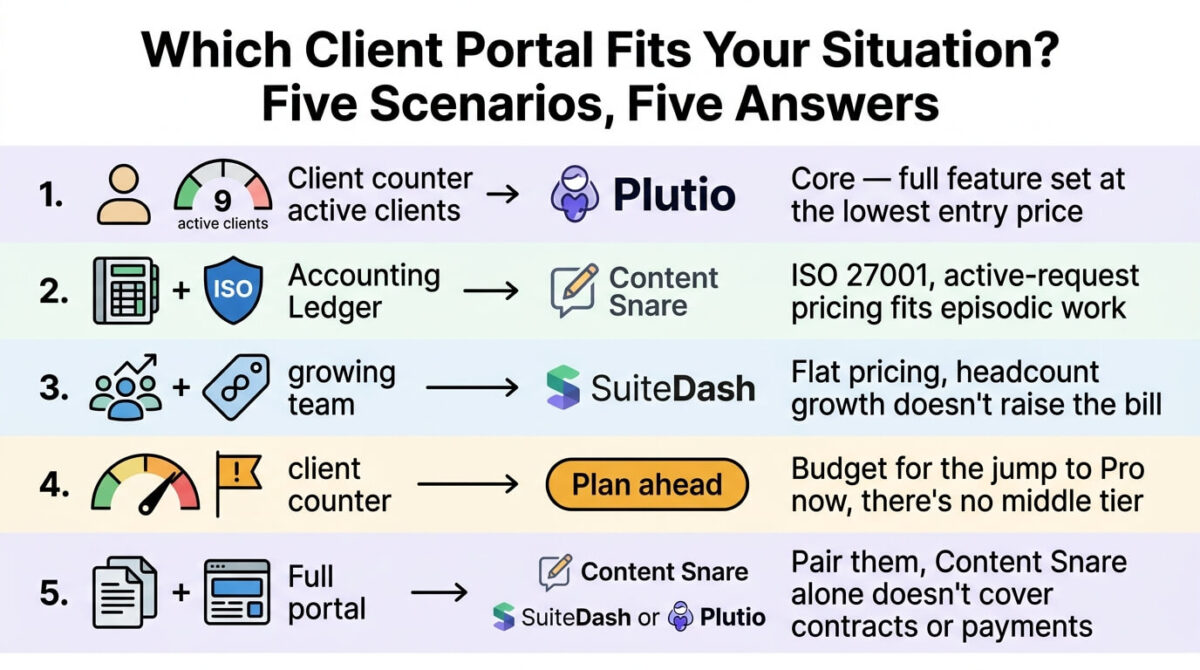
Solo freelancer just starting out with fewer than 9 active clients: Plutio Core, for the full feature set at the lowest entry price available.
Accounting or professional services firm needing structured document collection specifically: Content Snare, for the ISO 27001 certification and active-request pricing that fits episodic engagements.
Growing agency adding team members regularly: SuiteDash, where flat per-workspace pricing means headcount growth doesn’t multiply the bill.
Freelancer approaching 10 active clients on Plutio Core: Budget for the jump to Pro now rather than being surprised by it, since there’s no middle tier to ease the transition.
Business needing both document collection and a full client portal: Content Snare paired with SuiteDash or Plutio, since Content Snare alone doesn’t cover contracts, payments, or ongoing portal access.
Final Verdict
SuiteDash and Plutio compete directly as all-in-one client platforms, while Content Snare solves a narrower, specific piece of the same broader problem.
- SuiteDash, 4.2 / 5, the most feature-complete option, with meaningful setup time to work through
- Plutio, 4.1 / 5, the most complete feature set at the lowest starting price, with a sharp cliff at 10 clients
- Content Snare, 4.0 / 5, the strongest tool for document collection specifically, not a full portal replacement
Before comparing these three on price alone, confirm which job is being solved. Document collection points toward Content Snare. A full client platform points toward SuiteDash or Plutio, with the choice between those two coming down to whether flat unlimited-user pricing or an all-features-included low entry price matters more.
Frequently Asked Questions
Does Plutio really jump 2.6x in price for one extra client?
Yes. Core caps at 9 active clients with no way to add a single additional client without upgrading to Pro at $49/month, a jump from $19, with no intermediate tier available to soften the transition.
Is Content Snare a full client portal replacement?
No. It handles document and information collection specifically, with no payment processing, contract signing, or ongoing portal communication built in. It’s designed to be paired with other tools for everything beyond the collection step.
Does SuiteDash charge per user like most business software?
No. SuiteDash prices flat per workspace regardless of team size, so a five-person team pays the same as a solo user on the same tier. Storage and feature toolkits, not user count, are what differ between plans.
Which tool is cheapest for a solo freelancer just starting out?
Plutio Core at $19/month, provided the client count stays under 9, since it includes the full feature set with no functionality gated behind a higher tier at that price point.
Does SuiteDash really offer a lifetime pricing option?
Yes, published openly on its own pricing page rather than through a third-party marketplace deal. Lifetime “Century” plans run $2,240 to $6,840 depending on tier, with a break-even point against annual billing of roughly 5.75 to 7.13 years on the top tier.
Can Content Snare’s active-request pricing support a large client base?
Yes, because completed or archived requests free up the slot for the next one. The 20 active requests on Basic can realistically cover a few hundred total clients across a year at a steady pace, since it’s concurrent volume being billed, not total client count.
Why does SuiteDash have a reputation for being slow to set up?
Multiple independent reviews describe its interface as slower-loading and more time-intensive to configure than competitors, a tradeoff for the breadth of toolkits and automation options available once fully set up.
Is it normal to use Content Snare alongside SuiteDash or Plutio?
Yes, and it’s a reasonable combination for firms with heavy document collection needs: Content Snare handles the structured intake specifically, while SuiteDash or Plutio manages the broader client relationship, proposals, contracts, and invoicing around it.