
Every order needs a label, a postage rate, and a tracking email, and buying postage at the counter costs both time and money. Choosing between ShipStation vs Shippo vs Pirate Ship is how most small online stores fix that. The three charge very differently, and one of them is free. Online merchants building their store setup should also evaluate top online payment processors for small business to handle checkouts smoothly.
Shipping software prints labels at discounted carrier rates and pulls orders in from your store. These tools mainly serve US senders. Pirate Ship charges nothing, Shippo is free up to 30 labels a month, and ShipStation starts at $14.99 and moved its API behind a higher plan in July 2025. USPS also changed its rules on July 12, 2026, so older rate guides are out of date.
I tested ShipStation vs Shippo vs Pirate Ship for 30 days, shipping the same 40 test orders through each from a Shopify store: a mix of 8-ounce, 1-pound, and 5-pound parcels, plus one international order and one return, and comparing each quoted rate with USPS retail. Here is the honest comparison, including the catch most small stores miss: ShipStation’s headline price describes its most limited plan, and the free tools cover most stores that sell on one channel.
Table of Contents
How We Tested
I scored each tool on five criteria:
- Cost at your volume: software fees at 100, 500, and 1,000 labels a month.
- Carrier rates and coverage: which carriers each tool supports and how rates compare with retail.
- Store connections: how well orders sync from Shopify, Etsy, eBay, and WooCommerce.
- Automation and API: rules, batch printing, and developer access.
- Limits and fees: caps, add-ons, and charges that are not on the pricing page.
ShipStation Review: Multi-Channel Automation at a Higher Price
- Free plan: No free plan; a 30-day free trial with no credit card
- Starting price: $14.99/month for 50 shipments (Starter); annual billing takes 20% off
- Best plan for most users: Standard, which adds the API, your own carrier accounts, and 10 users
- Platforms: Web
- Affiliate program: Yes, through CJ: a flat payout of $35 to $400 per paying referral, 30-day cookie
ShipStation is a multi-channel shipping platform that connects stores, marketplaces, and carriers. In July 2025 it replaced eight legacy tiers with three plans, Starter, Standard, and Premium, priced by monthly shipments. Many reviews still quote the retired $9.99 Starter and $29.99 Bronze tiers.
What ShipStation does best
ShipStation is built for sellers on several channels. One queue holds orders from Shopify, Etsy, Amazon, and eBay, and automation rules encode your routing logic, such as sending parcels under 1 pound by the cheapest ground service. Reviewers credit batch flows with turning a multi-hour daily routine into a few clicks.
Standard unlocks the depth. It includes unlimited automations, API access, your own carrier accounts, 10 users, and phone support. Premium adds inventory management, auto-split, and 15 users, matching features found in dedicated inventory management software for small business. If you sell on two or more channels, the rules engine can save more in labor than the subscription costs.
Where ShipStation falls short
The headline price is the bottom step of the most limited plan. The advertised $14.99 buys up to 50 shipments, three users, no API, and no own carrier accounts. The July 2025 restructure moved the API behind Standard. One documented example: 1,000 monthly shipments went from $59.99 on the old Silver plan to $149.99 on Standard, a 150% increase.
Extras are not all on the pricing page. Seats beyond those included cost about $5 per user a month on Standard and Premium. A “Your Carriers” fee can apply when you connect your own carrier accounts in some setups, and ShipStation does not publish the amount. Because volume sets the step, two stores on the same plan can pay different prices.
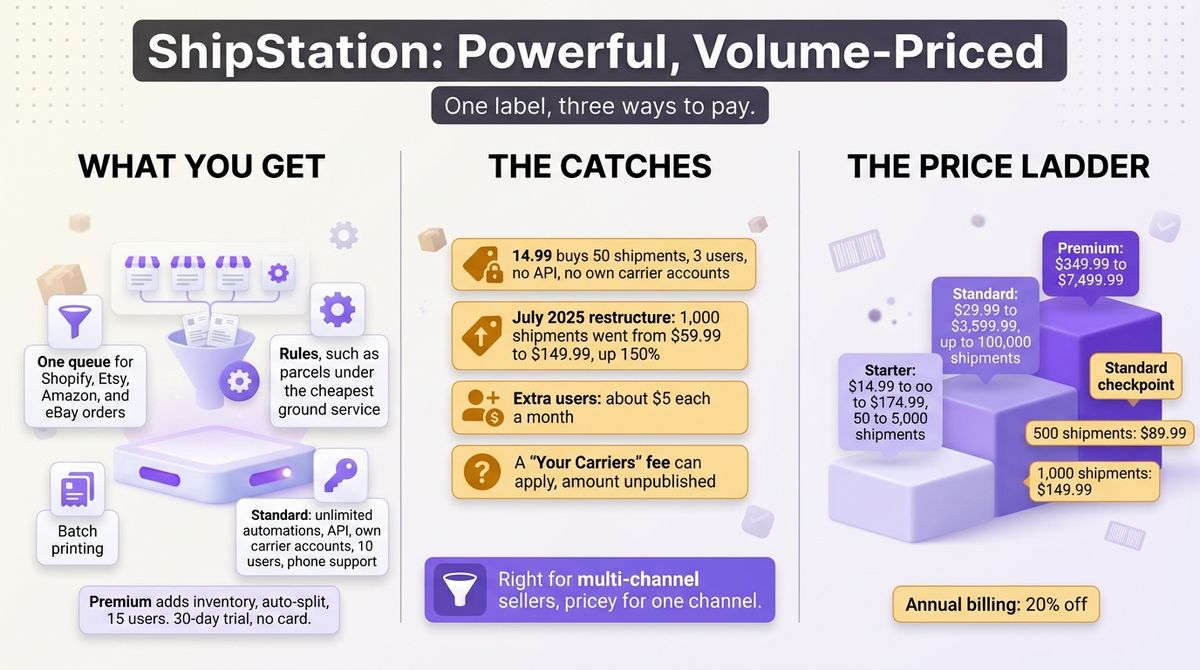
ShipStation pricing
| Plan | Monthly price | What gates here |
|---|---|---|
| Starter | $14.99 to $174.99 (50 to 5,000 shipments) | Core shipping and basic automation; 3 users, no API, no own carrier accounts |
| Standard | $29.99 to $3,599.99 (up to 100,000 shipments) | Unlimited automations, API, own carrier accounts, 10 users, phone support |
| Premium | $349.99 to $7,499.99 | Inventory management, auto-split, 15 users |
| Checkpoints | $89.99 at 500 shipments; $149.99 at 1,000 | Both on Standard |
| Extra users | About $5 per user per month | Standard and Premium |
| Billing | 20% off annually; 30-day trial | No permanent free plan |
ShipStation: Pros and Cons
Pros:
- One queue for Shopify, Etsy, Amazon, and eBay orders.
- A rules engine and batch printing that save labor at volume.
- Standard includes the API, your own carrier accounts, and 10 users.
- A 30-day free trial with no credit card.
Cons:
- The $14.99 headline plan has no API and a three-user cap.
- The July 2025 restructure raised some prices by about 150%.
- Extra users cost about $5 each, and a “Your Carriers” fee is unpublished.
- No permanent free plan.
Rating: 3.9 / 5, the right tool for multi-channel sellers, but expensive for single-channel stores.
Shippo Review: The Free Tier With More Carriers
- Free plan: Yes; Starter: up to 30 labels a month, 1 user, API included
- Starting price: $19/month billed monthly, or $17/month billed annually (Pro, up to 200 labels)
- Best plan for most users: Pro
- Platforms: Web, API
- Affiliate program: Unconfirmed; no public affiliate program found
Shippo is a shipping app and API with discounted USPS, UPS, FedEx, and DHL Express rates across more than 40 carriers. Starter is free. Pro scales with monthly label volume up to 10,000 labels, and Premier is custom-priced with 15 or more users.
What Shippo does best
Shippo has a usable free tier. Starter gives 30 labels a month with the same carrier discounts as paid plans, unlimited store connections, tracking, and API access, which ShipStation reserves for Standard. That makes it a low-risk way to test a workflow before you pay.
The middle plans are cheap. Pro costs $19 a month for up to 200 labels, or $17 billed annually, and $29 or $26 for 201 to 500 labels. Your own carrier accounts add no per-label fee on Pro. With FedEx, DHL Express, and international carriers in the network, it covers more than Pirate Ship does.
Where Shippo falls short
Starter is small. It caps at 30 labels and one user, and connecting your own carrier account costs 5 cents a label on Starter, though never on Shippo’s own rates. Developers who use the API pay about 7 cents per label after the first 30 each month.
Automation is lighter than ShipStation’s, whose rules engine is its main selling point. Larger teams and heavy international shippers face extra costs, and Premier is quote-only. Third-party sites still list older figures such as $19 for up to 10,000 labels, so check the live pricing page for your volume. Sellers with complex multi-step processes can supplement these shipping features by integrating leading no-code automation tools into their stack.
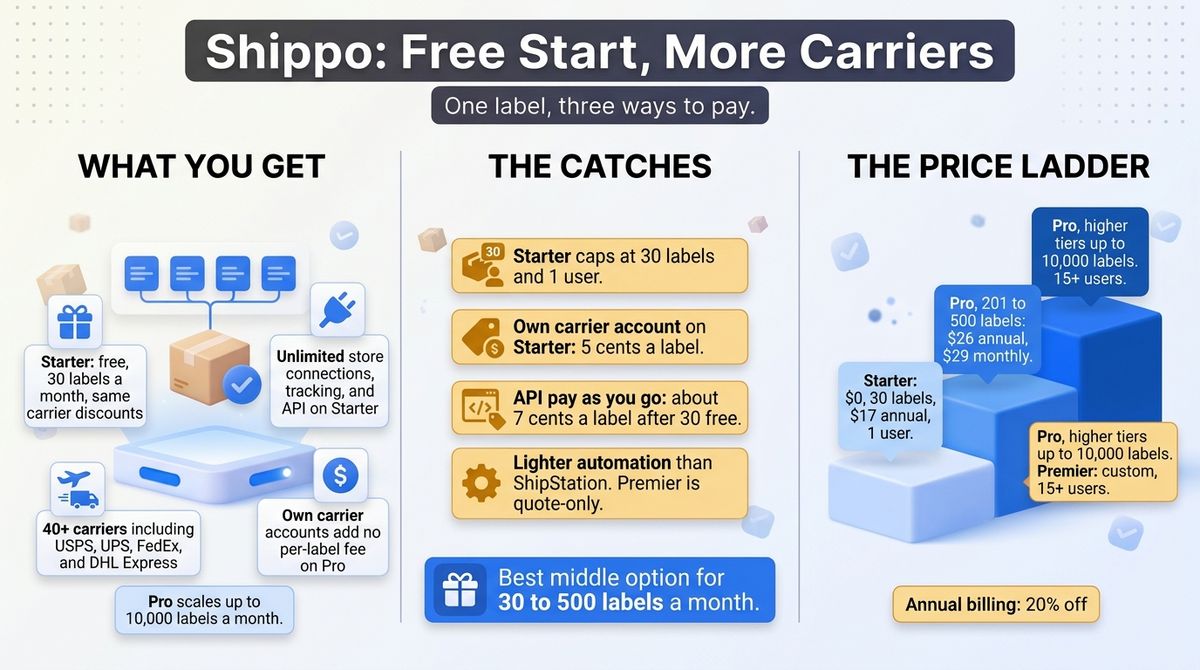
Shippo pricing
| Plan | Monthly billing | Annual billing (per month) | What you get |
|---|---|---|---|
| Starter | $0 | $0 | 30 labels a month, 1 user, discounted rates, API, unlimited store connections; 5 cents per label on your own carrier accounts |
| Pro, 1 to 200 labels | $19 | $17 ($205/year) | Own-carrier labels free, more users |
| Pro, 201 to 500 labels | $29 | $26 | The same features |
| Pro, higher tiers | Scales with volume | Scales with volume | Up to 10,000 labels a month |
| Premier | Custom | Custom | 15+ users, dedicated account manager, unlimited shipments |
| API pay as you go | About 7 cents per label after 30 free | Not applicable | For developers |
Shippo: Pros and Cons
Pros:
- A free Starter plan with 30 labels, full rates, and API access.
- Pro costs $17 to $26 a month for up to 500 labels.
- More than 40 carriers, including FedEx and DHL Express.
- No per-label fee on your own carrier accounts on Pro.
Cons:
- Starter caps at 30 labels and one user.
- 5 cents per label for your own carrier accounts on Starter.
- Lighter automation than ShipStation.
- Premier is quote-only, and older figures circulate online.
Rating: 4.2 / 5, the best middle option for stores shipping 30 to 500 labels a month.
Pirate Ship Review: Free Software With Deep Postage Discounts
- Free plan: Yes, the whole product is free; you pay only for postage
- Starting price: $0
- Best plan for most users: The free plan, its only plan
- Platforms: Web
- Affiliate program: Unconfirmed, no public affiliate program found (Pirate Ship says it adds no markup)
Pirate Ship is a free shipping platform for US senders. It sells USPS Commercial Pricing, including Cubic rates, and discounted UPS rates. It connects to Shopify, Etsy, and eBay, and it earns its margin on the carrier side, not from you.
What Pirate Ship does best
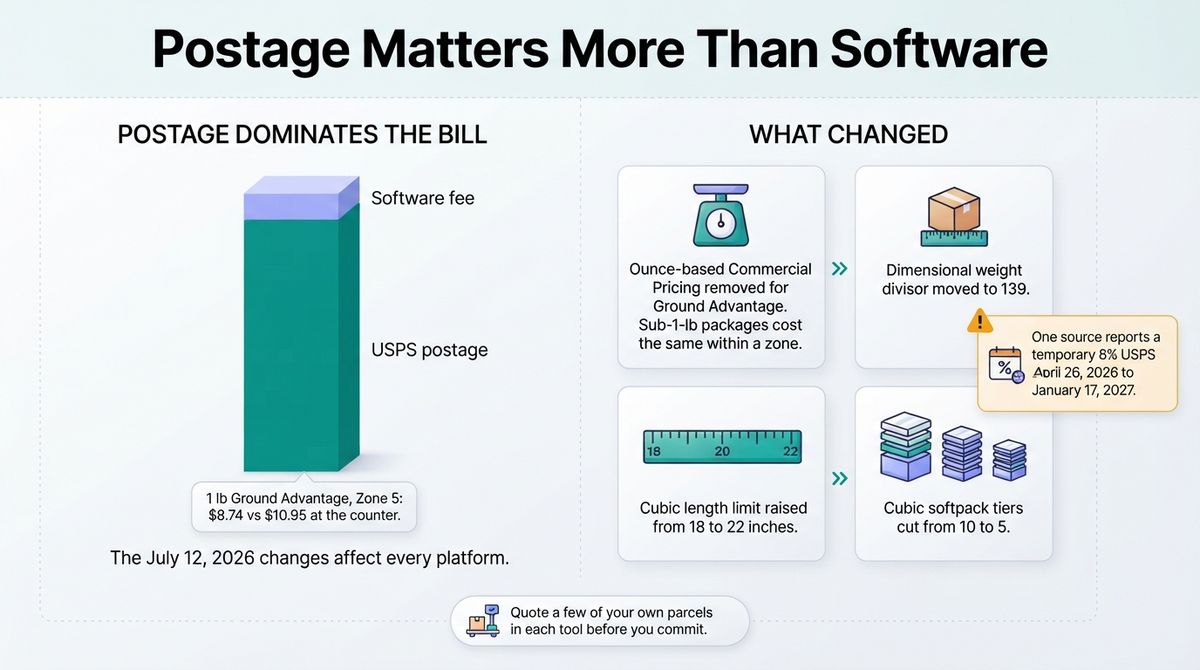
Pirate Ship costs nothing. There is no monthly fee, no label fee, and no minimum, and you pay only for postage. It rate-shops between weight-based and Cubic pricing on Ground Advantage for you, and $100 of USPS insurance is included on Ground Advantage and Priority Mail. One July 2026 example shows a 1-pound Ground Advantage label to Zone 5 at $8.74, against $10.95 at the counter.
It is also simple. You import orders or connect a store, buy postage, and print labels in batches. UPS rates are pre-negotiated and passed through without markup. For a store that ships under about 200 orders a month on one channel, there is little else to configure. Merchants looking to boost customer engagement after order fulfillment often test effective SMS marketing software for small business.
Where Pirate Ship falls short
The limits are scope, not price. Pirate Ship supports USPS and UPS only, so there is no FedEx or DHL. It has no automation rules and no multi-channel routing, and carrier billing adjustments are passed straight through to you.
USPS rules changed on July 12, 2026. USPS removed ounce-based Commercial Pricing for Ground Advantage, so Pirate Ship’s below-Commercial rates now apply to most contiguous shipments only. One source also reports a temporary 8% USPS surcharge from April 26, 2026 to January 17, 2027. These changes hit every tool, but Pirate Ship has no other features to offset them.
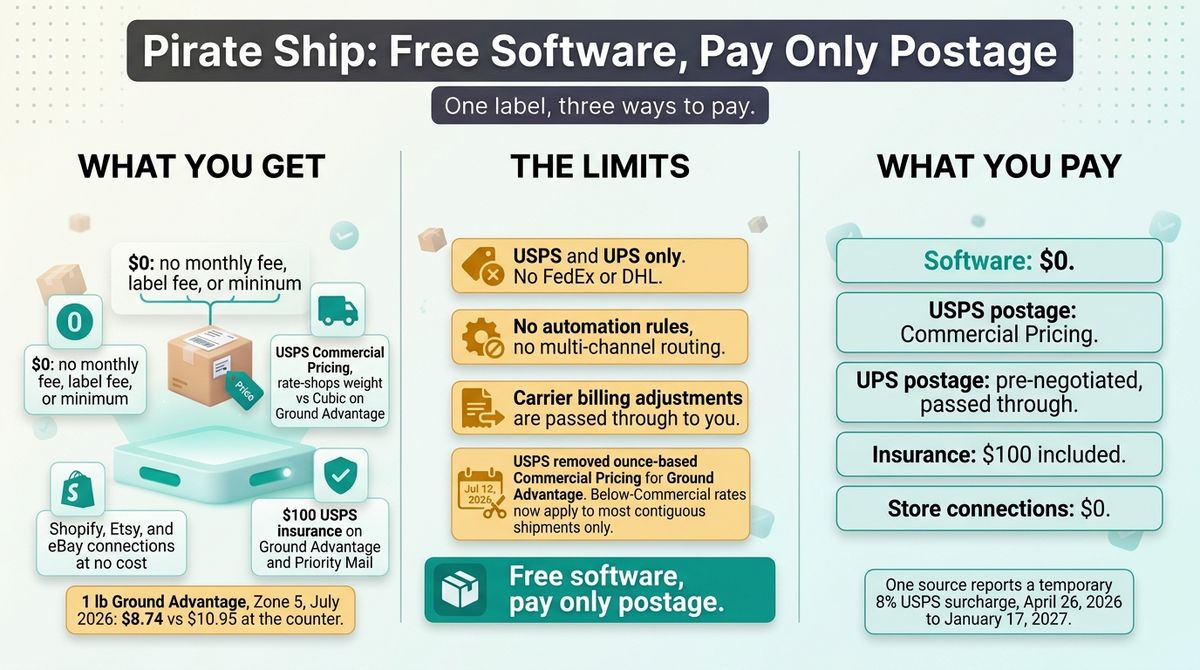
Pirate Ship pricing
| Item | Price | Notes |
|---|---|---|
| Software | $0 | No monthly fee, label fee, or minimum |
| USPS postage | USPS Commercial Pricing | Includes Priority Mail Cubic and Ground Advantage Cubic |
| UPS postage | Pre-negotiated UPS rates | Passed through with no markup |
| Insurance | $100 included | On Ground Advantage and Priority Mail |
| Store connections | $0 | Shopify, Etsy, and eBay |
| Example rate | $8.74 | 1 lb Ground Advantage, Zone 5, July 2026 (counter price $10.95) |
Pirate Ship: Pros and Cons
Pros:
- Free software with no monthly fee, label fee, or minimum.
- USPS Commercial and Cubic pricing, with automatic rate shopping.
- $100 of USPS insurance included.
- Shopify, Etsy, and eBay connections at no cost.
Cons:
- USPS and UPS only, with no FedEx or DHL.
- No automation rules or multi-channel routing.
- Carrier billing adjustments are passed through to you.
- Built for US senders, and USPS changes in 2026 affect its rates.
Rating: 4.4 / 5, the best choice for most small stores that ship from one channel.

Head-to-Head Comparison Table
| Feature | ShipStation | Shippo | Pirate Ship |
|---|---|---|---|
| Free option | 30-day trial, no card | Starter: 30 labels a month | Free, no limits |
| Entry price (monthly billing) | $14.99 (Starter) | $19 (Pro) | $0 |
| Price at 500 shipments a month | $89.99 (about $72 annual) | $29 ($26 annual) | $0 |
| Carriers | 40+ carriers | 40+ carriers, including FedEx and DHL Express | USPS and UPS only |
| Automation rules | Unlimited on Standard | Basic automation | None |
| API | Standard and above | Included on Starter | Not stated |
| Store connections | Shopify, Etsy, Amazon, eBay, WooCommerce | Shopify, Etsy, Amazon, WooCommerce, unlimited | Shopify, Etsy, eBay |
| Hidden costs | $5 per extra user; unpublished carrier fee | 5 cents per label on own carriers (Starter) | Carrier adjustments passed through |
| Best for | Multi-channel sellers at 500+ orders | Stores with 30 to 500 labels a month | Single-channel stores under about 200 orders |
| Rating | 3.9 / 5 | 4.2 / 5 | 4.4 / 5 |
Which Should You Choose?
The right tool depends on how many orders you ship, how many channels you sell on, and which carriers you need.
- Choose Pirate Ship if you ship from one channel with USPS and UPS and want the lowest cost.
- Choose Shippo if you need FedEx, DHL, an API, or international carriers, and ship 30 to 500 labels a month.
- Choose ShipStation if you sell on two or more channels, ship 500 or more orders a month, and want automation rules.

Postage matters more than software
Your software fee is the small number. USPS postage dominates the bill, and the July 12, 2026 rule changes affect every platform. USPS removed ounce-based Commercial Pricing for Ground Advantage, moved to a 139 dimensional weight divisor, and raised the Cubic length limit from 18 to 22 inches. Quote a few of your own parcels in each tool before you commit.
What each costs over three years
Take software fees only, with postage excluded. At 500 shipments a month, ShipStation Standard costs $3,239.64 over 36 months at $89.99, or about $2,592 on annual billing. Shippo Pro costs $1,044 monthly or $936 annually, and Pirate Ship costs $0.
At about 100 labels a month, Shippo Pro costs about $615 over three years on annual billing, and ShipStation Starter costs around $864. At 1,000 shipments, ShipStation Standard costs $5,399.64. None of the three shows a first-year promotion, so nothing doubles at renewal. The trap is ShipStation’s volume steps and plan gating.

Our Recommendations
- Single-channel store under about 200 orders a month: Use Pirate Ship. It costs $0 and gives USPS Commercial Pricing and discounted UPS.
- Store that needs FedEx, DHL, or an API on a small budget: Use Shippo Pro at $17 a month on annual billing, or start on the free Starter plan.
- Multi-channel seller on Shopify, Etsy, and Amazon at 500 or more orders: Use ShipStation Standard, and budget about $89.99 a month at 500 shipments.
- Freelancer or agency setting up client stores: Use Shippo when the API matters, and ShipStation Standard when you must configure automation rules.
- Store with a tight budget: Start on Pirate Ship, then move to Shippo or ShipStation when you add channels or carriers.
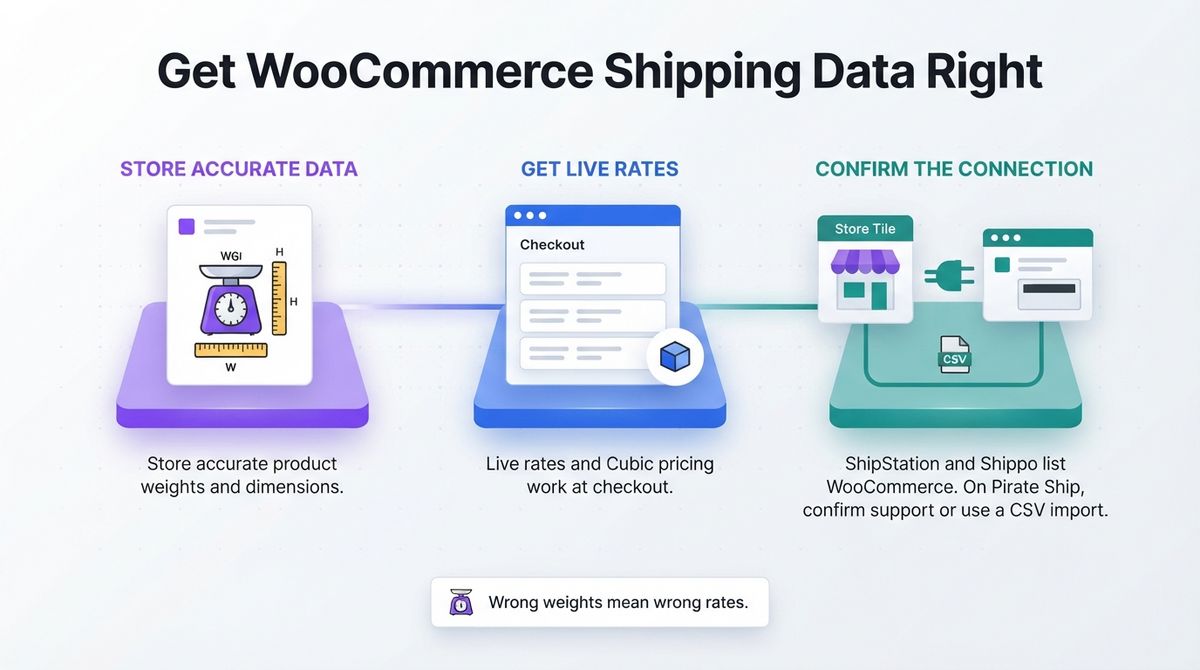
WordPress note: If you run WooCommerce, store accurate product weights and dimensions so live rates and Cubic pricing work at checkout. ShipStation and Shippo list WooCommerce connections, so confirm that your platform is supported on Pirate Ship or plan on a CSV import.
Final Verdict
Pirate Ship is the best choice for most small online stores. It costs nothing and gives USPS Commercial Pricing and discounted UPS rates, and it covers a single channel well. Shippo is the better middle option when you need FedEx, DHL, or an API. ShipStation earns its price only for multi-channel sellers who ship 500 or more orders a month.
In the ShipStation vs Shippo vs Pirate Ship decision, start free with Pirate Ship, move to Shippo when you need more carriers, and choose ShipStation for multi-channel automation.
- Pirate Ship: 4.4 / 5, best for single-channel stores on USPS and UPS.
- Shippo: 4.2 / 5, best middle option for 30 to 500 labels a month.
- ShipStation: 3.9 / 5, best for multi-channel sellers at 500 or more orders.
Frequently Asked Questions
What is the best shipping software for small online stores?
Pirate Ship is the best fit for most small stores that ship with USPS and UPS from one sales channel. It costs $0 in software fees and gives USPS Commercial Pricing. Shippo suits stores that need FedEx, DHL, or an API. ShipStation suits multi-channel sellers shipping 500 or more orders a month.
Is Pirate Ship free?
Yes. Pirate Ship charges no monthly fee, label fee, or minimum, and you pay only for postage. It earns its margin on the carrier side. The limits are scope, not price: it supports USPS and UPS only, has no automation rules, and passes carrier billing adjustments through to you.
How much does ShipStation cost in 2026?
ShipStation starts at $14.99 a month for 50 shipments on Starter, which allows three users and no API. Standard, which adds the API and your own carrier accounts, costs about $89.99 at 500 shipments and $149.99 at 1,000. Annual billing takes 20% off. Older reviews quote retired tiers such as $9.99 and $29.99.
How much does Shippo cost?
Shippo’s Starter plan is free for up to 30 labels a month with one user. Pro costs $19 a month billed monthly, or $17 billed annually, for up to 200 labels, and $29 or $26 for 201 to 500 labels. Connecting your own carrier account costs 5 cents a label on Starter and nothing on Pro.
Did ShipStation raise its prices?
Yes. In July 2025, ShipStation replaced eight tiers with three volume-based plans and moved API access and your own carrier accounts behind Standard. One documented example: 1,000 monthly shipments went from $59.99 on the old Silver plan to $149.99 on Standard. Check the current price at your volume before you budget.
What changed in USPS rates in July 2026?
On July 12, 2026, USPS removed ounce-based Commercial Pricing for Ground Advantage, so sub-1-pound packages cost the same within a zone. It also moved to a 139 dimensional weight divisor, raised the cubic length limit from 18 to 22 inches, and cut Cubic softpack tiers from 10 to 5. Rates quoted in older guides no longer apply.
Which shipping software works with WooCommerce?
ShipStation and Shippo both list WooCommerce connections, alongside Shopify, Etsy, and Amazon. Pirate Ship lists Shopify, Etsy, and eBay, so check whether your platform is supported or plan on a CSV import. Whichever you pick, store accurate product weights and dimensions in WooCommerce so live rates and Cubic pricing work.
When should I switch from free shipping software to ShipStation?
Consider ShipStation when you ship 500 or more orders a month, sell on two or more channels, or need automation rules and an API. Below about 200 orders a month on one channel, Pirate Ship or Shippo Pro at $17 a month usually do the job. Compare the subscription with the labor the rules would save.