Starting an online store in 2026 has never been more accessible or more confusing. There are dozens of e-commerce platforms competing for your business, each promising to be the easiest, fastest, and most profitable way to sell online.
The reality: three platforms dominate the market for good reason. Shopify powers over 4.6 million online stores worldwide. WooCommerce runs on 6.6 million websites as a WordPress plugin. BigCommerce serves thousands of mid-market and enterprise retailers. Each is genuinely excellent and genuinely wrong for certain types of sellers.
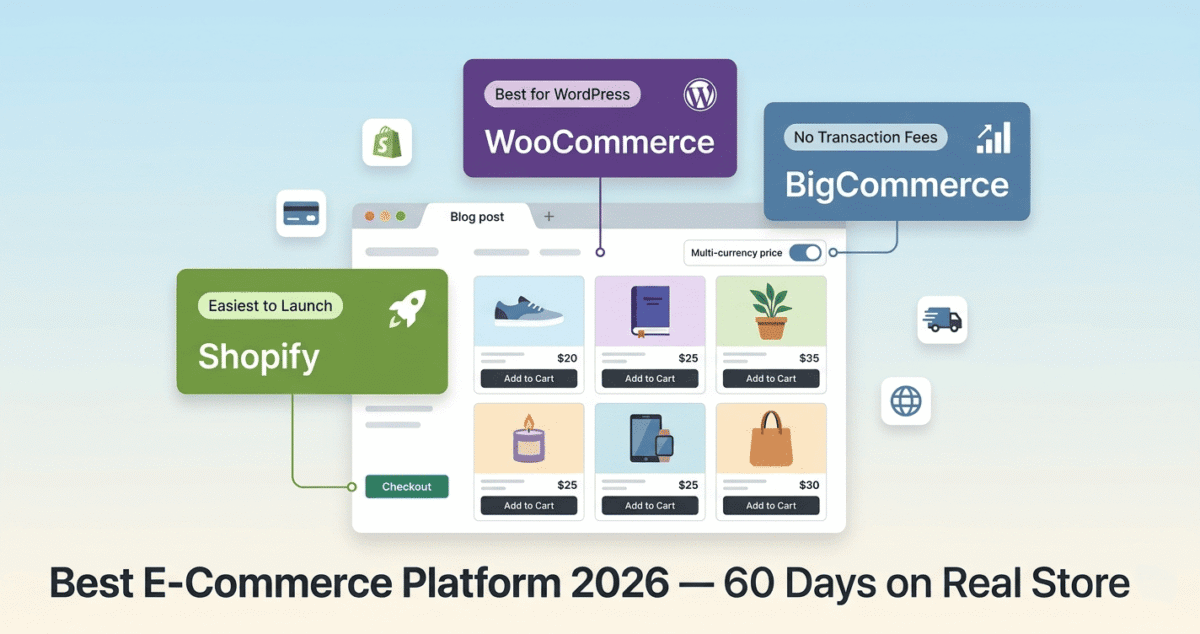
I tested all three (Shopify vs WooCommerce vs BigCommerce) for 60 days across real store setups, physical products, digital downloads, subscription boxes, and dropshipping. Here is the honest comparison of which platform actually delivers in 2026.
Table of Contents
How We Evaluated These Platforms
Every platform was tested across five criteria:
– Ease of setup: how quickly can a non-technical person launch a working store?
– Sales features: product management, checkout, payment processing, abandoned cart recovery
– Design flexibility: theme quality, customisation depth, and mobile experience
– Scalability: how well does the platform handle growth from 10 to 10,000 products?
– Total cost: monthly fees, transaction fees, app costs, and hidden expenses
Why Your E-Commerce Platform Choice Is Irreversible (Almost)
Before comparing platforms, one critical point: switching e-commerce platforms after launch is painful, expensive, and time-consuming. Your product data, customer records, order history, SEO rankings, and custom integrations all need to migrate. Most businesses that switch platforms experience a period of reduced traffic and revenue during the transition.
Choose carefully from the start. This comparison is designed to help you make that decision correctly the first time.
Shopify Review: Best E-Commerce Platform for Most Businesses
Free plan: No (3-day free trial, then $1/month for 3 months promotional)
Starting price: $29/month (Basic)
Best plan for most users: Basic, $29/month
Platforms: Web, iOS, Android, desktop POS
Affiliate program: Yes, up to $150 per merchant referral
Shopify is the world’s most popular dedicated e-commerce platform, and for most people starting an online store in 2026, it is the right choice. It is the fastest to launch, the easiest to manage, and the most complete out-of-the-box solution available. The trade-off is cost: Shopify is more expensive than WooCommerce when you factor in transaction fees and app subscriptions.
What Shopify does best
Shopify’s setup experience is unmatched. From signing up to having a live, working online store with products, a custom domain, and a payment processor takes under two hours, even for users with no technical experience. The onboarding wizard guides you through every step: adding products, choosing a theme, setting up payments, and configuring shipping.
The theme library includes over 100 professional themes, 13 free, and the rest priced at $180–$350 one-time. Every theme is mobile-optimised, fast-loading, and designed by professional e-commerce designers. The free themes are genuinely attractive; you do not need to buy a premium theme to launch a professional-looking store.
Shopify’s checkout is the strongest of the three platforms. It is fast, mobile-optimised, and converts well. Shopify reports that its one-page checkout (introduced in 2023 and refined since) reduces cart abandonment compared to multi-step alternatives. Shopify Payments processes credit cards without transaction fees (on top of standard processing rates) and accepts PayPal, Apple Pay, Google Pay, Shop Pay, and buy-now-pay-later services natively.
The App Store is Shopify’s greatest strength and its most significant cost driver. With over 8,000 apps covering email marketing, loyalty programmes, upsells, product reviews, subscriptions, dropshipping, and virtually every other e-commerce functionality, Shopify can be extended to handle almost any business model. The downside: many essential apps cost $10–$50/month each, and a fully-equipped Shopify store can easily cost $100–$200/month in app fees on top of the base plan.
Shopify’s multichannel selling is the best of the three platforms. You can sell on Instagram, Facebook, TikTok Shop, Pinterest, Google Shopping, Amazon, eBay, and in-person via Shopify POS, all managed from a single Shopify dashboard. For sellers who want to reach customers across multiple channels from one platform, Shopify’s native integrations are unmatched.
Shopify’s analytics and reporting have improved significantly in recent years. The dashboard shows real-time sales, top products, traffic sources, customer lifetime value, and cohort analysis, giving store owners the data they need to make informed inventory and marketing decisions.
Where Shopify falls short
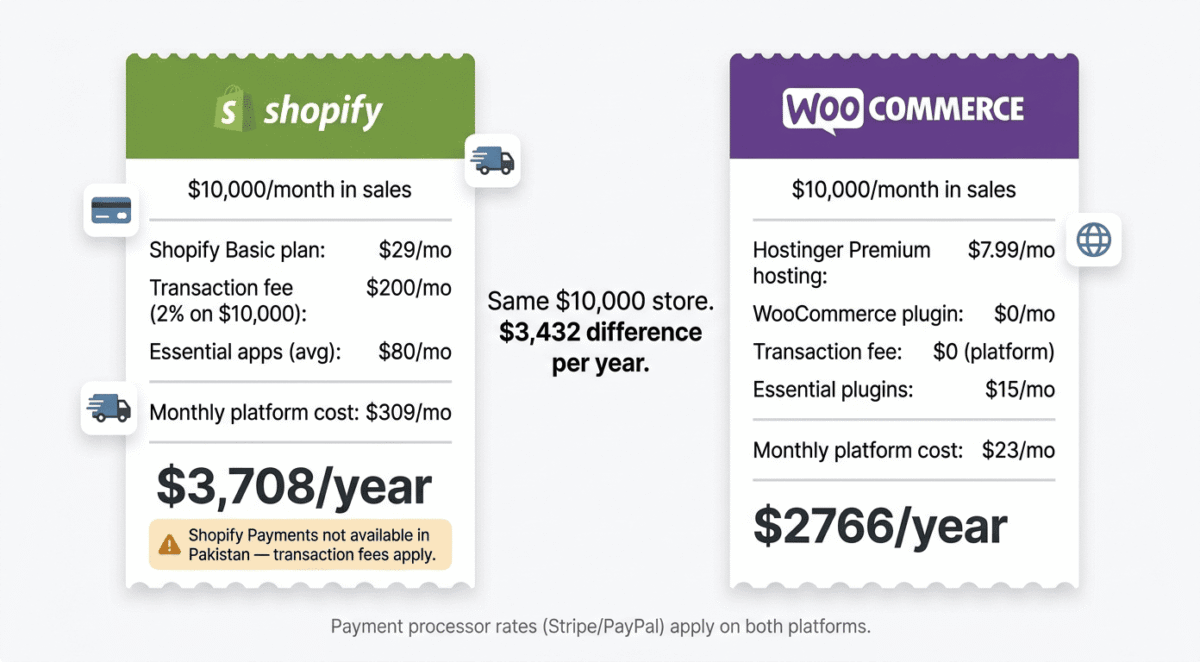
Shopify’s transaction fees are its most controversial feature. Unless you use Shopify Payments as your payment processor, Shopify charges a transaction fee on every sale: 2% on Basic, 1% on Shopify, 0.5% on Advanced. For stores with significant revenue, these fees are a meaningful cost. Sellers in countries where Shopify Payments is not available, including Pakistan, must use a third-party payment processor and pay transaction fees on every order.
Content and blogging capabilities are limited. Shopify includes a basic blog, but it is significantly less powerful than WordPress as a content marketing platform. Bloggers who want to drive organic traffic through content marketing will find Shopify’s blog frustrating compared to WordPress with WooCommerce.
URL structure customisation is also limited; Shopify forces certain URL patterns that SEO purists consider suboptimal, though in practice the impact on rankings is minimal for most stores.
Shopify pricing
Plan | Price/month | Transaction fee | Staff accounts | Key features |
Basic | $29 | 2% (non-Shopify Pay) | 2 | Full store, 2 staff, basic reports |
Shopify | $79 | 1% | 5 | Professional reports, gift cards |
Advanced | $299 | 0.5% | 15 | Advanced reports, third-party calculated shipping |
Plus | $2,300 | 0.15% | Unlimited | Enterprise features, custom checkout |
Shopify: Pros and Cons
Pros:
– Fastest setup, live store in under two hours with no technical skills
– Best checkout experience, fast, mobile-optimised, high-converting
– 8,000+ app integrations for virtually any functionality
– Best multichannel selling, Instagram, TikTok, Amazon, eBay, POS in one dashboard
– Shopify Payments eliminates transaction fees for supported countries
– Excellent 24/7 customer support via live chat and phone
– Most reliable uptime, 99.99% guaranteed
– Up to $150 per merchant referral on affiliate program
Cons:
– Transaction fees on non-Shopify Payments processors (issue for Pakistani sellers)
– Essential apps add $50–$200/month to total cost
– Limited content/blogging capabilities vs WordPress
– More expensive than WooCommerce for high-revenue stores with many apps
– URL structure less flexible than WordPress
– Theme customisation requires Liquid coding for deep changes
Rating: 4.7 / 5 Best e-commerce platform for most businesses. Fastest to launch, easiest to manage, most complete out-of-the-box solution.
WooCommerce Review: Best E-Commerce Platform for WordPress Users and Content-Driven Stores
Free plan: Yes, WooCommerce plugin is free
Starting price: Free (requires WordPress hosting ~$3–$15/month)
Best plan for most users: WooCommerce on Hostinger or SiteGround (~$5–$12/month hosting)
Platforms: WordPress (web, iOS, Android app available)
Affiliate program: Yes, WooCommerce extensions marketplace
WooCommerce is not a standalone platform; it is a free, open-source plugin that transforms a WordPress website into a fully functional online store. This distinction has profound implications: WooCommerce gives you complete ownership and control of your store and its data, but it also makes you responsible for hosting, security, performance, and maintenance in a way that Shopify and BigCommerce do not.
What WooCommerce does best
WooCommerce’s greatest advantage is cost, specifically, the absence of transaction fees. Unlike Shopify, WooCommerce never charges a percentage of your sales. You pay your hosting provider, your payment processor’s standard rates (typically 2.9% + $0.30 per transaction via Stripe or PayPal), and any premium plugin costs, but never a platform transaction fee. For high-revenue stores, this difference compounds significantly.
The content integration is WooCommerce’s second major advantage. Because WooCommerce runs on WordPress, the world’s most powerful content management system, your store and your blog are one unified website. Product pages rank in Google the same way blog posts do. You can build a content marketing strategy that drives organic traffic to your store without the limitations of Shopify’s basic blog.
For bloggers specifically, WooCommerce is the natural choice if you decide to sell physical products, digital downloads, or online courses alongside your content. You already have WordPress; adding WooCommerce is a free plugin installation.
WooCommerce’s flexibility is unmatched. Every aspect of the store can be customised: product types, checkout fields, shipping calculations, tax rules, payment gateways, and customer emails, either through the settings, free plugins, or custom development. There are no platform-imposed limitations on what your store can do or how it can look.
The plugin ecosystem mirrors Shopify’s App Store in breadth if not in polish. Thousands of free and paid WooCommerce extensions cover subscriptions, memberships, bookings, auctions, wholesale pricing, and virtually every other e-commerce use case.
WooCommerce for beginners: the honest assessment
WooCommerce has a steeper learning curve than Shopify. Setting up a WooCommerce store involves: buying hosting, installing WordPress, installing WooCommerce, choosing and configuring a theme, setting up payment gateways (Stripe, PayPal), configuring shipping zones and rates, setting up taxes, and adding products. This process takes 4–8 hours for a first-timer compared to Shopify’s 2 hours.
Maintenance is also the store owner’s responsibility. WordPress and WooCommerce updates need to be applied regularly. Security plugins (Wordfence), caching plugins (WP Rocket), and backup solutions (UpdraftPlus) should be installed and configured. If something breaks- a plugin conflict, a hosting issue, you troubleshoot it yourself or hire a developer.
For technically confident users or existing WordPress users, these responsibilities are manageable. For non-technical users who want to focus on selling rather than site management, Shopify’s managed infrastructure is worth the additional cost.
WooCommerce and payment gateways for Pakistani sellers
WooCommerce’s flexibility with payment gateways is a significant advantage for sellers in Pakistan. Unlike Shopify Payments (not available in Pakistan), WooCommerce integrates with international payment processors (Stripe, PayPal) and Pakistani payment gateways (JazzCash, Easypaisa, HBL Pay, Bank Alfalah) through available plugins. Sellers in Pakistan have more payment flexibility with WooCommerce than with Shopify.
WooCommerce total cost breakdown
Expense | Typical cost |
WordPress hosting (Hostinger Premium) | $3.99–$7.99/month |
WooCommerce plugin | Free |
Theme (Storefront, Astra, or Flatsome) | Free to $59 one-time |
SSL certificate | Free (via host) |
Payment gateway (Stripe/PayPal) | 2.9% + $0.30 per transaction |
Essential plugins (security, backup, SEO) | $0–$15/month |
Total monthly (basic store) | ~$5–$25/month |
Compared to Shopify Basic at $29/month plus transaction fees plus apps, WooCommerce is significantly cheaper for budget-conscious sellers, particularly those already paying for WordPress hosting.
WooCommerce: Pros and Cons
Pros:
– Free plugin, no monthly platform fee beyond hosting
– No transaction fees, only payment processor standard rates
– Complete ownership of store data, no platform lock-in
– Best content integration, store and blog unified on WordPress
– Unlimited customisation, no platform-imposed restrictions
– Widest payment gateway support including Pakistani gateways
– Perfect for bloggers already on WordPress
– Most cost-effective for high-revenue stores
Cons:
– Steepest setup process, 4–8 hours vs Shopify’s 2 hours
– Store owner responsible for hosting, security, updates, and backups
– No built-in 24/7 platform support, community forums and documentation
– Performance depends on hosting quality; cheap hosting = slow store
– Plugin conflicts can cause issues requiring technical troubleshooting
– Less polished out-of-the-box than Shopify
Rating: 4.5 / 5 Best e-commerce solution for WordPress users, content-driven stores, and budget-conscious sellers. Requires more technical involvement than Shopify.
BigCommerce Review: Best E-Commerce Platform for Scaling Mid-Market Stores
Free plan: No (15-day free trial)
Starting price: $39/month (Standard)
Best plan for most users: Standard, $39/month (up to $50k annual sales)
Platforms: Web, iOS, Android
Affiliate program: Yes, BigCommerce affiliate program, up to $1,500 per enterprise referral
BigCommerce is the least well-known of the three platforms to most consumers, but among e-commerce professionals, it is respected as the most feature-complete hosted platform available. It includes built-in features that Shopify charges app fees to access, has no transaction fees on any plan, and is built specifically for stores that intend to scale beyond the hobbyist level.
What BigCommerce does best
BigCommerce’s built-in feature set is its defining advantage over Shopify. Features that require paid Shopify apps, professional product reviews, advanced shipping rules, faceted search (filter by multiple attributes simultaneously), Google AMP support, and multi-currency pricing are built directly into BigCommerce at no additional cost.
No transaction fees on any plan are BigCommerce’s most direct competitive advantage over Shopify. Regardless of which payment processor you use, BigCommerce never charges a percentage of your sales. For stores processing $500,000+ annually, this alone represents tens of thousands of dollars in savings compared to Shopify’s transaction fees.
BigCommerce’s B2B capabilities are the strongest of the three platforms. Customer groups with custom pricing, quote management, purchase order support, and net payment terms are all built in, making it the best choice for businesses that sell to both consumers and other businesses from the same storefront.
SEO capabilities are the strongest of the three hosted platforms. BigCommerce gives you full control over URL structures, metadata, canonical tags, robots.txt, and structured data, a level of technical SEO control that Shopify restricts and WooCommerce requires plugin configuration to achieve.
The multi-storefront feature, available on Plus plans and above, lets you run multiple branded storefronts from a single BigCommerce account, sharing products, inventory, and customer data. This is invaluable for brands selling across multiple markets or product lines.
Where BigCommerce falls short
BigCommerce’s Annual Sales Thresholds are its most controversial feature. Each plan has a maximum annual sales volume: Standard is capped at $50,000/year, Plus at $180,000/year, and Pro at $400,000/year. Exceeding these thresholds automatically upgrades your plan to the next tier, a cost increase that can come as an unpleasant surprise during a successful sales period.
The theme library is smaller than Shopify’s, with fewer options at both free and paid tiers, and the design customisation interface, while capable, is less intuitive than Shopify’s. First-time store builders typically find Shopify’s design experience more approachable.
BigCommerce’s app marketplace, while growing, is smaller than Shopify’s 8,000+ apps. For niche functionality not covered by BigCommerce’s built-in features, finding a compatible app may be more challenging.
BigCommerce pricing
Plan | Price/month | Annual sales limit | Transaction fees | Key features |
Standard | $39 | $50,000 | None | Full store, unlimited products, 3 storefronts |
Plus | $105 | $180,000 | None | Abandoned cart, customer groups, loyalty |
Pro | $399 | $400,000 | None | Custom SSL, Google reviews, faceted search |
Enterprise | Custom | Unlimited | None | Multi-storefront, priority support, custom features |
BigCommerce: Pros and Cons
Pros:
– No transaction fees on any plan, significant saving vs Shopify at scale
– Most built-in features, advanced shipping, reviews, faceted search included
– Best SEO control of the three hosted platforms
– Best B2B features, customer groups, purchase orders, net terms
– Multi-storefront management from one account
– 15-day free trial, longer than Shopify’s 3-day trial
– Strongest enterprise and mid-market feature set
Cons:
– Annual sales thresholds force plan upgrades during successful periods
– Smaller theme library than Shopify
– Smaller app marketplace than Shopify
– Less intuitive for beginners than Shopify
– More expensive starting price than WooCommerce
– Less brand recognition, harder to find community support
Rating: 4.3 / 5 Best e-commerce platform for scaling mid-market stores that need built-in features and zero transaction fees. Less suitable for beginners.
Head-to-Head Comparison
Shopify Basic | WooCommerce | BigCommerce Standard | |
Monthly platform cost | $29 | $0 (+ hosting) | $39 |
Transaction fees | 2% (non-Shopify Pay) | None | None |
Setup difficulty | Easy (2 hours) | Moderate (4–8 hours) | Moderate (3–5 hours) |
Built-in features | Good | Depends on plugins | Excellent |
App/plugin ecosystem | 8,000+ apps | Thousands of plugins | 1,000+ apps |
Content/blogging | Basic | Excellent (WordPress) | Basic |
SEO control | Limited | Excellent | Good |
Multichannel selling | Excellent | Good (via plugins) | Good |
Payment flexibility | Limited (Shopify Pay preferred) | Maximum | Good |
Pakistani payment gateways | No | Yes | Limited |
Annual sales cap | None | None | $50,000 (Standard) |
24/7 support | Yes | Community/docs | Community/docs |
Free trial | 3 days ($1/mo for 3 months) | N/A (free plugin) | 15 days |
Affiliate payout | Up to $150/merchant | N/A | Up to $1,500 enterprise |
Which E-Commerce Platform Should You Choose?
Choose Shopify if:
You want the fastest path from idea to live store with the least technical involvement. Shopify’s managed infrastructure, beautiful themes, powerful app ecosystem, and multichannel selling make it the best choice for sellers who want to focus on products and marketing rather than technical store management. Also, the best choice if you plan to sell in person via POS alongside your online store.
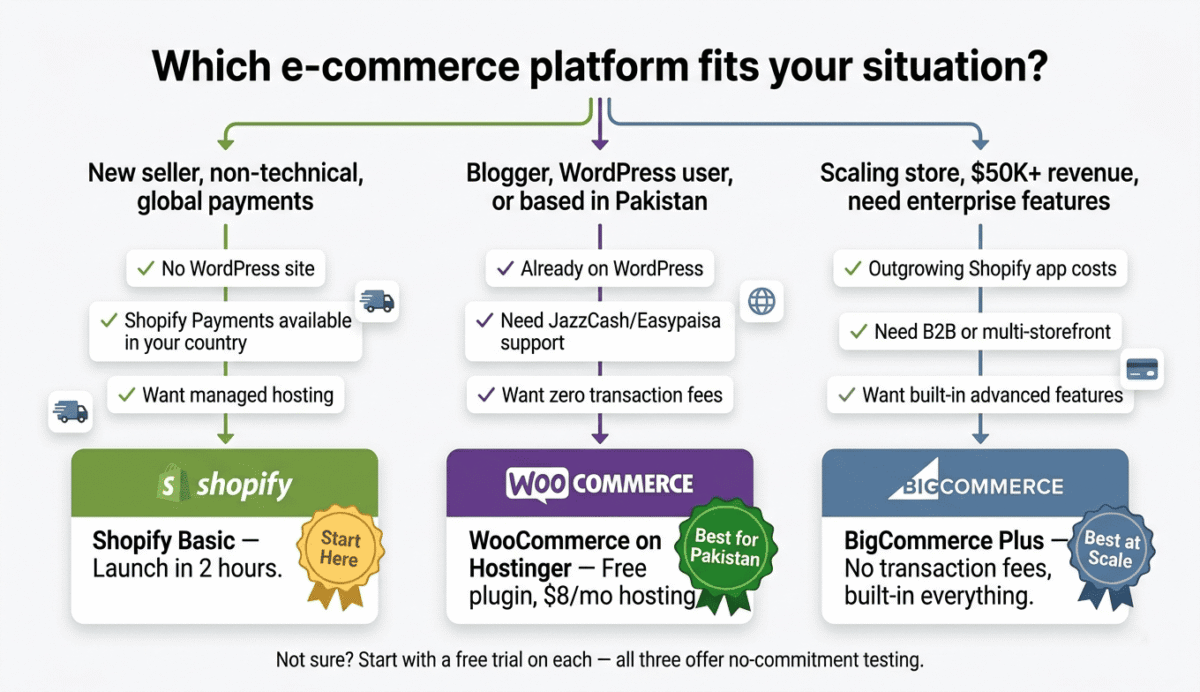
Choose WooCommerce if:
You already have a WordPress blog or website, you are based in Pakistan or another country where Shopify Payments is unavailable, you want zero transaction fees, or you need maximum customisation and control over your store. WooCommerce is also the right choice for bloggers who want to sell digital products or online courses alongside their content. The unified WordPress environment makes content and commerce work seamlessly together.
Choose BigCommerce if:
Your store is growing rapidly, and you need a hosted platform with no transaction fees, advanced built-in features, and strong B2B capabilities, without the app costs that Shopify charges for equivalent functionality. BigCommerce is the right choice when you have outgrown Shopify’s feature set and do not want to manage the technical complexity of WooCommerce at scale.
Special Consideration for Pakistani Sellers
If you are based in Pakistan, as many readers of this blog are, there is an important platform consideration beyond the standard comparison.
Shopify Payments is not available in Pakistan, meaning every sale incurs Shopify’s transaction fee (2% on Basic) on top of your payment processor’s standard rates. This makes Shopify significantly more expensive for Pakistani sellers than for sellers in supported countries.
WooCommerce is the most practical choice for Pakistani sellers because:
– It integrates with JazzCash, Easypaisa, HBL Pay, and international gateways via available plugins
– There are no platform transaction fees, only payment processor rates
– You own your store completely, no dependency on a US-based platform’s policies
– The total monthly cost ($5–$15 including hosting) is the most affordable available
For Pakistani sellers starting an online store in 2026, WooCommerce on Hostinger hosting is the recommended starting point.
Our Recommended Path
Stage 1 | New seller, simple product range: Shopify Basic ($29/month) for its fastest launch and easiest management, or WooCommerce free if already on WordPress or based in Pakistan.
Stage 2 | Growing store (up to $50k annual revenue): Shopify Basic with selective apps, or WooCommerce with premium plugins as needed. BigCommerce Standard is worth considering if transaction fees are a significant cost.
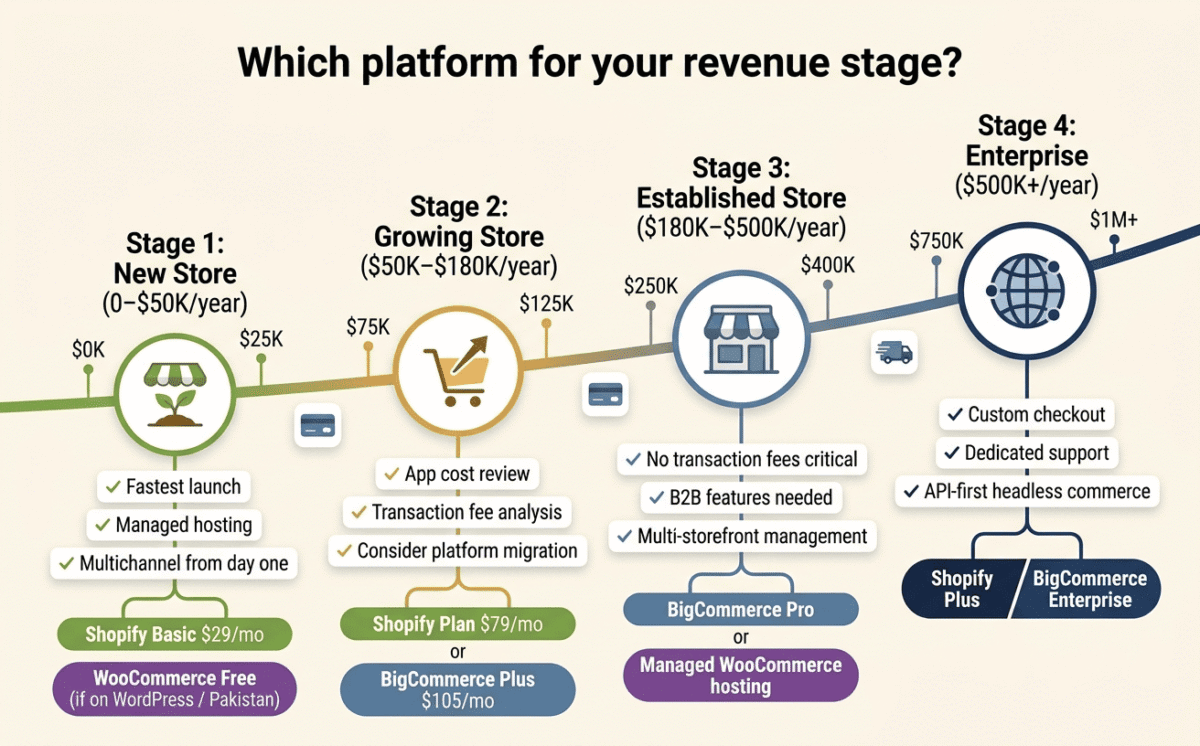
Stage 3 | Scaling store ($50k–$500k annual revenue): BigCommerce Plus for built-in features and zero transaction fees, or WooCommerce with managed WordPress hosting for maximum control and cost efficiency.
Stage 4 | Enterprise ($500k+ annual revenue): BigCommerce Enterprise or Shopify Plus, depending on your technical team’s capabilities and preferred ecosystem.
Final Verdict
Shopify is the best e-commerce platform for most new sellers, with the fastest setup, the most polished experience, and the most complete out-of-the-box solution. Accept that you will pay more as your store grows and plan your app budget accordingly.
WooCommerce is the best choice for WordPress users, Pakistani sellers, and budget-conscious store owners who want maximum flexibility and zero transaction fees and are willing to manage the technical aspects of running a self-hosted store.
BigCommerce is the best choice for scaling mid-market stores that need enterprise features, zero transaction fees, and B2B capabilities without Shopify’s app costs, particularly stores already generating $100k+ annually.
Ratings:
– Shopify: 4.7 / 5
– WooCommerce: 4.5 / 5
– BigCommerce: 4.3 / 5
Frequently Asked Questions
What is the best e-commerce platform for beginners in 2026?
Shopify is the best e-commerce platform for beginners. Its guided setup, professional themes, built-in payment processing, and 24/7 customer support mean complete beginners can launch a professional online store in under two hours without any technical knowledge. The $29/month Basic plan covers everything most new sellers need.
Is WooCommerce free?
The WooCommerce plugin itself is completely free. However, you need WordPress hosting to run it, typically $3–$15/month depending on your hosting provider. Additional costs include a domain name (~$12/year), an SSL certificate (free via most hosts), and any premium themes or plugins you choose. The total cost for a basic WooCommerce store is typically $5–$25/month, significantly less than Shopify.
Does Shopify charge transaction fees?
Yes, if you do not use Shopify Payments as your payment processor. The transaction fee is 2% on the Basic plan, 1% on the Shopify plan, and 0.5% on the Advanced plan. If you use Shopify Payments, these transaction fees are waived, but Shopify Payments is only available in certain countries. Pakistan is not currently a supported Shopify Payments country, meaning Pakistani sellers pay transaction fees on every sale.
Can I sell on Amazon with Shopify?
Yes, Shopify integrates directly with Amazon, eBay, Etsy, Walmart, and other marketplaces. You can list products on multiple channels and manage all orders from your Shopify dashboard. WooCommerce also supports Amazon integration via plugins, though the setup is more manual. BigCommerce includes multi-channel selling capabilities on all plans.
What is the best e-commerce platform for dropshipping?
Shopify is the most popular platform for dropshipping; it integrates directly with Oberlo (Shopify’s own dropshipping tool), DSers (AliExpress dropshipping), Spocket, and dozens of other dropshipping apps. WooCommerce also supports dropshipping via plugins like AliDropship and WooDropship. Shopify’s overall ease of use and dropshipping-specific app ecosystem make it the preferred choice for most dropshippers.
How much does it cost to start an online store?
With Shopify Basic: $29/month + domain (~$1/month) + apps = $40–$100/month. With WooCommerce on Hostinger: $4–$8/month hosting + domain (~$1/month) + plugins = $5–$25/month. With BigCommerce Standard: $39/month + domain = ~$40/month. The cheapest way to start an online store is WooCommerce on budget hosting, with a total cost under $10/month.
Is BigCommerce better than Shopify?
BigCommerce has advantages over Shopify in specific areas. no transaction fees on any plan, more built-in features (avoiding app costs), better SEO control, and stronger B2B capabilities. Shopify has advantages in ease of use, theme quality, app ecosystem breadth, and multichannel selling. For stores generating significant revenue, BigCommerce’s no-transaction-fee policy makes it more cost-effective. For ease of launch and management, Shopify wins.
What is the best e-commerce platform for selling digital products?
WooCommerce with the WooCommerce Digital Downloads extension is the best option for selling digital products, eBooks, templates, courses, software — with no transaction fees and complete control over delivery. Easy Digital Downloads (another WordPress plugin) is also excellent, specifically for digital products. Shopify supports digital products via apps but charges transaction fees. For bloggers selling their own digital products, WooCommerce on an existing WordPress site is the lowest-cost, highest-control solution.